
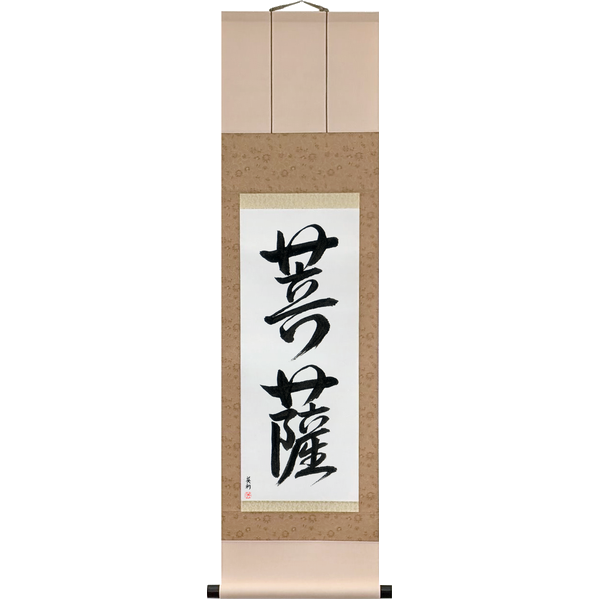
菩薩 bosatsu Bodhisattva
This is a philological study of 菩薩 (bosatsu), the Japanese word for a bodhisattva, following the two characters from their Sanskrit sound through the titles Japan gave its monks and its gods to the dictionaries that carried the word into English.
Abstract
菩薩 (bosatsu) is the Japanese form of the Sanskrit bodhisattva, and its two characters carry a sound, not a meaning: they abbreviate 菩提薩埵, the Chinese transliteration that the Buddhist canon glossed as a being whose mind is set on the awakening of the buddhas. In Japanese the word has led several lives beside the doctrinal one: an honorific for a monk, first by the acclaim of the people and only later by the court's grant; an honorific for a kami once the gods were read as manifestations of buddhas; and, in the speech of the Edo period, a name for rice. The history below finds that the sentence most modern reference works repeat, that Emperor Shōmu granted Gyōki the title in 749, is not what the eighth-century record says: the Shoku Nihongi says the people of his day called him that, and the grant first appears in a monastic history of 1322. The English word bodhisattva came from Sanskrit scholarship and not from Japanese; the romaji reached English print in 1727, inside the names of gods and saints in Kaempfer's History of Japan, became a dictionary headword in Hepburn's dictionary of 1867, and has stayed a specialist's word, carried mostly as the suffix of a name.
Overview
The sense. A Buddhist term, 仏語 in the general dictionaries, and in ordinary Japanese a word met in the names of the great bodhisattvas, 観音菩薩, 地蔵菩薩, 文殊菩薩, before it is met on its own. デジタル大辞泉 gives three senses: 《〈梵〉bodhisattvaの音写「菩提薩埵」の略。悟りを求める人の意》仏語。1 仏の位の次にあり、悟りを求め、衆生を救うために多くの修行を重ねる者。文殊・観音・弥勒・勢至・普賢など。元来は釈迦の前生時代の称で、大乗仏教がおこると、将来仏になる者の意で用いられるようになった。2 昔、朝廷から高徳の僧に賜った称号。「行基菩薩」3 本地垂迹説により、日本の神につけた尊号。「八幡大菩薩」, one who stands next below the rank of a buddha, seeks awakening and undergoes many practices to save living beings; originally the name of Śākyamuni in his former lives, and with the rise of the Mahāyāna the name of one who will become a buddha; a title the court once granted to monks of high virtue; a title given to Japanese kami under the theory that they are manifestations of buddhas [1]. 精選版 日本国語大辞典 gives the same three and three more, each with its earliest example: the doctrinal sense, first in the 勝鬘経義疏 of 611; the monk's honorific, first in the 日本往生極楽記 of about 985; the kami's honorific, first in the 文徳実録 under the year 857; a gagaku dancer costumed as a bodhisattva; 米の異称, another name for rice, first in the 慶長見聞集 of 1614; and, from that, a kitchen maid [1]. The English bodhisattva covers the first sense and none of the others; English has no word for a monk or a god honored with the title, and saint, the word the bilingual dictionaries reached for, is a paraphrase with a different theology under it. The English word also carries a slant of its own. Robert E. Buswell Jr. and Donald S. Lopez Jr. note that Western literature often describes the bodhisattva as someone who postpones his enlightenment in order to save all beings from suffering, and that this description is primarily relevant to the mainstream schools, while in the Mahāyāna … the bodhisattva postpones nothing, instead striving to achieve buddhahood as quickly as possible [2]. The Japanese definitions do not say postpone: 大辞泉 has 悟りを求め、衆生を救うために多くの修行を重ねる者, and the 日国 悟りを求め修行するとともに、他の者も悟りに到達させようと努める者, one who seeks awakening and practices, and strives to bring others to awakening too [1]. The postponement does have a Japanese scholarly voice: Sadakata Akira 定方晟, in the 世界大百科事典, writes that the Mahāyāna bodhisattva 自分の悟りを一時延期しても衆生のそばにとどまって, stays beside living beings even at the cost of deferring his own awakening, and adds his own suspicion that the idea carries 成仏しえぬ自己への反省と、成仏以前の段階にとどまることの正当化, a reflection on the self that cannot become a buddha, and a justification for remaining at the stage before buddhahood [1]. Katō Junshō 加藤純章, in the ニッポニカ, gives the word's doctrinal history in a sentence: in the early schools the bodhisattva was singular, the Buddha before his awakening; with the Mahāyāna it became plural, every practitioner on the path; and 菩薩は大乗仏教を理解するうえで、もっとも重要なキーワードである, the bodhisattva is the most important keyword for understanding Mahāyāna Buddhism [1].
The words. The two characters are a transliteration and contribute nothing of their own: 菩 and 薩 are the first and third syllables of 菩提薩埵 bodai satta, the Chinese rendering of bodhisattva, and the abbreviation was made in Chinese before it reached Japan [1][3]. The canon glossed the syllables rather than the characters. The 大智度論, in Kumārajīva's Chinese, asks what bodhi and sattva name and answers 菩提名諸佛道,薩埵名或眾生,或大心, bodhi names the way of the buddhas; sattva names either a living being or a great mind, and closes 是名菩提薩埵, such a one is called bodhisattva [4]. The Japanese dictionaries carry the tradition's paraphrases of that gloss, 覚有情, 大心衆生, 開士, 大士 [3]. The reading is bosatsu, the only reading any modern witness gives. An older reading bosachi, with the go-on さち for 薩, survives in Heian prose: the 日国 cites the 鈴虫 chapter of the 源氏物語, 阿彌陀仏けうしのほさち, Amida and the attendant bodhisattvas, which the modern critical text prints as 阿弥陀仏、脇士の菩薩 [1][5], and the 大日本國語辭典 of 1919 adds a line of the 枕草子 [6]. Neither character has an older glyph form; every witness below, Meiji typesets included, prints 菩薩. In romaji the word has homographs that the kanji settle: Brinkley's dictionary of 1896 sets 菩薩 beside 簿冊 bosatsu, account books [7], and Inouye's of 1909 sets it beside 謀殺 bōsatsu, murder, and 忙殺 bōsatsu, being worked to death [8]. The design carries the kanji.
The text in English. The English word did not come through Japanese: bodhisattva is a borrowing from Sanskrit, and its English history belongs to the Indologists [9]. The romaji was in English print from 1727, as bosatz, the suffix of a bodhisattva's name in the English translation of Engelbert Kaempfer's History of Japan [10]. What the Meiji bilingual dictionaries did was make it a headword and try, over four editions, to say what it meant. James Curtis Hepburn's first edition of 1867 has BOSATSZ, ボサツ, 菩薩, Name of Buddhist divinities inferior to Hotoke [10]; his second of 1872 replaces that with a definition in the language of the Sanskritists, The Sanscrit word Bodhisattva, meaning he whose essence has become intelligence; a being that has only once more to pass through human existence before it attains to Buddhaship; a class of Buddhas who are not yet perfected by entrance into Nirvâna [11], which is the wording of Ernest John Eitel's Hand-book of Chinese Buddhism of 1870 [12], and the third of 1886 keeps it word for word [13]. Frank Brinkley's dictionary of 1896 has A being worshipped by the Buddhists as next to none but a Buddha [7]; Inouye's of 1909 has one word, A Buddhisattva, misspelled [8]; E. Papinot's dictionary of 1910 has Buddhist saints who have to pass only once more through a human existence before attaining the state of hotoke [14]; Kenkyūsha's of 1942 has Bodhi-sattva; Buddha elect [15], and its fourth edition of 1974 a bodhisattva; a Buddhist saint; a Buddha elect [16]. The Buddhist dictionaries of the later twentieth century give the concept, not the word: Daitō Shuppansha's of 1965 has A being destined for enlightenment and a separate entry for 菩薩号, Bodhisattva used as a title [17]; Inagaki's of 1989 tells the story of the title [18]; Kodansha's encyclopedia of 1993 cross-refers bosatsu to bodhisattva and there gives the postponement, has vowed not to become a Buddha until all other beings have been helped to attain this state [19]; the Princeton dictionary of 2014 lists J. bosatsu under the Sanskrit headword [2]. Today JMdict gives bodhisattva; one who has reached enlightenment but vows to save all beings before becoming a buddha [20], and the current Kenkyūsha (a) Bodhisattva; a Buddhist saint [21].
The historical record
Early fifth century, the 大智度論, the great commentary on the Perfection of Wisdom, in Kumārajīva's Chinese. The fourth fascicle glosses the syllables: 問曰:何等名菩提?何等名薩埵?答曰:菩提名諸佛道,薩埵名或眾生,或大心。是人諸佛道功德盡欲得,其心不可斷不可破,如金剛山,是名大心, Question: what is called bodhi, and what is called sattva? Answer: bodhi names the way of the buddhas; sattva names a living being, or a great mind. This person wishes to obtain every merit of the way of the buddhas, and his mind cannot be cut or broken, like a mountain of diamond: that is called a great mind; and after a verse, 菩薩心自利利他故,度一切眾生故,知一切法實性故,行阿耨多羅三藐三菩提道故,為一切賢聖之所稱讚故,是名菩提薩埵, because the bodhisattva's mind benefits self and other, because he ferries all beings across, because he knows the true nature of all dharmas, because he walks the way of unsurpassed perfect awakening, and because he is praised by all the sages, he is called bodhisattva [4]. This is the sense the word carried into Japan, and the one the design sells.
611, the 勝鬘経義疏, the commentary on the Śrīmālā sūtra attributed to Prince Shōtoku. The 日国 places its first Japanese example of the doctrinal sense here [1]. The text is a Chinese-language commentary written in Japan, and the word in it is the canon's, not yet a Japanese one.
749, the 続日本紀, the second of the six national histories, under the second month of 天平勝宝元年, in the typeset of 1883. The obituary of Gyōki 行基 (668–749), the monk who built bridges, ports and almshouses across the Kinai and led the laity in the work, ends with the honors he received: 豐櫻彦天皇甚敬重焉。詔授大僧正之位。并施四百人出家。和尚靈異神驗觸類而多。時人号曰行基菩薩。留止之處皆建道場, Emperor Shōmu revered him greatly; by edict he conferred the rank of Great Archbishop and granted the ordination of four hundred persons. The master's wonders and divine signs were many of every kind. The people of the time called him Gyōki Bosatsu. Wherever he stayed, a place of practice was built [22]. What the emperor conferred was the rank 大僧正; what the people gave was the name. The kotobank biographies keep the distinction: 生前から菩薩と仰がれ, revered as a bosatsu in his own lifetime, and 行基菩薩と称された, was called Gyōki Bosatsu [23].
857, the 日本文徳天皇実録, the fifth national history, under 天安元年. The 日国's earliest example of the kami's honorific: the two shrines of Ōarai and Sakatsura in Hitachi were given the title 薬師菩薩名神 [1]. The theory that made a kami a bodhisattva, 本地垂迹, held the Japanese gods to be traces left by buddhas and bodhisattvas as their original ground, and the title followed. Its most familiar instance is 八幡大菩薩, the god of war as Great Bodhisattva, which the ブリタニカ dates from 781 and the 日国 attests in the 延喜式 of 927 [24].
About 985, the 日本往生極楽記, the earliest Japanese collection of rebirth biographies. The 日国's first example of the monk's honorific as a Japanese word is its entry on 行基菩薩, written two centuries and more after the man [1].
1001 to 1014, the 源氏物語, the 鈴虫 chapter. Murasaki's word for the attendant bodhisattvas of an Amida triad is the older reading: 阿彌陀仏けうしのほさちおのおの白たんしてつくり奉りたる in the 日国's citation, Amida and the attendant bosachi, each made of white sandalwood; the critical text reads 阿弥陀仏、脇士の菩薩、おのおの白檀して作りたてまつりたる [1][5].
1300, the 拾芥抄, the medieval encyclopedia, in its list of monks' titles. 大法師叡尊〈思円房、号興正菩薩、正安二年閏七月三日被下勅書〉, the great dharma-master Eison, called Kōshō Bosatsu; the imperial letter was handed down on the third day of the intercalary seventh month of Shōan 2 [1]. This is the first grant of the title that the sources document with a date: Eison 叡尊 (1201–1290), the restorer of the precepts at Saidaiji, received it ten years after his death.
1322, the 元亨釈書, the first comprehensive history of Buddhism in Japan, by Kokan Shiren 虎関師錬 (1278–1346), in the typeset of 1901. Here the grant to Gyōki appears: 二十一年正月。皇帝受菩薩戒。及皇太后皇后。乃賜號大菩薩。二月二日。於菅原寺東南院右脇而寂。年八十二, In the first month of the twenty-first year the emperor received the bodhisattva precepts, as did the empress dowager and the empress, and thereupon granted him the title Great Bodhisattva. On the second day of the second month he died, lying on his right side, in the southeast hall of Sugawaradera, aged eighty-two [25]. The sentence is five hundred and seventy years after the event, and the eighth-century record does not carry it. Nara Hiromoto 奈良弘元, in the one study of the title's history, sets the two texts side by side, adds the 諸門跡譜 and the 僧官補任, which give the grant other dates, and rules: 行基の歿後五十日ほどして書かれた『大僧正舎利瓶記』には、菩薩号に関して、なんの言及もないし、『続日本紀』もしかりである。したがって、行基に対して菩薩号が下賜されたか否かは、今のところ不明である, the reliquary inscription written some fifty days after Gyōki's death makes no mention of a bodhisattva title, and neither does the Shoku Nihongi; therefore whether the title was granted to Gyōki is at present unknown; the grants he calls certain are those to Eison, Ninshō and Kakujō, 鎌倉時代の末期の頃, at the end of the Kamakura period [26]. The story that Shōmu granted the title in 749 is a fourteenth-century backformation from a name the people had given.
1614, the 慶長見聞集, Miura Jōshin's 三浦浄心 miscellany of Edo life, in the typeset of 1906. The rice sense, with its own explanation: 米を菩薩と云ふ事、種の時は文珠菩薩、苗の時は地藏菩薩、稻の時は虛空藏菩薩、穗の時は普賢菩薩、飯の時は觀世音菩薩、一體分身、皆毘沙門天にてまします, on rice being called bosatsu: as seed it is Monju Bosatsu, as seedling Jizō Bosatsu, as the standing plant Kokūzō Bosatsu, as the ear Fugen Bosatsu, as cooked rice Kanzeon Bosatsu, one body in many forms, and all of them Bishamonten [27]. The 日国 quotes the same chapter for its earliest example of the sense, かるがゆへに人間は米をぼさつと云, and that is why people call rice bosatsu [1].
1900 and 1901, the 俚言集覧 and the 皇国俚諺叢, two Meiji dictionaries of dialect and common speech. Both carry the rice sense as living usage. The 俚言集覧: 遠江天龍の川上にてボサツと稱す(此所にては米といはずしてぼさつとのみとなふ), on the upper Tenryū in Tōtōmi it is called bosatsu (there they do not say kome, they say only bosatsu), with a note that pilgrims to Ōmine and Haguro call rice bosatsu during their seven days of abstinence, and a derivation from the copyists' hand: 佛經を書寫する早書の法に菩薩の二字の艸冠のみをとりて, in the rapid hand used for copying sutras the two characters were written with their grass radicals alone, so that the abbreviation looked like a word for a plant [28]. The 皇国俚諺叢: 俗に菜穀を菩薩といふ、遠江天龍川の上にては、專ら稱す、○信濃にては米をぼさつといふ, in common speech grain is called bosatsu; on the upper Tenryū in Tōtōmi it is the usual word; in Shinano rice is called bosatsu [29].
1919, the 大日本國語辭典, the first great modern dictionary of Japanese, fourth volume. The entry orders the senses as the 日国 does a century later, with the same witnesses: ぼ-さつ 菩薩 (梵 Bodhi-sattva) 〔ぼだいさった(菩提薩埵)の略、大覺有情と譯す〕, then 一 佛語。佛に亞ぐ位置, the rank next below a buddha; 二 昔、朝廷より碩德の高僧に賜はりたる號, a title the court once granted to monks of great virtue, citing the 拾芥抄; 三 昔時、佛家に擬して用ひたる神の尊號, a title of kami modeled on the Buddhist one, citing the 文徳実録; 四 the gagaku piece; 五 こめ(米), citing the 慶長見聞集 and the 毛吹草's proverb 菩薩實が入ればうつむく、人間實が入れば仰く, rice bows its head when it fills; a person lifts his [6]. The lexicography of this word has been stable since the Taishō period.
What is not a source. 菩提薩埵, the full transliteration, is the word's own longer form and has its own dictionary entry [3]; 大菩薩 is the honorific's fuller shape, in 行基大菩薩 and 八幡大菩薩 [24]; 菩薩号 names the title as an institution [26]. None is an origin for the design's word, which is the canon's, and none is a pairing in the proverb's sense: they are the same word at different lengths.
The word in English
1727, Engelbert Kaempfer, The History of Japan, in the English of Johann Caspar Scheuchzer, read in the Glasgow edition of 1906. The romaji, a century and a half before the dictionaries, as the tail of a name. In the second book's chapters on the ecclesiastical emperors: The Soul of Quosobosatz is believ'd to have by transmigration dwelt in him, and a mother's dream, I the holy Gusobosatz must be born again to teach the world, and therefore I descend to enter into thy Womb [10]; and in the fourth book, among the gods named in the general form of a Japanese oath, Fatzman Daibosatz between Missima Dai Mioosin and Tenman Dai Sisai Tensin [30]. Kaempfer's spellings are his own, and bosatz is what he heard.
1867, James Curtis Hepburn, A Japanese and English Dictionary, page 32. BOSATSZ, ボサツ, 菩薩, n. Name of Buddhist divinities inferior to Hotoke [31]. The earliest known dictionary entry for the word in English, in Hepburn's first spelling, before he settled on tsu.
1871, The Far East, Yokohama, volume 2, number 7, September 1, 1871. A photographic magazine's notice of a Hachiman shrine: After death he was deified under the title of Hatchiman dai Bosatsz, and regarded as the god of War; and in the same volume the images of Monjo Bosatsz' and Fungen Bosatsz' in a temple hall [32]. Hepburn's sz spelling, in the English press of the treaty port, five years before Griffis.
1872, Hepburn, second edition, page 38. BOSATSU, ボサツ, n. The Sanscrit word Bodhisattva, meaning he whose essence has become intelligence; a being that has only once more to pass through human existence before it attains to Buddhaship; a class of Buddhas who are not yet perfected by entrance into Nirvâna [11]. The definition is Eitel's, from the Hand-book of Chinese Buddhism of 1870, whose entry reads he whose essence (sattva) has become intelligence (bodhi) and the third class of saints who have to pass only once more through human life before becoming Buddhas, including also those Buddhas who are not yet perfected by entering Nirvâna [12]; Hepburn took it over nearly word for word. Its second clause, only once more, describes the bodhisattva of one more birth, not the bodhisattva of the Mahāyāna path; the third clause, a class of Buddhas, is wrong on the tradition's own terms, since a bodhisattva is by definition not yet a buddha. The page prints 薩埵 at the headword, on which see the Notes.
1875, the Japan Weekly Mail. A list of the 本地 pairings of a shrine's gods: Kanzeon bosatz … Nikko bosatz … Guakko bosatz, each set against a gongen [33]. The word as a suffix in English, already, and in a spelling of its own.
1876, William Elliot Griffis, The Mikado's Empire. The warrior's prayer, Namu Hachiman Dai-bosatsu, glossed Glory to Hachiman, the incarnation of Great Buddha [34]. The kami's honorific is the sense in which the word first reached an English reader outside a dictionary; the gloss makes Hachiman a Buddha, which the title does not say.
1886, Hepburn, third edition, page 44. BOSATSU ボサツ 菩薩, the 1872 definition word for word [13].
1896, Frank Brinkley, Nanjō Bun'yū and Iwasaki Yukichika, An Unabridged Japanese-English Dictionary, page 86. Bosatsu, ぼさつ, 菩薩, n., then the book's own bracketed Sans., then A being worshipped by the Buddhists as next to none but a Buddha, on the same page as Bosatsu, 簿冊, account books, and Bosatsu-ibara, a plant [7]. A definition of rank, which is what the Japanese dictionaries' 仏の位の次にあり also gives, and no theology.
1909, Inouye Jukichi 井上十吉, Inouye's Japanese-English Dictionary, page 111. Bosatsu (菩薩), n. A Buddhisattva, between 謀殺 murder and 忙殺 [8]. The book's own misspelling; the entry gives the word and nothing more.
1910, E. Papinot, Historical and Geographical Dictionary of Japan, volume 1. Bosatsu (Sanscr. Bodhisattva). Buddhist saints who have to pass only once more through a human existence before attaining the state of hotoke, and under Gyōgi, that the emperor bestowed on him the title of Bosatsu [14]. The definition descends from Hepburn's; the sentence on Gyōki repeats the 元亨釈書's story as fact, the first English book on this page to do so.
1942, Takenobu Yoshitarō, Kenkyusha's New Japanese-English Dictionary, American edition, page 110. Bosatsu (菩薩) n. 《梵》Bodhi-sattva; Buddha elect. ¶外面如菩薩内心如夜叉 An angel without, a devil within [15]. Buddha elect is Kenkyūsha's own English and stays through the fourth edition; the proverb, a bodhisattva's face and a demon's heart, is the one idiom of the word the dictionaries give.
1965, Japanese-English Buddhist Dictionary, Daitō Shuppansha. Bosatsu 菩薩 bodhisattva. A being destined for enlightenment, and Bosatsu-gō 菩薩号 Bodhisattva used as a title [17]. The first English dictionary on this page to enter the title as its own sense.
1974, Masuda Kō, Kenkyusha's New Japanese-English Dictionary, fourth edition, page 103. bōsatsu 菩薩 n. 《梵》a bodhisattva; a Buddhist saint; a Buddha elect [16]. The book prints a macron on the first vowel that the word does not have; bosatsu is short.
1988, John Stevens, Sacred Calligraphy of the East, revised edition. The word as the suffix of a name in the plates of seed syllables: Monju Bosatsu (Mañjuśrī Bodhisattva), Fugen Bosatsu, Jizō Bosatsu [35]. This is how the romaji lives in twentieth-century English: attached to a proper name, in art history and Japanese studies, while the common noun for the concept stays bodhisattva.
1989, Inagaki Hisao, A Dictionary of Japanese Buddhist Terms, first American edition. Under the title: The first such instance in Japan was in 749 when Gyogi … was given the title of daibosatsu by Emperor Shomu [18]. The sentence is the 元亨釈書's, not the 続日本紀's; the eighth-century record says the people gave the name, and the study of the title calls the grant unproven [22][26]. The same claim stands in the ブリタニカ's Japanese entry, 日本では聖武天皇が行基に菩薩の号を賜わったのを初めとする [1].
1993, Japan: An Illustrated Encyclopedia, Kodansha. bosatsu → bodhisattva, and under the English headword a bodhisattva has vowed not to become a Buddha until all other beings have been helped to attain this state [19]. The postponement, as English reference works give it.
2014, Robert E. Buswell Jr. and Donald S. Lopez Jr., The Princeton Dictionary of Buddhism. Under bodhisattva, with J. bosatsu among the forms: the etymology of sattva left uncertain, the gloss being intent on enlightenment, and the caution quoted in the Overview, that the postpones his enlightenment description belongs to the mainstream schools and that in the Mahāyāna the bodhisattva postpones nothing [2].
Today. JMdict gives bodhisattva; one who has reached enlightenment but vows to save all beings before becoming a buddha [20]; Kenkyūsha's current (a) Bodhisattva; a Buddhist saint [21]. The design is sold as Bodhisattva, with the line A bodhisattva, one who seeks awakening for the sake of all beings, which is Timothy L. Jackowski's for Takase Studios; the title is the English word the Japanese one transliterates, and the line renders the Japanese dictionaries' definition rather than the English reference works' postponement. A rendering must keep the two things the word holds: the seeking of awakening, and that it is done for others.
A reading
The word for sale is a sound. Two characters that mean nothing on their own carry the whole of a Sanskrit idea into Japanese, and the buyer who asks what 菩 means or what 薩 means is asking the wrong question, as the catalogue's own explanation says. The right question is what the sound has meant, and the answer is that it has meant several things in Japan that it never meant in India. The canon's bodhisattva is a being whose mind is set on the awakening of the buddhas and who walks toward it for the sake of others; that is the sense on the scroll, and I would put the English of it exactly as the page does, one who seeks awakening for the sake of all beings, and not as the English reference works put it, one who postpones his own enlightenment. The postponement is a Western description that Buswell and Lopez assign to the wrong schools, and the Japanese dictionaries, which had the tradition's own gloss to work from, do not use it. Sadakata's aside that the idea may be a rationalization for not attaining is the honest footnote to it.
What the word did next in Japan is the part a philologist should tell plainly, because the reference books do not. A people who saw a monk build bridges called him a bodhisattva while he lived; that is what the 続日本紀 says, in four characters, 時人号曰. Five and a half centuries later a monastic historian wrote that the emperor granted him the title, and the sentence has been copied since by every dictionary that needed a first instance of the title, in Japanese and in English, so that a reader of Inagaki or the ブリタニカ learns as fact what the one scholar to study the question calls unknown. The court's grants that can be dated begin with Eison in 1300, and the title Japan gave its gods, 八幡大菩薩, is the same act of honor turned toward the shrines. The rice is the sense I like best and would never put on a scroll: a copyist's shorthand, two grass radicals for two long characters, read by farmers as the name of the thing that fed them, and kept in the mountains of Tōtōmi and Shinano until the dialect dictionaries of 1900 wrote it down.
In English the word never became a word. Kaempfer's translator printed it in 1727 inside the names of gods and saints, where it has stayed; Hepburn made it a headword in 1867, tried three definitions in three editions, and the dictionaries after him settled on saint or Buddha elect and let bodhisattva, which English already had from Sanskrit, do the work. Bosatsu survives in English as a suffix, Monju Bosatsu and Jizō Bosatsu, which is a fair picture of how it survives in Japanese too: a word met in names. On a scroll it stands alone, and stands for the idea whole.
Notes
- Hepburn's second edition of 1872 prints 薩埵 at the headword BOSATSU where the first edition of 1867 and the third of 1886 print 菩薩. 薩埵 is the second half of the full transliteration 菩提薩埵, and the page reads as a printing error of the second edition, corrected in the third; no Japanese witness writes the word with these characters.
- Inouye's dictionary of 1909 prints A Buddhisattva; the page keeps the book's spelling.
- Kenkyūsha's fourth edition of 1974 heads the entry bōsatsu, with a long vowel the word does not have; the book's neighboring entries 謀殺 and 忙殺 are long, and the head takes their form.
- The kotobank 大辞泉プラス entry under this headword is the Steely Dan song Bodhisattva of 1973, a use of the English word and not of the Japanese one [1].
References
- 「菩薩」, デジタル大辞泉, 精選版 日本国語大辞典, 日本大百科全書(ニッポニカ) (加藤純章), 改訂新版 世界大百科事典 (定方晟), マイペディア, ブリタニカ国際大百科事典, 山川 世界史小辞典, デジタル大辞泉プラス, at kotobank. https://kotobank.jp/word/菩薩
- Robert E. Buswell Jr. and Donald S. Lopez Jr., The Princeton Dictionary of Buddhism, Princeton University Press, Princeton, 2014, s.v. bodhisattva.
- 「菩提薩埵」, デジタル大辞泉, 精選版 日本国語大辞典 and ブリタニカ国際大百科事典, at kotobank. https://kotobank.jp/word/菩提薩埵
- 龍樹『大智度論』卷四, 鳩摩羅什譯, Taishō 25, no. 1509, p. 86a13–25, at CBETA. https://cbdata.dila.edu.tw/stable/juans?work=T1509&juan=4
- 紫式部『源氏物語』鈴虫, 渋谷栄一校訂, at Wikisource. https://ja.wikisource.org/wiki/源氏物語/鈴虫
- 上田万年・松井簡治『大日本國語辭典』卷四, 金港堂, 1919, s.v. ぼさつ 菩薩 and ぼさち. National Diet Library pid 954648, scan 353. https://dl.ndl.go.jp/pid/954648/1/353
- F. Brinkley, F. Nanjō and Y. Iwasaki, An Unabridged Japanese-English Dictionary, Sanseidō, Tokyo, 1896, p. 86, s.v. Bosatsu. Internet Archive cu31924082117288. https://archive.org/details/cu31924082117288
- 井上十吉, Inouye's Japanese-English Dictionary, Sanseidō, Tokyo, 1909, p. 111, s.v. Bosatsu. Internet Archive inouyesjapanesee00inou. https://archive.org/details/inouyesjapanesee00inou
- bodhisattva, English entry, at Wiktionary. https://en.wiktionary.org/wiki/bodhisattva
- Engelbert Kaempfer, The History of Japan, together with a Description of the Kingdom of Siam, 1690–92, translated by J. G. Scheuchzer (1727), James MacLehose and Sons, Glasgow, 1906, vol. 1, book II, chapters III and IV. Internet Archive historyofjapanto01kaem. https://archive.org/details/historyofjapanto01kaem
- J. C. Hepburn, A Japanese-English and English-Japanese Dictionary, 2nd ed., American Presbyterian Mission Press, Shanghai, 1872, p. 38, s.v. BOSATSU. National Diet Library pid 993689. https://dl.ndl.go.jp/pid/993689
- Ernest John Eitel, Hand-book of Chinese Buddhism, being a Sanskrit-Chinese Dictionary, second edition (1888), reprinted Sanshusha, Tokyo, 1904, s.v. Bodhisattva; first edition 1870. Internet Archive handbookchinese00takagoog. https://archive.org/details/handbookchinese00takagoog
- J. C. Hepburn, A Japanese-English and English-Japanese Dictionary, 3rd ed., Maruya, Tokyo, 1886, p. 44, s.v. BOSATSU.
- E. Papinot, Historical and Geographical Dictionary of Japan, vol. 1, Kelly & Walsh, Yokohama, 1910, s.vv. Bosatsu and Gyōgi. Internet Archive PapinotDictionaryOfJapanVol1AllPages1To462PrefaceHistoricalSectionEntriesAThroughN. https://archive.org/details/PapinotDictionaryOfJapanVol1AllPages1To462PrefaceHistoricalSectionEntriesAThroughN
- Takenobu Yoshitarō, Kenkyusha's New Japanese-English Dictionary, American edition, Harvard University Press, Cambridge, 1942, p. 110, s.v. Bosatsu.
- Kō Masuda, editor, Kenkyusha's New Japanese-English Dictionary, fourth edition, Kenkyusha, Tokyo, 1974, p. 103, s.v. bōsatsu.
- Japanese-English Buddhist Dictionary, Daitō Shuppansha, Tokyo, 1965, s.vv. Bosatsu and Bosatsu-gō.
- Hisao Inagaki, A Dictionary of Japanese Buddhist Terms, first American edition, Heian International, Union City, 1989, s.v. Bosatsu.
- Japan: An Illustrated Encyclopedia, Kodansha, Tokyo, 1993, s.vv. bosatsu and bodhisattva.
- JMdict, 「菩薩」, at jisho.org. https://jisho.org/word/菩薩
- 「菩薩」, 研究社 新和英中辞典 and 斎藤和英大辞典, at Weblio 英和・和英辞典. https://ejje.weblio.jp/content/菩薩
- 『續日本紀』卷第十七, 天平勝寶元年二月丁酉, in 岸田吟香等編『續日本紀』巻第10−19, 1883. National Diet Library pid 772185, scan 85. https://dl.ndl.go.jp/pid/772185/1/85
- 「行基」, デジタル大辞泉プラス, 旺文社日本史事典, 日本大百科全書(ニッポニカ), 日本人名大辞典, and others, at kotobank. https://kotobank.jp/word/行基
- 「八幡大菩薩」, デジタル大辞泉, 精選版 日本国語大辞典 and ブリタニカ国際大百科事典, at kotobank. https://kotobank.jp/word/八幡大菩薩
- 虎關師錬『元亨釋書』卷第十四, 行基, in 経済雑誌社編『國史大系』第14巻, 1901. National Diet Library pid 991104, scan 441. https://dl.ndl.go.jp/pid/991104/1/441
- 奈良弘元「わが国における菩薩号の下賜について — 行基・叡尊を中心として」『日本佛敎學會年報』51, 1986, pp. 459–472. https://www.jstage.jst.go.jp/article/nbra/51/0/51_459/_article/-char/ja
- 三浦浄心『慶長見聞集』巻之一, 芳賀矢一校, 富山房, 1906. National Diet Library pid 898456, scan 11. https://dl.ndl.go.jp/pid/898456/1/11
- 太田全斎『俚言集覧』中巻, 井上頼圀・近藤瓶城増補, 1900, s.v. ぼさつ. National Diet Library pid 991570, scan 53. https://dl.ndl.go.jp/pid/991570/1/53
- 『皇國俚諺叢』, 1901, s.v. ぼさつ. National Diet Library pid 767884, scan 53. https://dl.ndl.go.jp/pid/767884/1/53
- Engelbert Kaempfer, The History of Japan, Glasgow, 1906, vol. 2, book IV, chapter X, "Some Proclamations, Pasports, Orders, &c." Internet Archive historyofjapanto02kaem. https://archive.org/details/historyofjapanto02kaem
- J. C. Hepburn, A Japanese and English Dictionary; with an English and Japanese Index, American Presbyterian Mission Press, Shanghai, 1867, p. 32, s.v. BOSATSZ.
- The Far East, Yokohama, vol. 2, no. 7, September 1, 1871, and the same bound volume. Internet Archive fareast2738unse. https://archive.org/details/fareast2738unse
- The Japan Weekly Mail, Yokohama, 1875, bound volume. Internet Archive jwm-bound-1875. https://archive.org/details/jwm-bound-1875
- William Elliot Griffis, The Mikado's Empire, Harper, New York, 1876. Internet Archive mikadosempire0000grif. https://archive.org/details/mikadosempire0000grif
- John Stevens, Sacred Calligraphy of the East, revised edition, Shambhala, Boston and Shaftesbury, 1988, the plates of seed syllables.
Books Cited
Books this article cites that can be ordered today.