

Five Bible verses in Japanese · 望みを抱いて喜び · 信仰と希望と愛 · 主は我が力 · 愛は全てを完全に結ぶ帯である · 始めに神は天と地を創造された
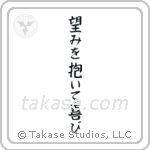
Sold as Romans 12:12 Be Joyful in Hope · 1 Corinthians 13:13 Faith, Hope and Love · Psalms 118:14 The Lord is My Strength · Love Binds Them All Together (Colossians 3:14) · In the Beginning God Created the Heavens and the Earth (Genesis 1:1) · Read nozomi wo idaite yorokobi · shinkō to kibō to ai · shu wa waga chikara · ai wa subete wo kanzen ni musubu obi de aru · hajime ni kami wa ten to chi wo sōzō sareta · Oldest witness for the Japanese words, the Japan Bible Society's colloquial translation, New Testament 1954, whole Bible 1955; for the verses, the Greek and Hebrew, not opened here · Sense five verses a Japanese reader can read aloud from the wall; every scroll is the 1955 Bible's sentence, and the classical Bible of 1887 and 1917 says each of them differently.
The words
Each scroll is the 1955 口語訳's wording with, in three of them, a kanji where the Bible prints kana (抱いて for いだいて, 全て for すべて, 始めに for はじめに), and in one a particle dropped (天と地を for 天と地とを). No word is changed. What a reader should know about the words is what a version does with them. 抱いて, holding, is a verb the 1955 Bible supplies for in hope and the classical Bible does without. 信仰と希望と愛 are faith, hope and love in the same order in every version, and the third is charity in the King James. 主, the Lord, is the 1955 Bible's word for the divine name where the classical Old Testament wrote ヱホバ, Jehovah. 帯 is a sash and 結ぶ is bind; the 1955 Bible has love binding everything together, the classical Bible has love perfecting virtue, and that is two readings of one Greek phrase. された is the honorific passive by which the 1955 Bible writes what God does; the classical Bible wrote たまへり.
A history, from the earliest witness
1887 and 1917. The classical Bible (文語訳): the Meiji Old Testament and the Taishō New Testament. The Bible in which Japanese Protestants read these verses for their first seventy years, and the one in the public domain at the Japanese Wikisource. Its five verses: 望みて喜び、患難にたへ、祈を恆にし (Romans 12:12); げに信仰と希望と愛と此の三つの者は限りなく存らん、而して其のうち最も大なるは愛なり (1 Corinthians 13:13); ヱホバはわが力わが歌にしてわが救となりたまへり (Psalm 118:14); 凡て此等のものの上に愛を加へよ、愛は徳を全うする帶なり (Colossians 3:14); 元始に神天地を創造たまへり (Genesis 1:1). It differs from the scrolls in every verse and in two of them in sense. [ja.wikisource.org, ロマ人への書(文語訳) · コリント人への前の書(文語訳) · 詩篇(文語訳) · コロサイ人への書(文語訳) · 創世記(文語訳); text]
1954 and 1955. The colloquial Bible (口語訳), the Japan Bible Society. The New Testament in 1954 and the whole Bible in 1955, the first Japanese Bible in plain speech, and the one every scroll follows: 望みをいだいて喜び、患難に耐え、常に祈りなさい; このように、いつまでも存続するものは、信仰と希望と愛と、この三つである。このうちで最も大いなるものは、愛である; 主はわが力、わが歌であって、わが救となられた; これらいっさいのものの上に、愛を加えなさい。愛は、すべてを完全に結ぶ帯である; はじめに神は天と地とを創造された. Its readings were revised in 1975, 1984 and 2002, in small things. In Japan its first edition is out of copyright and in the public domain; in the United States it is not, which is why the Japanese Wikisource's copy sits under a deletion request and the text is read here at another site that carries the 1955 date on its index and no label on its pages. [wordproject.org/bibles/jp/45/12.htm · /46/13.htm · /19/118.htm · /51/3.htm · /01/1.htm; text; the dates and the copyright posture at ja.wikipedia.org/wiki/聖書_口語訳]
1987 and after. The church's Bibles today. The 新共同訳 of 1987 and the 新改訳 are the Bibles a Japanese congregation reads now, and both are in copyright; neither was opened, so whether a scroll's sentence is also the current Bible's is not said here. The house says it works from three Japanese Bibles and does not name them; on the wording, one of them is the 1955 Bible.
The English the titles follow. The King James Version and the New International Version were opened for each verse. Three titles follow the NIV (Be joyful in hope; Love binds them all together; the heavens and the earth), one is the same in both (The Lord is my strength), and Faith, Hope and Love is the NIV's where the King James has charity, which the page names as the other reading. [en.wikisource.org, Bible (King James); biblegateway.com, NIV; text]
The sense across time
A verse's sense is its church's business and not this page's. What changes across the Japanese versions is register and, twice, the reading of a phrase: the classical Bible is compressed, honorific and Hebraic, and its Colossians has love as the sash that perfects virtue, its Genesis 元始に神天地を創造たまへり; the 1955 Bible is plain speech, and its Colossians has love as the sash that binds all things in completeness, following the sense the NIV also takes. A scroll in the 1955 Bible's words is a scroll a Japanese reader reads without a dictionary. A scroll in the classical Bible's words would be a different object, and for Genesis and the Psalm a different sentence.
What is not a source
The house's English titles are not translations of the Japanese; they are the English Bible's own words, and the Japanese and the English are two translations of one Greek or Hebrew sentence that this history has not opened. The page for Psalm 118:14 cites Psalms 118:114, a verse that does not exist; the design row has the reference right, and the other candidate, Psalm 119:114, is about a hiding place and a shield.
The text in English
The English is the reader's own here. Every scroll's title is a phrase of the King James or the New International Version, and the account records which. What a title must do for a scripture scroll is name the verse, so that a buyer with a Japanese Bible can open it and find the sentence on the wall; four of the five titles do, and the fifth, Love Binds Them All Together, names it on the page.
A reading
Five scrolls that do the one thing a scripture scroll must: they brush a real Bible's words and not a paraphrase. They are the 1955 Bible's, character for character but for three kanji and a particle, and each page should say so, because a buyer who owns a Japanese Bible will look the verse up and should find it. The classical Bible deserves its sentence on each page as well: it is what the verse sounded like for seventy years, and for Genesis and the Psalm it is another sentence. The one defect is the psalm's reference on its page, which the design row already has right. Signed, 典, 2026-09-05.
How this was read
By text, at the address: each verse in the classical Bible at the Japanese Wikisource and in the 1955 Bible at wordproject.org, all ten re-opened; each verse in the King James and the NIV; the Japanese encyclopedia's article on the 1955 Bible for its dates and copyright posture; the five live word pages. Not opened: the Greek and Hebrew; the 1987 and later Bibles, in copyright; a labeled print copy of the 1955 edition, which would make the wordproject text's edition certain; the house's three Bibles, unnamed. Every address in this history is a text address, and a reader's AI can open all of them. The full apparatus, with every address, is in the account.
References
- Romans 12:12 (ours) (—) — C3065SSVB6A; cultural_works 67
- 口語訳 (1955) — wordproject 45/12
- 文語訳 (大正改訳) (1917) — ja.wikisource
- 1 Corinthians 13:13 (ours) (—) — C3066SSVB7A; 68
- 口語訳 (1955) — wordproject 46/13
- 文語訳 (1917) — ja.wikisource
- Psalm 118:14 (ours) (—) — C3067SSVB5A; 69
- 口語訳 (1955) — wordproject 19/118
- 文語訳 (明治元訳) (1887) — ja.wikisource
- Colossians 3:14 (ours) (—) — L5008SSVB5A; 390
- 口語訳 (1955) — wordproject 51/3
- 文語訳 (1917) — ja.wikisource
- Genesis 1:1 (ours) (—) — R0064SSVB5A; 947
- 口語訳 (1955) — wordproject 01/1
- 文語訳 (明治元訳) (1887) — ja.wikisource