

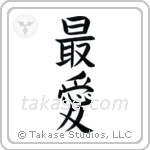
最愛 saiai Beloved
最愛 (saiai) is the one a person loves most, and in a second sense the bond between husband and wife. The earliest citation in the national dictionary's entry is a wife, in a tale of the late tenth century. In 1867 Hepburn's dictionary marked it with the sign for a word used only in books or obsolete.
Abstract
最愛, saiai, is a Sino-Japanese noun for the one a person loves most and, in a second sense, for the bond between husband and wife. In the classical Chinese and Korean verse read for this study the two characters are a verb and its object, what I love most is; Japanese made them a word for a person, and the first use the national dictionary cites, from the Utsuho monogatari of the late tenth century, is a most-beloved wife. In the digitized books of the 1870s to the 1940s the word is used of a wife more often than of anyone else, and it belongs to the eulogy, the prayer, the law of inheritance and the letter. Its English has stood since Hepburn's first dictionary of 1867, which marked it with the sign for a word used only in books or obsolete: most beloved, dearest.
Overview
The sense. Two senses, and the Japanese dictionaries give both. The 精選版 日本国語大辞典's first is 非常にかわいく思うこと。たいそう愛すること。また、そのもの, holding someone very dear; loving greatly; also, the one so loved, so the word names the person as well as the loving; its second is 男女または夫婦が互いに親しみ睦むこと。また、その間柄, a man and a woman, or husband and wife, being close and loving with each other; that bond [1]. デジタル大辞泉 gives the same two, 最も深く愛していること with the examples 最愛のわが子, my most beloved child, and 最愛の妻を亡くす, to lose one's most beloved wife, and 男女または夫婦の仲のよいこと [1]. Its register is the solemn one: the uses below are the eulogy, the prayer, the law and the letter, and Hepburn's first edition marks it with the sign for a word used only in books or obsolete [2]. It is a noun that also serves as a modifier with の.
The words. 最 is the superlative, in Kroll's words indicator of superlative: most X of all, the 最 of 最高, all-highest, and in Buddhist use of 最勝, a name for a buddha [3]. 愛 is be partial to, and so be fond of, care for; be attached to, cherish, love [3]. The 字通 glosses the compound 最も愛する, to love most [1]. The reading is saiai in every dictionary; the Utsuho citation spells it さいあひ, the same word in historical kana, and the Heike citation writes 㝡, a form of 最 [1].
The text in English. Hepburn's first edition of 1867 gives Most beloved, well beloved [2]; Brinkley in 1896, Dearest or most beloved [4]; Inouye in 1909, Most dear; dearest; beloved [5]; Saitō in 1928, Dearest; beloved; darling [6]; Kenkyūsha in 1942, Most dear; dearest; beloved; nearest one's heart [7]; JMdict today, beloved; dearest [8]. A century and a half of dictionaries has kept two English words, beloved and dearest, and one idea, most.
The historical record
Bai Juyi (772–846), 錢塘湖春行, a poem on West Lake in spring. The pair in Chinese, as a verb and its object [9][10]:
最愛湖東行不足,綠楊陰裏白沙堤。 What I love most is the east of the lake, which I cannot walk enough: the white sand causeway in the shade of the green willows.
The Sinitic verse of Korea printed in Japan uses the pair the same way: 平生最愛僧窻眠, all my life what I have loved most is sleep at a monk's window, in the collected works of 李穡 [11], and 最愛湖山景氣加 in a poem of 禹倬's that the 東國輿地勝覽 records [12]. The Taiwan Ministry of Education's dictionary has no entry for the pair [13].
Late tenth century. The Utsuho monogatari. The national dictionary's first citation for the first sense, from the chapter 蔵開 [1]:
人の国にも、さいあひの妻もたるにぞそしりとりたるめる
A most-beloved wife, already a thing a man might have and be talked about for. The first person the word is cited of is a wife.
Early thirteenth century. The Heike monogatari, in the Hiramatsu-ke text. Of Kiyomori and the dancer Giō: 入道相国〈略〉姉の義王を㝡愛して, the lay chancellor … loved the elder sister, Giō, above all [1]. Here the word is a verb, to love most.
1220. Jien, 愚管抄, a history of Japan. The national dictionary's first citation for the second sense [1]:
世間のゆゆしき沙汰にて、最愛の中になりて、師家と云ふ子うみて To the world's great scandal, they became most loving with each other, and she bore a son called 師家.
The word names a couple's bond, and the bond produces a son.
1283. Mujū, 沙石集, Sand and Pebbles, in an undated woodblock printing. The collection was finished in 1283 and revised by its author afterward [14]. The scene: Saigyō, when he first resolved to leave the world, and the most-beloved little daughter who clung to him [15]:
西行法師初發心ノ時。最愛ノイトケナキムスメノ。トリツキタリシヲ。縁ヨリケヲトシテ … 心ヅヨク。ステタリケル When the priest Saigyō first set his heart on the Way, his most-beloved little daughter clung to him; he kicked her off the veranda … and, hardening his heart, left her.
The same book has a woman inconsolable for her child, 妹ノ女房最愛ノ一子ニヲクレテ。人ノ親ノ習トイヒナガラ。アナガチニ歎キケレバ, bereaved of the one child she loved most, she grieved beyond what is usual even for a parent [15]. The beloved is what one gives up for the Way, and what one cannot give up.
Late Muromachi. The tale of Sayohime, 御伽草子. そののちさよひめは、やまとのこくしとさいあひして、御子あまたいでき給ふ, after that Sayohime lived in love with the governor of Yamato, and many children were born to them [1]. The second sense, as a verb.
1597. 節用集, a dictionary, in a printing whose afterword the library dates 1597. 最愛 stands among the words that begin with イ, and the reading beside it begins イト and ends シ: here the two characters write a native word, dear, not saiai [16]. Hepburn's second edition of 1872 gives the same two characters to ITŌSHII, Very dear, darling, beloved; exciting pity or compassion [17].
1622. 信長記, the record of Nobunaga, in a movable-type printing whose colophon the library dates 1622. Of the families left in a castle the enemy had entered [18]:
老タル母イトケナキ子最愛ノ女房共 aged mothers, little children, most-beloved wives
1867. James Curtis Hepburn, A Japanese and English Dictionary. The first bilingual entry cited here, with the gloss mottomo aiszru, to love most, and an example [2]:
†SAI-AI, サイアイ, 最愛, (mottomo aiszru.) Most beloved, well beloved. — no ko, dearly beloved child.
The dictionary's list of abbreviations defines the mark † as word used only in books or obsolete [2]. The second edition of 1872 prints the same entry, spelling the gloss mottomo aisuru, without the mark, which its list of abbreviations no longer gives [17]. The fourth edition of 1888 prints the same entry [19].
1896. F. Brinkley, An Unabridged Japanese-English Dictionary. Dearest or most beloved. Sai-ai no ko, dearest child [4].
1897. 田代律雄, 『相続法』, lectures on the law of inheritance. The law's presumption about who inherits is written in the word [20]:
被相續人は其生前の地位と財産とは之を最愛の者に讓るとの意思ありて其最愛の者は最近卑屬親なりとの推測に基くものなり It rests on the presumption that the deceased intended to leave his standing and his property to the one he loved most, and that the one he loved most is his nearest descendant.
Undated, the 1900s in the library's record. 千秋季隆, 『神楽歌評釋』, lectures on the kagura songs. In the song 階香取 a man in a boat sings that his 妹, imo, the woman he loves, has boarded too, and the commentator's paraphrase says it with this word: われも亦たわが最愛の妹も乘りたればとなり, since I and my most beloved have both boarded [21].
1908 to 1920. The eulogy. 『女子の慰安』 (1908) tells of a woman who had lost her most-beloved child and went nowhere but the grave, 最愛の子を失つて。日夜悲哀にのみ沈み。其の墓所にばかり參つてゐた夫人があつた [22]. In the third 『乃木会講演集』 (1916), lectures given in 1915, 加藤玄智 says that the memorial service the people of Shikoku held after the Russo-Japanese War was not for the general but for those among them who might have lost a most-beloved child, husband or grandchild under Nogi: 四國の人の中には乃木將軍の配下で、或は自身の最愛の子供が死んで居るかも知れぬ、或は又自身の最愛の夫を喪つた人があるかも知れぬ、又自身が最愛の孫を失つて居る人もあるかも知れぬ [23]. 『恩師乃木院長』 (1917) records that in the autumn of 1876, in the rebellion of 前原一誠, Nogi's most-beloved younger brother was the first to join and was killed, 最愛の弟眞人氏は、最先に此の亂に加はつて、討死を遂げられた [24]. 『恋のゲエテ』 (1920) says that on the day of Schiller's death the Weimar theater closed and everyone grieved as if they had lost a most-beloved friend, 人々皆最愛の友を喪つた如くに悲しんだ [25].
1909. Inouye Jūkichi, Inouye's Comprehensive Japanese-English Dictionary. Saiai-no (最愛の), a. Most dear; dearest; beloved, with one example, again a bereavement: 彼は最愛の息子に先立たれて悲嘆に暮れてゐる, He is plunged into profound grief by the death of his beloved son [5].
1910 and 1912. The church. Two of Alphonsus Liguori's books in 浦川和三郎's Japanese: 『聖母マリアの七の悲傷』 (1910) has the Virgin's 最愛の御子, most-beloved Son [26], and 『聖体訪問』 (1912) prays 然らば最愛の耶穌よ、私の心を全く御手に収めて、此處に玉座を設け、永遠に私の王となり給へ, then, most-beloved Jesus, take my heart wholly into your hands, set your throne here, and be my king for ever [27].
1924. 帆足理一郎 and others, 『婦人と新社会の建設』, lectures for the city of Tokyo. The word admits one person only [28]:
あなたは私の最愛の男であるとか … 最愛の女であるとかいひますと、それは僞をいつて居るのである。愛する對手が二人あつたのでは二人を最愛であるといふことはいへない If you tell someone "you are my most-beloved man" or "my most-beloved woman," you are lying; where there are two people you love, you cannot call the two of them most beloved.
And seven pages on: 最愛の妻、最愛の夫が意中に於てたつた一人であるところに無限の價値があります, the infinite worth of a most-beloved wife, a most-beloved husband, lies in there being only one of them in your heart [28].
1928. 斎藤秀三郎, 『斎藤和英大辞典』. Dearest; beloved; darling, with 最愛の子 a darling child, 最愛の友 a beloved friend, and 最愛の妻 the wife of one's bosom [6].
1942. Kenkyūsha's New Japanese-English Dictionary, American edition. Most dear; dearest; beloved; nearest one's heart, with 最愛の子 one's dearest (beloved) child; a darling child and 最愛の妻 a wife of one's bosom [7].
1942. 原田光子 (trans.), 『天才ショパンの心 : ショパンの手紙』, Chopin's letters. In the letters of 1830 to his friend Tytus Woyciechowski the word is the form of address: 最愛のテイトウス, dearest Tytus; 最愛なる人よ、君は何とよい人なのだらう, dearest, how good you are; 最愛の生命よ, my dearest life [29].
The books of the 1870s to the 1940s. In the public-domain books the National Diet Library has digitized, the word most often goes before 妻, wife, more than twice as often as before 子, child, and after those before 夫, husband, 娘, daughter, and 女, woman [30]. The older Chinese and Korean books read among the same hits use it as a verb [30].
1983. Kenkyūsha's New Collegiate Japanese-English Dictionary, third edition. 最愛の, one's dearest, with beloved given in the book's square brackets as the alternative [31].
1984 to 2021. The bare word as a title. 柏原芳恵's single 「最愛」 (1984) [32]; KOH+'s 「最愛」 (2008), words and music by 福山雅治, the theme of the film 容疑者Xの献身 [1]; and the TBS drama 『最愛』 (2021) [33].
Today. The national anthems of Mozambique and the Philippines are known in Japanese as 最愛の祖国 [34] and 最愛の地 [35]; the encyclopedia's summary of the Genji chapter 紅葉賀 has the emperor 最愛の藤壺 [36]. The word is also a girl's given name, read Moa [8], and a member of the band BABYMETAL, 菊地最愛, carries it [37]. 研究社's 新和英中辞典 gives one's dearest, and JMdict beloved; dearest [8].
What is not a source. Bai Juyi's line and the Korean verse printed in Japan use the two characters as a verb and its object [9][11][12]. They are the pair's history in classical Chinese, not a source for the Japanese noun, which names a person.
A reading
最愛 has named the person one loves most since the tenth century, and the earliest citation in the national dictionary's entry is a wife. It carries, as a second sense, the bond of a married couple, so a wife stands inside the word twice. It names the person as well as the love, which is why it can stand alone without の人, and why a songwriter, a television network and parents naming a daughter have used it alone. Its register is the solemn one, marked in Hepburn's 1867 dictionary as a word used only in books or obsolete: it is spoken over the greatest losses because it names the greatest love, and it admits only one, as a lecturer said outright in 1924. What the word does not carry is time. 最愛 says most beloved and nothing about forever. Its neighbors say less or other things: 愛妻 is a man's wife in the domestic register, the wife of the 愛妻弁当; 恋人 is a sweetheart; 愛する人 is a clause, not a word; 永遠の愛 has no person in it; 最愛の人 is this word with a noun it does not need. In the classical Chinese verse read here the two characters are a verb and the start of a sentence, what I love most is; in Japanese they became a person. That is a fact about two languages.
References
- 「最愛」, 精選版 日本国語大辞典 · デジタル大辞泉 · 字通 · デジタル大辞泉プラス, at kotobank. https://kotobank.jp/word/最愛-507146
- J. C. Hepburn, A Japanese and English Dictionary; with an English and Japanese Index, Trübner & Co., London, 1867, pp. xii (abbreviations) and 365. https://archive.org/details/japaneseenglishd00hepb
- Paul W. Kroll, A Student's Dictionary of Classical and Medieval Chinese, revised edition, Brill, Leiden and Boston, 2017, pp. 1 (愛) and 634 (最).
- F. Brinkley and others, An Unabridged Japanese-English Dictionary, Sanseidō, Tokyo, 1896, p. 1154. Internet Archive cu31924082117288. https://archive.org/details/cu31924082117288
- Inouye Jūkichi, Inouye's Comprehensive Japanese-English Dictionary, Sanseidō, Tokyo, 1909, p. 1291. Internet Archive inouyesjapanesee00inou. https://archive.org/details/inouyesjapanesee00inou
- 斎藤秀三郎『斎藤和英大辞典』, 日英社, 1928, 「最愛」, in the digital edition edited by 日外アソシエーツ辞書編集部, at Weblio 英和・和英辞典. https://ejje.weblio.jp/content/最愛
- Takenobu Yoshitarō, ed., Kenkyusha's New Japanese-English Dictionary, American edition, Harvard University Press, Cambridge, Massachusetts, 1942 (photographed from the printing of 1939), p. 1545.
- 研究社『新和英中辞典』, JMdict and JMnedict, 「最愛」, at Weblio 英和・和英辞典. https://ejje.weblio.jp/content/最愛
- 白居易「錢塘湖春行」, at Wikisource (Chinese). https://zh.wikisource.org/wiki/錢塘湖春行
- 「白居易」, デジタル大辞泉 · 日本大百科全書(ニッポニカ), at kotobank. https://kotobank.jp/word/白居易-113647
- 李穡『牧隠集』, vol. 4 in the library's record. National Diet Library pid 2574178, scan 4. https://dl.ndl.go.jp/pid/2574178/1/4
- 『東國輿地勝覽』, 卷24. National Diet Library pid 11445848, scan 10. https://dl.ndl.go.jp/pid/11445848/1/10
- 教育部『重編國語辭典修訂本』, 「最愛」, at 萌典. https://www.moedict.tw/最愛
- 「沙石集」, デジタル大辞泉 · 精選版 日本国語大辞典 · 改訂新版 世界大百科事典, at kotobank. https://kotobank.jp/word/沙石集-76017
- 無住『沙石集』, undated woodblock printing, vol. 3 in the library's record. National Diet Library pid 2568297, scans 8 and 22. https://dl.ndl.go.jp/pid/2568297/1/8
- 『節用集』 2巻, printed, afterword dated 慶長2 (1597) in the library's record, vol. 1 in the library's record. National Diet Library pid 2543886, scan 7. https://dl.ndl.go.jp/pid/2543886/1/7
- J. C. Hepburn, A Japanese-English and English-Japanese Dictionary, 2nd ed., American Presbyterian Mission Press, Shanghai, 1872, pp. 175 (ITŌSHII) and 422 (SAI-AI). National Diet Library pid 993689, scans 105 and 229. https://dl.ndl.go.jp/pid/993689/1/229
- 太田牛一 輯録, 小瀬甫庵 重撰『信長記』, movable type, colophon 元和八 (1622) in the library's record, vols. 11–12. National Diet Library pid 2544603, scan 25. https://dl.ndl.go.jp/pid/2544603/1/25
- J. C. Hepburn, A Japanese-English and English-Japanese Dictionary, fourth edition, Z. P. Maruya, Tokyo, 1888, p. 519. Internet Archive japaneseenglishe00hepbuoft. https://archive.org/details/japaneseenglishe00hepbuoft
- 田代律雄 述『相続法』, 東京専門学校, 1897, p. 8. National Diet Library pid 791573, scan 8. https://dl.ndl.go.jp/pid/791573/1/8
- 千秋季隆 述『神楽歌評釋』, 東京專門學校出版部, undated, p. 77. National Diet Library pid 1082439, scan 43. https://dl.ndl.go.jp/pid/1082439/1/43
- 瀟湘女史『女子の慰安』, 文禄堂, 1908, p. 48. National Diet Library pid 757152, scan 30. https://dl.ndl.go.jp/pid/757152/1/30
- 中央乃木会 編『乃木会講演集』第3回, 乃木會, 1916, p. 29, 加藤玄智「死して亡びざる者は壽し」, a lecture of 13 September 1915. National Diet Library pid 950767, scan 18 (colophon, scan 84). https://dl.ndl.go.jp/pid/950767/1/18
- 服部他助『恩師乃木院長』, 民友社, 1917, p. 402. National Diet Library pid 955889, scan 240. https://dl.ndl.go.jp/pid/955889/1/240
- 正富汪洋『恋のゲエテ』, 洛陽堂, 1920, p. 252. National Diet Library pid 962951, scan 141. https://dl.ndl.go.jp/pid/962951/1/141
- 聖アルホンソ 著, 浦川和三郎 訳『聖母マリアの七の悲傷』, 天主堂, 1910, p. 15. National Diet Library pid 824787, scan 13. https://dl.ndl.go.jp/pid/824787/1/13
- アルホンソ 著, 浦川和三郎 訳『聖体訪問』, 天主堂, 1912, p. 39. National Diet Library pid 916562, scan 126. https://dl.ndl.go.jp/pid/916562/1/126
- 帆足理一郎 等述, 東京市 編『婦人と新社会の建設』, 東京市, 1924, pp. 29 and 36. National Diet Library pid 984113, scans 21 and 25. https://dl.ndl.go.jp/pid/984113/1/21
- ショパン 著, 原田光子 訳『天才ショパンの心 : ショパンの手紙』, 第一書房, 1942, pp. 72–75. National Diet Library pid 1125261, scans 43 and 44. https://dl.ndl.go.jp/pid/1125261/1/44
- National Diet Library, NDL Lab full-text search, 「最愛」. https://lab.ndl.go.jp/dl/fulltext?keyword=最愛
- Kenkyusha's New Collegiate Japanese-English Dictionary (新和英中辞典), 3rd ed., Kenkyusha, Tokyo, 1983, p. 460.
- 「最愛 (柏原芳恵の曲)」, Wikipedia (Japanese). https://ja.wikipedia.org/wiki/最愛_(柏原芳恵の曲)
- 「最愛 (テレビドラマ)」, Wikipedia (Japanese). https://ja.wikipedia.org/wiki/最愛_(テレビドラマ)
- 「最愛の祖国」, Wikipedia (Japanese). https://ja.wikipedia.org/wiki/最愛の祖国
- 「最愛の地」, Wikipedia (Japanese). https://ja.wikipedia.org/wiki/最愛の地
- 「紅葉賀」, Wikipedia (Japanese). https://ja.wikipedia.org/wiki/紅葉賀
- 「菊地最愛」, Wikipedia (Japanese). https://ja.wikipedia.org/wiki/菊地最愛