

瑞気集門 · zuiki shūmon · Auspicious air gathers at the gate
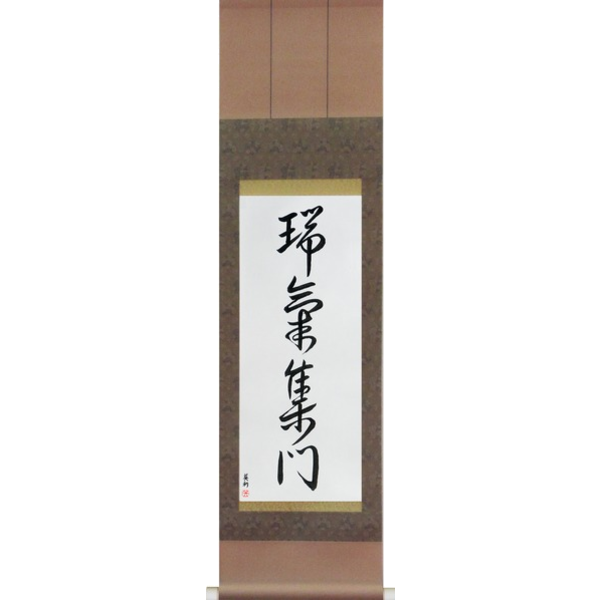
Sold as Gathering of Good Omens · Read zuiki shūmon; the catalogue writes zuikishuumon; the older Japanese reading is 瑞気門に集まる, zuiki mon ni atsumaru · Oldest witness the phrase book Edo calligraphers kept beside the inkstone, 1836, in its spring section, with no author · Sense may good fortune gather at this house: a wish written at New Year or over a door.
The words
瑞気, zuiki, is めでたい雲気。瑞祥の気, an auspicious aura, the air of a good omen: the vapor that attends a lucky sign, in Japan since a poem by Emperor Saga in 814 and in China before that. The page's Good Omens is 瑞 without 気; the omen itself is 瑞祥 or 瑞兆, and 瑞気 is the auspicious air that gathers, which is why the phrase gives it a verb. 集, shū, is gathers, intransitive: the reading marks on every witness from 1838 to 1942 read it 門に集まる, gathers at the gate, not gathers the gate. 門, mon, is the gate, and by the gate the house and family: the 1938 handbook glosses it 其人の家門, that person's house and line. Two readings coexist and both are old: the Sino-Japanese zuiki shūmon, which is the catalogue's, and the Japanese reading the reading marks prescribe, zuiki mon ni atsumaru, which a letter manual of 1879 spells out in katakana; the 1838 leaf carries a return mark on 集, so its compiler read it the second way. 氣 is written in its old form in every witness; the design writes the modern 気.
A history, from the earliest witness
1836, in the issue of 1838. 市河米庵, 墨場必携, book three, the spring four-character phrases, leaf four. 瑞氣集レ門, with the reading mark and no author, sharing its column with 呈祥獻瑞, also unnamed; the column before ends 春風致和 鍾伯敬, and the column after opens 琴酒相壽 張湖 以下清, from here on, Qing. 米庵's names mark sources loosely; the phrase sits in the span he brackets as Ming. So the leaf says what the compiler thought and no more: a Ming-era phrase, source not given. This is the earliest witness opened. [National Institute of Japanese Literature, kokusho.nijl.ac.jp, item 200023335, canvas 102, by eye; an image, with no page-API text address]
1878. 宇高三蔵, 文人必携懐中雅字便, a pocket derivative of the phrase book. 瑞氣集門 鍾伯敬 · 呈祥獻瑞 仝: the phrase now carries an author, 鍾惺, whose courtesy name was 伯敬, the poet of the 竟陵 school, 1574 to 1625. On 米庵's leaf that name is printed under 春風致和 at the foot of the previous column, and the two unnamed phrases follow it; the pocket book's compiler read the name across the column break. No text of 鍾惺's carrying the four characters was found. The attribution is reported here from a derivative, not as a source. [2]
1879. 久保田梁山, 文章機材 作文須知, a letter-writing manual. The model reply to a New Year's greeting quotes the correspondent's own phrase back: 如高諭瑞氣集門欲呈祥, as you kindly say, auspicious air gathers at the gate and is about to show its auspice, glossed in katakana ズイキ モンニ アツマリ ショウヲ テイセント ホッス. The phrase as kanbun courtesy, with the reading written out for the man who has to copy it. [3]
1880. 書家自在, a calligrapher's phrase book. 瑞氣集門, no author, in the 米庵 order. [4]
1892. 出金八郎, 要言類集, a school copybook list. 恒其德貞 · 瑞氣集門 · 天長せつ · 御國の光: what a Meiji schoolchild copied, the reign's holiday and the nation's light, and this. [5]
1891, seen in 1915. 坪谷水哉, 東西南北, a travel sketch of rain at Nikkō. 瑞氣集門の四大字は、宮小路康文の筆で、明治二十四年三月菅公祭日書, the four large characters zuiki shūmon are in the hand of 宮小路康文, dated the festival day of 菅公, March 1891: a priest of 太宰府天満宮 brushed them for an inn, and a writer found them over the transom of a room where the rain would not stop. [7]
1910. 藤井乙男, 諺語大辞典. Absent at the leaf where it would fall, and absent from the whole book: the proverb dictionary does not have it, because it is not a proverb. [pid 862766, scan 285, by eye; text at lab.ndl.go.jp/dl/api/page/862766_285]
1912 and 1938. 墨場必携 reprinted. The 1912 typeset resets the 1838 leaf line for line. The 1938 annotated edition glosses it: 瑞氣集門 — めでたき氣が其人の家門に集合する, auspicious air gathers at that person's house. [6][8]
1942. 松崎覚本, 揮毫辞典, a dictionary of phrases to brush, spring section. 瑞氣門ニ集マル — メデタキ雲氣ガ門ニ集マリ來ル, auspicious cloud-air comes gathering at the gate: the Japanese reading printed as the headword. [9]
Today. The phrase is in no dictionary of proverbs, idioms or four-character phrases opened, and kotobank, Weblio and the EDRDG have no entry for it; 瑞気 alone is in the 精選版日本国語大辞典 with its 814 citation. It is in a calligraphy blog of 2021, which learned it from the modern 四字名句 墨場必携, and in a Korean-American newspaper piece of 2010, which paraphrases it auspicious energy gathers before the gate. The public-domain corpus of the National Diet Library returns eleven books for the four characters, all Meiji or later. [kotobank.jp/word/瑞気-539609; text; the corpus count from the saved search in the account]
The sense across time
The sense is a wish and has not changed: auspicious air, gather at this gate; good fortune, come to this house. What the witnesses show is where the wish lives. In 1836 it is a phrase for the brush, set among the wishes for spring. In 1879 it is what a correspondent writes at New Year and what one writes back. In 1892 it is a schoolchild's copy line. In 1891 it is four large characters over an inn's transom, and a travel writer notes the priest's fame and the rain's indifference to the wish. The 1938 and 1942 handbooks say plainly what it means and print the reading, so the reading is not a modern guess. The route from the 1836 leaf to today's New Year writing lists runs through one book title the whole way.
What is not a source
The phrase is not in the Chinese canon as the ctext full-text search holds it, not in the classical facet of the National Diet Library's corpus, not in 鍾惺's collected works as Wikisource can search them, and not in any Chinese couplet collection opened. The sibling 瑞氣盈門, auspicious air fills the gate, paired with 祥光滿室, is in the Chinese couplet stock Japanese folklorists recorded in the 1930s and in a Zen ritual text of 1911; 集門 is the calligrapher's form. The attribution to 鍾惺 is a reading of a column break in 1878 and is reported as that. And the page's sentence that the phrase is often used in Feng Shui as an element by the main entrance has no source in anything opened; what is real is the meaning, a gate, and the placement, a transom, a door, a shop front at its opening, which need no Feng Shui to explain them.
The text in English
There is no English lineage; the phrase was never translated as literature, and it is in none of the six English proverb books on the shelf, all searched. The English in hand is the house's and two web paraphrases.
Today. The house title, Gathering of Good Omens, keeps the verb and loses the gate, and the gate is the point: this is a wish spoken over a door. The 2010 piece has auspicious energy gathers before the gate; the 2021 blog, good fortune gathers at the gate. A title that carries all four characters: Good Fortune Gathers at the Gate. What a rendering must keep: the gathering, the gate, and 気, the air or energy that does the gathering.
A reading
The design and the romaji are sound. The frame is wrong in kind: not a proverb, not a four-character idiom in any dictionary, but a calligrapher's auspicious phrase, which is a better thing to be on a scroll than a proverb, because a scroll is exactly where it has lived since 1836. The story for the page is one sentence with a source: this phrase comes from 墨場必携, the phrase book Japanese calligraphers have kept by the brush since the 1830s, where it sits among the wishes for spring; it means may auspicious air gather at your gate, and it is what you write at New Year or over a door, as a priest of 太宰府天満宮 did for an inn at Nikkō in 1891. The Feng Shui sentence goes unless a source appears; the gloss of 瑞気 gains its 気; the title gains its gate. One thing recorded and not asked: every witness before the design writes 氣, the design writes 気, and that is the same question as 経 and 經, which is parked. Signed, 典, 2026-09-05.
How this was read
By eye: the 1838 leaf at the National Institute of Japanese Literature; the 1878 leaf, re-read on the day of writing; the 1879, 1880, 1892, 1912, 1915, 1938 and 1942 leaves; the 1910 dictionary at the leaf where the phrase would fall. By text at the address: the kotobank entry for 瑞気; the ctext and Wikisource searches; Weblio and the EDRDG for the absence; the blog and the newspaper piece; the six English paperbacks in their text layers. Not opened: 米庵's own preface, which would settle how his attributions work; 鍾惺's 隱秀軒集 at any page; any Chinese couplet collection; the 1843 五體墨場必携; the sibling phrases' witnesses of 1905 and 1931 beyond OCR. Every National Diet Library leaf named by eye has a page-API text address beside it; the 1838 leaf is an image at the National Institute of Japanese Literature and checkable only as one. The full apparatus, with every address, is in the account.
References
- 市河米庵 輯『墨場必携』巻之三 春類 四字 (work 1836; this issue 天保9 = 1838) — NIJL 200023335 canvas 102, leaf 四 recto, by eye
- 宇高三蔵『文人必携懐中雅字便』四言 慶賀 (1878) — pid 891725 scan 15, by eye ↩
- 久保田梁山『文章機材 作文須知』賀歳首 還章 (1879) — pid 865327 scan 13, by eye ↩
- 『書家自在』下 春 四字 (1880) — pid 852570 scan 14, by eye ↩
- 出金八郎『要言類集』四字 (1892) — pid 758433 scan 5, by eye ↩
- 『墨場必携』大屋書房 typeset (1912) — pid 853182 scan 5, by eye ↩
- 坪谷水哉『東西南北』雨の日光 (1915) — pid 954901 scan 10, by eye ↩
- 『墨場必携 新註』 (1938) — pid 1033232 scan 49, by eye ↩
- 松崎覚本『揮毫辞典』春之部 四字句 (1942) — pid 1884879 scan 19, by eye ↩
- The catalogue and both live pages (2026) — cultural_works.csv:357