

善は急げ · zen wa isoge · Hurry the good
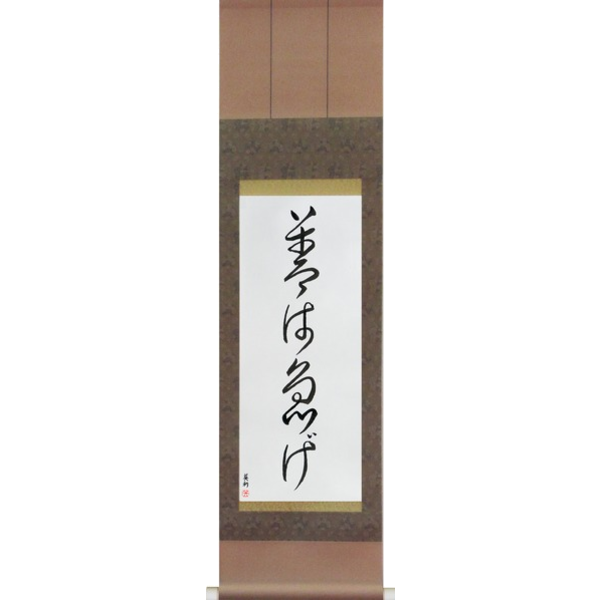
Sold as If It's Worth Doing, It's Worth Doing Promptly · Read zen wa isoge · Oldest witness the first Japanese proverb collection, 1638, where it has a second half, and put off the bad · Sense a good thing is to be done at once, before the chance is lost.
The words
善, zen, is the good: virtue, and here a good deed, a good thing to do. は is the topic particle, written with the kana for ha and said wa; the catalogue writes the sound, and a dictionary that writes zen ha isoge is writing the spelling, which is a fact about romanization and not an opinion about the proverb. 急げ, isoge, is 急ぐ, to hurry, in the imperative: the proverb is a command, hurry! The half the design does not carry, 悪は延べよ, aku wa nobeyo, is the same command reversed: 延べる is to put off, and the pair says do good at once, delay wrong. The 1656 witness writes the particle をば, the emphatic object marker, as for the good, hurry it; everything from 1718 on writes は, and the popular books spell it in kana, ぜんはいそげ, which is how the sound is settled.
A history, from the earliest witness
1638, printed 1645. 毛吹草, 松江重頼's handbook for haikai poets, whose second book is a list of common sayings in いろは order. ぜんはいそげ、あくはのべよ, hurry the good, put off the bad: both halves, in kana. This is the 精選版日本国語大辞典's first citation. [the 日国 at kotobank.jp/word/善は急げ; the book is digitized at the National Institute of Japanese Literature in twenty copies and was not opened at the leaf]
1656. 世話尽, the second proverb collection. 善をばいそげ, the first half alone, with the emphatic particle, in the last column of the left page after there are horses that run a thousand leagues, but only one man who can judge a horse. [2]
1718. やふにまくは, a joke-book. 善は急げ悪は延よ。早牛もよど遅牛も段まて。いそがはまはれ。七度尋て人うたがへ商は牛の涎。短気は損気, a run of proverbs of haste and delay: hurry the good and put off the bad; the fast ox reaches Yodo and so does the slow one; if you hurry, go round; ask seven times before you doubt a man; trade is an ox's drool; a short temper is a short purse. [3]
1777 to 1841. The popular fiction of Edo. A geisha in a 洒落本 of 1777: ぜんはいそげじゃァじきにやってこましたい, hurry the good, they say, so let's have it done right now; 十返舎一九 in 1813, ぜんはいそげとすぐに; the 合巻 and 人情本 of 1825 to 1841, 善は急けといへる諺, using it for weddings and bargains. [4][5][6]
1910. 藤井乙男, 諺語大辞典. 【善ハイソゲ惡ハノベヨ】〔毛吹草〕――。〔日本諸士百家記〕六、名残はつきず候へども、善は急げと候はゞ、とくとくして御出候べし。〔左傳〕成公八年、君子曰、從善如流。註、如流喩速。〔讀書錄〕五、遷善如風之速、改過如雷之迅。 The headword carries both halves; a Genroku-era letter, we have much still to say, but since good is to be hurried, come at once; and two Chinese lines, from the 左傳 on a general who followed good advice like flowing water, with the traditional note that like water means quickly, and from a Ming scholar's reading-notes, move to the good as fast as wind, correct faults as quick as thunder. No European parallel is printed for this one. [7]
1913. 水戸黄門漫遊記, a popular retelling of the Mito Kōmon stories. Twice, and both times to hurry a wedding: 思ひ立たが吉日、善は急げ惡は延せと云ふ事がある、今晩の內に三々九度の盃を爲せませう, the day you think of it is the lucky day, hurry the good and put off the bad, as they say; let us have the wedding cups tonight; and 善は急げ惡は延ろとやら、今晩の內にも三三九度の盃だけでもさせたいと思ひます. [8]
1914. 夏目漱石, こゝろ, part three. The narrator's uncle, pressing a marriage the narrator does not want: けれども善は急げという諺もあるから、できるなら今のうちに祝言の盃だけは済ませておきたいともいいました, but there is the proverb, hurry the good, he said, so if possible he wanted at least the wedding cups exchanged now. [青空文庫, aozora.gr.jp/cards/000148/files/773_14560.html; text]
Today. デジタル大辞泉: よいことはためらわずすぐに行え. 精選版日本国語大辞典: よいことをするのに躊躇するな、善事はただちに実行せよの意。善事は急ぐ。⇔悪は延べよ. ことわざを知る辞典: よいことはためらわず、ただちに実行せよ, with the note that 悪は延べよ often follows, the kin proverb 思い立ったが吉日, and the English There is no time like the present. [kotobank.jp/word/善は急げ; text]
The sense across time
The dictionaries' sense, do a good thing at once, has not moved since 1638. What the witnesses show and the dictionaries do not record is who says it and why. From the geisha of 1777 to the go-betweens of the 1840s to Sōseki's uncle in 1914, the speaker is someone who wants a deal or a wedding closed and uses the proverb to shut off delay. That is the proverb's social life: a moral maxim borrowed as leverage. The second half, put off the bad, is in the first collection, in the 1718 joke-book, in 藤井's headword and in the 1913 novel, and dropped by the 1656 book, by Sōseki, by the modern headwords and by the catalogue; both forms have been current since the seventeenth century.
What is not a source
藤井's two Chinese lines lead back, step by step, to a canon address: the Ming scholar's as fast as wind, as quick as thunder comes from 朱熹, 遷善如風之速,改過如雷之猛, and behind Zhu Xi is the 易 itself, on the hexagram 益 whose two trigrams are wind and thunder: 風雷,益;君子以見善則遷,有過則改, wind and thunder: Increase. The gentleman, seeing good, moves to it; having faults, corrects them. So the thought that good must be done at speed has a Confucian pedigree with the same image. Whether the Japanese proverb descends from it or only rhymes with it, no witness says; 毛吹草 gives no source, and the Japanese form is a vernacular command with a second half the Chinese does not have. These are parallels, and that is how 藤井 offered them. 思い立ったが吉日, the day you think of it is the lucky day, is the Japanese kin proverb, and the two travel together in the 1913 novel. [ctext.org/chun-qiu-zuo-zhuan/cheng-gong-ba-nian/zh; ctext.org/book-of-changes/yi1/zh; zh.wikisource.org/wiki/朱子語類/072; transcriptions]
The text in English
The Meiji bilingual shelf does not carry the proverb by search, so the English begins with the American paperbacks, and they agree on one rendering.
1965. Daniel Crump Buchanan, Japanese Proverbs and Sayings, University of Oklahoma Press, page 146. Zen wa isoge: "Hasten to do good." Don't wait to do good, but do it quickly. English parallel: Make hay while the sun shines. [LCCN and ASIN not collected; read in the shelf's text layer, the page from the running head; a printed book, checkable by a reader who holds it]
1987. David Galef, Even Monkeys Fall from Trees, Tuttle, number 61, page 136. Zen wa isoge. Do quickly what is good., and in the list of English equivalents, Strike while the iron is hot. The rendering every later book copies. [ASIN 0804832269, amazon.com/dp/0804832269; read in the 2015 EPUB, the page as the EPUB numbers it]
2004. Edward Trimnell, Tigers, Devils, and Fools, Beechmont Crest, page 164. Do quickly what is good., Galef's line to the word, then: When the opportunity to do good presents itself, you should immediately do what you know to be right. If you hesitate, then the opportunity may be lost. [ASIN not collected; read in the shelf's text layer; a printed book, checkable by a reader who holds it]
2012. David Galef, Japanese Proverbs: Wit and Wisdom, Tuttle, number 61, page 79. The 1987 entry reissued: Do quickly what is good. [Strike while the iron is hot.] Timing matters, especially in the performance of admirable deeds. "Make hay while the sun shines" is another Western equivalent, in a sense the opposite of 56: Isogaba maware: "When in haste, take the roundabout route." [ASIN not collected; read in the shelf's text layer, the page from the book's own contents list]
The proverb is not in Galef's Even a Stone Buddha Can Talk (Tuttle, 2000) or in Guy Zona's Even Withered Trees Give Prosperity to the Mountain (1996), both searched.
Today. The house title, If It's Worth Doing, It's Worth Doing Promptly, lends the cadence of an English proverb to a Japanese one, and the page's second gloss, If it is a good thing, hurry and do it, is the literal one. Every English equivalent on offer, strike while the iron is hot, make hay while the sun shines, there is no time like the present, is about acting now; none carries 善, the goodness of the thing, which is what makes the Japanese a moral maxim and not a counsel of speed. What a rendering must keep: the good as the object, and the imperative.
A reading
The design is sound and the reading is sound. The page's explanation is right in substance and broken in form: the design page prints the raw markup of its word glosses and links three gloss fragments as dictionary words, while the scroll page renders the same text correctly, so the fault is the design-page template; and the paragraph on romaji is correct but belongs to the house's romanization standard rather than a product page. What the page could say instead: that the proverb has a second half, put off the bad; that it is first in a haikai handbook of 1638 and has been used ever since to hurry weddings, from a geisha in 1777 to Sōseki's uncle in 1914; and that the thought has a canon behind it, the hexagram of wind and thunder, where the gentleman seeing good moves to it. Every piece of that is at an address. Signed, 典, 2026-09-05.
How this was read
By eye: the 1656 leaf, re-read on the day of writing, where the small dakuten of をば is at the limit of what the width form shows and the earlier reading stands; the 1910 dictionary at the entry. By text at the address: the 1718 joke-book and the 1913 novel at the page API, located by the in-book search; the kotobank page with its three dictionaries; Sōseki at 青空文庫; the 左傳, the 易 and 朱子語類 in transcription; the six English paperbacks in their text layers, four of which carry the proverb. By OCR from the full-text search, not opened at a page: the Edo popular books of 1777 to 1841. Not opened: 毛吹草 at the leaf; the Genroku letter-book 藤井 quotes; the Ming reading-notes at the page; the Meiji bilingual dictionaries by eye. The 1656 and 1910 leaves have page-API text addresses beside them; the English paperbacks are checkable only by a reader who holds them. The full apparatus, with every address, is in the account.
References
- 毛吹草 (松江重頼) 巻二 世話 (1638) — 日国 初出 (kotobank); 藤井 1910 cites 〔毛吹草〕 by eye with no quotation; the book not opened — NIJL WID 169937, twenty digitized copies, the proverb list is 巻二 in いろは order
- 世話尽 (1656) — NDL 古典籍 pid 2554768 scan 34, by eye; the OCR reads 善をはいそげ ↩
- やふにまくは (1718) — pid 2568482 scan 9 (OCR; text at lab.ndl.go.jp/dl/api/page/2568482_9; located s36 by `page/search?f-book=2568482&q-contents=善は急げ`; the scan 14 this row carried until s36 was the book-search API's `page` field, which is not the scan, and the reader found the anchor absent there) ↩
- 妓者呼子鳥 (田螺金魚, 洒落本) (1777 (安永6)) — pid 2534200 (search highlight, OCR); the Edo colloquial ↩
- 磯ぜせりの癖 (十返舎一九) (1813 (文化10)) — pid 9893317 (OCR) ↩
- 富士裾うかれの蝶鵆 (柳亭種彦) · 菊酒屋娘庭訓 · 風俗粋好伝 (1831 · 1841 · 1825) — pids 10301538 · 10303475 · 8942993 (OCR) — the 合巻 and 人情本 use it for weddings and bargains ↩
- 諺語大辞典 (藤井) (1910) — pid 862766 koma 301, by eye ↩
- 水戸黄門漫遊記 (1913) — pid 912427 scans 24 and 29 (OCR; text at lab.ndl.go.jp/dl/api/page/912427_24 and 912427_29; located s36 by the in-book page search) — paired with 思い立ったが吉日, and a wedding both times ↩
- 夏目漱石 こゝろ 下 (1914) — 青空文庫 text — the uncle pressing the marriage
- 精選版 日本国語大辞典 · ことわざを知る辞典 () — kotobank
- The catalogue and both live pages (2026) — cultural_works.csv:347