

勇者は幸運に恵まれる · yūsha wa kōun ni megumareru · The brave are blessed with good fortune
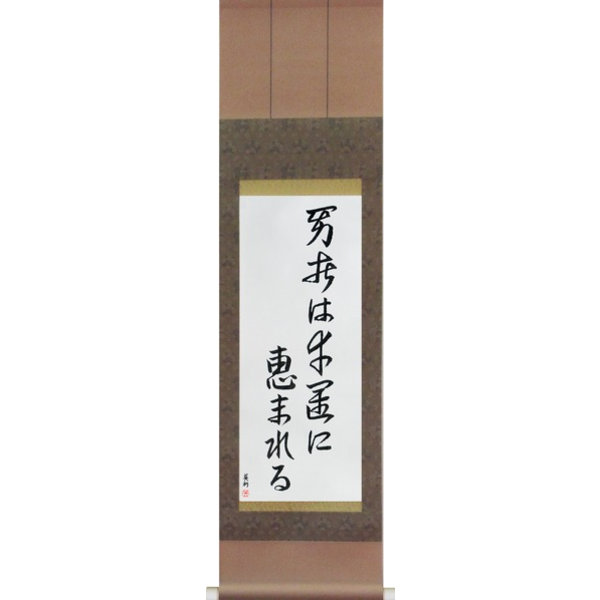
Sold as Fortune Favors The Brave · Read yūsha wa kōun ni megumareru; the catalogue writes yuusha wa kouun ni megumareru · Oldest witness a Roman comedy of 161 BC, and Cicero calling the line an old proverb a century later; the Japanese sentence is a modern dictionary rendering with no Japanese proverb under it · Sense boldness moves fortune.
The words
勇者, yūsha, is a person of courage, a word as old as the 平治物語 of about 1220 and the Analects' 勇者不懼, the brave do not fear; to a Japanese reader under fifty its first association today is the hero of a game or a manga, which is not wrong for a scroll but is a different color from the Latin fortis. 幸運, kōun, is good fortune, a lucky turn, the abstract noun; it is not Fortuna. 恵まれる, megumareru, is to be blessed with, the ordinary construction for being fortunate in something. So the Japanese says the brave are blessed with good fortune, a statement about the brave. The Latin, and every Japanese dictionary rendering from 1888 to 1946, is a statement about Fortune, who helps, loves or favors the brave. The sold wording turns the goddess into a passive blessing and moves the brave into the subject; it reads as a gloss, which is what it is, below.
A history, from the earliest witness
Second century BC. Ennius, Annals, book seven. Fortibus est fortuna viris data, fortune is given to brave men, in hexameter, quoted by Macrobius four centuries later as the model for Virgil's line. [Macrobius, Saturnalia 6.1.62, in a Latin Wikisource search result; not opened whole]
161 BC. Terence, Phormio, line 203. A slave, Geta, urging a young man to act: fortis fortuna adiuvat, fortune helps the brave. The oldest line opened. [thelatinlibrary.com/ter.phormio.html; text]
45 BC. Cicero, Tusculan Disputations 2.11. "Fortes" enim non modo "fortuna adiuvat", ut est in vetere proverbio, sed multo magis ratio, for not only does fortune help the brave, as the old proverb has it, but much more does reason. Already a proverb, and already old. [thelatinlibrary.com/cicero/tusc2.shtml; text]
19 BC. Virgil, Aeneid 10.284. Turnus, ordering a charge that will fail: audentis Fortuna iuvat, Fortune helps the daring. [thelatinlibrary.com/vergil/aen10.shtml; text]
About AD 107, of the year 79. Pliny the Younger, Letters 6.16.11. His uncle, sailing toward Vesuvius to his death, to a frightened helmsman: 'Fortes' inquit 'fortuna iuvat: Pomponianum pete.' [thelatinlibrary.com/pliny.ep6.html; text] So the four classical witnesses are a soldier's saying, a slave's encouragement, a doomed king and a doomed admiral.
The twelfth century onward. The audaces form. Alan of Lille's Parabolae, Albertanus of Brescia in 1238, and John Owen's epigram of 1606 all have Audaces fortuna iuvat, Fortune helps the bold. This is the schoolbook form, and it is the form the house page prints, with the words in an order that is nobody's. [Latin Wikisource search results; not opened whole]
1888. An English-Japanese Lexicon, appendix of Greek, Latin and modern foreign phrases, page 1069. The earliest Japanese rendering found: Audaces fortuna juvat. 〔羅〕天運ハ勇者ヲ愛ス, 天勇者ニ與ミス, Heaven's fortune loves the brave; Heaven sides with the brave. Fortuna becomes the Confucian Heaven. [National Diet Library pid 1677027, koma 551, by eye; text at lab.ndl.go.jp/dl/api/page/1677027_551]
1901. 佐々政一, 修辞法, a rhetoric manual, pages 230 to 231. A school essay on the set topic 運命は勇者を愛す, fate loves the brave, and its critic's complaint that the student forgot his proposition and wrote about fate alone. The line was a topic, not a saying. [pid 864859, koma 116, by eye; text at lab.ndl.go.jp/dl/api/page/864859_116]
1909. 神田乃武 and 南日恒太郎, 英和双解熟語大辞典, appendix pages 38 to 39 and 12 to 13. Three Latin forms, three Japanese: fortes fortuna adjuvat, 勇者には幸栄あり, with the Terence address; audentes fortuna juvat, 福神は勇者に幸ひす, with Virgil's; audaces fortuna juvat, 福神は勇敢なる者に幸ひす. Fortuna becomes 福神, a god of luck. [pid 990169, koma 858 and 845, by eye; text at lab.ndl.go.jp/dl/api/page/990169_858]
1911. The dictionary 新渡戸稲造 oversaw, 英和俗語熟語故事大辞典, pages 1716 to 1717. Fortes fortuna juvat. 運の神は勇者を愛顧す; 天は勇者を祐く, and beside it Fortuna favet fatuis, 幸運は愚者を祐く (the OCR reads 恵む), Fortune favors fools. The Western shelf holds both, and the Japanese copied both. [pid 902975, koma 864, by eye; text at lab.ndl.go.jp/dl/api/page/902975_864]
1918 to 1946. A dozen more. 斎藤秀三郎 (1918): 運は勇者を助く. A composition dictionary (1925): 幸運は勇者を寵す, marked 西諺, a Western proverb. Ethics textbooks of 1928 to 1939: 天は勇者に幸する, and one teacher's guide supplies the English original for the Japanese proverb, Heaven favours the brave, which is the whole reception in one sentence. A world-maxim anthology (1932): 運は勇者を寵愛す, credited to Virgil. The 1946 Standard: 天運ハ勇者ニ幸スル. Twelve renderings in sixty years, none of them fixed. [pids 1681530, 914586 koma 356 by eye, 1457231, 1108066, 1126792; the rest OCR]
Today. kotobank has no headword for any Japanese form of the line. Weblio's machine-generated English-Japanese dictionary, which says of itself that a program produces its entries, glosses fortune favors the brave as 勇者は幸運に恵まれる, and that is the catalogue's wording, character for character; the archive of seven thousand nine hundred and eighty-five books has it in none. Neither 藤井乙男's proverb dictionary of 1910 nor 中野's of 1933 files any form of the line. [ejje.weblio.jp/content/fortune+favors+the+brave; text]
The sense across time
The Latin claim is that boldness moves fortune. What moved in Japanese is Fortuna. She became Heaven in 1888 and 1946, a god of luck in 1909, the god of fortune and Heaven side by side in 1911, and plain luck in 1918, and the two are not the same claim: 天は勇者を祐く says the moral order rewards courage; 運は勇者を助く says the dice do. The sold wording says neither; it says the brave are blessed, and leaves the blesser out.
What is not a source
There is no Japanese proverb under this sentence. The Japanese proverb tradition's own line on fortune says the opposite and is said in the same situation, before a charge: 運は天にあり, fortune is Heaven's, from the 太平記 of the fourteenth century, 運は天にあり、一足も引く事有るべからず。只討死をせよ, fortune is Heaven's; do not retreat a step; only die fighting. The Roman claims that boldness moves fortune; the Japanese resigns fortune to Heaven and moves anyway. The Edo parodies, fortune is Heaven's and the rice cakes are on the shelf, mock the resignation. 勇者は懼れず, the brave do not fear, from the Analects and the first Japanese proverb book, is a real Japanese proverb about the brave and says nothing about fortune. Seneca's letter 94 and Erasmus's Adagia, which the dictionaries and the web cite, were not opened. [kotobank.jp/word/運は天にあり; text]
The text in English
Fortune favours the brave is the standing English on the whole Japanese shelf from 1904, with the bold for audaces and the daring for audentes in 1909; the house title is that equation and is right. 1987. David Galef, Even Monkeys Fall from Trees, Tuttle, number 66, page 146. 運は勇者を助く, Un wa yūsha o tasuku, Fortune favors the brave, and in his list of equivalents Fate aids the courageous: 斎藤's 1918 rendering given as a Japanese proverb, with no source. [the 2015 EPUB text layer] Not in Buchanan (1965), Galef's second book (2000), Zona (1996) or Trimnell (2004). Today. JMdict has no entry for the sentence. What a rendering must keep is Fortune as the actor, which the English title does and the Japanese wording does not.
A reading
The title and the class are right, the characters are sound, and nothing needs to be re-brushed: the words are grammatical, ordinary Japanese, and a customer who buys Fortune Favors The Brave gets a Japanese sentence that says so. The page needs one correction and two clauses. The correction is the Latin: fortuna audaces iuvat is neither Terence nor Virgil; give Terence's fortis fortuna adiuvat or Virgil's audentis Fortuna iuvat, and say that Cicero already called it an old proverb. The clauses: that the Japanese wording is a modern rendering, that the Meiji dictionaries rendered the line a dozen ways and 斎藤's 運は勇者を助く is the plainest, and that the Japanese proverb tradition's own line on fortune says the opposite before a charge. What the page should stop doing is implying that a Japanese proverb exists under it. And one thing for the house rather than the page: the wording is a machine dictionary's gloss, and the next design in this class should start from a form with a person behind it. Signed, 典, 2026-09-05.
How this was read
By eye: the 1888 appendix and the 1909 appendix, both re-read on the day of writing; the 1911 dictionary; the 1901 rhetoric manual; the 1925 composition dictionary. By text at the address: Terence, Cicero, Virgil and Pliny at The Latin Library; Ennius and the medieval witnesses in search results; the five leaves above at the National Diet Library's page API; 斎藤, the ethics textbooks, the 1932 anthology and the 1946 Standard by OCR; the kotobank entries for the words and for 運は天にあり; Weblio in both directions; Galef in the text layer. Not opened: Seneca and Erasmus at their texts; the Greek antecedents; Macrobius, Alan of Lille, Albertanus and Owen whole; the 1932 anthology's leaf crediting Virgil; any print proverb dictionary of today. Every address in this history is a text address except Galef's page, which a reader checks by holding the book. The full apparatus, with every address, is in the account.
References
- Ennius, *Annales* VII (fragment) (2nd c. BCE) — Macrobius, *Sat.* 6.1.62, naming it as Virgil's model — Wikisource snippet, not opened whole
- Terence, *Phormio* 203 (161 BCE) — The Latin Library, read in the line
- Cicero, *Tusc.* 2.11 (45 BCE) — The Latin Library, read in the line
- Virgil, *Aen.* 10.284 (19 BCE) — The Latin Library, read in the line
- Pliny the Younger, *Ep.* 6.16.11 (c. 107 CE, of 79 CE) — The Latin Library, read in the line
- Alan of Lille, *Parabolae* (12th c.) — Wikisource snippet, not opened
- Albertanus of Brescia, *De amore et dilectione Dei* III (1238) — Wikisource snippet, not opened
- John Owen, *Epigrammata* (1606) — Wikisource snippet, not opened
- Erasmus, *Adagia* I.ii.45 (1500–) — reported (web), not opened
- the page (2026) — neither Terence nor Virgil: *audaces* is the medieval and schoolbook form, and the word order is nobody's