

油断大敵 · yudan taiteki · Carelessness is a great enemy
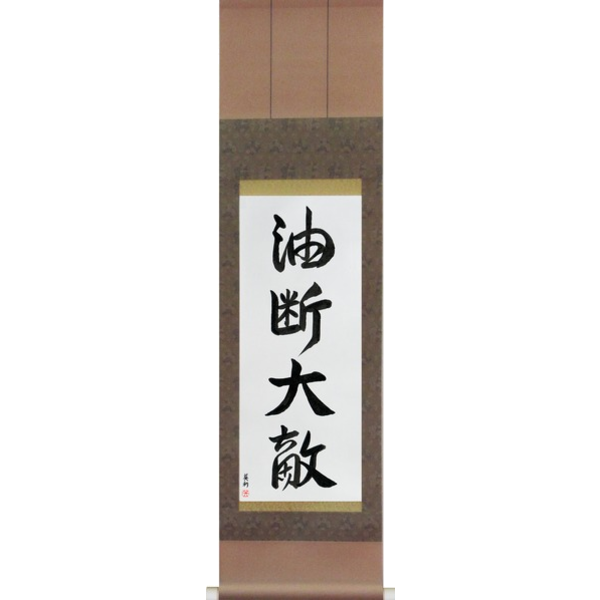
Sold as Carelessness is one's greatest enemy · Read yudan taiteki; the catalogue runs it together as yudantaiteki · Oldest witness the older form carelessness becomes a strong enemy in the first Japanese proverb collection, 1638; the four characters in a puppet play of 1668; a whole chapter built on them by a Confucian scholar in 1732 · Sense the moment your guard drops is the enemy to fear most.
The words
油断, yudan, is the moment of a dropped guard: 気をゆるすこと、たかをくくって注意をおこたること, letting the mind relax, underrating a thing and neglecting attention. It is not habitual sloppiness, which is why carelessness, unpreparedness and complacency are each about as near as the other. The word is Japanese and its origin is not known; the 精選版日本国語大辞典 marks it 語源未詳 and dates it from a 1309 manuscript of the Tale of the Heike, where it appears once, in the form ゆたむ, while the other recensions of the same passage use other words, so it was not yet common in the fourteenth century. Two stories are told about where it comes from, and both dictionaries print them as 説, theories. One is a sutra: デジタル大辞泉's note cites the 北本涅槃経, chapter 22, where a king orders a courtier to carry a bowl of oil through a crowd and forfeit his life if a drop spills, and reads 油断 as the oil cut off, the spilled drop. The other is a native word, ゆたに, at ease, slack, worn down by sound change. Neither is more than a theory, and the sutra is the story people tell. 大敵, taiteki, is a great enemy, a formidable foe, and the proverb is a predicate: carelessness is a great enemy. 断 is written 斷 in every witness before 1946; the design writes the modern form of the same character.
A history, from the earliest witness
1638, printed 1645. 毛吹草, the first Japanese proverb collection, by 松江重頼. 油斷、强敵トナル, carelessness becomes a strong enemy: the same thought with a verb, before the four-character form. [5]
1668. The puppet play 源平敵討遺恨并頼光北国, act four. なむ三ぼう、かやうにないがまへを、してをきたりしを、しらずして、ゆだんたいてきとなしたる事の口をしやと, Buddha help us: not to have known they had made ready like this, and to have let carelessness be our great enemy, how bitter. This is the line the 精選版日本国語大辞典 gives as the first attestation of the four-character form, still with となす, to make into. [the 日国 at kotobank.jp/word/油断大敵-651960; the play not opened]
1718. やふにまくは, a joke-book. 六月夜に釜ぬかるゝ油断強敵猫の額の飯粒ねらふ鼠あり, the kettle stolen on a June night: carelessness is a strong enemy; there is a mouse that eyes the grain of rice on a cat's forehead. The older form, still alive seventy years after the four-character one. [3]
1732, printed 1750. 室鳩巣, 駿台雑話, book four. The Confucian scholar builds a chapter on the proverb, and heads it with the four characters and their reading, ゆだんたいてき. In the Kan'ei years 永井尚政, young and rising fast in the shogun's favor, met the old 井伊直孝, the elder statesman of the age, and asked him for anything from his long experience that a young man in high office should keep. Naotaka said he had one thing, too important to say in passing, and named a day; Nagai came in formal dress to his house, and after the greetings Naotaka said: 世話に油断大敵といふ事定て御覚へあるべし、某が伝授外にはなく候、此一言にて候ぞ、必御忘れあるな, you will know the common saying yudan taiteki. That is my whole transmission; there is nothing else. This one phrase. Never forget it. Kyūsō then tells the story of King Wu of Zhou, newly enthroned, asking 太公望 for a rule brief enough to keep and lasting enough to hand down, and receiving the four lines of the 丹書, the Red Book: 敬勝怠者吉、怠勝敬者滅、義勝欲者従、欲勝義者凶, where care conquers negligence, good fortune; where negligence conquers care, ruin; where right conquers desire, obedience; where desire conquers right, disaster. And he concludes: 今油断大敵の語、鄙諺なれども丹書の戒に叶へり, the phrase yudan taiteki is a rustic proverb, but it agrees with the warning of the Red Book. Everyone knows carelessness is bad, he adds, and everyone hears the proverb without stopping at it, which is why they fail; Naotaka's distinction was that he never let it near him. The 1894 typeset edition heads the chapter 大敵外になし, there is no enemy but this one. [4][4]
Edo. The Edo いろはかるた. The card for ゆ is 油断大敵, and the catch-phrase children shouted with it was 火がぼうぼう, and the fire roars: the proverb's domestic scene, an unwatched lamp or hearth. [ことわざを知る辞典 at kotobank.jp/word/油断大敵-651960; the cards not opened]
1910. 藤井乙男, 諺語大辞典. Four headwords in a row. 【油斷、强敵トナル】 pointing to the next, with 毛吹草 as its source; 【油斷大敵】 with Kyūsō's chapter compressed, his 鄙諺 become 俗話, then the Chinese classical company of the thought, 通俗編, 説苑, the 後漢書 on 患生于所忽、禍起于細微, trouble is born where it is neglected, disaster starts from small things, the 荀子 on 百事之成也、必在敬之、其敗也必在慢之, every undertaking succeeds by care and fails by neglect, and the 耳談続纂 on 慣熟之斧、乃傷厥跗, the familiar axe is the one that cuts your foot; then, unusually for this dictionary, two European proverbs, Delays are dangerous, marked Italian, and Danger comes soonest when it is despised, marked Latin; 【油斷ハ怪我ノ基】, carelessness is the root of injury, from the play 世継曽我; and 【油斷モスキモナラヌ】. [5]
Today. デジタル大辞泉: 油断は失敗のもとであるから、大敵である。油断して失敗を招くのを戒めた言葉. 精選版日本国語大辞典: 油断は失敗のもとであるから、恐ろしい敵であるということ. ことわざを知る辞典: 油断は大敵と思っていましめよ。大丈夫だろうと気をゆるめて注意を怠ると、思いもよらない危険を招くことになる; 四字熟語を知る辞典 adds two uses, 太宰治 in 1933, たけは、油断大敵でせえ、と言っただけで, and 石川淳 in 1949. The public-domain corpus of the National Diet Library returns two thousand one hundred and eighty books for the four characters, three hundred and fifty-nine for the reading in kana, and thirty-two for the older 油断強敵, all re-derived on the day of writing. [kotobank.jp/word/油断大敵-651960 and kotobank.jp/word/油断-651959; text; lab.ndl.go.jp/dl/api/book/search]
The sense across time
The sense has not moved: a warning against the relaxed guard. What the witnesses add is a scale. In the puppet play it is a commander's regret after an ambush; in Kyūsō it is the whole of a statesman's counsel, dignified by a Zhou king's maxim; on the children's card it is a kitchen fire; in the modern dictionaries it is the everyday word for don't get complacent. The one variant, 油断強敵, carelessness becomes a strong enemy, is older than the four-character form and says the same thing with a verb; the dictionaries list it as a synonym. Kyūsō's reading is the hard one, and the 1894 editor made it a title: no other enemy counts.
What is not a source
The proverb is Japanese, and the Chinese lines the 1910 dictionary sets beside it, the 丹書's 敬勝怠者吉, the 荀子's 必在敬之, the 説苑's 患生于所忽, are the classical company of the thought, given in the dictionary's habit, not its source. Kyūsō himself said so: a rustic proverb that happens to agree with the Red Book. The sutra's oil bowl is a story about the word 油断, told by the dictionaries as one theory of its origin, and a page may tell it as a story so long as it says so. Of 藤井's two European proverbs, the Latin one, Danger comes soonest when it is despised, is a fair match and the Italian, Delays are dangerous, is a different proverb.
The text in English
1965. Daniel Crump Buchanan, Japanese Proverbs and Sayings, University of Oklahoma Press, page 42. Yudan taiteki: "Carelessness is a great enemy." The Japanese word "yudan" translated "carelessness" or "incaution," literally means "without oil." Hence, it can be appropriately applied to the five foolish virgins in the New Testament narrative. See Matthew 25:1-13. The rendering is exact and is the house title's ancestor. The etymology is not: 油断 does not literally mean without oil, the dictionaries mark its origin unknown and print the sutra's oil bowl as one theory among two, and the parable of the virgins is Buchanan's own bridge from a folk etymology to a Christian text. [LCCN and ASIN not collected; read in the shelf's text layer, the page from the running head; a printed book, checkable by a reader who holds it]
The proverb is not in David Galef's Even Monkeys Fall from Trees (Tuttle, 1987), Even a Stone Buddha Can Talk (Tuttle, 2000) or Japanese Proverbs (Tuttle, 2012), Guy Zona's Even Withered Trees Give Prosperity to the Mountain (1996) or Edward Trimnell's Tigers, Devils, and Fools (2004), all searched in their text layers; Trimnell uses the word carelessness only under even monkeys fall from trees. The bilingual dictionaries of the Meiji shelf were not searched for this proverb.
Today. The house title, Carelessness is one's greatest enemy, is Buchanan's line with greatest for great, and the page's three glosses, Unpreparedness is one's greatest enemy; He that is too secure is not safe; Overconfidence can be dangerous, cover the ground between them: the literal shape, the nearest English proverb, and the everyday paraphrase. What a rendering must keep: the enemy, because the proverb's whole force is that an inward lapse is treated as an outward foe; and a word for 油断 that means a dropped guard rather than a bad habit.
A reading
Sound design, sound reading, sound glosses. The proverb belongs on skin without reservation, a warning and not a creed, and the page's word for it, a gift for a dojo, is right: it is the martial-arts maxim of the family, and Kyūsō's chapter is why. What the page lacks is the story, and this one has two, of different kinds. Ii Naotaka's one-phrase transmission is short, quotable and true to a named source, and a page could tell it in three sentences with the 1750 leaf under it. The sutra's oil bowl is a legend of the word, and can be told as one. The romaji yudantaiteki as one word is the catalogue's house style for four-character idioms; yudan taiteki is the dictionary's division, and this history writes the dictionary's. One thing on the page is broken rather than thin: the design page prints the raw markup of its word glosses, and the catalogue row misspells negligence; that is in the page-defects ledger. Signed, 典, 2026-09-05.
How this was read
By eye: the 1750 leaf of 駿台雑話 with its furigana, re-read on the day of writing; the 1894 typeset at the chapter; the 1910 dictionary's four entries. By text at the address: the 1718 joke-book at the page API, located by the in-book search; the kotobank entries for the proverb and for the word 油断, with the 日国's note on the word's history; the 丹書 lines in the 大戴礼記 and the 荀子 in transcription; the sutra parable at the CBETA column; the six English paperbacks in their text layers, one of which carries the proverb; the three corpus counts, re-derived live. Not opened: the 1668 puppet play; 毛吹草 in its print; 世継曽我; the 通俗編, 説苑, 後漢書 and 耳談続纂 at the page; the Edo cards as objects; the Meiji bilingual dictionaries for this proverb. The 1750 and 1894 leaves and the 1910 entry each have a page-API text address beside them; the 1718 witness is OCR only; Buchanan is checkable only by a reader who holds the book. The full apparatus, with every address, is in the account.
References
- 毛吹草 (松江重頼) (1645) — 藤井 1910 koma 537 (【油斷、强敵トナル】〔毛吹草〕); 俚言集覧 1900 (OCR, koma 402); the book not opened
- 浄瑠璃 源平敵討遺恨并頼光北国 四 (1668) — 日国, 初出の実例; not opened
- やふにまくは (NDL title) (1718) — NDL pid 2568482, scan 10 (located s36 by the in-book page search, `page/search?f-book=2568482&q-contents=油断強敵`; text at lab.ndl.go.jp/dl/api/page/2568482_10), OCR; the older form still alive ↩
- 駿台雑話 (室鳩巣), 巻之四 (written 1732; printed 1750) — pid 2559323 koma 62 by eye, furigana ゆだんたいてき; pid 754747 koma 109 (1894 typeset, section 大敵外になし) by eye ↩
- 諺語大辞典 (藤井) (1910) — pid 862766 koma 537, by eye ↩
- 江戸いろはかるた (Edo) — ことわざを知る辞典; the karuta not opened
- 精選版 日本国語大辞典 · デジタル大辞泉 () — kotobank
- The design () — cultural_works 343; whole_designs row 86