

笑う門には福来る · warau kado ni wa fuku kitaru · Fortune comes to the gate that laughs
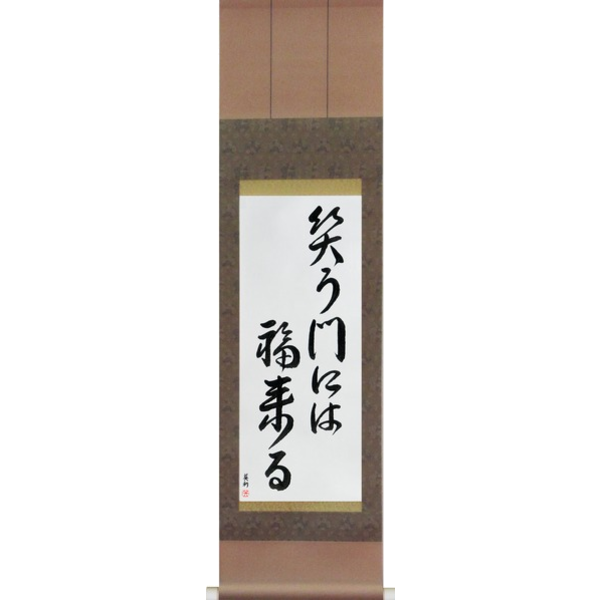
Sold as Fortune Comes To Those Who Smile · Read warau kado ni wa fuku kitaru · Oldest witness a line of comedy: a kyōgen play of the late Muromachi or early Edo period, quoted by farmers who want an official to laugh; in the proverb collections from 1638 · Sense a house full of laughter is a house good fortune visits.
The words
笑う, warau, in the older spelling 笑ふ, is the one Japanese verb for both laugh and smile; English has to choose, and the house title chose smile. The modern proverb dictionary says which laugh is meant: この笑いは、弱い者や劣った者をばかにする嘲笑ではなく、無邪気で、腹の底から楽しく笑えるもの, not the sneer at the weak or the lesser, but an innocent laugh from the bottom of the belly. 門, kado, is a gate, and by the oldest Japanese figure the house and the family behind it: 「門」は家の出入り口ですが、同時に家そのものや家族、一門を象徴しています. The seventeenth-century books said it plainly, the place that laughs, the house that laughs; 門 is the literary word that won. 福, fuku, is good fortune, and in the Edo imagination a visitor, 福の神, the god of fortune who comes to the door; that is why the proverb says comes. 来る is read kitaru, the classical form of the verb, not the modern kuru; the proverb keeps the old form and so does the catalogue's romaji. には is the topic particle with a locative before it, as for the gate that laughs, to it fortune comes; the particle is in the kyōgen text and in every witness after 1829, and only the 1910 dictionary's headword compresses it away.
A history, from the earliest witness
Late Muromachi to early Edo. The kyōgen 筑紫奥, in the Ōkura school text copied by 大蔵虎寛 in 1792. Two farmers from the far end of Tsukushi have paid their tax, been excused their levies, and been told to laugh once for every tan of field; guessing that the order was the sour official's own idea, they turn back to make him laugh too. The official: 汝らこそ御年貢は納る、萬雜公事は御免被成るゝ。笑ふ機嫌も有うが、此の御そうしやは今朝よりひえいたをあたゝめ、わらふ機嫌は無いやい, you have paid your tax and been let off your levies, so you may be in a mood to laugh; this official has been warming a chilled belly since morning and is in no mood for it. The shite: 左樣では御ざれども、笑らふ門には福來ると申に依て、追付御加增を取らせられ、御立身を被成れうは疑も御ざらぬ。是非共、and both farmers together, 笑らはせられて被下い, and the official, イヤ、どう有てもわらふ事は成らぬ. Be that as it may, since they say fortune comes to the gate that laughs, there is no doubt you will soon be given a raise and rise in the world. So please, laugh for us. No. Whatever you say, I will not laugh. The proverb is already a proverb, と申に依て, because they say, and it is used as leverage: laughter is owed because fortune is promised. This is the line the 精選版日本国語大辞典 takes as the first attestation, dated to the play, 室町末‐近世初. [1]
1638, printed 1645. 毛吹草, the first Japanese proverb collection, by 松江重頼. 笑フ所へ福來ル, fortune comes to the place that laughs: the house, not yet the gate. [8]
1649. 吾吟我集, 石田未得's collection of comic verse. A verse that turns the proverb on a bird-catcher's owl decoy: みゝづくでたほくとりぬる小鳥こそ笑ふ所へ福きたるなれ, the small birds caught by the horned-owl decoy are fortune coming to the laughing place; the form inside it is the place. [7]
1656. 世話尽, the second proverb collection. 笑の家に福來, fortune comes to the house that laughs: the house, not yet the gate. [7]
Edo, undated. 和漢古諺 and 野語述説. The 俚言集覧 credits these two books with 笑の所に福來, the place again; its headword above them, 笑ふ門にハ福來る, the gate, with the particle, is the compilers' own form, and the entry sets each source before what it quotes, as it does throughout the leaf. [7]
1829. 平田篤胤, 宮比神御伝記. The nativist scholar uses the proverb to explain a household custom: 世の諺に笑ふ門には福きたると云ひて、人相のよきを褒め、おかめの面といふ物を、またお多福ともいひて、諸人の愛敬をのぞむ家々に祝ふことは、或説に足利の末頃とか、ある神社の巫子に亀女とて, as the proverb of the world says, fortune comes to the gate that laughs, so people praise a good face, and the mask called おかめ, also called お多福, is hung in celebration in houses that hope to be liked by everyone; by one account this began around the end of the Ashikaga years, with a shrine maiden named 亀女. The furigana read わらふかど and ふく. The legend of the shrine maiden is told as 或説に, by one account, and is a legend. [6]
Edo. The Kamigata いろはかるた. The card for わ is this proverb, and its picture is 大黒, the god of fortune, grinning: 上方のいろはかるたにも収録され、絵札には満面の笑みを浮かべた大黒さまが描かれていました. Behind the card the dictionary sets the medieval door-to-door blessing arts, the 大黒舞, performers dressed as 大黒 and 恵比須 who came to the gate scattering laughter. [ことわざを知る辞典 at kotobank.jp/word/笑う門には福来る-665616; the cards not opened]
1900 to 1905. Meiji school grammars. 笑ふ門には福が來る in a grammar of 1900, 笑う門には福來る in textbooks of 1902 and 1903: by then a stock example sentence for schoolchildren. [National Diet Library full-text search, by OCR; the books not opened at the leaf]
1910. 藤井乙男, 諺語大辞典, the standard proverb dictionary. 【笑フ門ニ福來ル】笑フ所へとも、祝フ門へともいふ。〔漢書〕劉向傳、和氣致祥、乖氣致異。〔左傳〕桓公六年、民和而神降之福。〔毛吹草〕笑フ所へ福來ル。 The headword drops the particle, as his headwords do; he records the two older forms, the place that laughs and the gate that celebrates, which is the New Year's form; and he gives two Chinese classical lines on harmony drawing blessing. Two cross-references point here, from 和氣、財ヲ生ズ and from 祝フ門ヘ福來ル. [8]
Today. デジタル大辞泉: 笑いの絶えない人の家には、自然と幸福が訪れる. 精選版日本国語大辞典: いつも笑い声が満ち、和気あいあいとした家には、自然と幸福が訪れる, with the kyōgen line as its first citation. ことわざを知る辞典: なごやかで笑いのたえない家には福の神が訪れ、繁盛する, with two uses, 太宰治 in 1945, 笑う門には福が来る … のんきに福の神の御入来を待つがよい, laugh and fortune comes; open the shutters, sweep out the year's dust, and wait at ease for the god of fortune to call, and a street-hawker's patter recorded in 1984. [kotobank.jp/word/笑う門には福来る-665616 and kotobank.jp/word/笑門には福来たる-2094384; text]
The sense across time
The sense has not moved in four hundred years; what has moved is the noun. The seventeenth century said the place and the house; the gate is the literary word that stood for both, and it won because it makes a picture: a gate, a god of fortune arriving at it. The proverb has always been a wish for a household rather than advice to a person, and its uses show it: farmers on a stage promising an official a promotion if he will laugh, a scholar explaining why a laughing mask hangs in a doorway, a card that shows the god himself grinning, a novelist's character opening the shutters at New Year. The modern dictionary makes one thing explicit that the old books assumed, that the laugh is the innocent kind, from the belly, and not a sneer.
What is not a source
The two Chinese lines 藤井 prints, 和氣致祥、乖氣致異 from the 漢書 and 民和而神降之福 from the 左傳, say that harmony draws blessing and discord draws disaster; they are the classical company he gave a Japanese saying, in his dictionary's habit, not its source. The proverb is native, and no witness gives it a Chinese origin. 祝う門には福来る, fortune comes to the gate that celebrates, is the New Year's variant, not a different proverb. In English, laugh and the world laughs with you is about company, not fortune, and a merry heart doeth good like a medicine is scripture about health; neither is an equivalent, and the Japanese has none.
The text in English
The proverb has no Meiji career in English. The bilingual dictionaries of 1872 to 1946 on the shelf do not carry it by search, so the English begins with the American paperbacks.
1996. Guy Zona, Even Withered Trees Give Prosperity to the Mountain, Simon and Schuster, page 53. Fortune will call at the smiling gate. The gate is kept, and the laugh is softened to a smile, which is the choice the house title also made. Zona names no source for any proverb in the book. [ASIN not collected; read in the shelf's text layer, printed page from the footer; a printed book, checkable by a reader who holds it]
2004. Edward Trimnell, Tigers, Devils, and Fools, Beechmont Crest, page 154. Fortune comes to the home where there is laughter. Then: People who have an affable and pleasant disposition tend to draw good fortune to them. An optimistic outlook is an asset that can help one succeed. The home, not the gate, and the laughter kept; the commentary turns a wish for a house into advice for a person, which is what English does with it. [ASIN not collected; read in the shelf's text layer; a printed book, checkable by a reader who holds it]
The proverb is not in Daniel Crump Buchanan's Japanese Proverbs and Sayings (University of Oklahoma Press, 1965), nor in David Galef's Even Monkeys Fall from Trees (Tuttle, 1987), Even a Stone Buddha Can Talk (Tuttle, 2000) or Japanese Proverbs: Wit and Wisdom (Tuttle, 2012), all four searched in their text layers.
Today. The house title, Fortune Comes To Those Who Smile, moves the subject from the household to the person and the laugh to a smile. Both moves are inside the range of 笑う, and the page's own gloss, good fortune comes to the home that laughs, is exact. What a rendering must keep: the house, because the proverb is a wish spoken over a door and not a rule of temperament; the arrival, because 福 comes as a visitor; and a laugh that is a laugh.
A reading
The design is sound in form, reading and sense, and the page is right. This is a native Japanese proverb, first heard as a line of comedy, and it belongs on a wall or on skin as easily as any text in the catalogue: no owner, no sect, no legend that has to be believed, and a picture, a gate with a laughing house behind it and a god arriving, that the seven characters carry whole. What the page lacks is the story, and this one is short and sourced: two farmers trying to make an official laugh because fortune is promised to the gate that laughs; a scholar in 1829 explaining the smiling mask in the doorway from the same proverb; a playing card with the god of fortune grinning. The title's those who smile is a defensible softening; if the page ever revisits it, the laughing house is the picture. Signed, 典, 2026-09-05.
How this was read
By eye: the 1945 kyōgen text at the leaf and the 俚言集覧 entry, both re-read on the day of writing; the 1910 dictionary in three entries; 篤胤's 1829 page. By text at the address: the three kotobank entries and the entry for 吾吟我集; the four National Diet Library pages at the page API; the Meiji grammars by OCR from the full-text search; the six English paperbacks in their text layers, two of which carry the proverb. Not opened: 毛吹草 in its 1645 print; 世話尽 at the leaf; 吾吟我集, 和漢古諺 and 野語述説, the Edo books the 俚言集覧 quotes; the Kamigata cards as objects; 太宰's 1945 story and the 1984 hawker's book at the page. Every witness named by eye above has a page-API text address beside it; the two English paperbacks are checkable only by a reader who holds them. The full apparatus, with every address, is in the account.
References
- 狂言 筑紫奥, 大蔵虎寛本 (play: 室町末–近世初 (日国); the 虎寛本 manuscript 1792; ed. 1945) — pid 1129307 koma 94 (p. 184), by eye; the 日国's 初出 ↩
- 毛吹草 (松江重頼) (1645) — 藤井 1910 koma 566; 俚諺大辞典 1933 (OCR); the book not opened
- 世話盡 (皆虚) (1656) — 俚言集覧 koma 366 by eye; the book's leaf not located (OCR miss on kuzushiji)
- 吾吟我集 (石田未得), printed 唔吟我集 in the 俚言集覧 (1649 (kotobank, 精選版日国: 慶安二年成立)) — 俚言集覧 koma 366 by eye (the OCR layer at this koma reads 暗吟我集; the book's own leaf not opened)
- 和漢古諺 · 野語述説 (Edo, undated here) — 俚言集覧 koma 366 by eye, as its headword form
- 宮比神御伝記 (平田篤胤) (1829) — pid 2539085 koma 22 (p. 十九), by eye; furigana わらふかど · ふく ↩
- 増補俚言集覧 (1900 printing (Edo compilation)) — pid 991571 koma 366, by eye ↩
- 諺語大辞典 (藤井) (1910) — pid 862766 koma 566, by eye — without は ↩
- school grammars (1900–1905) — NDL OCR; a stock example sentence by then
- 上方いろはかるた, わ (Edo) — ことわざを知る辞典 (kotobank); the karuta not opened
- 精選版 日本国語大辞典 () — kotobank
- デジタル大辞泉 () — kotobank
- The design () — cultural_works 342; whole_designs row 204