

多芸は無芸 · tagei wa mugei · To have many accomplishments is to have none
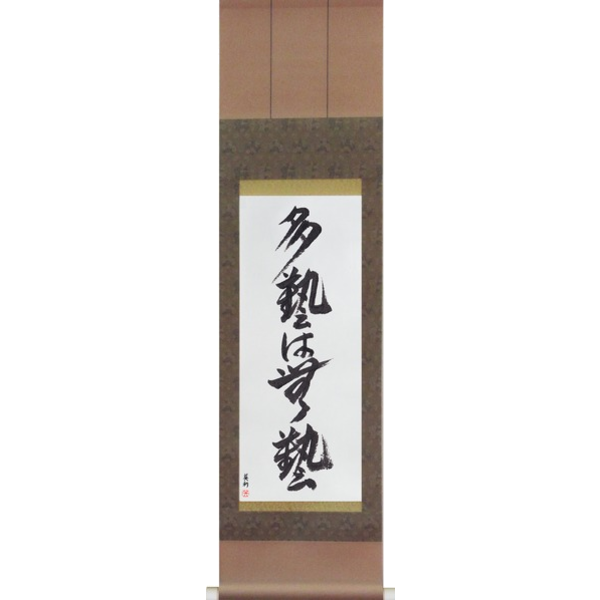
Sold as Too Many Accomplishments Make No Accomplishments · Read tagei wa mugei · Oldest witness 1906, in a Kyoto scholar's essay on how proverbs are built; nothing older has been found, and the dictionary that dates every proverb it can gives this one no date · Sense the person of many accomplishments masters none of them; the Japanese counterpart of Jack of all trades and master of none, with older Japanese sayings of the same thought behind it.
The words
Four characters and a particle. 多芸, tagei, is 多 many and 芸 gei, and 芸 is the word for an accomplishment, an art, a skill, a trick: the 芸 of 芸事, the polite accomplishments, and of 芸者, the woman who has them. 無芸, mugei, is its negative, without accomplishment, the word of the mocking compound 無芸大食, no art but a large appetite. は, wa, marks the topic. The page's gloss of 多芸 as versatility is fair, and its literal many techniques, many arts, many skills is the word laid out.
The line is built as a contradiction: 多芸 is 無芸, many accomplishments are no accomplishment. 藤井乙男, the Kyoto scholar who compiled the first great Japanese proverb dictionary, filed it in 1906 and again in 1929 among the proverbs made by antithesis, with 逢うは別れの始め, to meet is the beginning of parting, 論語読みの論語知らず, the reader of the Analects who knows no Analects, and 負けるが勝ち, losing is winning. The form is the point: the proverb does not say that many skills are a disadvantage, it says they add up to nothing.
The modern dictionaries agree on the sense and do not date it. 精選版日本国語大辞典: 多芸であることは、ひとつの芸に深く通じることができにくく、結局無芸に等しいということ, to be many-skilled is to find it hard to go deep in any one, and so to be, in the end, the same as unskilled; this dictionary gives a first attestation wherever it has one, and gives none here. デジタル大辞泉: 多芸の者は、かえって一つの芸に精通しにくく、すぐれた芸をもっていないということ. ことわざを知る辞典: 多くのことに手を付けては、一つのことに精通することはできない, a hand in many things, mastery of none, with the English A Jack of all trades is a master of none printed beside it. [kotobank.jp/word/多芸は無芸-559989; text]
The reading is tagei wa mugei. The old form 多藝 and the modern 多芸 are one word, and the wording has never varied in any witness, which is what a proverb born in print looks like.
A history, from the earliest witness
1876. 漢譯伊蘇普譚, the Chinese Aesop, re-cut in Tokyo. The title page names a Hong Kong original (香港英華書院原本), the Tokyo scholar 阿部弘国 who added reading marks, and the date, the ninth month of Meiji 9; a 1911 study counts seventy-three fables and names 大槻磐渓's preface. Its fable 裁縫戲法, The Tailor and the Conjurer, is the story behind everything that follows. 裁縫匠與變戲法者評論世事。匠曰、我只會裁縫、別無所長、難以自護、何如足下多才多藝、定自不妨。戲法者曰、汝勿憂、吾當授汝方法、遂將一二易學者教之。忽遇年歲饑荒、人民困苦、其戲法者經旬不發市。而裁縫匠究係世所必需、尚能糊口。於是戲法者反求於匠人。俗云、百藝無如一藝精是也. A tailor and a conjurer were discussing the world. The tailor said: I can only sew, I have nothing else, I could hardly protect myself; how unlike you, with your many talents and many arts, who will surely never be in want. The conjurer said: do not worry, I will teach you my methods, and taught him one or two easy tricks. A famine came, the people suffered, and for ten days the conjurer had no market; but tailoring is what the world needs, and it kept the tailor fed, and so the conjurer came begging to the tailor. As the common saying goes: a hundred arts are not as good as one art perfected. This is a Chinese proverb in a Chinese book, printed for Japanese readers of classical Chinese. It is not the Japanese proverb, and no Japanese source says the Japanese proverb was made from it; but every Japanese dictionary that names a source for 多芸は無芸 names this line, and this book. [dl.ndl.go.jp/pid/896789 koma 19, by eye; lab.ndl.go.jp/dl/api/page/896789_19, text]
1887. 安藤次郎, 通俗一語千金集 英文插訳, a reader of Chinese sayings with English beside them. Item 9: 百藝無如一藝精 = Better be master of one than Jack of all trades. The Chinese line and the English proverb are set side by side in a Japanese schoolbook two decades before any Japanese proverb appears between them. [dl.ndl.go.jp/pid/757780 koma 17, by eye; lab.ndl.go.jp/dl/api/page/757780_17, text]
1906. 藤井乙男, 俗諺論, an essay on the proverb as a form. 多藝は無藝 closes a list of proverbs built on antithesis: 逢ふは別れの始、合せものは離れもの、譽むるは毀るの基、兄弟は他人の始、淺い川も深く渡れ、論語よみの論語知らず、遠くて近きは男女の中、人を使ふは使はるゝ、負けるが勝、損して得とれ、知つて知らざれ、多藝は無藝、の類これなり (the OCR run garbles 逢ふは, 淺い川も深く and 論語よみ, and writes 使はるる). This is the earliest print of the Japanese proverb found anywhere: the National Diet Library's full-text search over its public-domain books returns nothing earlier under nine spellings, and nothing at all in the classical facet. [dl.ndl.go.jp/pid/902816 scan 22, OCR]
1906. 俚諺辞典, a proverb dictionary of the same year. 多藝は無藝 多藝の者は、一藝も秀でたるものなしとの意, the many-skilled has not one skill in which he excels. The plainest gloss, and the one every later dictionary repeats. [dl.ndl.go.jp/pid/900343 scan 323, OCR; the OCR layer reads もいなし for ものなし]
1910. 藤井乙男, 諺語大辞典, the first great dictionary of Japanese proverbs. 【多藝ハ無藝】〔漢譯伊蘇普譚〕百藝無如一藝精。Jack of all trades, and master of none. He that sips many arts drinks none. Who does all he may never does well.—Ital. Where 藤井 has a Japanese source, an Edo comedy or a Noh play, he names it; here he names only the Chinese Aesop and three European proverbs, the English Jack, an English line about sipping, and an Italian one. Under a second headword he records the Chinese line as a Japanese saying in its own right: 【百藝ハ一藝ノ精シキニ如カズ】多藝ハ無藝ともいふ, also said as 多芸は無芸. And under two older Japanese sayings he points back to it: 【何デモ來イニ名人ナシ】多藝ハ無藝の意, no master among the anything-goes: the sense of 多芸は無芸, and 【八細工七貧乏】多藝の人にして貧乏するをいふ, eight crafts, seven poverties: said of the many-skilled who stays poor. [dl.ndl.go.jp/pid/862766 scan 316 and scan 455, by eye; scans 386 and 418, OCR; lab.ndl.go.jp/dl/api/page/862766_316, text, where the source note is legible and the headword is not]
1916. 神田雄次郎, 万国共通ことわざ集, a dictionary of proverbs common to many nations. 多藝は無藝 heads an entry that gives its kin by country: from England 萬藝足つて一能なし, all the arts and not one ability, 多藝を誇るものは能く其一藝をだに飮むことなし, he who boasts many arts cannot drink even one of them, and 萬能は事缺く, the all-capable is short of something; from China 百藝無如一藝精, with the Aesop named as its source; and an Italian line. The Japanese proverb is filed as one member of an international set, ten years after it first appears. [dl.ndl.go.jp/pid/980943 koma 27, OCR; the OCR layer reads 際る for 誇る]
1926. 修養亀鑑, a manual of self-cultivation. 多藝は無藝 所謂多業に涉るものは一業を爲す得ず, the so-called: he who spreads himself over many trades cannot carry out one, printed between 藝は身の仇, accomplishment is the body's enemy, and 藝は身を助く, accomplishment saves the body, the two older proverbs that argue with each other about whether a skill is worth having. [dl.ndl.go.jp/pid/913432 koma 229, OCR; the OCR layer reads 多業ヒ涉るものは一業を爲す得す]
1931. 金融研究会, a research report on banking. 大都會に於ける集成的大銀行は…『多藝は無藝』と云ふ非難は當らぬ, the criticism that the great combined banks of the big cities are "many arts, no art" does not hold. The proverb as a live figure in economic prose, quoted in order to be refuted: by 1931 it was the standing objection to doing everything at once. [dl.ndl.go.jp/pid/1271755, OCR from the library's search return]
1933. 俚諺大辞典. 【多藝は無藝】多藝の者は、一藝も卓越したるものなしとの意。〔漢譯伊蘇普譚〕「百藝無如一藝精」. The 1906 gloss, with 藤井's Chinese source note attached; the dictionaries have converged. [dl.ndl.go.jp/pid/1766149 scan 282, OCR; the OCR run carries three characters bled from the column head]
Today. The three dictionaries quoted under The words, none with a date. The National Diet Library's full-text search over its public-domain books returns thirty-three books carrying the proverb, all from 1906 onward, and none before. [lab.ndl.go.jp/dl/api/book/search, contentonly, 多芸は無芸 and 多藝は無藝: modern 33, classical 0; derived 2026-09-03]
The sense across time
One sense, from 1906 to today: the person of many accomplishments has mastered none. What changes is the frame around it. 藤井 hears a figure of speech first, a proverb that works by saying a thing is its opposite. The 1916 comparative dictionary hears a proverb every nation has. The 1926 manual hears a maxim about trades and livelihood, and prints it between the two older proverbs that argue whether skill helps or harms. The 1931 bankers hear an accusation. The modern dictionaries gloss it flat and hand the reader the English. No source reads it as a compliment, and none reads it as old.
What is not a source
The Chinese line 百藝無如一藝精, a hundred arts are not as good as one art perfected, is what the dictionaries set beside the proverb, not what they derive it from; 藤井 names it as he names the English and Italian proverbs, as kin. The English Jack of all trades and master of none is likewise a pairing, first made in a Japanese book in 1887 for the Chinese line and in 1918 for the Japanese one. Neither is the proverb's origin, and the honest thing to say is that the four characters 多芸無芸 look like a Japanese compression made in the decades when both the Chinese Aesop and the English Jack were in print in Japan, by someone nobody has named.
Japanese did not lack the thought before 1906. 八細工七貧乏, eight crafts, seven poverties; 何でも来いに名人なし, no master among the anything-goes; 器用貧乏, the deft man's poverty, the word the example dictionaries still put beside it; and the Chinese line itself read as Japanese, 百芸は一芸の精しきに如かず. These are older sayings of the same thought, and a reader who wants a proverb with Edo roots for this idea has them. Japanese also holds the opposite: 諸芸二百石、無芸高なし, arts earn two hundred koku; no art, no stipend, from 平賀源内's satire 放屁論, and 芸者百石無芸高なし from the Edo lexicon 俚言集覧, both recorded by 藤井. The proverb sold here is one side of an old argument. [dl.ndl.go.jp/pid/862766 scans 200, 280, 386, 418, OCR]
The text in English
The English came first, and the Japanese proverb was made to meet it. Hepburn's Japanese-English dictionary of 1872 has nothing under either word. The English-Japanese dictionaries of 1904 and 1911 explain Jack of all trades in prose, 諸藝に通ずる人, a man versed in every art, 萬能にして一能も有せざる人, all-capable and without one capability, and offer no Japanese proverb for it. The Meiji bilingual dictionaries that carry every other proverb in this family, ロイド 1907, 和田垣 1908, 井上 1909 and 1911, 渡部 1910, do not carry this one. [dl.ndl.go.jp/pid/993689, 870143, 902975, OCR]
1918. 武信由太郎, 武信和英大辞典, Sanseidō, page 2038, under tagei. 多藝は無藝. Jack of all trades and master of none. The first equation on the shelf, and the dictionary makes it three times, under 藝, under 無藝 and under 多藝. [dl.ndl.go.jp/pid/925665 koma 1022, by eye; komas 184 and 700, text at lab.ndl.go.jp/dl/api/page/925665_1022]
1918. 斎藤秀三郎, 熟語本位英和中辞典, under Jack. To be Jack of all trades and master of none. 多藝は無藝(八細工七貧乏). Saitō hears the older Japanese proverb under the new one and prints both. [dl.ndl.go.jp/pid/1681530 scan 720, OCR]
1923. 鈴木芳松, 英文和訳の急所, a translation textbook. 私は彼に注意してやつたが所謂「多藝は無藝」である, I warned him, but he is what they call "many arts, no art". The equation taught as the so-called, a phrase students were expected to recognize. [dl.ndl.go.jp/pid/943238, OCR from the library's search return]
1946. スタンダード和英大辞典. 百藝ニ通ジテ一藝ニ秀デズ (the OCR reads 百日ニ通ジテー藝ニ秀ナズ) (He is a) Jack of all trades and master of none. The Chinese line, back-translated into a Japanese sentence, offered as the Japanese for the English. [dl.ndl.go.jp/pid/1126792 scan 145, OCR]
1965. Daniel Crump Buchanan, Japanese Proverbs and Sayings, University of Oklahoma Press, pages 180–181, chapter PRACTICALITY. Taigei wa mugei: "Many accomplishments are no accomplishments." If you have too many hobbies you will be master of none. English parallel: Jack of all trades and master of none. The page quotes him correctly and at the right page; the sentence turns the page. Two things the page does not carry. Buchanan romanizes the proverb Taigei, a misreading (多 is ta), so a customer who searches his romaji finds nothing. And his hobbies is a shade the Japanese does not have: 芸 is an accomplishment or an art, something one is trained in, not a pastime. His literal, many accomplishments are no accomplishments, is one word from the house title, and twenty-two years older than Galef's. He cites no source, as nowhere in the book. [Library of Congress Catalog Card Number 65-24192; the page links amazon.com/dp/0806110821; by image at the page and in the text layer; a printed book, checkable by a reader who holds it]
1987. David Galef, Even Monkeys Fall from Trees: The Wit and Wisdom of Japanese Proverbs, Tuttle, number 18, page 50. Tagei wa mugei. / Too many accomplishments make no accomplishment. / [Jack of all trades, master of none.] The house title is Galef's literal, one plural apart. The page says Galef repeats Buchanan's hobbies sentence; he does not. He gives his own literal and the English equation, and no source. [the page links amazon.com/dp/0804832269; text layer of the 2015 ebook; a printed book, checkable by a reader who holds it]
2004. Edward Trimnell, Tigers, Devils, and Fools: A Guide to Japanese Proverbs, Beechmont Crest, page 138. Jack of all trades, master of none, then: Dabblers can sometimes impress people with their superficial knowledge of many subjects. However, a person who knows a little bit about everything probably doesn't have a deep understanding of any one area. This proverb encourages people to focus on one thing, and avoid the temptation to "major in minors." A reading, not a source; the page quotes its last sentence correctly. [the page links amazon.com/dp/0974833029; text layer; a printed book, checkable by a reader who holds it]
2012. David Galef, Japanese Proverbs: Wit and Wisdom, Tuttle, number 18, page 36. The 1987 and 2000 books reissued in one volume. The entry as in 1987, with a commentary the 1987 entry did not carry: Versatility is not a virtue prized much in Japanese society, nor in trade and the arts, where people make a reputation based on one specific skill or technique. This proverb is an indirect argument for specialization. See 27, Mochi wa mochiya: "For rice cakes, go to the rice-cake maker." The cross-reference is apt; the claim about Japanese society is Galef's own, cites nothing, and sits badly on a proverb with an English twin and a Chinese cousin, both older than it. [ISBN 978-1-4629-1020-5, the ebook on the shelf; text layer]
Today. JMdict: a jack of all trades is a master of none. The house title, Too Many Accomplishments Make No Accomplishments, is Galef's literal and very nearly Buchanan's, and it is the better of the page's two renderings because it keeps the contradiction the proverb is built on; Jack of all trades explains it away. What a rendering must keep: the paradox, many are none; the word accomplishment or art for 芸, not hobby or skill; and no suggestion that the line is old.
A reading
The design is sound and so is the romaji. What the page gets wrong is the frame. It presents the Japanese proverb as if this were 猿も木から落ちる, an old saying with Edo witnesses; the sources show a saying first printed in 1906, equated with the English in 1918, and standing beside a Chinese fable's moral that Japanese readers had known since 1876. The honest page says that, briefly and without apology: a modern Japanese proverb, the Japanese counterpart of Jack of all trades, with older Japanese sayings of the same thought behind it and the Chinese Aesop's line beside it. That is a better story than antiquity, and it is true. The three paperbacks stacked in the page's explanation add nothing a reader can check and belong to housekeeping, not to the text.
My own reading is that the proverb is a warning to the versatile, and that Japanese has always held both sides of the argument: 芸は身を助く, an accomplishment saves you, sits one line from it in the 1926 manual, and 源内's arts earn a stipend; no art, no ceiling is its exact counter. A scroll sold as a reminder to stay focused might spare a clause for the other side, since the buyer who needs the reminder is usually someone with more than one art worth keeping. Signed, 典, 2026-09-05.
How this was read
By eye: 藤井's 1910 dictionary at both entries, the 1876 Aesop at the fable, the 1887 reader at item 9, and 武信's 1918 dictionary at the tagei entry, each at the National Diet Library's page image at width 3600 on the day of writing; Buchanan 1965 at the page, by image. By text at the address: the kotobank entries; the library's page API for the Aesop, the reader, and the 1910 dictionary; the OCR layer of the archive for 俗諺論, 俚諺辞典, the 1916 and 1933 dictionaries, the 1926 manual, 藤井's 1929 essay, Saitō, the 1923 textbook, the 1931 report and the 1946 dictionary; the text layers of Buchanan, Galef 1987 and 2012, Trimnell, and of Galef 2000 and Zona 1996, which do not carry the proverb. Every archive address was re-opened by a reader before writing and the OCR quoted raw; where this history's Japanese differs from the OCR, the OCR reading is given in the bracket. Not opened: any Japanese text before 1906 carrying the proverb, because none surfaced under nine spellings; the Canton Aesop of 1840 that the Hong Kong original descends from; the 1875 通俗伊蘇普物語 at the same fable; the 1902 亜細亜言語集 beyond the library's snippet; the Italian and Spanish proverbs at a source; the two modern Japanese dictionaries that date proverbs, 故事俗信ことわざ大辞典 and 岩波ことわざ辞典, which are not on the desk. The printed books check only for a reader who holds them. The account beneath this history carries every address, the raw OCR beside each reading, and the page-image addresses for the leaves read by eye.
References
- 意拾喩言 → 漢譯伊蘇普譚 (Chinese Aesop; Hong Kong printing re-cut in Tokyo with 阿部弘国's reading marks) (Canton 1840 (recall); Tokyo 1876) — pid 896789 koma 19, by eye
- 通俗一語千金集 (安藤次郎) (1887) — pid 757780 koma 17, by eye
- 俗諺論 (藤井乙男) (1906) — pid 902816 scan 22, by OCR; the earliest print found
- 俚諺辞典 (1906) — pid 900343 scan 323, by OCR
- 諺語大辞典 (藤井) (1910) — pid 862766 scan 316, by eye
- 万国共通ことわざ集 (1916) — pid 980943 koma 27, by OCR
- 武信和英大辞典 · Saito (1918) — 武信 pid 925665 koma 1022, printed p. 2038, by eye; also komas 184, 700 by OCR · Saito pid 1681530 scan 720, by OCR
- 鈴木芳松's translation textbooks (1923, 1926) — by OCR
- 俚諺大辞典 (1933) — by OCR
- The catalogue and both live pages (2026) — cultural_works.csv:362