

住めば都 · sumeba miyako · Live there, and it is the capital
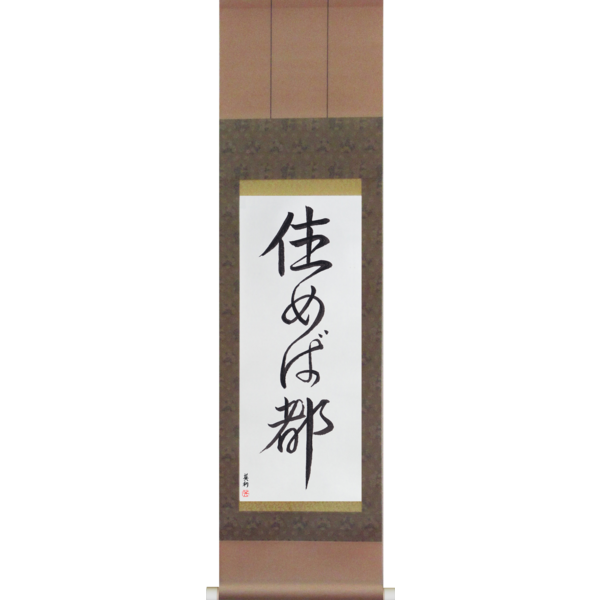
Sold as Home Is Where You Live · Read sumeba miyako · Oldest witness a courtier's poem of 1183, written at sea in exile, where the sentence is literally true because the emperor is aboard; a proverb by 1614, in the first proverb book by 1656 · Sense any place, however remote or poor, becomes home once you have lived in it.
The words
Two words. 住めば, sumeba, is the verb 住む, to dwell, in its conditional form: if one lives there, once one lives there. 都, miyako, is the capital, and in 1872 Hepburn still defined it as the place in which the Mikado resides, the Imperial city. That is the word's old sense, and it is the reason this proverb could begin as a sentence about the emperor. The page parses both words correctly; its last clause wants world for word. [dl.ndl.go.jp/pid/993689 koma 180, OCR]
藤井乙男's 1910 dictionary glosses the whole: おのが住所となればいかなる邊鄙も都のやうに思はる, once it is one's own dwelling, however remote a place comes to seem like the capital. The modern dictionaries add the turn the proverb took: 精選版日本国語大辞典, どんなさびしい田舎や不便な所でも、住み慣れれば住みよくなって、離れにくいものだ … 転じて、物質的わびしさも慣れれば、精神的楽しさになる, however lonely or inconvenient the place, once you are used to it it is good to live in and hard to leave; by extension, material poverty, once you are used to it, becomes a pleasure of the mind; ことわざを知る辞典 extends it to any hard circumstance, 厳しく辛い境遇も、慣れてしまえば苦にならず. The proverb is about habituation, not about choice. [dl.ndl.go.jp/pid/862766 koma 290, by eye; kotobank.jp/word/住ば都-2053961 and /住めば都, text]
It has a twin one vowel away that means the opposite. 住まば都, sumaba miyako, is if you are to live anywhere, let it be the capital, and it is older in print: a small song of the 1590s, 住まば都よ、捨てば都、あぢきなの身や, if I am to live, the capital; if I am to throw myself away, the capital; what a wretched body. The 精選版日本国語大辞典 gives it its own headword and gloss, 住むなら都がよい, and the デジタル大辞泉 warns under the main entry: 住むのなら都会が良いの意で使うのは誤り, to use this to mean "the city is the place to live" is an error. The design says sumeba, and the buyer should know that sumaba exists. [kotobank.jp/word/住ば都-2053961 and /住めば都, text]
The reading is sumeba miyako. The archive writes it 住めば都, すめば都, 住ば都 and すめばみやこ, one proverb in four spellings.
A history, from the earliest witness
1183. A Taira courtier, a poem in the 源平盛衰記, book 33. The Taira have fled the capital with the child emperor and are at sea off Kyushu on the harvest moon; the courtiers are given the topic love, on the moon, and one of them writes 君すめばこゝも雲居の月なれどなほ戀しきは都なりけり, since you, my lord, dwell here, this too is the moon above the cloud-palace; and yet what I long for is the capital. The chronicle says they looked at one another and wrung out their sleeves. Who wrote it depends on the chronicle. In the 源平盛衰記, read by eye in its 1926 typeset, the poem stands under 平大納言時忠, and 左馬頭行盛's poem is the next one, 名にしおふ秋のなかばも過ぎぬべしいつより露の霜に替らむ; 藤井 in 1910 and the 俚言集覧 of 1900 cite the poem from the 平家物語 under 行盛, and the dictionaries follow them. The proverb's sentence is here in its first form, 君住めば, since the sovereign dwells here, and it is literally true: the capital is where the emperor is. It is also a consolation that fails. [dl.ndl.go.jp/pid/1018065 koma 160, pages 300–301, by eye; lab.ndl.go.jp/dl/api/page/1018065_160, text; the 平家物語 attribution as quoted at dl.ndl.go.jp/pid/862766 koma 290 and pid 991570 koma 221, OCR]
1381. 藤原為忠, in the 新葉集, the Southern Court's anthology. At the mountain temple that served the exiled court as a palace: 君すめば峯にも尾にも宮居して深山ながらの都なりけり, since my lord dwells here there are palaces on every ridge and spur, and deep in the mountains it is a capital. The OCR layer reads 源山なからの; read as 深山ながらの. The same sentence, two centuries on, from the other side of a civil war, and still about the emperor. [dl.ndl.go.jp/pid/991570 koma 221, in the 1900 增補俚言集覧, OCR; not opened in the anthology]
Muromachi period. 御曹子島わたり, a tale of the young 義経's voyage to the islands. The islanders of Ezo urge him to stay: これより都へは、順風よくして七十餘日、只よの常の船路ならず、同じくは是にとゞまり給ふべし、住めばいづくも都なり, from here to the capital is seventy days with a fair wind and no ordinary voyage; you had better stay here; live anywhere, and it is a capital. The emperor has dropped out of the sentence. It is now about anyone, and it is an invitation. 義経 refuses. [dl.ndl.go.jp/pid/977912 koma 54, the 1922 annotated edition, pages 78–79, by eye; lab.ndl.go.jp/dl/api/page/977912_54, text]
1614. 慶長見聞集, a book of things seen and heard in the new capital of Edo. 野の末山のおくにも住ば都、すまされば都も旅なり, at the end of the moor or the back of the mountains, live there and it is a capital; where you do not live, even the capital is a journey. The first attestation the dictionaries give for the proverb as a proverb, and the one that states its logic whole: the second half is the proof of the first. [kotobank.jp/word/住ば都-2053961, text; not opened at the leaf]
1638. 毛吹草, the first collection of Japanese proverbs. みやこもたびはうし ぢごくもすみか, even the capital is hard when you are a traveler; even hell is home. The proverb's sibling, in the first book to gather proverbs, eighteen years before the proverb itself is written down in one. [kotobank.jp/word/地獄も住家-2045593, text]
1656. 世話尽, the second proverb collection, book two, leaf 33. In the list of sayings beginning with す, between すいよりぎやう and すねものゝにがわらひ: すめばみやこ. The proverb in a proverb book, in the hand of its first printing. [dl.ndl.go.jp/pid/2554768 koma 35, by eye at width 3600; lab.ndl.go.jp/dl/api/page/2554768_35, text]
1703. 松の葉, a songbook. 鳥も通はぬ山なれど住めば都よ我が里よ, a mountain no bird visits, but live there and it is a capital, my own village. A song line in the 七五七五 measure, and still sung in the provinces two centuries later: a Shimane boat-launching song collected in 1914 has 住めば都に尙まさる, and a Gunma folk song of 1925 has the 1703 line word for word. [dl.ndl.go.jp/pid/1874605 koma 140, pid 1879145 koma 222, pid 1020918 koma 855, OCR]
1832. 為永春水, 春色梅児誉美, the first of the sentimental novels. 外は田畑の薄冰、心解けあふ裏借家も、住めば都にまさるらん, thin ice on the fields outside, but a back-alley rented room where two hearts thaw is better than the capital, once you live in it. Love makes the tenement a capital; the dictionary still quotes the line under 裏借屋. [dl.ndl.go.jp/pid/1187751 koma 60, the 1928 typeset, OCR; kotobank.jp/search?q=住めば都, text]
1888 to 1896. Meiji prose. 宇田川文海 in 1888, 住めば都とか云ふ譬喩もあれば、山家の住居を面白いものと思へは (the OCR's は, read as ば); a tract of 1891, 地獄も住み家深山の奧荒磯の浦も所謂住めば都なり, pairing the proverb with its sibling; and 徳富蘇峰 in 1896 making a maxim of the mind of it: 熱も冷も … 心より生ずる … 住めば都とは、則ち此の意味なり, heat and cold are born in the mind; this is what "live there and it is the capital" means. [dl.ndl.go.jp pids 886950 koma 51, 755479 koma 26, 755005 koma 61, OCR]
1910. 藤井乙男, 諺語大辞典. 【住メバ都】, with the gloss quoted above and four sources in order: the 平家物語 poem, the 御伽草子 islanders, the 松の葉 song, and the Chinese cousin from 荀子; then two English and Italian parallels, There is no place like home and To every bird its own nest is charming. Beside it, 【住メバ田舍モ名所】, live there and even the country has its famous sights, and elsewhere 【地獄モ住所】住メバ都と同意. [dl.ndl.go.jp/pid/862766 koma 290, pages 546–547, by eye at width 3600; komas 329 and 569, OCR]
1929 and 1933. 藤井 lists it among the two- and three-word proverbs, 「善は急げ」「十人十色」「住めば都」「氣は心」 (the OCR layer reads 善は念げ), and reproduces a comic song that strings proverbs together, 我いまだ住めば都を見ず候程に. 中野's 俚諺大辞典 of 1933 repeats 藤井's gloss and sources and, under the sibling 地獄も棲所, names the 1699 諺草 as the book that first set 荀子 beside it. [dl.ndl.go.jp/pid/1452761 komas 14 and 205; pid 1453041 komas 248 and 291, OCR]
Today. The dictionary glosses quoted under The words; ことわざを知る辞典's example is a 1952 story set in a Hokkaidō coal town, いまは、住めば都だと思っている, now I think of it as home. The National Diet Library's public-domain books carry the proverb in its main spelling in four hundred and six books, from 1888 onward in typeset, and in the 1656 leaf in kana. [kotobank.jp/word/住めば都, text; lab.ndl.go.jp full-text search, 住めば都 406 books, すめば都 34, 住ば都 18, すめばみやこ 7, derived 2026-09-03]
The sense across time
The sentence was true before it was wise. For two courtiers in exile, in 1183 and in the 1350s, where the sovereign dwells is the capital was a fact of Japanese political grammar and a consolation that did not console; both poems say and yet. The tale of 義経 takes the emperor out and makes it an offer: stay, anywhere is a capital. The 1614 witness makes it a rule with its own proof, and where you do not live, even the capital is a journey. The proverb books of 1638 and 1656 file it beside even hell is home. The songs make it a village's pride; 春水 makes it love's; 蘇峰 in 1896 makes it Stoicism, heat and cold are in the mind. The modern dictionaries flatten it to habituation and add the warning about its twin. In none of these is the place chosen. That is the one thing every sense keeps: the capital is wherever you already are.
What is not a source
Two foreign cousins are set beside the proverb and neither is its parent. The Chinese is 荀子's 榮辱篇: 越人安越,楚人安楚,君子安雅, the man of Yue is at ease in Yue, the man of Chu in Chu, the gentleman in what is correct, and the passage says why, 是注錯習俗之節異也, it is a matter of habit and custom, not of nature; 藤井 and 中野 cite it, and 中野 says the pairing goes back to the 1699 諺草. The Latin is Pacuvius through Cicero's Tusculans, patria est, ubicumque est bene, one's country is wherever one is well, with Socrates calling himself a citizen of the world, and the Proverbia Senecae's non in loco, sed in homine est, it is not in the place but in the man; the Italian dictionary's tag ubi bene ibi patria is the late form. Both cousins are about the man who is at ease anywhere; the Japanese proverb is about the place that becomes home. And the twin 住まば都, one vowel away, is not a variant but a contrary, older in print, and to be kept apart. [zh.wikisource.org/wiki/荀子/榮辱篇, text; la.wikisource.org, Tusculanae Disputationes V 108, text]
The text in English
Hepburn's dictionary of 1872 has 都 as the Mikado's city and 住む as to dwell and no proverb between them. [dl.ndl.go.jp/pid/993689 komas 180 and 271, OCR]
1898. 井上十吉, 英語学講義録, lessons in translating Japanese into English. 住めば都, Where we live, there is the capital. The first English found, and the best: literal, with the capital kept, so that the sentence can still be true of an emperor. [dl.ndl.go.jp/pid/869647 koma 33, page 61, by eye]
1910. 藤井. There is no place like home, and the Italian To every bird its own nest is charming. Both are proverbs of the home one already has and loves, which is the opposite direction from a proverb about the home one grows into. [dl.ndl.go.jp/pid/862766 koma 290, by eye]
1946. 竹原常太, スタンダード和英大辞典. 住メバ都, There is no place like home: 藤井's equation, thirty-six years on. [dl.ndl.go.jp/pid/1126792 koma 502, OCR]
1965. Daniel Crump Buchanan, Japanese Proverbs and Sayings, University of Oklahoma Press, page 180, chapter PRACTICALITY. Sumeba miyako: "If you live there, it is the capital." Where you live will become the capital in your eyes and the best of all possible places. English parallel: An Englishman's home is his castle. His literal is right and his gloss is right; his parallel points the wrong way, since the English proverb is about a man's right to his own house and not about growing used to a place. He cites no source. [Library of Congress Catalog Card Number 65-24192; text layer and PDF page; a printed book, checkable by a reader who holds it]
2004. Edward Trimnell, Tigers, Devils, and Fools, Beechmont Crest, page 134. Wherever one lives is the capitol (his spelling), A person grows fond of the place in which he is living. Even if he didn't want to live in a particular town or region at first, over time he will come to think of it as the best place on earth. 井上's direction, the capital kept, and the right sense. [text layer; a printed book, checkable by a reader who holds it]
The Galef collections of 1987, 2000 and 2012 and Zona's of 1996 do not carry the proverb; the 2012 Galef attaches There's no place like home to a different Japanese proverb, birds return to their old nests.
Today. JMdict: you can get used to living anywhere; home is where you make it; wherever I lay my hat is home. The house title, Home Is Where You Live, is the nearest of the shelf's, and 井上's 1898 line is its ancestor. What a rendering must keep: the direction, from living to home and not from home to loving; the capital, which is what makes the sentence about an emperor possible; and the warning that sumaba is a different proverb.
A reading
The page is right and thin, and it has a typo. What the sources add is a history worth one clause each: the proverb began as a courtier's sentence about the emperor, where you dwell, my lord, is the capital, said twice in exile by men who did not believe it, and the people made it true of themselves by the Muromachi period; the 1614 witness gives its logic entire, live there and it is the capital; do not, and even the capital is a journey; and there is a twin one vowel away that means the reverse and is older in print. I would fix word, keep the parse, and add the emperor and the twin. The English equations on the shelf, no place like home, a man's castle, point the wrong way; the page's own title points the right way, and so did a Japanese schoolmaster in 1898.
My own reading is that the proverb's whole force is in the failed consolation it began as. The courtier wrote that the moon over the sea was the palace moon because the emperor was there, and then wrote that he still longed for the capital; the proverb is what happened when ordinary people took the first half and lived long enough somewhere for the second half to stop being true. A scroll sold for a housewarming carries that history whether or not the page says so; it might as well say so. Signed, 典, 2026-09-05.
How this was read
By eye: 藤井's 1910 dictionary at the 住メバ都 leaf and the 1656 世話尽 at leaf 33, both re-read at width 3600 on the day of writing; the 源平盛衰記 and the 御伽草子 in their 1920s typesets; 井上's 1898 lessons at the page. By text at the address: the kotobank entries for the proverb, its twin and its sibling, and the search page; 荀子 and Cicero at Wikisource; the National Diet Library's page API for the five leaves; the OCR layer of the archive for the 1900 俚言集覧 with its two poems, the 1703 song in three typesets and its two folk descendants, 春水, the Meiji prose, 藤井's 1929 essay, 中野, 竹原, Hepburn, and the counts; the text layer and PDF of Buchanan at the page; the text layers of Trimnell, of Galef 1987, 2000 and 2012 and of Zona, the last four not carrying the proverb. Every archive address was re-opened by a reader before writing and the OCR quoted raw, and every one agreed with the account. Not opened: the 1614 慶長見聞集 and the 1590s song at their leaves, both cited from the dictionary; the 新葉集 of 1381 in the anthology, read in the 1900 俚言集覧; the 平家物語 in a typeset of its own, the poem being opened in the 源平盛衰記; the 松の葉 in its own edition; the 1699 諺草 for the 荀子 pairing; the 撰集抄 for the sibling. The printed books check only for a reader who holds them. The account beneath this history carries every address, the raw OCR beside each reading, and the page-image addresses for the leaves read by eye.
References
Each witness is cited in the account above, at the frame or entry where it was read. A linked list follows when the record for this text is completed.