

仕方が無い · 仕様が無い · 仕方無い · shikata ga nai · shiyō ga nai · shikatanai · It cannot be helped
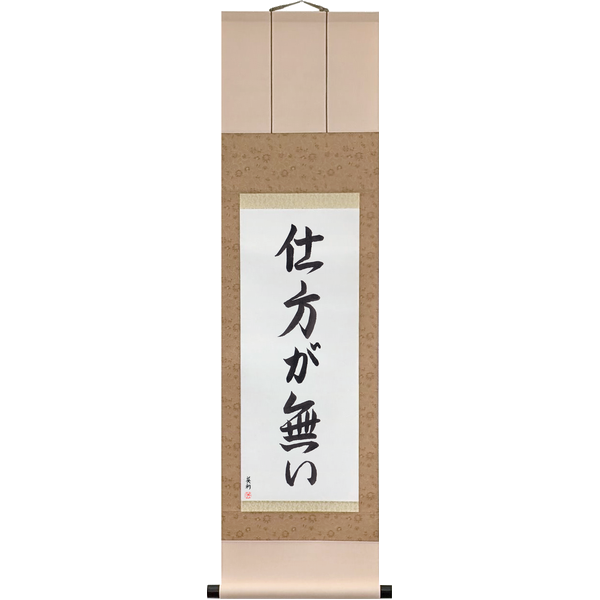
Sold as It Cannot Be Helped · It Can't Be Helped · It Can't Be Helped · Read shikata ga nai · shiyō ga nai, spoken shō ga nai · shikatanai · Oldest witness a Kyoto commentary on the Book of Odes of about 1535, as the great dictionary cites it; in English, Hepburn's dictionary of 1872, no resource · Sense there is no way; what is said when nothing can be done, and, in the dictionary's own words, unsatisfying, but nothing to do but accept it.
The words
One idiom, three shapes. 仕方 and 仕様 are two nouns for a way of doing: 仕 is do, and 方 and 様 are manner. が無い is there is none. The scrolls write 無い in kanji where the dictionaries write ない in kana, the same word; the third scroll clips the particle, 仕方無い, which is how the phrase is often said. The second form's reading is the thing to know: 大辞泉 says 現在では多く「しょうがない」と発音される, it is now mostly pronounced shō ga nai, so the scroll's shiyō ga nai is the spelling and shō ga nai is the speech, and a 1903 novel spells the same syllables a third way, 詮様. The dictionaries give the phrase three senses and the scrolls sell the first: 1 どうすることもできない。ほかによい方法がない。やむを得ない, nothing can be done; there is no better way; it is unavoidable; 2 よくない。困る, no good, a nuisance, of a person (彼は怠け者で仕方がないやつだ); 3 我慢ができない。たまらない, unbearable, of a feeling (彼女に会いたくて仕方がない, I cannot stand how much I want to see her). A phrase on a wall is read by people who know all three.
A history, from the earliest witness
About 1535. A Kyoto lecture-commentary on the Book of Odes (毛詩抄), as the 精選版日本国語大辞典 cites it. The dictionary's first example of 仕方がない: なごりをしけれどもしかたがない程に郡国族の処へ行ぞ, sorry to part, but there is no way, so off to the provinces. The manuscript was not opened; the dictionary is the witness. [2]
1676. A New Guide to Interpreters (捷解新語), a Japanese textbook for Korean interpreters, as the same dictionary cites it. The first example of 仕様がない: なにともしやうかなさに、たいくゎんとももいろいろにおもゑども, there being no way at all, the officials thought this and that. Not opened. [3]
1813 to 1846. Edo comic fiction. The dictionary's next examples: 浮世床's そんなら仕方がねへ。化物で出て呉べい, then there's no help for it; come out as a ghost, and 松翁道話's どうも仕様のないものぢゃ, a hopeless sort, which is the second sense, of a person. [the same two kotobank pages; text]
1872. J. C. Hepburn, A Japanese-English and English-Japanese Dictionary (和英語林集成), second edition. The first English opened. Under 仕方: Way or method of doing or making; resource … Shikata ga nai, no resource. Under 仕樣: The way or manner of doing or making any thing, how to do; resource, expedient … -ga nai, no resource. Syn. SHI-KATA. And under 諦, akirame, the missionary files the whole sentence: Shikata ga nai to, finding there is no remedy, to be resigned, with the synonyms omoikiru and kwan-nen. The English is no resource, and the place he files it, resignation, is the sense the next century would make a national character of. [7]
1945 and after. The phrase in English as a concept. The English encyclopedia gives the romanized phrase a career in English beginning with a Time magazine piece of 8 October 1945, then Jeanne Wakatsuki Houston's Farewell to Manzanar (1973), which gives the idea a chapter to explain why interned Japanese Americans did not resist more; John Hersey's Hiroshima; James Clavell's Shōgun. A library search for the romanized phrase returns two dozen items, the earliest being editions of Houston's book; none could be opened at the page, so the English career is one encyclopedia's list, confirmed at no text. [en.wikipedia.org/wiki/Shikata_ga_nai; archive.org search; text]
Today. The Japanese encyclopedia defines the idiom as what is said 理不尽な困難や悲劇に見舞われたり、避けられない事態に直面したりしたさいに、粛々とその状況を受け入れながら, when struck by unreasonable hardship or tragedy, or facing what cannot be avoided, while accepting the situation quietly; and 仕様がない redirects to it. [ja.wikipedia.org/wiki/仕方がない; text]
The sense across time
The first sense has not moved in five hundred years: there is no way, so accept it. The dictionary's own gloss, 不満足ではあるが、あきらめるほかない, unsatisfying, but there is nothing to do but give it up, is the whole character of the phrase, and Hepburn heard it in 1872 when he filed the sentence under resignation. What changed is who was listening. In Japanese it stayed a phrase of daily life with two further senses, hopeless of a person and unbearably of a feeling. In English, from the occupation on, it became a word for how the Japanese bear what cannot be helped, which is a reading of a people through a phrase, and the encyclopedia that records it names the books.
What is not a source
The English books that made the phrase a concept are its reception, not its source, and none was opened here. The three scrolls are three spellings of one idiom, not three sayings, and the catalogue files the third as a word.
The text in English
Hepburn's no resource is the first English, and the plainest. The house's It Cannot Be Helped and It Can't Be Helped are the received English of the last eighty years and exact for the first sense; the second scroll's page could give shō ga nai beside its romaji, since that is what is said. What a rendering must keep is the acceptance in the phrase: not there is no solution, which is a report, but nothing to be done, which is a decision to stop looking.
A reading
Three scrolls, one idiom, and the house is right to sell the forms: the first is the fuller one a textbook teaches, the second is what people say, and the third is the first clipped. The page for the second should say shō ga nai, because shiyō is a spelling nobody pronounces. What the histories can carry that a scroll cannot is the other two senses, and Hepburn's filing under resignation, which is where the phrase's whole English career already sits in 1872. Signed, 典, 2026-09-05.
How this was read
By text, at the address: both kotobank pages, two dictionaries each, whole; Hepburn 1872 at three pages of the National Diet Library's page API, each located from the book's OCR zip; the Japanese and English encyclopedia articles; a library search; the three catalogue rows; the live pages. Not opened: the 1535 and 1676 texts at the line; Hepburn's successors between 1886 and 1946; the Time article of 1945 and the books the encyclopedia names; the page images behind the three Hepburn scans. Every address in this history is a text address, and a reader's AI can open all of them. The full apparatus, with every address, is in the account.
References
- The two scrolls (ours) (—) — S0010SSVB4A · S0034SSVB4A
- 京大二十冊本毛詩抄 (1535頃) — 精選版日国, 初出 (kotobank 517291); the text not opened ↩
- 捷解新語 (1676) — 精選版日国, 初出 (kotobank 530458); the text not opened ↩
- 浮世床 (1813–23) — 精選版日国
- 松翁道話 (1814–46) — 精選版日国
- 魔風恋風 (小杉天外) (1903) — 精選版日国 (詮様 for 仕様)
- Hepburn, 和英語林集成 2nd ed. (1872) — NDL pid 993689 komas 249, 257, 22, OCR ↩
- The third scroll (ours) (—) — S0038SSVB3A; cultural_works 992 (a word row)
- デジタル大辞泉 · 精選版日国 (current) — kotobank
- ja.wikipedia (current) — TEXT