

猿も木から落ちる · saru mo ki kara ochiru · Even monkeys fall out of trees
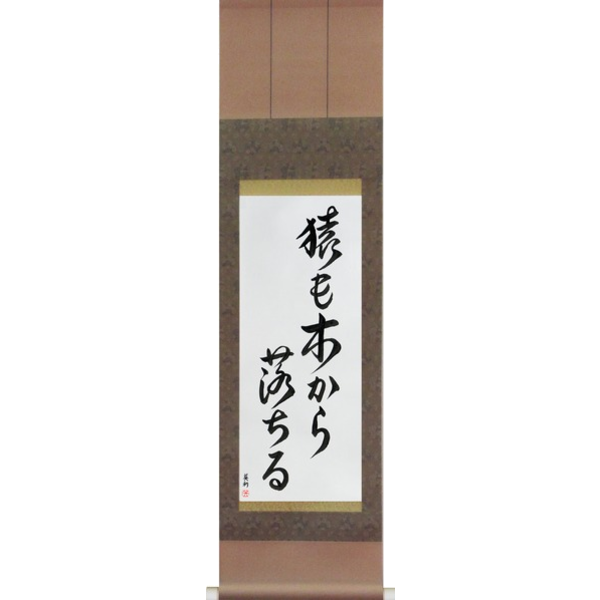
Sold as Even Monkeys Fall Out of Trees · Read saru mo ki kara ochiru, as the catalogue has it · Oldest witness a haikai verse of 1638 that calls it the saying, so it was current before that; in a book of sayings by 1656 · Sense the expert fails at the very thing they are expert in; so be careful at what you do best, and be gentle when someone else slips.
The words
猿, saru, is the monkey, and the tree-climber in question is the Japanese macaque; Hepburn's dictionary of 1872 gives A monkey, ape, and the 1910 proverb dictionary's page around the headword is a whole leaf of monkey sayings, the animal of imitation, cleverness and vanity. も is even: even a monkey. 木から落ちる, ki kara ochiru, falls from a tree, and the verb is where the witnesses vary. The classical form is 落つる, otsuru, in 1638 and in the dictionaries of 1900 and 1906; the same verb with its ending unwritten, 落る, in 1656 and 1718; and the colloquial 落ちる, ochiru, in Hepburn and on every modern surface. The school grammars of the Meiji sometimes write より for から because they are teaching the literary language. The prewar corpus writes the modern verb far more often than the others, and the catalogue's form is the modern standard; nothing needs changing. The English on the page, even monkeys fall out of trees, is Hepburn's rendering of 1872 with out of for from, and the only thing the design's English has that the three American books lack.
A history, from the earliest witness
1638. 鷹筑波集, a haikai anthology of the 貞門 school edited by 西武, the third book, a verse by 定之. 猿も木から落るたとへの木葉かな, so the 日国 prints it, with the reading オツ over 落る; 藤井 prints 落つるたとへの木の葉かな. Even monkeys fall from trees, as the saying goes; and here fall the leaves. The verse names the proverb as a たとへ, a saying, so it was already one; this is the first citation the 精選版日本国語大辞典 gives, and the one 藤井 gives. The book is digitized in four copies at the National Institute of Japanese Literature and the leaf was not opened; the verse stands on the two instruments that quote it, and the poet's name is read from both. [kotobank.jp/word/猿も木から落ちる, the 日国 entry, which prints the verse with 〈定之〉; text; 藤井 1910, below, by eye; the Kagawa copy at kokusho.nijl.ac.jp/biblio/100001832/manifest, image, not opened]
1656. 世話尽, a book of sayings in kana. 猿も木から落る, in a column of monkey sayings: the monkey's rice cakes, the monkey's cleverness, the monkey's Tosa dance, monkey eyes. [2]
1718. やふにまくは, a book of comic tales. 文殊も筆の誤、猿も木から落る事もしれず, even Mañjuśrī's brush slips, and who knows, even a monkey falls from a tree; then a story about a master well-digger who tells his apprentice careful only on the easy last step of the climb out, because that is where the expert relaxes. The proverb already paired with its brush-slip cousin, and already carrying the do not relax reading, three centuries before the page's. [3]
1872. James Curtis Hepburn, 和英語林集成, second edition, page 434. SARU … mo ki kara ochiru (prov.) even a monkey sometimes falls from a tree. The first English, with the modern verb, and sometimes as Hepburn's fair addition, since the proverb says can, not always. In 1898 井上十吉's exercise book for translating Japanese into English gives the same sentence word for word. [4]
1900 and 1906. Two Meiji proverb dictionaries. 世諺叢談 explains the picture: 猿は四手獣とて四肢皆手の如くなれば、樹木を昇降すること巧にして … されど猿もたまさかには木の上より落つることあるは何ぞや、是れ謂はゆる智者千慮の一失, the monkey is a four-handed beast, all four limbs like hands, so it climbs as we walk the flat; yet even a monkey sometimes falls from a tree, and why is that? It is what is called the wise man's one slip in a thousand thoughts. 俚諺辞典: 能者功者といへども、時に失敗過誤あるをいふ (the OCR reads いハども), it says that even the able and the skilled fail and err at times, with the 淮南子 beside it. [7]
1901 to 1916. The school grammars. 猿も木より落ちる and 猿も木から落ちることがある are stock example sentences for conjugating the verb to fall in a dozen Meiji textbooks, which is probably why every Japanese adult knows the proverb in exactly this form. [6][6][6][6]
1910. 藤井乙男, 諺語大辞典. 【猿モ木カラ落チル】弘法ニモ筆ノ誤といふ類, of the same kind as "even Kōbō's brush slips"; then the 1638 verse with the poet's name; three Chinese parallels, from the 淮南子, the 説苑 and the 史記; and two European proverbs, A good marksman may miss and the Italian A horse may stumble though he have four legs. He files the proverb with its cousins, the Kōbō Daishi brush and the stumbling of a fine horse, and gives a Japanese source and no Chinese one. [9]
Today. 精選版日本国語大辞典: その道にすぐれている人でも、時には失敗をすることがあるというたとえ, a figure for how even one who excels at a thing sometimes fails at it, with the brush-slip and the leaking-hand proverbs beside it and the 1638 verse as first citation. ことわざを知る辞典: 木登りのじょうずな猿でも木から落ちることがある。名人や達人でも時には失敗するたとえ。まして凡人なら、少々の失敗はしかたがないことになる, even a monkey good at climbing sometimes falls from a tree; a figure for how even masters and experts sometimes fail; and if they do, then for ordinary people a small failure is only to be expected; kin: 弘法にも筆の誤り, 河童の川流れ, 上手の手から水が漏れる; and the Korean 원숭이도 나무에서 떨어진다. [kotobank.jp/word/猿も木から落ちる; text]
The sense across time
One sense, and it is narrower than the page's nobody's perfect: the expert fails at the very thing they are expert in. Every kin proverb the dictionaries give has that shape, Kōbō Daishi's brush, the kappa drowning, water leaking from the skilled hand, and 藤井's European parallels are a marksman and a horse. What the tradition adds is two ways to use it, and both are old. The 1718 joke-book uses it to say do not relax where you are good; the modern dictionary's last sentence, then for ordinary people a small failure is only to be expected, uses it to forgive. The page's two hands, be careful and be tolerant, are both in the sources.
What is not a source
The proverb is native, and the three Chinese lines the dictionaries cite beside it are parallels of image, not sources; each was opened at its sentence. The 淮南子, 猿狖顛蹶而失木枝, has monkeys stumbling and losing their branches because the dragon has risen and heaven and earth are in uproar: a picture of cosmic terror, not of skill failing. The 説苑, 猿猴失木,禽於狐貉者,非其處也, has a monkey off its tree, caught by foxes because it is out of its element, the same sentence that puts a fish out of water in the mouths of ants; 藤井 files that image under a separate headword, like a monkey that has left the tree, meaning helpless. The 史記, 智者千慮,必有一失, the wise man in a thousand thoughts has one slip, is the sense without the monkey. So the Japanese proverb took a Chinese thought and an image Chinese texts use for something else and made a picture that is its own: the climber falling from the thing it climbs. Nor is the proverb one of the Iroha karuta, whatever the page says: the three traditional decks give other sayings for さ, and the shop page the sentence links is dead. Modern commercial decks may carry it. [zh.wikisource.org/wiki/淮南子/覽冥訓; zh.wikisource.org/wiki/說苑/卷16; ctext.org/shiji/huai-yin-hou-lie-zhuan, paragraph 12; transcriptions; the karuta decks from ja.wikipedia.org/wiki/いろはかるた, secondary]
The text in English
1872. Hepburn. Even a monkey sometimes falls from a tree. The rendering the house descends from, repeated by 井上 in 1898. 1987. Nina S. Ragle, Even Monkeys Fall Out of Trees: John Naka's Collection of Japanese Proverbs. The bonsai master's favorites, with the house's own English as its title; the book was not opened and is not on the shelf. [Amazon ASIN 0961847506, which the page links] 1987. David Galef, Even Monkeys Fall from Trees: The Wit and Wisdom of Japanese Proverbs, Tuttle, number 3, page 20. Saru mo ki kara ochiru. Even monkeys fall from trees, with Jun Hashimoto's drawing of three monkeys in a tree and one in mid-air, and in the list of English equivalents, Anybody can make a mistake. Galef's preface says the equivalents were his own newspaper game; his book names no source for any proverb, and says nothing about karuta for this one. [Amazon ASIN 0804832269, which the page links; read in the 2015 EPUB text layer and the page image] That two English collections took this proverb as their title in the same year says where it stands: it is the Japanese proverb an English reader is most likely to know. 1996. Guy Zona, Even Withered Trees Give Prosperity to the Mountain, Simon and Schuster, page 18. Even monkeys fall from trees. No Japanese, no source. 2004. Edward Trimnell, Tigers, Devils, and Fools, Beechmont Crest, page 126. Even monkeys fall from trees. This is perhaps the most famous of all Japanese proverbs … this proverb suggests that anyone can fall victim to carelessness. Moreover, even the experts can be expected to make a mistake from time to time. The two-hands reading, a generation after the page. [ISBNs and ASINs not collected; both read in the shelf's text layers; printed books, checkable by a reader who holds them] Daniel Crump Buchanan's Japanese Proverbs and Sayings (1965) is locked on the shelf and was not opened.
Today. Three English books, one rendering, from trees; the house's out of trees is alone on the shelf and is the better English. What a rendering must keep: the monkey, and the fall from the thing it climbs; sometimes or even to say it can happen, not that it always does.
A reading
The design, the reading and the first two sentences of the page are sound, and the two-hands reading is well supported: the 1718 story carries the first, and the 史記's other half, the fool in a thousand thoughts has one hit, the second. Two things I would change. Nobody's perfect is too loose; the proverb is about the expert's slip, and the page's own next sentence knows it. And the karuta sentence should go, or be rewritten to say what is true: that the proverb is not in the traditional decks, but is the title of two English collections, which is the better credential anyway. The story worth telling is the one the sources give. The dictionaries reach for the 淮南子 and the 説苑, but the Chinese monkey is a monkey off its tree, helpless in the wrong element; the Japanese monkey falls, and the fall is the point. The proverb was already a saying when a haikai poet in 1638 made the autumn leaves fall with it. Signed, 典, 2026-09-05.
How this was read
By eye: the 1656 leaf and the 1910 entry, both re-read on the day of writing; Hepburn at the entry; 井上 1898 at the page. By text at the address: the 1718, 1900 and 1906 books by OCR from the archive, each re-fetched at the page API by a second reader; the two kotobank dictionaries; the three Chinese texts in transcription; Galef, Zona and Trimnell in the shelf's text layers, and Galef's page by image. Not opened: the 1638 verse at its leaf, in any of the four digitized copies; the poem 藤井 cites under the monkey-off-its-tree headword; Ragle; Buchanan; any modern karuta deck that may carry the proverb. Every address in this history is a text address except the leaves named by eye, and each of those has a page-API text address beside it; the four American books are printed books, checkable by a reader who holds them. The full apparatus, with every address, is in the account.
References
- 鷹筑波集 巻三 (西武 編; 貞門 haikai) (1638 (寛永15; the 国書DB dates the printing 寛永19, 1642)) — 日国 初出 (kotobank); 藤井 1910 koma 248 quotes it by eye with the poet's name abbreviated after it (定之, as the second copy's OCR reads it); 『国語読本…新研究』1912 quotes it; the book itself not opened — NIJL BID 100001832 (香川大 神原文庫, 寛永15 printing, 186 canvases) is the copy to open
- 世話尽 (1656) — NDL 古典籍 pid 2554768 scan 27, by eye; the OCR agrees ↩
- やふにまくは (1718) — pid 2568481 scan 14 (OCR); the older 落る form, and the pairing with the writing-brush proverb already ↩
- Hepburn, 和英語林集成 2nd ed. (1872) — pid 993689 scan 235, p. 434, by eye ↩
- 和漢泰西俚諺集 (1890) — pid 758478 (search highlight)
- School grammars (1901–1916) — pids 863962, 863793, 863938, 864152 … (search highlights) ↩
- 世諺叢談 出処註釈 (1900) — pid 757592 scan 63 (OCR) ↩
- 俚諺辞典 (1906) — pid 900343 scan 124 (OCR)
- 諺語大辞典 (藤井) (1910) — pid 862766 koma 248, by eye ↩
- 精選版 日本国語大辞典 · ことわざを知る辞典 () — kotobank
- The catalogue and both live pages (2026) — cultural_works.csv:346; both slugs say *saru-mo-ki-kara-ochiru*