

鬼は外福は内 · oni wa soto fuku wa uchi · Demons out, fortune in
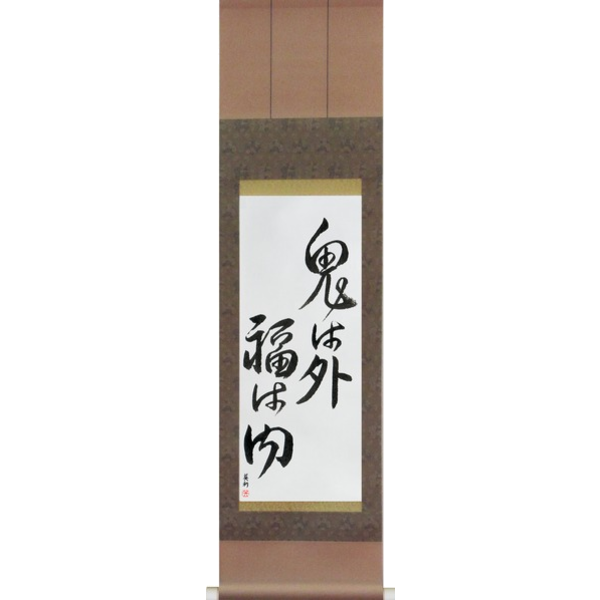
Sold as Devils Go Out Fortune Come In · Read oni wa soto, fuku wa uchi · Oldest witness a Zen abbot's diary for the last day of winter, 1447, recording what people were shouting as they threw beans · Sense the call of the bean-throwing on the eve of spring: demons out of the house, good fortune into it.
The words
鬼, oni, is the demon of the rite, the plague-demon of the court's old year-end exorcism; devils and demons are both used in English, and demons is the usual modern word. は, wa, is the topic particle, and it is not a subject marker here, because the call has no verb for a subject to belong to: as for the demons, out; as for fortune, in. The page says は marks the subject, and that is the common mistake. 外, soto, is outside; 福, fuku, is good fortune, and in the dictionaries' gloss the god of it, 福の神, who is invited in; 内, uchi, is inside, the house. Seven syllables of Japanese with four kanji in them: the page's frame, four-character idiom, is wrong in kind, and the design's writing, kana and all, is the ordinary modern one. Two things vary among the witnesses and neither touches the design. The order: the 1447 diary and the antiquarians write 鬼外福内, demons first, while the kyōgen of the 1640s and the 1910 dictionary's gloss say 福は内 first, and the dictionaries today list both. The writing: the diary gives the call as four characters because a Zen monk writing Chinese records seven syllables of Japanese that way; every Japanese-language witness writes it in kana.
A history, from the earliest witness
1415. 花営三代記, the shogunal household record, the eighth day of the first month. 節分大豆打役, the officer for the bean-throwing at 節分, with the manner of throwing, from the lucky direction and back to it. The rite, thirty years before the call. [as quoted in 武家名目抄稿 and 古今要覧稿, by OCR; the record itself not opened]
1447, the twenty-second day of the twelfth month of 文安 4, which is early 1448 by the Western calendar. 瑞渓周鳳, abbot of 相国寺, in his diary 臥雲日件録. 廿二日。明日立春。故及昏景富每室散熬豆。因唱鬼外福内四字、蓋此方驅儺之樣也。 The twenty-second. Tomorrow is the first day of spring. So at dusk the rich scatter roasted beans in every room, and call the four characters demons out, fortune in; this is our country's form of the demon-expulsion. A Zen scholar describing a lay custom as already established and already Japanese, and comparing it to the Chinese rite he knew from books. This is the 精選版日本国語大辞典's first citation for the call. The next entry begins 廿三日。九淵西堂來。茶話移刻, a visit and tea. [1]
Early 1640s. The kyōgen 節分, in the Ōkura school text of 大蔵虎明, 1642. ふくはうちふくはうち、おにはそとへおにはそとへ, fortune in, fortune in; demons out, demons out: the other order, and the earliest witness the dictionaries give for it. [the 日国 at kotobank.jp/word/福は内鬼は外; the play not opened]
1623, in a printing of 1658. 安楽庵策伝, 醒睡笑, the first Japanese joke collection. A samurai dreams a nest flies into his house; the interpreter, punning on ふく, fortune, and ふくろ, owl, tells him それは目出し鬼はそとへふくろは内へと申ならはして候程に, that is lucky: as everyone says, demons out and the owl in, and is given a robe for it. A pun on the call means everyone knew it. [4]
1776 to about 1800. The Edo joke-books and picture-books. おにはそとへふくはうちへとまめをまく in 新落噺初鰹 (1776); 鬼は外へとうつ豆は雨霰のごとく, the beans thrown at demons out fall like rain and hail, in 山東京伝's 四時交加 (1798), fiercer, he adds, than 田村麿's arrowheads. [pids 2575132, 2534277, 9892823 and 9893053, by OCR from the National Diet Library's full-text search; the scans not located, so these are search highlights and not opened pages]
Edo to Meiji. The antiquarians. From 華実年浪草 through 事言類考, 打聞 and 屋代弘賢's 古今要覧稿 (printed 1883) to the 日本社会事彙 of 1891, a chain of reference books quotes the diary and says the same thing, and the 1891 sentence was copied word for word into four more by 1902: 惡鬼を逐ふ事は、除夜の追儺の、朝儀の民間に移れる者ながら、炒豆を屋中に撒するは、四五百年以還の俗にて、其より古き物に管見せず、臥雲日件録に… (the OCR writes 者なから and 管見せす), driving out demons is the court's New Year's Eve rite passed to the people, but scattering roasted beans in the house is a custom of the last four or five hundred years, and I know of nothing older than the 臥雲日件録. That sentence is still true. [日本社会事彙, pid 898057, scan 915, by OCR; the others by OCR from the full-text search, scans not located]
1910. 藤井乙男, 諺語大辞典. 【鬼ハ外】追儺の時、福は內鬼は外と、三聲づゝ唱へて豆を打つことあり, at the demon-expulsion one calls fortune in, demons out, three times each, and throws the beans. The manner, recorded. [6]
Today. 精選版日本国語大辞典 under 鬼は外福は内: 節分の夜の豆まきのときに唱えることば, with the diary as first citation. デジタル大辞泉 files it under 福は内鬼は外: 節分の夜、豆まきの行事をするときに唱える言葉。幸運を招く福の神は内へ、禍をもたらす鬼は外への意, and the 日国 there adds the season word, winter. The 日本大百科全書 on 節分, by 井之口章次: the court's demon-expulsion came to be held at 節分 from the Muromachi period on, 室町時代以後; the rite has two forms, a costumed demon chased out and beans thrown from a measuring box; in an ordinary house the head of the household, as the year's man, scatters the beans through the rooms calling 福は内、鬼は外, and each person eats as many beans as their years. [kotobank.jp/word/鬼は外福は内; kotobank.jp/word/福は内鬼は外; kotobank.jp/word/節分; text]
The sense across time
The words have meant one thing since 1447 and the rite has hardly changed: at dusk on the eve of spring, roasted beans thrown through the house, the demons ordered out and the fortune in. What the witnesses add is a point of view. The abbot sees it from outside, as a scholar: a lay custom, the rich do it, and it is this country's version of the Chinese rite. The joke-book hears it as a setup for a pun. 京伝 hears the beans. 藤井 counts the calls. The encyclopaedia explains where it came from: the court's 追儺 of the last night of the year, itself Chinese, moved to the eve of 立春 and into the houses. Nothing in the tradition disputes the sense; the only things that vary are the order of the two halves and whether a monk writes the call in Chinese or a townsman in kana.
What is not a source
The call has no author and no text behind it; it is a rite's words, and the diary is a witness to the rite, not its origin. The court's 追儺, with its peach bows and drums, is the rite's ancestor and is documented in the 延喜式 and 公事根源, neither opened here. The shrines that call 鬼は内, demons in, are regional variants the account did not search. There is no Chinese four-character phrase behind 鬼外福内; the abbot made those four characters himself, to write down what he heard.
The text in English
The call was never translated as literature, and the Meiji bilingual shelf was not searched for it. One English proverb book carries it.
1965. Daniel Crump Buchanan, Japanese Proverbs and Sayings, University of Oklahoma Press, page 154. Fuku wa uchi, oni wa soto: "Good luck inside, devils outside." This formula is used when beans are thrown around the house on "setsubun" (the days of the vernal equinox), to drive out evil influences and bring in good ones. The master of the house, early in the morning, goes from room to room, scattering beans to the four corners while shouting the phrase: "In fortune, out devils." Special services on this day are also held in many Buddhist temples, and crowds gather to catch the beans scattered to them by the priests. The rendering is fair and the temple scene is right. Two things are wrong: 節分 is the eve of 立春, the first day of spring by the old calendar, in early February, and not the vernal equinox, which is six weeks later; and the diary of 1447 and the encyclopaedia both put the throwing at dusk, not early morning. [LCCN and ASIN not collected; read in the shelf's text layer, the page from the running head; a printed book, checkable by a reader who holds it]
The call is not in David Galef's three Tuttle collections (1987, 2000, 2012), Guy Zona's book of 1996 or Edward Trimnell's of 2004, all searched.
Today. The house rendering, Devils Go Out Fortune Come In, supplies the verbs the Japanese leaves out and is a fair one; demons is the more usual modern English for 鬼 in this rite. What a rendering must keep: the two halves as a pair, the out and the in, and the sense that these are words shouted, not a maxim.
A reading
The design and the romaji are sound, and the page's account of the rite is right. The explanation has two errors of kind: four-character idiom for a kana call, and subject for は. The story the page lacks is one sentence long and is the best kind, a dated witness: in the winter of 1447 the abbot of 相国寺 wrote in his diary that people were scattering roasted beans in every room and shouting demons out, fortune in, and that it was Japan's way of doing what the Chinese did with peach bows and drums. That sentence is at 史籍集覧 page 24, and it is older than every other text in this family except the Analects. Signed, 典, 2026-09-05.
How this was read
By eye: the 1898 typeset of the diary at the leaf, re-read on the day of writing; the 1910 dictionary at the entry. By text at the address: the two kotobank entries for the call, in both orders, and the encyclopaedia entry on 節分; the 醒睡笑 and the 日本社会事彙 at the page API and in the archive's OCR; the six English paperbacks in their text layers, one of which carries the call. By OCR from the full-text search, not opened at a page: the Edo joke-books and picture-books, and the antiquarian chain. Not opened: the diary in the 大日本古記録 edition; the kyōgen at its page; 花営三代記 at its page; 公事根源 and the 延喜式 on the court rite; the 醒睡笑 leaf by eye; the regional variants. The two leaves named by eye have page-API text addresses beside them; Buchanan is checkable only by a reader who holds the book. The full apparatus, with every address, is in the account.
References
- 臥雲日件録 (瑞渓周鳳, abbot of 相国寺), 文安四年十二月廿二日 (1447; the 1550s excerpts; 1898 typeset) — pid 769659 p. 24, by eye ↩
- 花営三代記, 応永廿二年正月八日 (1415) — quoted in 武家名目抄稿 and 古今要覧稿, by OCR
- 虎明本狂言 節分 (1642) — the 日国, reported
- 醒睡笑 (安楽庵策伝, 1623), 1658 printing (1658) — pid 2554787 scans 39–40, by OCR ↩
- 新落噺初鰹 · 今度者鬼息子 · 四時交加 · 一陽来伏帳 (1776 · 1797 · 1798 · c. 1800) — by OCR
- 諺語大辞典 (1910) — pid 862766 scan 109, by eye ↩
- The catalogue and both live pages (2026) — cultural_works.csv:356