

人間万事塞翁が馬 · ningen banji saiō ga uma · Everything in this world is the old man's horse
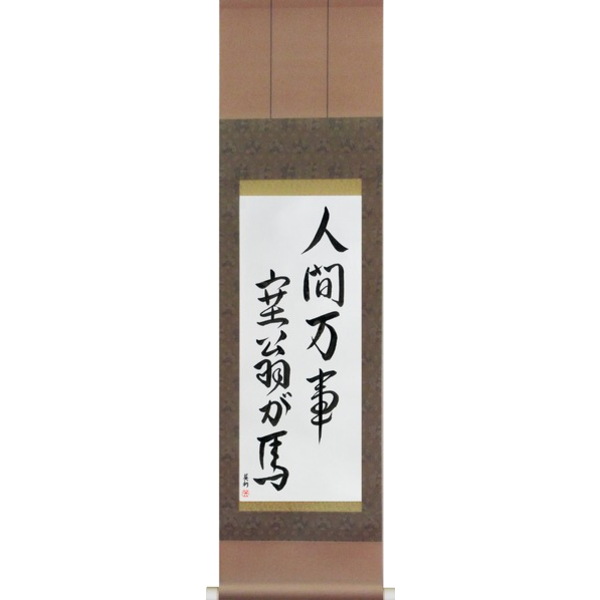
Sold as All is Saiou's Horse · Read ningen banji saiō ga uma; the catalogue has written jinkan, and the reading is settled below · Oldest witness a parable in the 淮南子, second century BC; the seven characters are a line of Chinese verse by a Zen monk of about 1300, and a Japanese proverb by the late 1500s · Sense good luck and bad turn into each other without warning, so neither is to be rejoiced at or grieved over yet.
The words
人間 is the word the reading turns on. In this line it is the Chinese word for the human world, not the Japanese word for a human being, and the question is how to say it. Every Japanese witness opened that writes the sounds says にんげん, ningen: the 1656 proverb book, the 1673 poetic glossary, the 1695 retelling, the Noh text the dictionaries take as the first attestation, 馬琴's own furigana in a novel, the 1910 proverb dictionary twice, and the dictionaries of the 1930s. An archive of seven thousand nine hundred and eighty-five public-domain books has no jinkan for this line at all. Jinkan is the Sino-Japanese reading of the Chinese word, and one modern dictionary records it as an interpretation some readers prefer: 「人間」を「じんかん」と読み、「世の中の運不運は見極めがたい」という意味だとする解釈もあります. It is a legitimate learned choice; it is not the older reading, and ningen is not a drift. 万事, banji, is all matters. 塞翁, saiō, is the old man at the frontier fort: 塞 is a border stronghold and 翁 an old man, and no text gives him a name, so Saiou is a description, not a surname. が is the classical possessive, the old man's. 馬, uma, is the horse; the seventeenth-century books spell it むま. The old man has a second Japanese name, 北叟, the old man of the north, and it survives in an everyday verb: ほくそ笑む, to smile to oneself, which the dictionaries trace to the 北叟笑い, the frontier old man's half-smile at every turn of fortune.
A history, from the earliest witness
Second century BC. 淮南子 (Huainanzi), the chapter 人間訓. The parable, without any proverb attached. A man skilled in divination lives near the frontier. His horse runs off to the nomads and the neighbors console him; he asks how they know it is not good fortune. The horse comes back leading a fine nomad horse and the neighbors congratulate him; he asks how they know it is not calamity. His son rides the new horse, falls and breaks his thigh; the neighbors console him. A year later the nomads invade, nine in ten of the young men die in the fighting, and the lame son and his father keep each other alive. The chapter's own moral: 故福之為禍,禍之為福,化不可極,深不可測也, so fortune becomes calamity and calamity fortune; the change cannot be exhausted and the depth cannot be measured. [zh.wikisource.org/wiki/淮南子/人間訓; text; a transcription, the edition not opened]
About 1300. 晦機元熙 (Huiji Yuanxi), a Zen monk of Yuan China, the poem 寄徑山虛谷陵和尚. The seven characters are the seventh line of his eight-line poem, whose last couplet reads 人間萬事塞翁馬、推枕軒中聽雨眠, everything in the human world is the frontier old man's horse; I push away the pillow and lie in the veranda room listening to the rain. The couplet is a Zen monk's equanimity, not a moral. It is the line Japan took. [12][21]
Thirteenth century, before the poem: the old man of the north in court poetry. The parable was in Japanese verse a century before the monk wrote, under the name 北の翁. The retired emperor 後鳥羽院, in exile after 1221, is quoted: いつとなく北の翁が如くせばこのことわりや思ひ入れなん, if I could be like the old man of the north, would I take this reason to heart?; 土御門院: 心をば北の翁にならへども又たちかへる駒だにもなし, I school my heart on the old man of the north, but no horse comes back to me. A poem by 公朝 already has the proverb's whole shape: 世の中は北の翁の馬なれや善きもあしきも後を知らねば, the world is the old man of the north's horse: good or bad, no one knows what follows. Why north: 馬琴 explained in an essay, 燕石雑志, that 塞, the frontier, meant the northern frontier, so the poets translated the word. [20][18]
Fourteenth century. The Zen monasteries. 清拙正澄, who came from China to Kamakura in 1326, preached the Chinese four-character forms from the hall: 塞翁得馬未必為福 塞翁失馬未以為禍 (the OCR reads 塞符 for the first 塞翁), the old man gaining a horse was not necessarily fortune; losing one was not necessarily calamity. The 精選版日本国語大辞典 gives the 東海一漚別集, about 1375, as the first Japanese use of 塞翁が馬; the dictionary names only the title, and the book is the collected writings of the Zen monk 義堂周信. [3]
Late 1500s. The Noh play 綾鼓, the passage sung by the chorus. 然るに世の中は、人間萬事塞翁が馬なれや, and so the world is the old man's horse in all things, with the reading にんげんばんじさいをうがうま written beside it in the 1908 edition. This is the line the 日国 takes as the first attestation of the full proverb. [5]
Around 1500 to 1600. A 節用集, a household dictionary. Under the headword 寒翁 (for 塞翁) the book tells the parable in Chinese, draws the moral 不可喜不可悲之意, the sense that one should neither rejoice nor grieve, and adds 世俗口號云人間萬事塞翁馬, what the world says is: everything in the human world is the old man's horse. A proverb already, and called one. [4]
1638. 毛吹草, the first Japanese proverb collection, by 松江重頼. 人間萬事塞翁が馬 stands in its list of sayings, between a sleeve you have can be waved and one you lack cannot and calamity too becomes the beginning of fortune. [7]
1656. 世話尽, the second proverb collection, edited by 皆虚. 人間万事塞翁が馬 with every syllable written beside it: にんげん ばんじ さいおう が むま. The earliest dated witness opened that tells us how the line was said. [9]
1673. 和歌呉竹集, a glossary for poets. きたの翁とは塞翁が事なり。宋人の句に人間万事塞翁馬推枕軒中聴雨眠 此句のこゝろは人間万事善も善ならず悪も必しも悪ならず よろこぶべからず かなしむべからず, the old man of the north is the frontier old man. A Song poet's line runs [the couplet]; its meaning is that in the human world good is not good and bad is not necessarily bad, so rejoice at nothing and grieve at nothing. The reading beside the couplet is にんげんばんじさいをうがむま. This is the first witness to give the poem to the wrong dynasty, and the proverb books kept the error for three centuries. [10]
1695. 世話重宝記. The parable retold in Japanese, ending 人間生の事善悪禍福ともに極むべからず, in a human life good and bad, calamity and fortune, can none of them be settled, and 塞翁が馬 read さいおうがむま. [11]
1763. 伊藤東涯, 秉燭譚. The Confucian scholar corrects the record: 人間萬事塞翁馬ト云ハ元ノ僧熙晦機ノ詩ナリ, the line is a poem by the Yuan monk 熙晦機, and he names its anthology, the 江湖風月集, the collection of Yuan Zen verse the Japanese monasteries read. The modern 日国 follows him. The proverb dictionaries of 1673, 1894, 1901 and 1933, and 俚言集覧, never did, and print the couplet as Su Dongpo's. [12]
Early nineteenth century. 曲亭馬琴. The novelist used the line three ways: as the title of an illustrated comic book, 人間萬事塞翁馬, whose preface puns the horse on his own pen name and whose year of print was not read; as a line in the 八犬伝, 禍福は糾纏の如し、人間万事往として、塞翁が馬ならぬはなし, fortune and calamity are a twisted rope; in all things human there is nothing that is not the old man's horse; and in an essay, 燕石雑志, as the explanation of why the court poets said north. [13][18]
1910. 藤井乙男, 諺語大辞典, the standard proverb dictionary. Two entries. 【塞翁ノ馬】吉凶禍福の轉變常なきをいふ, it says that good and ill, calamity and fortune, turn without constancy, followed by the 淮南子 parable in Chinese, the court poems, and a 1638 haikai verse that puns the horse on the year of the horse: 萬事よき春や塞翁が馬の年. The long form is shelved under ニンゲン. [pid 862766, koma 234 and 395, by eye; text at lab.ndl.go.jp/dl/api/page/862766_234]
Today. 精選版日本国語大辞典: 人間の吉凶や禍福は、転変きわまりがないことをいう, with the Noh line as first attestation and the monk's poem as its source. 故事成語を知る辞典: 一見、不運に思えたことが幸運につながったり、その逆だったりすることのたとえ。幸運か不運かは容易に判断しがたい, a figure for what looked like bad luck leading to good, or the reverse: luck and misfortune are not easily told apart, with 漱石 in 1905–06 (人間万事塞翁の馬、七転び八起き) and 円地文子 in 1979 (君がくよくよすることはないよ。人間万事塞翁が馬さ) as its examples. [kotobank.jp/word/人間万事塞翁が馬-593690; text]
The sense across time
The sense has not moved. The 節用集 says 不可喜不可悲, the 1673 glossary よろこぶべからず かなしむべからず, the 1910 dictionary 禍福は糾へる繩の如く常なき, and the modern dictionaries say the same in modern words: fortune reverses without warning, so neither good news nor bad is to be trusted yet. What the witnesses add is a temperament. In the 淮南子 the old man is a diviner who declines to react; in the monk's couplet he is the figure for a man listening to the rain; in the Japanese verb ほくそ笑む he is a half-smile. The proverb is used, then and now, as consolation after a loss, and 太宰治 in 1945 has a character say exactly that: 人間万事塞翁の馬。元気を出して、再挙を図るさ, the old man's horse; take heart and try again. Two things the tradition disputes are not the sense: the reading of the first two characters, settled above, and the poet, settled in 1763.
What is not a source
禍福は糾える縄の如し, fortune and calamity are strands of one rope, is a line from the 史記 that the dictionaries list as a synonym and that 藤井 used to gloss this proverb; it is a parallel, not an origin. 沈む瀬あれば浮かぶ瀬あり, 楽あれば苦あり and 一の裏は六 are Japanese kin proverbs of the same sense. The Chinese four-character cut 塞翁失馬, usually completed 焉知非福, the old man lost his horse; how do you know it is not a blessing, is the form the saying takes in Chinese and in English books about China; it comes from the same parable by a different road and is not the Japanese proverb's source. Su Dongpo did not write the couplet, whatever the proverb books say.
The text in English
The English career of the Japanese proverb begins in the Meiji dictionaries, and every later equation descends from them. 1904, イーストレーキ and 越山, 新撰英和熟語集. Under the English proverb It is an ill wind that blows nobody good the Japanese gloss reads 人間萬事塞翁の馬, with the translator's warning that the English saying is 意味深長 and not to be read by its letters. [pid 870143, scan 77, OCR] 1909 and 1911, 井上十吉, 和英辞典 and 新訳和英辞典. Saiō-no-uma, n. The unexpected turns of the world's affairs; 人間萬事塞翁の馬, The unexpected always happens in human affairs. [pid 1869465, scan 651; pid 870153, scan 653; OCR] 1918, 斎藤秀三郎, Idiomological English-Japanese Dictionary. Inscrutable are the ways of Heaven = 人間萬事塞翁が馬, in three places. This is the equation the house page still carries, word for word. [pid 1681530, scans 283, 325 and 764, OCR] 1946, スタンダード和英辞典. Saiō-ga-uma … Nothing is certain in the world. [pid 1126792, scan 392, OCR] The proverb is absent from Hepburn's dictionary of 1872 and from nine other Japanese-English dictionaries between 1904 and 1929.
1965. Daniel Crump Buchanan, Japanese Proverbs and Sayings, University of Oklahoma Press, page 156. Ningen banji Saiō no uma: "An evil sometimes turns out to be a blessing in disguise." (Lit., "People and all things are like Saiō's horse."), then the parable in five sentences, and The future often provides happy solutions of difficult problems. He reads 人間 as ningen, in 1965, and credits the retelling to Okada Rokuo's Japanese Proverbs (Japan Travel Bureau, 1955). A blessing in disguise carries only half the proverb, the half where bad turns good. [LCCN and ASIN not collected; read by page image; a printed book, checkable only by a reader who holds it] The proverb is not in David Galef's Even Monkeys Fall from Trees (Tuttle, 1987) or Even a Stone Buddha Can Talk (Tuttle, 2000), nor in Edward Trimnell's Tigers, Devils, and Fools (2004) or Guy Zona's Even Withered Trees Give Prosperity to the Mountain (1996), all opened.
Today. The house title, All is Saiou's Horse, is a literal rendering that gives an English reader nothing until the story is told, and the page then tells it, correctly in outline. Its meaning line, inscrutable are the ways of heaven; fortune is unpredictable and changeable, is Saito's 1918 English with his Japanese gloss translated after it. What a rendering must keep: the old man, who is a person and not a name; the reversal running both ways; and the refusal to rejoice or grieve yet, which a blessing in disguise, every cloud has a silver lining and inscrutable are the ways of Heaven each lose in a different place.
A reading
The proverb is sound and the design is sound; seven characters unchanged since the 1500s, with no owner, no sect and no legend. The page has three particulars wrong, and the first matters most. It says 人間 was read jinkan in the old days and that ningen is a modern drift. The witnesses say the opposite: ningen from 1656 to 1939, from a proverb book to a Noh text to 馬琴's own furigana, and jinkan nowhere. Jinkan is a learned modern choice and a defensible one; a page may note it; it cannot call it the original. So the catalogue reading is corrected to ningen banji saiō ga uma. Second, Saiou is not old man Sai; 塞 is a frontier fort, and the old man has no name in any text. Third, the page tells the parable without saying where it comes from, and misses the better story: a Han parable, carried into Japanese court poetry as the old man of the north, given its seven characters by a Yuan Zen monk listening to rain, taught from the hall at Kamakura, and standing in the first Japanese proverb book of 1638. The old man's smile is still in the language as a verb. That is what the page could say. Signed, 典, 2026-09-05.
How this was read
By eye: the 1656 世話尽 leaf and 藤井's 1929 reprint of the 毛吹草 list, both re-read on the day of writing; the 節用集, 呉竹集 1673, 世話重宝記 1695, 秉燭譚 1763, the 1908 Noh edition, the 1910 dictionary in three entries, the 1915 大日本国語辞典, 皇国俚諺叢 1901, 俚言集覧 in three leaves, and Buchanan 1965 at the page. By text at the address: the 淮南子 chapter in transcription; the kotobank entries for the long form, the short form and ほくそ笑む; the 1763 and 1910 pages at the National Diet Library's page API; the Meiji and Shōwa dictionaries and the older manuscript witnesses by OCR from the archive; the four English paperbacks in their text layers. Not opened: the 淮南子 in an edition; the 江湖風月集; 義堂周信's collected writings; the Zen sermon and the Momoyama chronicle at the leaf; the 1645 print of 毛吹草; the court poems in a poetry edition; the 蒙求; 馬琴's comic book in its own print; Okada's 1955 booklet. Every address in this history is a text address except the leaves named by eye, and each of those from a printed book has a page-API text address beside it in the account; the manuscript leaves and Buchanan are checkable only by image or by a reader who holds the book. The full apparatus, with every address, is in the account.
References
- 淮南子 人間訓 (Han, 2nd c. BC) — Wikisource transcription; 藤井 1910 quotes the same text at koma 234 and 395 (by eye); 事文類聚 in a 1600 Japanese print carries it under 塞翁失馬 (OCR)
- 晦機元熙, 寄徑山虛谷陵和尚 (poem) (Yuan, c. 1300) — 秉燭譚 1763 koma 18 by eye (writes 都率天 and 黄金宅); 故事熟語辞典 1925 koma 396 OCR (黄金色); 藤井 1910 koma 395 quotes the couplet alone with 推枕軒頭
- 清拙和尚語録 (清拙正澄, in Japan 1326–1339) (14th c.; MS) — pid 2537749 koma 71, OCR only; the Chinese four-character forms in a Gozan sermon, a generation before the 日国's 東海一漚別集 ↩
- 節用集 (NDL WA16-22) (undated; NDL enters 1500) — pid 2532232 koma 89, by eye; the small script between the two ellipses not fully read ↩
- 綾鼓 (Noh), クセ (室町末 (日国's dating)) — 謡曲評釈 1908 pid 876570 koma 23 (p. 三十六) by eye; 日本文学大系 1926 pid 1018058 koma 68 OCR; the 日国 cites the 大観本 with the same furigana ニンゲンバンジサイオウ ↩
- 日本治乱記 (山中長俊, d. 1607) (c. 1600; MS) — pid 10303684 koma 81, OCR only; カ for が
- 毛吹草 (松江重頼) 世話付古語 (1638 preface, 1645 print) — 藤井 1929 pid 1452761 scan 147, by eye (the 1638 book itself not opened); 皇国俚諺叢 1901 cites 〔毛吹草〕 by eye ↩
- 鷹筑波 (haikai) (1638) — 藤井 1910 koma 234 OCR; 藤井 俗諺論 1906 pid 902816 scan 151 OCR; the leaf not opened, and the pun on the horse year wants 午
- 世話尽 (皆虚 編), 世話二 (1656) — pid 2554768 koma 6, by eye; the earliest dated kana witness opened; 藤井 1929 scan 160 OCR ↩
- 和歌呉竹集 (1673) — pid 2550690 koma 11, by eye ↩
- 世話重宝記 (1695) — pid 2550735 koma 19, by eye ↩
- 秉燭譚 (伊藤東涯) 巻之三 (1763) — pid 2564858 koma 18, by eye ↩
- 人間萬事塞翁馬 (kibyōshi, 曲亭馬琴) (1792 (recall; the 1926 typeset gives no year at the hit)) — 黄表紙集 1926 pid 1018333 koma 9 and 104, OCR ↩
- 連城叢書 (小寺玉晁) (c. 1800) — pid 2533399 koma 29, OCR
- 燕石雑志 (曲亭馬琴) (1811 (recall)) — as quoted in 俚言集覧 上 pid 991569 koma 356, by eye
- 南総里見八犬伝 四 (馬琴) (1814–42) — 日国, 初出の実例 for 塞翁が馬; the 1886 print pid 879352 koma 43 OCR (furigana さいをう…うま)
- 暁斎百図 (万亭応賀 案, 河鍋暁斎 画) (江戸末) — pid 2574926 koma 3, OCR
- 俚言集覧 (村田了阿; 1900 increased edition) (early 19th c. / 1900) — pids 991570 koma 63, 991569 koma 356, 991571 koma 150, by eye ↩
- 諺語大辞典 (藤井乙男) (1910) — by eye; transcriptions in § 評釈
- 大日本国語辞典 (1915) — pid 954645 koma 562, by eye ↩
- 故事熟語辞典 (池田蘆洲) (1925) — pid 969163 koma 396; headword by eye, the rest OCR ↩
- The design () — cultural_works 366; whole_designs row 12