

七転八起 · nana korobi ya oki · Fall down seven times, get up eight
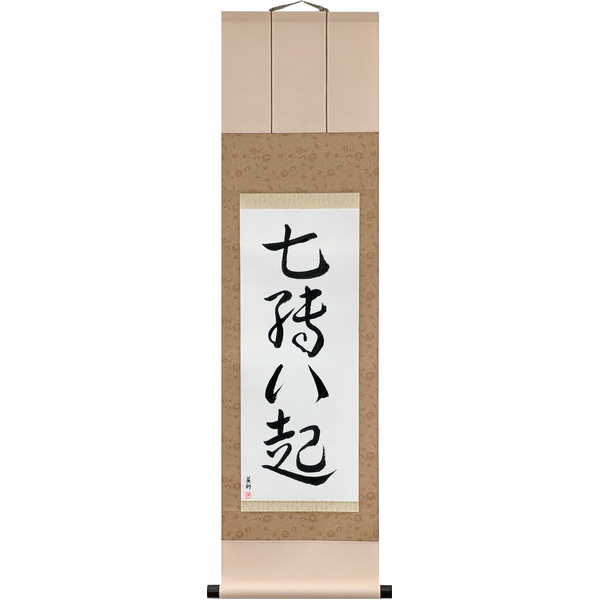
Sold as Fall Down Seven, Get Up Eight · Read nana korobi ya oki, the proverb; the same four characters also read shichiten hakki, a word · Oldest witness a picture book by 十返舎一九, 1798, where it is already called a saying · Sense knocked down again and again, get up once more than that; at first a consolation about the turns of luck, since Meiji a resolve.
The words
Four characters, two verbs with their counts. 七 nana, seven. 転 korobi, to fall over, to tumble; the older books write 轉 or 顛, one word in three shapes. 八 ya, eight. 起 oki, to get up. The catalogue's glosses are right, and the arithmetic is the point: seven falls need only seven risings, and the proverb asks for eight. The current proverb dictionary explains the extra one as the number of standing up once more than one was knocked down, and adds the folklore of the two numbers, seven for many with a shadow on it, eight for the auspicious spread of the character's two strokes. The characters are read two ways. As a Japanese sentence they are ななころびやおき, the proverb, which is the older reading and the one the scroll carries. As a Sino-Japanese word they are しちてんはっき, a yojijukugo the big dictionary first finds in 1885, meaning the same thing as a noun. Under both sits an older idiom that shares three of the four characters, 七転八倒 shichiten battō, to writhe in agony, which is Chinese and Zen; the proverb is cut on its pattern with the last verb turned from topple to rise.
A history, from the earliest witness
1798, 十返舎一九, 御徳用黄金艸鞋, a picture book in two volumes, read at the National Diet Library's copy. A boy called 三太郎 has been given golden straw sandals and told to wear them out working, day and night; he keeps slipping and falling, and a rat picks him up: ころんでもいゝ七ころび八おきとたとへのとふりころんでも又おきるものなれはそこをしんぼうせねばならす, it's all right to fall; as the saying goes, seven falls and eight risings; one falls and gets up again, so that is where you must bear it. The phrase is already the saying, たとへ, and already a consolation. The leaf was opened; the picture is the rats and the fallen boy; the cursive is quoted from the library's text layer. [2]
Around 1800, the 俚言集覧, a dictionary of common sayings compiled by 太田全斎, read in its 1900 edition. Among the entries beginning with seven, 七乞食○七轉八起七小町, the four characters stand in a list without a gloss: a saying a lexicographer of the age already had to hand. [8]
1803 imprint, 山東京伝, 裡家算見通坐敷. In a comic piece on household fortunes: 人は七ころび八おきといふことがあれば, since there is the saying that a person falls seven times and rises eight. [4]
1805 and 1808, 曲亭馬琴, read in the typesets of the 1880s. Bakin uses the four characters as a stock phrase of the narrator's voice, with the reading over them: 七轉八起といへば。よき事もあり。あしき事もなくてや, as they say, seven falls eight risings: there are good things, and are there not bad ones too (三七全伝南柯夢); 人は七轉八起とかいふ世話もあるに, there is that saying, a person falls seven and rises eight (南総里見八犬伝). Once he uses it in the other idiom's sense: a poisoned man 七轉八起して狂ひ死にぞ死たりける, writhed, and died raving, with the on-reading しつてんはつき over it, where the dictionaries would write 七転八倒. The two idioms were not yet sorted in his prose. [9]
1821, 春亭三暁, 十種香萩廼白露, and 1824, 為永春水, 菊廼井草紙, two sentimental novels. わかき時には七ころび八おきといへば, when one is young, they say, seven falls eight risings; and, in a quarrel about a husband's failures, それも人は七轉八起とやらだから, still, they say a person falls seven and rises eight, so. Spoken consolation, both times, about luck that may turn. [5]
1825, 鼻山人, 風俗粋好伝, second series, illustrated by 渓斎英泉, read by eye. A reunion scene, and the line that is the proverb's Edo sense in one breath: ハテ人は七轉び八起じや。悪い跡は善といふから, well, a person falls seven and rises eight; they say good comes after bad. The printed characters are 七轉び八起 with their kana beside them, in the third column of the right-hand page. [7]
1885, 坪内逍遙, 当世書生気質, the first modern novel, read in the 1886 printing. A student holds forth on a fifty-year life: 人生五十年、其五十年間にやあ失策もあるし成功もあるも恥もかく名誉も得る七転八起、一栄一辱、棺に白布を蓋ふにいたつて初めて其名誉が定まるんだ, fifty years of a life, and in them failures and successes, shame and honor, seven falls and eight risings, a glory and a disgrace; only when the coffin is covered with white cloth is a man's honor settled. This is the sentence the 日本国語大辞典 gives as the first citation of the word しちてんはっき: the four characters as a noun, and a whole life as its subject. [12]
1894, 物集高見, 日本大辞林, the Imperial Household's dictionary. ななころびやおき。七轉八起。おくることの、ころぶことよりもおほくあるをいふことわざ, a proverb meaning that one's risings are more than one's fallings. The proverb's first dictionary definition found. [14]
1902, 日本社会事彙, second volume, the entry on daruma. On the papier-mâché dolls made at 高崎: 世人の之を購ふ所以のものは。盖し春夏秋蠶の當らんを祈り。且は七轉八起の功德に據らむが爲め, people buy them to pray that the spring, summer and autumn silkworm crops come in, and to draw on the merit of seven-falls-eight-risings. The doll that rights itself when pushed over is the proverb's emblem, and this is the earliest print pairing of the two found here. [17]
1910, 藤井乙男, 諺語大辞典, the great proverb dictionary. 【七顛八起】人世の浮沈定めなきこと。又困難に屈せずして、世と闘ふことにいふ, the ups and downs of a human life, which nothing fixes; also said of not yielding to hardship and fighting on in the world. Two senses in one line, the old and the new. The next entry is 【七顛八倒】のたうちて苦みもがくこと, to writhe and struggle in pain, with its source, the 碧巌録: 到這裏七顛八倒、於一切時中、得大自在. The proverb and the idiom it is cut from sit one above the other on the page. [19]
Today. 大辞泉 enters both readings: ななころびやおき《七度転んで八度起き上がる意から》多くの失敗にもめげず、そのたびに奮起して立ち直ること。転じて、人生には浮き沈みが多いことのたとえ; and しちてんはっき, not giving up however often one fails, and seeing it through. The proverb dictionary's examples are 岡本綺堂 in 1912 and 相馬愛蔵 in 1952; the yojijukugo dictionary's is 是川銀蔵 in 1991. The four-character kanji form is by far the commonest in print before 1945 (654 books in the National Diet Library's index against 415 for the headword spelling and 58 for the all-kana one), and the classical facet holds nothing before 1798 under any of nine spellings. [kotobank, whole entries; the index, every hit listed with the account.]
The sense across time
The tradition holds two senses and 藤井 names both. The older is consolation about luck: a person is knocked down seven times and gets up eight, so bad is followed by good, said to someone in trouble by a rat in 1798, a friend in 1803, a lover in 1824, a long-lost relative in 1825. The newer is resolve: not giving up, getting up once more than one is knocked down, which is what the kanji word came to mean when Meiji started using it as a noun for a life or a career and what the daruma doll stands for. The scroll sells the second, and the first is still inside it.
What is not a source
The Zen idiom 七顛八倒 is the pattern, not the source: it means writhing, its books are the Song recorded sayings and the 碧巌録, and no dictionary opened derives the proverb from it beyond setting the two side by side. The Korean 칠전팔기, the same four characters read in Korean and listed among a hundred Korean proverbs in an American book of 1982, is the same coinage in another language; which cut it first is not settled by anything read here. The daruma doll is the proverb's emblem, in print with it by 1902, not its origin. And If at first you don't succeed, try, try again, which Galef and the Oxford dictionary set beside it, is an English proverb of the nineteenth century with its own history.
The text in English
1888, 高橋五郎, 漢英対照いろは辞典, Tokyo, 長尾景弼, p. 504, read by eye. ななころびやおき 七轉八起(人生は禍多けれども又終に福にも至るの義をいふ) Seven times falling and eight times rising up. The earliest English found, and the gloss is the consolation sense: a life has many misfortunes but comes at last to fortune. 1896, F. Brinkley and others, 和英大辞典. Nanakorobi-yaoki … Seven times down (but) eight times …, from the library's search index; the page was not resolved. 1900, 島田豊 and 島田弟丸, 学生用和英字典, Tokyo, 博文館. To be successful the eighth time after seven repeated failures. [16] Hepburn's dictionary of 1872 has no entry, and neither does Daniel Buchanan's Japanese Proverbs and Sayings (University of Oklahoma Press, 1965), the standard American collection of its generation, read as text from the shelf: the proverb was not one the mid-century books chose.
1974, Kip Quotes, Clifton Burke, Taylor Publishing. Fall down seven times; get up eight. The earliest print of the modern English form in the Internet Archive's index, unattributed there. [snippet.] 1982, Bruce K. Grant, Korean Proverbs: Dragon Head, Snake Tail, Salt Lake City, Moth House, ISBN 0936718064. Fall down seven times and get up eight, among a hundred Korean proverbs. [snippet.] 1987, David Galef, Even Monkeys Fall from Trees: The Wit and Wisdom of Japanese Proverbs, Tokyo and Rutland, Tuttle, no. 100, ISBN 0804832269, https://www.amazon.com/dp/0804832269. 七転び八起き Nana-korobi ya-oki. Fall down seven times, get up eight, and in his list of equivalents, If at first you don't succeed, try, try again. The house's page cites this equation. [shelf epub, text.] 1996, Lillian B. Rubin, The Transcendent Child, New York, Basic Books, ISBN 0465086691. The title of chapter one. [snippet.] 2004, Edward Trimnell, Tigers, Devils, and Fools: A Guide to Japanese Proverbs, Beechmont Crest. NANAKOROBI YAOKI 七転び八起き "Fall down seven times...Stand up eight." Don't allow yourself to become discouraged by failure … All setbacks are temporary. [shelf PDF, text.] 2008, The Oxford Dictionary of Proverbs, fifth edition, Oxford University Press, ISBN 9780199539536. FALL down seven times, get up eight. Japanese proverb, with its first citation from the New York Times of 24 August 1997: 'I always told him, "Fall down seven times, get up eight,"' said John Kim, the bridegroom's father. [snippet.] 2009, Little Oxford Dictionary of Proverbs, ISBN 9780199568024. Fall seven times, stand up eight. Japanese proverb; compare If at first you don't succeed … [snippet.] 2012, David Galef, Japanese Proverbs: Wit and Wisdom, Tuttle, no. 100, p. 118, ISBN 9784805312001. Nana-korobu, ya-oki. Fall down seven times, get up eight. [shelf epub.] 2016, Naoki Higashida, translated by David Mitchell and K. A. Yoshida, Fall Down 7 Times, Get Up 8, Hodder & Stoughton, ISBN 9781444799101. The proverb as a title. [snippet.]
Today. Two English forms compete. Fall down seven times, get up eight is the Meiji dictionaries' descendant and Galef's; Fall seven times, stand up eight, the Little Oxford's, is now the commoner in print (over a thousand items in the Internet Archive's index against seven hundred). JMdict glosses the proverb not giving up; keeping at it until one succeeds; falling seven times, getting up eight, and adds the vicissitudes of life as a second sense, which is the older one. The house's title, Fall Down Seven, Get Up Eight, is Galef's 1987 wording with times dropped, and his credit stands. A rendering of this line must keep the count, both verbs, and the eighth rising as one more than the falls; never give up loses the arithmetic that is the proverb.
A reading
The scroll is right, the page is right, and the proverb is older and stranger than either says. The big dictionary's first citation of 1885 is only the first for the Chinese reading of the four characters; the saying itself is in a picture book of 1798, already called a saying, spoken by a rat to a boy who cannot stay on his feet. Its first sense is not resolve but consolation about luck, bad is followed by good, and every Edo speaker of it is comforting someone. The resolve is what Meiji read into the kanji word and what the self-righting daruma, paired with it in print by 1902, carries. And the phrase is cut on a Zen idiom for writhing in pain, three characters shared, the last verb turned from topple to rise; Bakin still used it in both senses in one decade. I would tell a buyer those three things and no more: the rat and the sandals, the eighth rising, the doll with no feet. No change to the design, the reading or the title.
How this was read
By eye at the leaf: 鼻山人 1825 (NDL pid 8942994, scan 17) and 高橋 1888 (pid 902745, scan 260), both pulled at 2,400 pixels; the 一九 leaf of 1798 (pid 9892863, scan 9) was opened and its picture read, but its cursive was not independently read and the line is quoted from the library's text layer. By OCR at the National Diet Library's next-generation digital library, the scan number part of every address: 一九 1798 (scan 9); the undated 申瓢黄菊月 (pid 2537849, scan 11); 京伝 (pid 9892405, scan 15); 三暁 1821 (pid 9893239, scan 13); 春水 1824 (pid 8942788, scan 18); Bakin in the 1883 and 1886 typesets (pids 878502 scan 26, 879731 scan 9); 逍遙 1886 (pid 887446, scan 171); 物集 1894 (pid 863449, scan 550); 島田 1900 (pid 870126, scan 396); the 俚言集覧 in its 1900 edition (pid 991570, scan 412), the 社会事彙 1902 (pid 1805636, scan 344), the 俚諺辞典 1906 (pid 900343, scan 328) and 藤井 1910 (pid 862766, scans 256 and 382) from the seat's harvest of the same library. A leaf named as pid P, scan N has its text at lab.ndl.go.jp/dl/api/page/P_N and its image at dl.ndl.go.jp/api/iiif/P/R<N as seven digits>/full/full/0/default.jpg; the pre-1868 books answer a signed address only with -L. As text: kotobank's five entries, whole; JMdict through the gokanji database; the library's full-text index on nine spellings, every hit listed; Buchanan 1965, Galef 1987 and 2012 and Trimnell 2004 from Tim's shelf; the Internet Archive's full-text index on six English spellings, ninety books dated from their scan records, snippets only. From the search index alone, scan not derived: Bakin's 殺生石後日怪談 and 八犬伝, Brinkley 1896, the 御重寶 of 1927. Not opened: 毛吹草 and 世話尽 at the leaf; 故事俗信ことわざ大辞典; Bakin at his own editions; Hepburn's third edition; the English books at the page. A printed book checks only for someone holding it, and the ISBNs above are for that.
References
- The design (ours) (—) — template M6010SSVB2A, by eye; cultural_works 563; whole_designs.csv:167
- 十返舎一九『御徳用黄金艸鞋』 (寛政10 (1798), the Lab's imprint) — NDL pid 9892863 scan 9, OCR; the leaf opened by eye (the rats and the fallen boy are the picture), the cursive kana not independently read; image `dl.ndl.go.jp/api/iiif/9892863/R0000009/full/,2400/0/default.jpg` ↩
- 『申瓢黄菊月』 (undated (the Lab gives no year; publisher blank)) — pid 2537849 scan 11, OCR
- 山東京伝『裡家算見通坐敷』 (imprint 享和3 (1803), 仙鶴堂) — pid 9892405 scan 15, OCR ↩
- 春亭三暁『十種香萩廼白露』2編 (文政4 (1821)) — pid 9893239 scan 13, OCR ↩
- 為永春水『菊廼井草紙』4編 巻之一 (文政7 (1824)) — pid 8942788 scan 18, OCR
- 鼻山人『風俗粋好伝』2編 四 (文政8 (1825)) — pid 8942994 scan 17, by eye: 七轉び八起 with its kana glosses in the third column of the right page; image `…/8942994/R0000017/full/,2400/0/default.jpg` ↩
- 『俚言集覧』, the 七 list (Edo compilation (太田全斎, c. 1800), read in the 1900 皇典講究所 edition) — pid 991570 scan 412, OCR (harvest) ↩
- 曲亭馬琴『三七全伝南柯夢』巻之5 (1808 by the standard dating (reported), read in the 1883 東京稗史出版社 typeset) — pid 878502 scan 26, OCR ↩
- 馬琴『稚枝鳩』下之巻 (1805 by the standard dating (reported), read in the 1886 共隆社 typeset) — pid 879731 scan 9, OCR
- 馬琴『殺生石後日怪談』 · 『南総里見八犬伝』第7輯 (1808 · 1814–42 (reported), 1883–88 typesets) — Lab search highlights (pids 878816 · 878824 · 878818 · 878821 · 879295); scans NOT derived
- 坪内逍遙『当世書生気質』 (1885–86, read in the 1886 晩青堂 printing) — pid 887446 scan 171, OCR; image R0000171 (200) ↩
- 高橋五郎『漢英対照いろは辞典』 (1888) — pid 902745 scan 260 = printed p. 504, by eye (the OCR reads 七轉八奥 and 福多); image R0000260
- 物集高見『日本大辞林』 (1894) — pid 863449 scan 550, OCR ↩
- Brinkley et al.『和英大辞典』 (1896) — pid 903159, the Lab's search highlight only; scan not resolved
- 島田豊・弟丸『学生用和英字典』 (1900) — pid 870126 scan 396, OCR ↩
- 経済雑誌社『日本社会事彙』下巻, the 達磨 entry (1902) — pid 1805636 scan 344, OCR (harvest) ↩
- 『俚諺辞典』 (1906) — pid 900343 scan 328, OCR (harvest)
- 藤井乙男『諺語大辞典』 (1910) — pid 862766 scan 256 (シ) and scan 382 (ナ), OCR (harvest) ↩
- 高島易断所『御重寶』昭和3年 (1927) — pid 2535554, Lab highlight only
- kotobank, 七転び八起き (current) — https://kotobank.jp/word/七転び八起き-589160, whole entries
- kotobank, 七転八起 (current) — https://kotobank.jp/word/七転八起-520866, whole entries
- JMdict (current) — gokanji.db
- The NDL Lab full-text index, pre-1945 (1798–1944) — `laball_*.tsv`
- Buchanan, *Japanese Proverbs and Sayings*, U. of Oklahoma Press (1965) — shelf PDF, pdftotext
- *Kip Quotes*, Clifton Burke, Taylor Publishing (1974) — archive.org `kipquotes0000clif`, snippet; the earliest English of the modern form in the index
- Bruce K. Grant, *Korean Proverbs: Dragon Head, Snake Tail*, Moth House (1982 (ISBN 0936718064)) — `koreanproverbsdr0000gran`, snippet
- David Galef, *Even Monkeys Fall from Trees*, Tuttle (1987 (ISBN 0804832269, the page's link)) — shelf epub, `The_Proverbs.xhtml` and `List_of_Proverbs.xhtml`, TEXT
- Lillian B. Rubin, *The Transcendent Child*, Basic Books (1996 (ISBN 0465086691)) — `transcendentchil0000rubi`, snippet
- *The Oxford Dictionary of Proverbs*, 5th ed., OUP (2008 (ISBN 9780199539536)) — `oxforddictionary0000unse_d0n2`, snippet (the entry's first citation)
- Edward Trimnell, *Tigers, Devils, and Fools*, Beechmont Crest (2004) — shelf PDF, pdftotext
- *Little Oxford Dictionary of Proverbs*, OUP (2009 (ISBN 9780199568024)) — `littleoxforddict0000unse`, snippet
- Galef, *Japanese Proverbs: Wit and Wisdom*, Tuttle (2012 (ISBN 9784805312001)) — shelf epub; IA snippet
- Naoki Higashida, tr. David Mitchell and K. A. Yoshida, *Fall Down 7 Times, Get Up 8*, Hodder & Stoughton (2016–17 (ISBN 9781444799101)) — `falldown7timesge0000naok`, snippet
- The house (2026) — the live page