

見猿聞か猿言わ猿 · mizaru kikazaru iwazaru · See not, hear not, say not
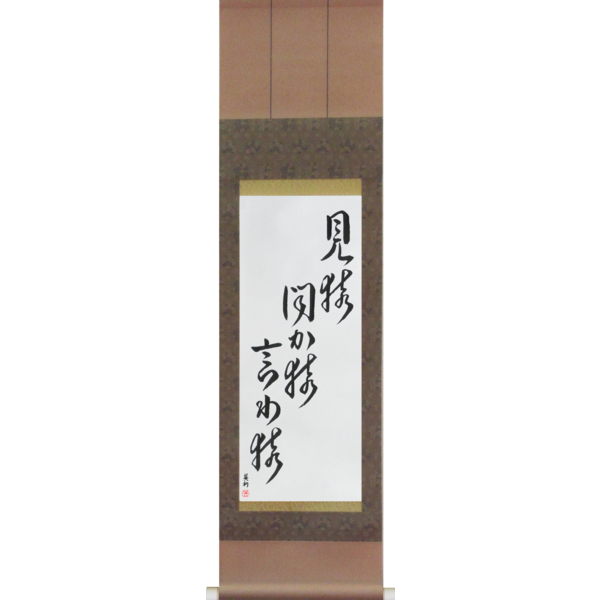
Sold as See No Evil, Hear No Evil, Speak No Evil · Read mizaru kikazaru iwazaru · Oldest witness three monkeys in a 1597 manuscript of a Kamakura Buddhist tale collection; the sentence itself first in a comic poem of 1649, already punning on the monkeys · Sense do not look at, listen to or speak of what is not yours to see, hear or say; in the old sources, other people's faults.
The words
Three verbs in the classical negative: 見ざる, not seeing, 聞かざる, not hearing, 言わざる, not saying. The sentence has no object, and the dictionaries supply one. The 精選版日本国語大辞典 says 他人の欠点・あやまち、あるいは自分に都合の悪いものなど, other people's faults and mistakes, or what is inconvenient to oneself; デジタル大辞泉 says 余計なことは, what is none of your business; a dictionary of 1906 calls the whole a recluse's rule, 隱遁する義. Nothing in the Japanese says evil. That word is an Englishman's, below. The pun is the point of the spelling. 猿, monkey, is read さる, and in compounds it voices to ざる, which is also the negative ending, so 見猿 reads mizaru and means, at once, not seeing and the seeing monkey. The catalogue's spelling with 猿 is the headword form in both major dictionaries. The three monkeys as a set are 三猿, san'en or sanzaru.
A history, from the earliest witness
1597, in a manuscript of 無住's 沙石集 (the tales themselves are of 1283). The oldest text opened. One manuscript witness of the collection carries a passage the others lack: 或人世のつねには三猿をたもつ。道人は四猿をたもつべし。其中に殊にたもつべきは、不思なりと云心をよめる, someone said: the ordinary man of the world keeps three monkeys; a man of the Way should keep four, and the one above all to keep is not-thinking. Then the poem: いはざるとみざるときかざると世にはあり思はざるをばいまだみぬかな, not-saying, not-seeing and not-hearing there are in the world; not-thinking I have yet to see. The three monkeys are already a set with names, and already worldly prudence next to a monk's harder rule. [岩波 edition of 1943, National Diet Library pid 1040496, koma 186, the apparatus to page 250, read by eye; text at lab.ndl.go.jp/dl/api/page/1040496_186; the manuscript's colophon is dated 慶長二年, 1597]
1632 and 1675. The three-monkey hall at 粟田口 in Kyoto, and the Tendai story. A guide of 1632, 尤草紙, knows a hall of three monkeys at 粟田口, with the speechless one in the middle, its mouth closed, and the not-seeing and not-hearing ones flanking it, said to be the work of 傳教大師, the founder of Japanese Tendai; litigants borrowed the monkeys to win their suits. A scholar's notebook of 1675, 遠碧軒記, gives the learned explanation: the Tendai master's three truths, 空假中, were set against 不見不聞不言, not seeing, not hearing, not saying, and the founder expressed that as monkeys. The attribution to the founder is legend, and the Edo writers who repeat it say とかや, so they say. [both reached through later books that quote them: 藤井乙男's 諺語大辞典, 1910, pid 862766, koma 492, by eye, text at lab.ndl.go.jp/dl/api/page/862766_492; the 日本社会事彙, 1891, pid 898056, koma 502 to 503, OCR; 山東京伝's 疑問録 in 続燕石十種, 1909, pid 991280, koma 196, OCR]
1649. 石田未得, 吾吟我集, a collection of comic verse, book six, the poem On the Monkey in a series of love poems on animals. うき事はみざるきかざるいはざるよ かほあかめあふうらみせんなし, my grievance is see-not, hear-not, say-not; we just blush at each other, and resenting it is no use. The first appearance of the sentence, and it is already a joke on the monkeys: the poem is on the monkey and the three negatives are its pun. The 日国 takes this as the first attestation. [read by eye in the 1776 Osaka reprint, National Institute of Japanese Literature, BID 200002654, canvas 45; the poem is also quoted by 藤井 1910 at the address above]
About 1700. 天野信景, 鹽尻. The same story, and a correction: this has nothing to do with the 庚申 cult, and the priests who put the monkeys on 庚申 halls are mistaken. [as quoted in a book of 1932, pid 1176096, OCR]
The 庚申 stones. The three monkeys' second home is the 庚申 vigil, a Taoist practice in which three worms inside the body report a sleeper's sins to Heaven on the night of the 庚申 sign, a belief attested in Japan from about 900. The monkeys attach to it by another pun, 申 being read saru. By 1782 a roadside 庚申 stone with three monkeys is a stock image, and the proverb dictionary of 1910 files the maxim under 庚申塚ノ三猿 as well as under itself. The learned writers of Edo agree that the attachment came later. [kotobank.jp/word/庚申待, kotobank.jp/word/庚申塚, kotobank.jp/word/三尸, text; 藤井 1910, pid 862766, koma 124, OCR]
1810s. 山東京伝's questions and the 兎園 circle's answers. The novelist asked where the 庚申 monkeys covering their eyes, ears and mouth came from and who first said it. The antiquarians reached for the Tendai poems attributed to 慈惠大師, and admitted they could not find them in any scripture. One quoted a travel book's version of the fourth monkey: 見す聞すいはさるまてはつなけとも思はさるこそつなかれもせす, you can tie up the not-seeing, the not-hearing and the not-saying, but the not-thinking cannot be tied. [続燕石十種, 1909, pid 991280, koma 196, OCR]
Around 1800. 大田南畝, on a picture. Three monkeys under a cherry tree: the white one shuts its own mouth and covers the other two's ears and eyes with its hands. His verse: 面白い事をもみざるきかざるはさくらを花といはざるの智惠, not seeing or hearing the interesting thing is the wisdom of not calling the cherry a flower. The maxim as a wit's dodge. [1913 edition, pid 1913656, koma 137, OCR]
1894. 尾崎紅葉, 紫. 物言へば唇寒し秋の風、見猿聞か猿言は猿がよし, Bashō's line about the cold that follows speaking, then see-monkey, hear-monkey, say-monkey is best, said of a man enduring a talker. The catalogue's spelling in the page's exact pattern. [1910 collected edition, pid 886301, koma 459, OCR]
1910. 藤井乙男, 諺語大辞典. The standard proverb dictionary files the sentence with a Chinese moral source from a Song tract, 省心詮要, 耳不聞人之非、目不視人之短、口不言人之過, the ear does not hear others' faults, the eye does not see others' shortcomings, the mouth does not speak others' errors; the 1649 poem; a Buddhist teaching verse; and the Tendai story. [pid 862766, koma 492, by eye]
Today. The 日国: 他人の欠点・あやまち、あるいは自分に都合の悪いものなどは、見ない、聞かない、言わないということを表わす, with the 1649 poem as first attestation. The ことわざを知る辞典, under the kana spelling, adds the modern turn: 自己保身のために見て見ぬふりをする場合にも使われ、現代では否定的なニュアンスを伴うことも少なくありません, it is also used of looking away to protect oneself, and today often carries a negative shade, and notes that three-monkey images have since been found in many parts of the world, so the Japanese pun cannot be the whole story. [kotobank.jp/word/見猿聞か猿言わ猿 and kotobank.jp/word/見ざる聞かざる言わざる; text; the second entry was recorded as absent when the account was written on 2026-09-03 and resolves on 2026-09-05]
The sense across time
The old sense is prudence about other people's faults, and it comes with a fourth monkey. From the 1597 manuscript through the Tendai poems to the 1810s, the Japanese tradition's own moral is that not seeing, not hearing and not saying are the easy three, and not thinking is the hard one. By 1897 the phrase 三猿主義, the three-monkey principle, is said of a man who refuses to know, and a dictionary of 1946 glosses it pigheadedness. Today's dictionaries carry both: a rule of restraint, and a name for looking away.
What is not a source
Confucius. The line always cited, from the Analects, is 非禮勿視,非禮勿聽,非禮勿言,非禮勿動: four clauses, the fourth do not move, the object what is not ritual, and no monkey. The Xunzi's 勸學 has a four-clause cousin with a different fourth, 使目非是無欲見也,使耳非是無欲聞也,使口非是無欲言也,使心非是無欲慮也, eye, ear, mouth and mind. The Edo dictionaries cite neither; they cite the Song tract above, three clauses in the Japanese order about other people's faults. The Analects link is a twentieth-century pairing, and the fourth monkey sometimes added to fit do not move is a rationalization after the fact; the Japanese fourth monkey is not thinking. The famous carving at the Nikkō shrine is an instance, not an origin: the earliest book in the archive to connect it with the maxim is a railway guide of 1919. The attribution of that carving to the sculptor 左甚五郎 has no source in any book opened. [zh.wikisource.org/wiki/論語/顏淵第十二 and zh.wikisource.org/wiki/荀子/勸學篇, text; the 1919 guide, pid 925400, koma 160, OCR]
The text in English
1894. Lafcadio Hearn, Glimpses of Unfamiliar Japan, Houghton Mifflin, volume one, the chapter Bon-odori, page 97. He is now Saruda-hiko-no-mikoto; and his presence is revealed only by the statues of the Three Mystic Apes which are his servants, — Mizaru, who sees no evil, covering his eyes with his hands, Kikazaru, who hears no evil, covering his ears with his hands, Iwazaru, who speaks no evil, covering his mouth with his hands. In the Enoshima chapter he finds them carved under roadside 庚申 stones. This is the earliest English opened and the source of the English formula: evil is Hearn's gloss on a Japanese sentence that has no object. [archive.org, glimpsesunfamil05heargoog, text]
The bilingual dictionaries from Hepburn 1872 to 1946 never carry the English maxim; Hepburn has mizaru only as the negative of to see, and the 1946 Standard has only the three monkey principle; pigheadedness. So the formula went from Hearn straight into English speech without passing through a dictionary. 2004. Edward Trimnell, Tigers, Devils, and Fools, Beechmont Crest, page 91. "See no evil, hear no evil, speak no evil." Don't concern yourself with that which does not concern you. Mind your own business and avoid trouble. Hearn's evil carried as if it were the proverb. Not in Buchanan (1965), Galef (1987, 2000) or Zona (1996). Today. JMdict: see no evil, hear no evil, and speak no evil; the three wise monkeys. The house title is the English formula, and it is right; what a rendering must keep is that the Japanese names no evil, only restraint, and that the sentence is three monkeys read aloud.
A reading
The page's story is backwards on the one point it makes. It says the 猿 spelling is a tribute to the monkeys, as if the kana were the proverb and the kanji a flourish. The sources say the monkeys came first: three monkeys with their hands over eyes, ears and mouth are in a 1597 manuscript, in a Kyoto hall by 1632, on roadside stones by the 1780s, and the sentence first appears in 1649 as a pun on them. The kanji spelling is not a tribute; it is the pun, and it is the dictionaries' own headword. The page's one source is Wikipedia, whose article leads to Confucius, who has four clauses about ritual and no monkey. What the page could say instead is short: the monkeys are older than the maxim, the maxim is the monkeys read aloud, the English evil is Hearn's word of 1894, and the Japanese tradition's own moral is the fourth monkey, that not seeing, hearing and saying are easy and not thinking is the hard one. Signed, 典, 2026-09-05.
How this was read
By eye: the 1597 passage in the 1943 岩波 apparatus, re-read on the day of writing; the 1649 poem in the 1776 reprint; 藤井's 1910 entry. By text at the address: the two kotobank headwords and the entries for 三猿, 庚申塚, 庚申待, 庚申信仰, 三尸 and 青面金剛; the 1891 encyclopedia article and 京伝's 疑問録 by OCR from the archive; 南畝, 紅葉, the 1919 guide, eight Meiji and Shōwa dictionaries and the bilingual shelf by OCR; the Analects and the Xunzi at Wikisource; Hearn at archive.org; Trimnell and the other English proverb books in their text layers. Not opened: 尤草紙, 遠碧軒記, 鹽尻, 嬉遊笑覧 and the other Edo notebooks at their own leaves, each reached through a later book quoting it; the Song tract 省心雜言 in Chinese; the Tendai poems in any Tendai source; the Nikkō shrine's own records; the Oxford English Dictionary for the formula's first English use as a proverb. Every address in this history is a text address except the 1649 leaf, which is an image at another institution, and Hearn's page has both. The full apparatus, with every address, is in the account.
References
Each witness is cited in the account above, at the frame or entry where it was read. A linked list follows when the record for this text is completed.