

十人十色 · jūnin toiro · Ten people, ten colors
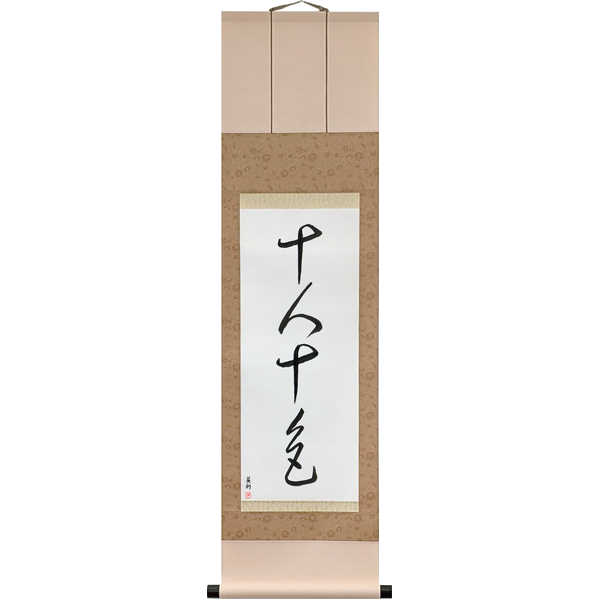
Sold as Ten People, Ten Colors · Read jūnin toiro; the catalogue writes it as one word, juunintoiro, the same sounds · Oldest witness a kabuki digest printed in 1854, and a novel of the pleasure quarter the dictionaries date only to the middle of the nineteenth century; behind it a family of ten people, ten something sayings from 1638 · Sense every person has their own tastes and their own mind; ten people are ten kinds.
The words
十人, jūnin, is ten people. 十色, toiro, is ten colors, with 色 read in its native Japanese sound iro, and the word here means kind, sort, character rather than a color of paint: an Edo Buddha's life quoted by the 1910 proverb dictionary has 十品, ten kinds, in the same slot of a kin saying. The word 色 also means love and the erotic, and the novel the dictionaries cite as the proverb's first use plays on that: its ten colors are ten drunk customers in a pleasure house, each to be handled in his own key. Ten is not a count; it stands for everyone, as in the kin proverb 十人寄れば十色, ten people together are ten colors, which a 1915 dictionary takes as the long form this one clips. A belly variant, 十人十腹, ten people, ten bellies, runs beside it from 1886. Nothing in the four characters varies across the witnesses, and the design carries the only form the proverb has ever been brushed in. The English on the page, ten people, ten colors, is the literal rendering and is right; what the Meiji translators did with the line is the story in the second half of this history.
A history, from the earliest witness
1638 and 1686. 毛吹草, 松江重頼's haikai handbook, and 西鶴's 好色五人女: the family the proverb comes from. 十人寄れば十国の者, ten people together are men of ten provinces. In 西鶴 the passengers on a ferry are 丹波の蚊帳賣、京の呉服屋、鹿島の事觸、乘合船こそをかしけれ, a mosquito-net seller from Tanba, a Kyoto draper, a crier of oracles from Kashima; a passenger boat is a comedy. Not the proverb, but its shape and its joke, half a century before Edo had the four-character form. [both as quoted in 藤井乙男, 諺語大辞典, 1910, pid 862766, koma 264, by eye; neither opened at its own leaf; the 西鶴 line by OCR in reprints of 1895 and 1920]
Mid-nineteenth century, year unresolved. 清談若緑, a 人情本 by 曲山人, the sequel to his 娘節用 of 1831 to 1834. The first citation the 精選版日本国語大辞典 gives: 夜の契りを挑むなる。十人十色の生酔客。千差万別それぞれに。調子をあはす憂苦労, the ones who come courting a night's promise: ten people, ten colors of half-drunk customers, a thousand differences and ten thousand distinctions, and the sorrow and labor of matching each one's key. The proverb's first recorded use is about handling drunks in a brothel. The original printing was not opened and the book's year is not settled; the sentence was read by eye in an 1883 typeset reprint, where the kana beside the four characters read じうにんといろ. [4]
1854. 踊形容花競, a kabuki picture-digest by 柳水亭種清 with prints by 豊国. 十人十色といふやつだから、順礼のうちはうまみがない, it's ten people ten colors, as they say, so among the pilgrims there's nothing to my taste. The oldest dated book in the public-domain corpus that carries the four characters, in a cursive hand, and already といふやつ, the thing they say: a proverb, not a coinage. [5]
1882. 無花果艸紙, a manuscript list of proverbs in the papers of 正岡子規. 十人十色 in a run of sayings, each with a red tick: …疝気持より半持になれ、十人十色、獅子身中の虫…, between better a half-share than a hernia and the worm inside the lion. The poet was fifteen, and the proverb was schoolroom stock. [6]
1882. 英仏通弁自在, 稲垣才三郎's English-French-Japanese phrasebook. The earliest equation with an English proverb opened: Many men, many [minds], then the French Autant de têtes, then 十人十色, with the English and French spelled out in katakana above. [7]
1887 to 1894. The Meiji novelists. 十人十色の手練手管, ten people, ten colors of wiles, is a stock phrase in four 戯作 of 1887 and 1888, one witness for a cliché of the courtesan's trade; an 1887 novel pairs the proverb with the Chinese line the dictionaries would soon reach for, 人心の同じからざるは面の如しとやらいふ事も有つて所謂十人十色, there is that saying that hearts differ like faces, and so, as they say, ten people ten colors; an 1894 book on the duties of women writes 諺にいふ。十人十色にして、蓼食ふ蟲も、好き好きと, as the proverb says, ten people ten colors, and some insects prefer smartweed. [8][9][10]
1888. An English-Japanese Lexicon with an appendix of foreign phrases, revised by 杉浦, 松下 and 曲直瀬, published by 大倉. Three Latin phrases are glossed with the proverb. Facies non omnibus una, 萬人ハ萬人ノ顏容ヲ有ス; 十人十色, every man has his own face. Quot homines, tot sententiæ, the Japanese ending 百人ノ思想アリ; 十人十色, a hundred people, a hundred thoughts. And under a headword misprinted Suus cuique most, 萬人萬人ノ慣習アリ, 十人十色ノ諺アリ, every man has his own custom; there is the proverb ten people, ten colors. The Japanese proverb is being used to explain Ovid and Terence to Japanese readers. [pid 1677027, scans 555, 564 and 566, printed pages 1098 to 1099 for the last, by eye, the last re-read on the day of writing; text at lab.ndl.go.jp/dl/api/page/1677027_566, whose OCR layer interleaves the two columns and misreads 諺 as 麻]
1901 to 1929. The dictionaries. 俗諺辞林 in 1901 glosses the proverb with the Chinese line outright. 俚諺辞典 in 1906: 十人が十人ながら各自皆心の同じからざるをいふ, it says that all ten of ten people have hearts unlike one another, and calls 十人十腹 the same proverb. 上田萬年's romanized dictionary of 1915 takes 十人十色 as the abbreviation of 十人寄れば十色 and renders So many men so many hearts. The Japanese-English dictionaries from 1907 give So many men, so many minds; 井上 in 1909 adds Men's tastes differ with each individual; 斎藤 in 1918 No two men are of a mind; 研究社 in 1929 Every man is in his humour, which is Ben Jonson's title. [pids 863228, 900343, 1900620, 903157, 1869465, 1681530, 1904907; all OCR]
1910. 藤井乙男, 諺語大辞典. 【十人十色】人おのおの好む所、思ふ所を異にするをいふ, it says that each person differs in what he likes and what he thinks, and then, in place of any Japanese source, four Western proverbs: So many men, so many minds and Every one has his taste, both marked French; All tastes are tastes, Italian; There's no disputing about taste. The next headword, 【十人十腹】, is same as above with a Dutch proverb, Many heads, many minds; and on the same page he shelves the family, 十人寄れば十色, 十人寄れば十里の事 from a Buddha's life, and 十人寄れば十国の者 from 毛吹草 and 西鶴. 藤井 gives a canon address for nearly every proverb in his book; for this one he gives none, because there is none. [pid 862766, koma 264, by eye; text at lab.ndl.go.jp/dl/api/page/862766_264, confirmed by the reader]
Today. 精選版日本国語大辞典: 好みや考えなどは、人によってそれぞれみな異なるということ, that tastes and ways of thinking all differ from person to person, with the 清談若緑 sentence as first citation. デジタル大辞泉: 考え方や好みなどが各人それぞれに違っていること. ことわざを知る辞典: 人には、それぞれ違った好みや個性がある, each person has their own different tastes and individuality, with 漱石's cat in 1905 noticing that the human proverb applies to cat society too, the two kin proverbs, and Every man to his taste as the English. [kotobank.jp/word/十人十色; text]
The sense across time
The sense has not moved: people differ, and the proverb says so without judging it. What moves is the register. In its first recorded uses it belongs to the pleasure quarter, drunk customers and courtesans' wiles, and the 色 carries its second meaning underneath. By 1882 it is in a schoolboy's proverb list, by 1901 in dictionaries glossed with a line of the Zuozhuan, and by the twentieth century it is the plain classroom proverb the modern dictionaries define. The Meiji dictionaries chose between hearts, minds and tastes in English, and the choice is real: 俚諺辞典 says hearts, 藤井 says likes and thoughts, ことわざを知る辞典 says tastes and individuality. The page's own gloss, that the saying celebrates our individuality, is the modern and gentlest of the readings, and it is one the sources support.
What is not a source
The proverb has no author and no Chinese source. The Zuozhuan line the Meiji dictionaries used to gloss it, 子產's 人心之不同,如其面焉, men's hearts differ as their faces do; how could I say your face is like mine, is a parallel the lexicographers found, not an origin. Terence's quot homines tot sententiae: suus cuique mos, as many opinions as men; each has his own way, and Ovid's facies non omnibus una, not one face for all, are the Latin the 1888 lexicon set the proverb beside; so many men, so many minds is Terence naturalized in English, and the dictionaries' favorite equivalent for that reason. The 1638 saying about ten people from ten provinces is the proverb's family, not its text. [the Zuozhuan at ctext.org/chun-qiu-zuo-zhuan/xiang-gong-san-shi-yi-nian/zh; Terence at thelatinlibrary.com/ter.phormio.html, lines 453 to 454; both transcriptions; the Ovid line not opened]
The text in English
The dictionaries made the English, and the three American paperbacks each chose differently. 1882 to 1929. Many men, many minds, So many men, so many minds, Men's tastes differ with each individual, No two men are of a mind, Every man is in his humour: the equations above, every one a proverb of minds or tastes, none of them the picture. 1987. David Galef, Even Monkeys Fall from Trees: The Wit and Wisdom of Japanese Proverbs, Tuttle, number 46, page 106. Jū-nin to-iro. Ten men, ten tastes., and in his list of English equivalents, There is no accounting for tastes. He turns the colors into tastes. This is the book the page links, and the equation the page reports from it is correct. [Amazon ASIN 0804832269, which the page links; read in the 2015 EPUB text layer; a printed book, checkable by a reader who holds it] 1996. Guy Zona, Even Withered Trees Give Prosperity to the Mountain, Simon and Schuster, page 55. Ten people, ten colors. The literal, with no Japanese and no source. [ISBN and ASIN not collected; read in the shelf's text layer] 2004. Edward Trimnell, Tigers, Devils, and Fools: A Guide to Japanese Proverbs, Beechmont Crest, page 67. Jūnin toiro. "Ten people, ten colors." Everyone has his or her own individual taste. You can't please all of the people all of the time. The house title, word for word. [ISBN and ASIN not collected; read in the shelf's text layer] The proverb is not in Galef's second book, Even a Stone Buddha Can Talk (Tuttle, 2000); Daniel Crump Buchanan's Japanese Proverbs and Sayings (1965) is locked on the shelf and was not opened.
Today. The EDRDG dictionary the site's own dictionary serves gives several men, several minds; everyone has his own (ideas, tastes, interests, etc.); different strokes for different folks; the page quotes an older text of the same entry. The house title, Ten People, Ten Colors, is the literal rendering that two of the three English books also chose, and it is the reason to buy the design: the picture is what every English proverb of minds and tastes lacks. What a rendering must keep: the ten, which means everyone; and the colors, which are the picture.
A reading
The design and the reading are sound and the title is exactly right. The page's explanation is the weakest in this family, not for what it says but for what it stands on: a dictionary gloss, a comedian, and a bookshop link, with the dictionary's name misspelled. What the page could carry instead, every piece at an address: that this is an Edo saying with no author, first found in an 1850s kabuki book and in a novel where the ten colors are ten drunk customers; that it descends from a saying of 1638 about ten people from ten provinces on one ferry; that when the Meiji translators had to render it they reached for Terence, so many men, so many minds, and for a line of the Zuozhuan, hearts differ as faces do; and that a fifteen-year-old 正岡子規 ticked it in red in his proverb list. Any of those is a better sentence than the one about snowflakes, and each can be checked. Signed, 典, 2026-09-05.
How this was read
By eye: the 1888 lexicon at its third Latin phrase, the 1882 manuscript and the 1883 typeset, all re-read on the day of writing; the 1854 kabuki digest at the four characters; the 1882 phrasebook; the 1910 dictionary at the headword and its family. By text at the address: every National Diet Library leaf above at the page API, re-fetched by a second reader; kotobank; the Zuozhuan and Terence in transcription; the Meiji dictionaries and novels by OCR from the archive; Galef, Zona and Trimnell in the shelf's text layers. Not opened: 清談若緑 in its original printing, and its year; 毛吹草 and 好色五人女 at the leaf; the Buddha's life 藤井 quotes; Ovid; Hepburn's 1872 dictionary by eye, where the proverb is absent by OCR; Buchanan; the 1883 typeset's smaller furigana past the four characters, which the width of the image read does not settle. Every address in this history is a text address except the leaves named by eye, and each of those has a page-API text address beside it; the three American books are printed books, checkable by a reader who holds them. The full apparatus, with every address, is in the account.
References
- 毛吹草 (松江重頼) · 好色五人女 (西鶴) (1638 · 1686) — 藤井 1910 koma 264 by eye, citing both; neither opened; the 西鶴 line in the 1895 and 1920 reprints by OCR (pids 1882876, 912257)
- 釋迦如來一代記 卷四 (Edo) — 藤井 1910 by eye; not opened
- 世話尽 (1656) — pid 2554768, within-book search for 十人 · 十色 · といろ → 0; absent as far as OCR reaches
- 清談若緑 (曲山人, 人情本), the sequel to 娘節用 (1831–34) (19th c. mid (日国); year unresolved) — 精選版 日国 初出; the 1883 春陽堂 typeset pid 879736 scan 160, by eye ↩
- 踊形容花競 (柳水亭種清 作, 豊国 画, kabuki digest) (安政1 = 1854) — pid 10303445 scan 28, cursive, by eye (the four characters and といふやつ read; the rest by OCR) — the oldest dated book in the corpus ↩
- 無花果艸紙 (迂加連達磨, a manuscript proverb list in the Shiki papers) (1882) — pid 2541082 scan 124, by eye, red-marked ↩
- 英仏通弁自在 (稲垣才三郎) (1882) — pid 1939229 scan 34, by eye — the earliest equation with the English proverb opened ↩
- 十人十色の手練手管 — a stock phrase of the 1887–88 戯作 (薔薇の花影 · 社会仮粧舞 · 当世滑稽文章 · 金蘭花縁) (1887–88) — pids 887857 · 882519 · 882623 · 886110 (OCR; the same sentence in four books, one witness) ↩
- 鶴殺疾刃庖刀 (1887) — pid 891402 (OCR) — the 左傳 line paired with it ↩
- 女子の本分 (1894) — pid 757164 (OCR; furigana じふにんといろ) ↩
- 十人十腹 (1886 first) — pid 754193 (OCR); 藤井 1910 同前; 俚諺辞典 1906 前の諺に同じ
- 十人寄れば十色 (1895 first) — pid 821069 (OCR); 上田 1915: 十人十色 is 十人寄れば十色の略
- 諺語大辞典 (藤井) (1910) — koma 264, by eye — no Japanese source given
- 精選版 日国 · 大辞泉 · ことわざを知る辞典 () — kotobank
- The catalogue and both live pages (2026) — cultural_works.csv:349