

人生は短い · jinsei wa mijikai · Life is short
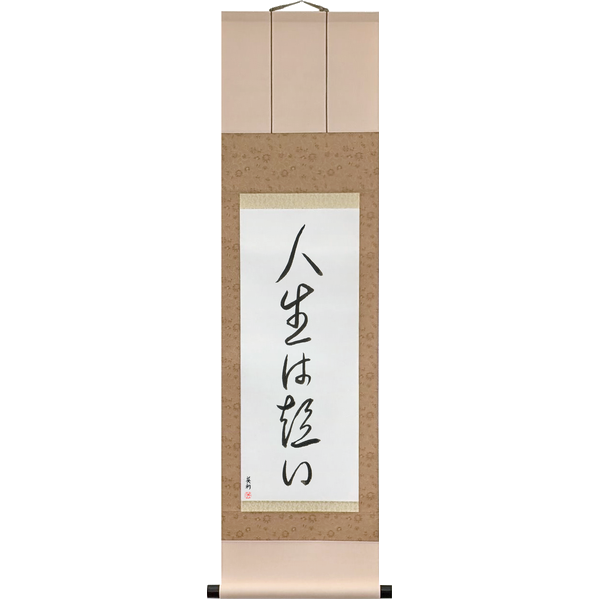
Sold as Life Is Short, one scroll · Read jinsei wa mijikai · Oldest witness the first sentence of the Hippocratic Aphorisms, life is short, and art long, read in Francis Adams's English of 1849; in Japanese, the sentence appears in Meiji readers and moral books from 1895, and Japan's own life is short is a song of 1915 · Sense a reason to do now what matters; in the Greek, a physician's complaint that the craft outlasts the life; in the Japanese proverb, that art outlives the artist; in the song, that a girl should love while her lips are red.
The words
Four words of plain modern Japanese. 人生, jinsei, is a human life, a life span; は marks it as the topic; 短い, mijikai, is short. The classical form of the adjective is 短し, mijikashi, and the proverb and the Meiji books use it, 人生は短し; the scroll's 短い is the modern form of the same word, and the two are one line. There is no pun, no season word, no variant to weigh: the line is a translation, and its history is the history of how life is short came into Japanese and what it was paired with when it did.
A history, from the earliest witness
Hippocrates, Aphorisms, section I, aphorism 1, in Francis Adams's English of 1849. Life is short, and Art long; the crisis fleeting; experience perilous, and decision difficult. The physician must not only be prepared to do what is right himself, but also to make the patient, the attendants, and externals cooperate. The art is medicine, and the aphorism is a working doctor's complaint that the craft takes longer to learn than a life allows. Europe remembers it in Latin, ars longa, vita brevis, and the Japanese proverb tradition cites the Latin; neither the Greek nor a Latin source was opened for this history. [en.wikisource.org/wiki/Aphorisms, Adams's translation; text]
Longfellow's A Psalm of Life, as a Japanese reader of 1902 explains it. The English poem that carried the aphorism to every schoolroom turns it, Art is long, and Time is fleeting, and a Meiji annotated anthology of English and American verse, 山県五十雄's 英米詩歌集, glosses that line for Japanese students in the words the scroll uses: 13. Art is long, and Time is fleeting 學藝に達するには長き歲月を要するに反して人生は短しとの意 (the OCR reads Time 1S fleeting), the sense that reaching mastery of an art takes long years, whereas life is short. The next note explains the muffled drums as the drums of a funeral march, 人の心臟は猶ほ此太皷の如く其打つ每に人の生命は縮まり行くものにて, the human heart is like this drum; with every beat a life shortens. [National Diet Library pid 871168, koma 24, page 40; by eye; text at lab.ndl.go.jp/dl/api/page/871168_24]
1895 to 1908. The sentence in Meiji moral books and English readers. By the 1890s 人生は短し is a sentence Japanese moralists reach for. A translated book of precepts for young men of 1895 quotes Emerson against it: エモルソン曰く人生は短しとせず。利他の爲めの時間は、常に充分に存すと, Emerson says: I do not hold that life is short; there is always time enough for the sake of others. An 1899 treatise on the character of teachers argues from it for order: 人生は短し、然かも數多の人は秩序規律を顧慮せずして自巳に與へられたる業務の時間を更に短縮す (the OCR's 自巳 for 自己), life is short, and yet many people, heedless of order and discipline, shorten still further the time given them for their work. The same year 内村鑑三's English conversation reader renders Life 1s short, and Japanese Politics 1S no place for men who have immortal souls (so the OCR, with its 1 for i) as 人生は短いものです、ソシテ日本の政治界は不滅の靈魂を有する人類の入るへき所では有りません, which is the scroll's exact modern wording, and a 1901 bilingual joke book puts a pun on the four letters of life as 人生は短し唯四字而己. By 1908 a middle-school composition primer sets 人生は短し as exercise 13, an English sentence every pupil should be able to write. [3][4]
1915. 吉井勇's ゴンドラの唄, written for the Geijutsuza's On the Eve, read in the printed play. Japan's own life is short is a song. 楠山正雄's stage adaptation of Turgenev's novel, printed in April 1915 for the 芸術座's April run, closes its preface by thanking the poet: 終りに、この脚本の第五幕のために、特に『ゴンドラの唄』を作して贈られた、吉井勇氏の厚意を謝する, finally, I thank Mr. 吉井勇 for his kindness in writing the Gondola Song especially for the fifth act of this script. In act five Elena sings it: いのち短し、戀せよ、少女、/朱き唇褪せぬ間に/あつき血汐の冷えぬ間に/明日の月日のないものを, life is short; love, girl, while your red lips have not faded, while your hot blood has not cooled; for there is no tomorrow. The stanza's first line is the Japanese sentence a century of listeners know, and it is the scroll's sentence with the classical adjective and 命 for 人生. [pid 954167, koma 4, page 3 (the preface, dated 一千九百十五年四月中旬) and koma 96, pages 180 to 181 (the stanza, headed 第五幕, which the OCR reads 第五墓); by eye; text at lab.ndl.go.jp/dl/api/page/954167_4 and 954167_96]
1915 to 1921. The song in the ear. The same year a Tokyo columnist writes of the gramophone shop bringing the new records, 松井須磨子吹込の「ゴンドラの唄」と「ローレライの唄」があつた, there were 松井須磨子's recordings of the Gondola Song and the Lorelei Song, and calls it 「命短し、戀せよ少女」のゴンドラの唄, the Gondola Song of "life is short, love, girl". A Buddhist moralist of 1917 quotes the line, 「命短し戀せよ少女、熱き血潮の冷えぬ間に」, against a life spent saving for old age, and elsewhere in the same book names it 當時の流行歌であつた, it was the popular song of the day, as an example of 「命短かし戀せよ乙女」といふやうな刹那的の快樂を追ふやうな歌, songs like "life is short, love, maiden" that chase the pleasure of the moment; on that page the OCR layer interleaves the furigana, so its run reads …命うたはやりうたこくみんせいしん一い當時の流行歌であつた。流行歌が國民精神の反映であるとすると、みぢこひをとめせつなてきかいらくたうたまつ短かし戀せよ乙女」といふやうな刹那的の快樂を追ふやうな歌. In 1921 a lecturer on the will pairs it with the Chinese schoolroom maxim: ゴンドラの歌に『生命短し戀せよ乙女』とある。これは全く此の心を歌へるものだ。少年易老學難成一寸光陰不可輕だ, the Gondola Song says "life is short, love, maiden"; that is exactly this mind sung; a boy grows old easily and learning is hard to complete, so do not make light of an inch of light and shade. [pid 954950, koma 39, pages 54 to 55 (松崎天民『人間世間』1915; by eye); pid 906510, koma 16, page 24 and koma 51 (泉芳璟『力と命』1917; koma 16 by eye, koma 51 OCR); pid 961844, koma 155 (千葉命吉『一切衝動皆満足』1921; OCR); text at lab.ndl.go.jp/dl/api/page/954950_39, 906510_16, 961844_155]
The proverb with art in front of it. 芸術は長く人生は短し, art is long, life is short, is in the modern dictionaries as a proverb, and ことわざを知る辞典 gives its Japanese sense: 芸術は永遠であるが、人生は短い。人間の命は短いが、すぐれた芸術作品は作者が死んだのちも長く残る。だから芸道に精進しなければならない, art is eternal but life is short; a person's life is short, but a great work of art survives long after its maker's death, so one must devote oneself to the art, with 坂口安吾 as its example of use. 精選版日本国語大辞典 says the proverb came to be used in that sense, which is the dictionary's own hint that the Greek meant something narrower. A Japanese lecture on German historiography quotes it as a set phrase, 「藝術は長く人生は短し」の語, in a book whose catalogue date of 1800 cannot be right for a text naming Ranke and Lamprecht; it is not dated here. [5]
Today. 人生は短い is in 158 digitized Japanese books to 1946 and 人生は短し in 117; the song's line 戀せよ乙女 in 28 and ゴンドラの唄 in 47. [lab.ndl.go.jp/dl/api/book/search, 2026-09-05 and 2026-09-06; text]
The sense across time
One sentence, three uses. The physician meant that the craft outlasts the life. The Japanese proverb, with 芸術 put in front, means that the work outlasts the maker and the maker should get on with it. The song means that youth is brief and love should not wait, and that is the sense most Japanese hear first, because 吉井勇's first line is the aphorism's first clause with 命 for 人生 and a girl for a doctor. The Meiji moralists used it the way the scroll does, as a reason to do now what matters, and Emerson's Japanese translator used it to say the opposite. The scroll carries the clause every use shares and none of the second halves.
What is not a source
The song is not the source of the scroll's sentence; it is the sentence's most famous Japanese setting, and a buyer who hears いのち短し in the scroll's 人生は短い is hearing that. Longfellow's poem is the English carrier of the aphorism, not its origin, and art is long is Hippocrates's. Seneca's De brevitate vitae, where the Latin form is usually cited from, was not opened, and the Greek was not opened. The proverb 芸術は長く人生は短し is a different scroll, with a different subject in front.
The line in English
The English is the original, and the Japanese is its rendering; the lineage runs the other way from most of this Library.
1849. Francis Adams, The Genuine Works of Hippocrates, the Aphorisms, section I. Life is short, and Art long; the crisis fleeting; experience perilous, and decision difficult. [en.wikisource.org/wiki/Aphorisms; text; the printed volume not opened]
1899. 内村鑑三 ed., 英和時事会話, Tokyo. Life 1s short, and Japanese Politics 1S no place for men who have immortal souls (the OCR's 1 for i), glossed 人生は短いものです. A Meiji English reader is where the scroll's modern wording first appears against its English. [3]
Today. Life Is Short is the house title and needs no change. The romaji is jinsei wa mijikai, no macron. A rendering must keep the sentence whole and alone; the English idiom life is short already carries the Japanese sense, and adding and art is long would make it the other scroll.
A reading
The scroll sells the half of the aphorism that everyone knows, and drops the half that makes it Hippocrates's, and it is right to: life is short is a complete thought, and in Japanese it has been one since the Meiji readers wrote it under English sentences. What I did not expect, and what the buyer should know, is that Japan has its own life is short, a song a poet wrote in a week for a stage adaptation of Turgenev in 1915, which a great actress recorded that year and a moralist was already calling the popular song of the day by 1917; its first line, いのち短し恋せよ乙女, is the scroll's sentence in the old adjective, and it is the line a Japanese reader will hear behind these four words. Romaji jinsei wa mijikai. Signed, 典, 2026-09-06.
How this was read
By eye, at the National Diet Library page images at width 3600 and on crops: the 1915 play's preface and act five, the 1915 column on 松井須磨子's record, the 1917 moral book's page 24, the 1902 anthology's page 40. By OCR at the local harvest: the 1895 and 1899 moral books, the 1899 and 1901 bilingual readers, the 1917 book's second page, the 1921 lecture, the undated historiography lecture; the 1908 primer at the lab search's snippet only. By text at the address: Adams's Hippocrates at Wikisource; the kotobank proverb page. Not opened: the Greek; Seneca; a Japanese translation of the Aphorisms; Longfellow's poem in an English edition; 吉井勇's own collected verse for the song's later printings; the live product page. A leaf cited as pid P, koma N resolves as text at lab.ndl.go.jp/dl/api/page/P_N and as an image at dl.ndl.go.jp/api/iiif/P/R<N, seven digits>/full/3600,/0/default.jpg. The full apparatus, with every address, is in the account.
References
- The scroll (ours) (—) — M6045SSVB3A; cultural_works 598
- Hippocrates, Aphorisms I.1 (Adams 1849) (c. 400 BC) — en.wikisource (TEXT)
- 内村鑑三 編『英和時事会話』 (1899) — NDL pid 871357 koma 13, OCR ↩
- 『笑話集:英和対訳』 (1901) — NDL pid 871206 koma 70, OCR ↩
- ことわざを知る辞典 and three others (current) — kotobank 488732 ↩