

言わぬが花 · iwanu ga hana · Not saying is the flower
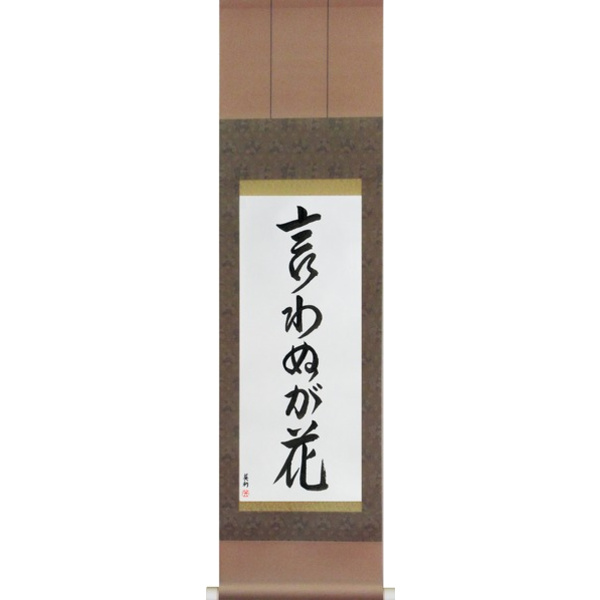
Sold as Not Saying Is A Flower · Read iwanu ga hana · Oldest witness stage manuscripts of about 1800, where the line is already a pun the audience knows; its ancestor, not saying surpasses saying, is in the Tale of Genji · Sense some things are better unsaid: said outright they lose their flavor, and their grace.
The words
言わぬ, iwanu, is not saying, with the classical negative ぬ kept in the proverb. が is the old nominative in a nominal sentence: not-saying is …. 花, hana, is the flower, and in this idiom the best of a thing, the graceful choice; the ことわざを知る辞典 notes the mold 「○○が花」, which limits an action and says nothing beats it, as in 知らぬが仏, not knowing is Buddha. It is not the flower of wisdom: no Japanese source completes the phrase, and the English book that says the proverb is short for a longer maxim invented the longer maxim, below. The dictionaries' constant is taste, not prudence. 藤井乙男 in 1910: 默止して言はざるが、却て勝れり、あらはに言ひては味なしなどいふ場合に用ふ, to keep silent is the better; used where saying it plainly would kill the flavor. デジタル大辞泉: 口に出して言わないほうが味わいもあり、差し障りもなくてよい, unsaid it keeps its savor, and causes no trouble. Wiktionary's gloss is 粋 or 奥ゆかしい, chic or reserved.
A history, from the earliest witness
The Heian period. The ancestor, in the Tale of Genji and the poets. いはぬをもいふにまさると知りながらおしこめたるは苦しかりけり, knowing that not saying surpasses saying, still to hold it in is painful, in the 末摘花 chapter; the same figure in the 横笛 chapter, in the 大和物語 and in the 古今六帖, always of love unspoken. By 1638 the line 云はぬは云ふにまさる is a proverb in the first printed proverb collection, 毛吹草; the flower is not there yet. [2]
About 1800. Two stage manuscripts. In 八陣守護城, a flower-arrangement scene: もう何事もいわぬか花のおもてなし, no more; not saying is the flower of this hospitality, with real flowers on the stage. In 實事譚血染紅葉: いわぬが花の春の道中, not saying is the flower of a spring journey. The line is already a saying the audience knows, and already a pun. The cursive of both leaves defeated my eye; they stand on the library's OCR. [3][4]
1816 to 1867. Comic books and kabuki. 古今亭三鳥 in 1816: いはぬか花のかに匂ふ, the scent of the flower unsaid; a 合巻 of 1824: いはぬがはなのちんざしき; 河竹新七 in 1864 and a 合巻 of 1865: いわぬが花のかうしさき (格子先), the flower unsaid at the lattice. Every Edo witness runs the 花 on into the next phrase. [pids 10301582 koma 9, 9893241 koma 10, 10303455 koma 8; OCR]
1886. 坪内逍遙, 当世書生気質. The novelist, on whether to spell out his characters' relations: 關係善きも惡きもあからさまに作者が自儘の考案もて。いえぬが花か讀む人が自得も花歟, or is it the flower for the author not to say, and the flower too for the reader to work it out? The print writes いえぬ, the Tokyo colloquial for いわぬ, with the reading はな beside each 花; the modern dictionary quotes it normalized. [7]
1893 to 1933. The dictionaries. 古今俚諺類聚 (1893) and 俚諺類集 (1906) list it beside its ancestor; 皇国俚諺叢 (1901) sets a line of the 史記 beside it as near in sense; 藤井 1910 files it with the gloss above and no source, and enters the counter-proverb next to it, 言わぬが損, not saying is a loss; 大日本国語辞典 (1915) and 言泉 (1922) read it as both charm and advantage, 趣味また利益; 俚諺大辞典 (1933) as to keep silent is the better. None cites a source. [pids 767886 scan 6, 903906 scan 6, 767884 scan 29, 954645 scan 169, 969159 scan 165, 1453041 scan 44; OCR]
Today. The ことわざを知る辞典: ことばで言わないほうが、かえってよい。はっきり言ってしまうと、身も蓋もない, better not to put it in words; said outright, there is nothing left, with 逍遙's sentence as its example. The 精選版日本国語大辞典's entry is not on kotobank for this headword and was not read. [kotobank.jp/word/言わぬが花-430611; text]
The sense across time
One sense from the stage of 1800 to the dictionary of today: the unsaid keeps a grace the said loses. The Edo stage uses it as a wink and a pun; 逍遙 turns it on the art of the novel; 藤井 reads it as taste; the 1915 dictionary adds advantage; the English dictionaries of 1909 to 1911 find its most Japanese use in 言はぬが花の年頃, a certain age, the age a woman does not state. What it is not is prudence. Silence is golden, its English equation since 1904, is about the safety of not speaking; this proverb is about the beauty of it.
What is not a source
The longer maxim. The house page reports that the proverb is short for Not to speak is the flower of wisdom. No Japanese source has that sentence, and a search of every spelling of 言わぬが花の in the pre-1945 corpus returns only the stage puns. The sentence is Daniel Crump Buchanan's parenthetical literal of 1965, with wisdom his own addition to a line that has 花 and no 智; he does not say the proverb is short for anything, and the page misreports him. A 1996 English collection prints his parenthesis as a proverb in its own right. The Chinese parallel the 1901 collection offers, 桃李不言、下自成蹊, the peach and plum say nothing, and a path forms beneath them, is a pairing, not an origin. [Buchanan 1965, page 74, by image; Zona 1996, page 30, text layer]
The text in English
Hepburn's dictionary of 1872 has nothing. 1904. 佐久間, 和英中辞林: Yuwanu ga hana. Silence is golden, the first equation. 1909 and 1911, 井上十吉: そこはいはぬが花だ, On that point silence is golden. 1918, 斎藤秀三郎: Better leave it unsaid; The least said the soonest mended; The less said the better, and Speech is silvern but silence golden kept for the ancestor. [pids 870208 scan 597, 1869465 scan 203, 1681530 scans 57 and 357; OCR] 1965. Daniel Crump Buchanan, Japanese Proverbs and Sayings, University of Oklahoma Press, page 74. Iwanu ga hana: "Better leave it unsaid." (Lit., "Not to speak is the flower of wisdom.") The person who knows when not to speak has true self-discipline. English parallel: Silence is golden. His rendering is 斎藤's, his parallel the 1904 equation. [by image; a printed book] 1996. Guy Zona, Even Withered Trees Give Prosperity to the Mountain, Simon and Schuster, page 30. Not to speak is the flower of wisdom. 2004. Edward Trimnell, Tigers, Devils, and Fools, Beechmont Crest, page 62. Not saying is a flower. Some things are better left unsaid. The page's title is his literal. [text layers] Not in Galef (1987, 2000). Today. JMdict: some things are better left unsaid; silence is golden. The house title keeps the flower, which is right; what a rendering must keep is the grace, not the caution, and some things are better left unsaid is the nearer of the two English proverbs.
A reading
The design and the romaji are sound, and the literal title is the right choice for this line, because the flower has to stay. The page is grounded on two paperbacks and repeats a claim that the proverb is short for a longer maxim; I searched for that maxim under every spelling and found only puns, and the book the page cites for it does not say it. What the sources give is smaller and better: a late-Edo stage saying, no older than about 1800, made from a Heian proverb of unspoken love and the mold 「○○が花」, read by every Japanese dictionary as a matter of taste rather than caution, and given its English equation in 1904. The page should drop the short for, say the proverb is a younger cousin of 言わぬは言うにまさる, and give 逍遙's sentence or one stage line. My own reading: this is the proverb of the unsaid as grace, not of silence as safety; silence is golden is its prudent cousin. Signed, 典, 2026-09-05.
How this was read
By eye: 逍遙's leaf and 藤井's, both re-read on the day of writing; Buchanan at the page. By text at the address: the kotobank entry with its two dictionaries; the two leaves above at the National Diet Library's page API; the stage manuscripts, the 合巻, seven Meiji and Shōwa dictionaries and the bilingual shelf by OCR; 藤井's 1929 reprints of the two first collections; Zona and Trimnell in their text layers. Not opened: the 日国's own entry, which kotobank does not carry for this headword; the 1800 manuscripts at the line by eye, a hand I could not read; 譬喩尽 of 1786, which the library does not hold. Every address in this history is a text address except Buchanan's page and the two paperbacks, which a reader checks by holding the book. The full apparatus, with every address, is in the account.
References
- 源氏物語 末摘花 · 横笛; 大和物語; 古今六帖 (the ancestor) (Heian) — quoted in 藤井 1910 scan 69, by eye; 大日本国語辞典 1915
- 毛吹草 巻二 (the ancestor) (1638/1645) — 藤井 1929 pid 1452761 scan 130, OCR ↩
- 八陣守護城 (stage MS) (c. 1800 (lab); the play 1807 (recall)) — pid 2537883 koma 4, the lab's OCR; leaf opened, not read ↩
- 實事譚血染紅葉 (stage MS) (c. 1800 (lab)) — pid 2560214 koma 17, OCR ↩
- 本町育戯作清書 (古今亭三鳥) · 狭夜衣恋歌謎々 · 伊達姿辰巳八景 (1816 · 1824 · 1828) — 合巻, the lab's OCR
- 三升蒔画巵 (桜田治助三世) · 処女翫浮名横櫛 (河竹新七二世) · 上総木綿小紋単地 (勝諺蔵) · 契情曽我廓亀鑑 (1862 · 1864 · 1865 · 1867) — kabuki and 合巻, the lab's OCR
- 当世書生気質 (坪内逍遙) (1886) — pid 887443 scan 6, by eye; ことわざを知る辞典's citation, normalized to いわぬ ↩
- 音曲集大全 (1889) — the local archive
- 古今俚諺類聚 · 皇国俚諺叢 · 俚諺類集 (1893 · 1901 · 1906) — OCR
- 諺語大辞典 (藤井) (1910) — scan 69, by eye; no source
- 大日本国語辞典 · 言泉 · 俚諺大辞典 (1915 · 1922 · 1933) — OCR; no citation in any
- The catalogue and both live pages (2026) — cultural_works.csv:366