

塵も積もれば山となる · chiri mo tsumoreba yama to naru · Even dust, piled up, becomes a mountain
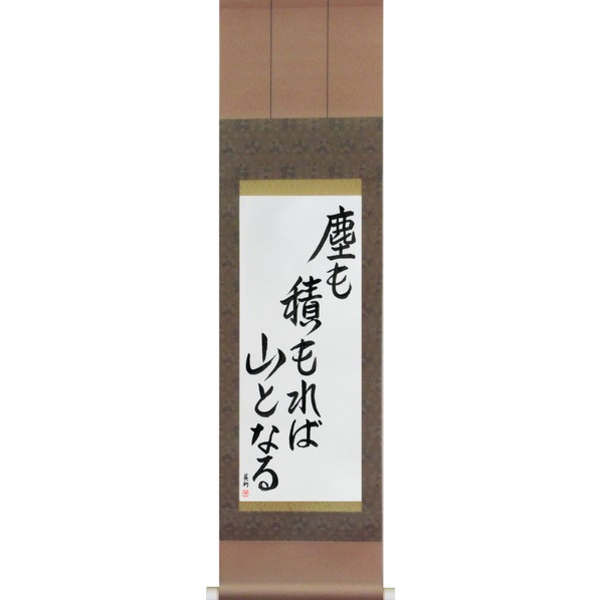
Sold as Even dust if piled can become a mountain · Read chiri mo tsumoreba yama to naru, as the catalogue has it · Oldest witness as a Japanese proverb, a book of sayings printed in 1656; as an image, the preface to the Kokinshū in 905, a Tang poet's couplet before that, and Chinese philosophers of the third century BC behind him · Sense many small things, kept up, come to something great; the dust is many, not one.
The words
塵, chiri, is dust, the least particle of anything; in Buddhist Chinese the word for the smallest unit of matter is 微塵, fine dust, and that is where the canon line below comes from. 積もれば, tsumoreba, is the verb to pile up, to accumulate in the conditional, if it piles up; the も before it is even: even dust, if it piles up. 山となる, yama to naru, becomes a mountain, with the classical となる that the proverb has kept. Three things vary across the witnesses and none of them touches the design. The verb: the older written form is 積りて, having piled up, in 1656; the Edo and Meiji spoken form is 積って, in Hepburn's dictionary of 1872 and a novel of 1885; the conditional 積れば is the form the dictionaries and the catalogue head with. The even: absent in 1656, present in a dictionary of 1908 and in every modern form. And the spelling of the verb's ending, 積れば against 積もれば, which is one word written two ways; the prewar corpus almost always writes the shorter, and the catalogue's 積もれば is the postwar standard. So the design carries the modern standard form of an old sentence, and needs no change. The English on the page is the literal rendering and is right, and what the page then does with it is the reading at the end.
A history, from the earliest witness
Third century BC. 荀子, the chapter 勸學, An Exhortation to Learning. 積土成山,風雨興焉;積水成淵,蛟龍生焉;積善成德,而神明自得,聖心備焉。故不積蹞步,無以致千里;不積小流,無以成江海, pile up earth and it becomes a mountain, and wind and rain rise from it; pile up water and it becomes a deep, and dragons are born in it; pile up good and it becomes virtue, and the spirit's clarity comes of itself. So without piling up half-steps there is no reaching a thousand miles; without piling up small streams there is no making a river or a sea. The image of piled earth is here already, as a figure for learning, and it is the image every later text reuses. 劉向's 説苑 in the first century BC, 土積成山,則豫樟生焉, and 董仲舒's memorial in the 漢書, 眾少成多,積小致鉅, the few become many, the small piled up reaches the great, say the same thing in the same century's prose; none of the three uses the word dust. [ctext.org/xunzi/quan-xue, paragraph 9; ctext.org/shuo-yuan/jian-ben, paragraph 9; ctext.org/han-shu/dong-zhong-shu-zhuan, paragraph 34; transcriptions read through a fetch summarizer]
Early fifth century. The 大智度論, Nāgārjuna's commentary on the Perfection of Wisdom in Kumārajīva's Chinese, fascicle 94. The line the modern dictionaries give as the proverb's origin: 譬如積微塵成山,難可得移動, it is like fine dust piled up into a mountain, which cannot be moved. In its column the mountain is the weight of accumulated karma, the deeds a being piles up out of greed and anger until they cannot be shifted, and the 故事成語を知る辞典 says so plainly: even a small anger or desire, repeated, makes the soul hard to save. It is a simile of the same shape as the proverb, with 微塵 and 成山 in one sentence, and its moral runs the other way. [CBETA, Taishō volume 25, number 1509, page 720b, line 11, at the column; text]
Ninth century. 白居易, 續座右銘, A Continued Motto for the Right of the Seat. The poet kept 崔子玉's old motto on his study wall, found it incomplete, and continued it: 千里始足下、高山起微塵 (Wikisource prints 髙)、吾道亦如此、行之貴日新, a thousand miles begins under the foot; a high mountain rises from fine dust; my way is like this too, and in walking it what counts is to be new each day. The first line is 老子's; the second is 荀子's piled earth in the Buddhist word for dust. This is the couplet Japan took. [zh.wikisource.org/wiki/白氏長慶集/卷039; transcription, through a fetch summarizer; 老子 chapter 64 not opened]
905. 紀貫之's kana preface to the 古今和歌集. Of how poetry grew from small beginnings: 遠き所も、出で立つ足もとよりはじまりて、年月をわたり、高き山も、麓の塵ひぢよりなりて、天雲たなびくまで生ひのぼれるが如くに、この歌も、かくの如くなるべし, as a far place begins from the foot that sets out, and crosses the years, and as a high mountain is made from the dust and mud at its base and grows up until the clouds of heaven trail across it, so must this poetry have been. Tsurayuki has taken Bai Juyi's couplet and made it grander, adding the years to the thousand miles and the trailing clouds to the mountain, and the preface's Chinese twin, the 真名序, says the same in Chinese. The Japanese trail of the proverb runs through this sentence. [1][1]
Fifteenth century. The 榮雅抄, a commentary on the preface, as quoted in 1939. 榮雅抄曰、白居易云、千里始足下、高山起微塵。大戴禮曰、積土成山、風雨興焉. The identification of Tsurayuki's sentence with Bai Juyi's couplet and with the piled earth of the Chinese classics is five centuries old, not a modern finding. An annotated edition of 1901 does not name Bai Juyi: at 遠き所も it sets the 中庸, the 老子 (千里之行、始於足下), the 止觀 and the 荀子, and at 高き山も the 大戴禮's piled earth. [紀要別冊文献蒐載, 1939, pid 1186341, scan 7, OCR, confirmed verbatim by the reader; 古今和歌集序析義, 1901, pid 873291, koma 18, OCR; text at lab.ndl.go.jp/dl/api/page/1186341_7 and lab.ndl.go.jp/dl/api/page/873291_18]
Fifteenth century. The Noh play 山姥, the mountain crone. The crone opens her sermon with the same image: 夫れ山と謂つば、塵泥より起つて、天雲かゝる千丈の峯 (the OCR reads 干丈)、海は苔の露よりしたゞりて、波濤を疊む萬水たり, what we call a mountain rises from dust and mud to a peak of a thousand fathoms that the clouds hang on; the sea drips from the dew on moss to the ten thousand waters that fold their waves. A 1908 commentary turns it back toward the sutra: mountain and sea are small things piled and piled, and in the bodies of living beings small delusions pile and pile into rebirth. [2][2]
1656. 世話尽, a book of sayings in kana. 塵積りて山となる, dust, having piled up, becomes a mountain (the OCR layer reads 山と成), at the head of a column that runs on to the judgments of hell too depend on money and a rich house has no second generation. The earliest witness opened to the proverb as a Japanese sentence; without the even the modern form carries. [3]
Edo, reprinted 1912. A tale of a merchant of Sakai, in the collection 雑史集. 遠き所もいで立つ足もとよりはじまると古人の申置きしも立身の肝要 … 山もふもとのちりひぢより起つて天雲のたな引く迄おひのぼるがごとし。されば堺にもずや宗安といひてうとくなる人有り, the ancients said that a far place begins under the foot that sets out, and that is the heart of making one's way; a mountain rises from the dust and mud at its base until the clouds trail across it. Now in Sakai there was a wealthy man, もずや Sōan. Tsurayuki's sentence, put to work as a lesson in getting on. [4]
1872. James Curtis Hepburn, 和英語林集成, second edition, page 567. Under the verb: TSUMORI … Chiri tsumotte yama to naru, (prov.) dust heaped up becomes a mountain. The first English on the shelf, marked as a proverb, in the spoken form without even. [5]
1885 and 1908. 三遊亭円朝's 塩原多助一代記 has 微塵積つて山となるの譬の通り, just as the saying goes, fine dust piled up becomes a mountain, with the Buddhist word for dust; a Japanese-English dictionary of 1908 has Chiri mo tsumotte yamato naru, 塵も積つて山となる, Even dust heaped up makes a hill, the first English with even. [7][8]
1910. 藤井乙男, 諺語大辞典. Three entries. Under 【塵ツモリテ山トナル】 he gives the two other headwords, 微塵積って山となる and 砂長じて巌となる, sand grows into a boulder, which is the image of the national anthem; then his sources in order: the Kokinshū preface first, the 説苑, Bai Juyi's couplet, the 大智度論, another Zen text, and 董仲舒; then four European proverbs, Drop by drop fills the tub, French; Many a little makes a mickle; Little and often makes a heap in time, German; Little brooks make great rivers, French. Under 【微塵積ツテ山トナル】 the preface and the 説苑 again, and under a headword for the Noh, the crone's line with 荀子 beside it. He puts the Japanese preface before the Chinese sutra, which is the right order for the Japanese proverb. [9]
Today. デジタル大辞泉: 《「大智度論」九四から》ごくわずかのものでも、数多く積もり重なれば高大なものとなることのたとえ, from the 大智度論, fascicle 94: a figure for how even the slightest things, piled up in numbers, become something high and great. ことわざを知る辞典 gives the same sense and a second, hortatory one, 小さな努力でもたゆまず続けていくと、いつか大きな成果が得られる, small efforts kept up without slackening bring a great result one day; it names the sutra as origin, the Kokinshū preface as the old Japanese form, the Edo period as when the present form came into common use, and the Edo いろは karuta as carrying it, and it gives Many a little makes a mickle as the English. The 故事成語を知る辞典 quotes the sutra in Japanese and says what it meant there. [kotobank.jp/word/塵も積もれば山となる; text]
The sense across time
One sense, from 荀子 to the modern dictionaries: many small things, kept up, come to something great. What changes is what the small things are. For 荀子 and 董仲舒 they are learning and virtue; for the sutra they are sins, and the mountain is the one you cannot move; for Bai Juyi and Tsurayuki they are the steps of a way and the growth of poetry; for the Noh crone they are the mountain itself, and her commentator makes them delusions; for the Edo tale and the Meiji savings posters the dictionaries mention they are coins. The Japanese proverb kept the shape and let the content go, which is what a proverb does. Nothing in the tradition reads the dust as a seed.
What is not a source
The 大智度論 is the origin the modern dictionaries name, and it is a real parallel in the canon, the one text that has fine dust and becomes a mountain in a single line; but its mountain is the weight of bad karma, and the Japanese trail runs through the Kokinshū preface, whose source the commentators named as Bai Juyi five hundred years ago. The honest order is the preface as the Japanese source and the sutra as the canon parallel. 砂長じて巌となる, sand growing into a boulder, is the anthem's image, which 藤井 sets beside the proverb as the same thought; 積少成多 is the Chinese four-character form the dictionaries print beside it, and 티끌 모아 태산 the Korean. Great oaks from little acorns grow, which the page offers as another translation, is an English proverb about one small thing growing by its nature, and the next section shows where it came in.
The text in English
The literal rendering is a century and a half old and every English book keeps it. 1872. Hepburn. Dust heaped up becomes a mountain. 1908. Even dust heaped up makes a hill. 1910. 藤井's four equivalents, above, every one about many small things adding up. 1965. Daniel Crump Buchanan, Japanese Proverbs and Sayings, University of Oklahoma Press, page 158. Chiri mo tsumoreba yama to naru: "Even dust when accumulated makes a mountain." English parallel: Little and often makes a heap in time. The literal, with even for も, and 藤井's German proverb as the parallel. [LCCN and ASIN not collected; read by page image and in the shelf's text layer; a printed book, checkable by a reader who holds it] 1987. David Galef, Even Monkeys Fall from Trees, Tuttle, number 32, page 78. Chiri mo tsumoreba yama to naru. Even dust amassed will grow into a mountain., and in his list of English equivalents, Great oaks from little acorns grow. This is where the acorn enters the proverb's English life, in a newspaper game Galef's own preface describes; it is the one equivalent in the whole lineage that is about one thing growing rather than many things piling. [Amazon ASIN 0804832269; read in the 2015 EPUB text layer] 1996. Guy Zona, Even Withered Trees Give Prosperity to the Mountain, Simon and Schuster, page 14. Even dust, when accumulated, makes a mountain. No Japanese, no source. 2004. Edward Trimnell, Tigers, Devils, and Fools, Beechmont Crest, page 21. Dust, when accumulated, makes a mountain, then This proverb encourages people to be patient when accumulating savings or combining many small efforts. Zona's wording without the even, and the savings reading the Japanese dictionaries also record. [ISBNs and ASINs not collected; both read in the shelf's text layers] The proverb is not in Galef's second book, Even a Stone Buddha Can Talk (2000).
Today. The house translation, Even dust if piled can become a mountain, stands in Hepburn's and Buchanan's line: literal, even for も, piled for the verb, can become softening となる. What a rendering must keep: the dust as many, and the piling as the act; even is worth keeping, and can is a courtesy the Japanese does not need.
A reading
The design is sound, the reading is sound, and the page's first paragraph is right: little things add up. The second paragraph is where it goes wrong, and in an interesting way. It offers Great oaks from little acorns grow as another translation, concedes that the Japanese has nothing to do with acorns, and then keeps the acorn's meaning anyway: regardless of what we start as, we can become something great. That is a proverb about one small thing becoming great by its nature. This proverb is about many small things becoming great by number, and every witness from 荀子 to Hepburn to Buchanan says so: piled earth, piled water, drop by drop, little and often, many a little. The dust is not a seed. The acorn came in through one American paperback in 1987, and the page took the paperback's equivalent for the proverb's sense. What the page could say instead is the chain, which is better than the acorn and is true: an image of piled earth in a Chinese philosopher of the third century BC; a Tang poet's couplet on his study wall; the preface to Japan's first imperial anthology, using it for how poetry itself grew; a Noh crone using it for the mountain she haunts; and the proverb in a book of sayings in 1656, on a karuta card since, and on savings posters in the Meiji. On the sutra: name it, as the dictionaries do, and say what it meant there, because a buyer who looks it up will find a mountain of sins, and should not be surprised. Signed, 典, 2026-09-05.
How this was read
By eye: the 1656 leaf, re-read on the day of writing; Hepburn at the entry; 藤井's three entries; Buchanan at the page by image. By text at the address: the Chinese classics in transcription through a fetch summarizer; the sutra at CBETA's column; Bai Juyi at Wikisource; the two annotated Kokinshū editions, the 1939 extracts, the 1901 commentary, the Noh in two printings, the 1912 tale and the 1908 dictionary by OCR from the archive, each re-fetched at the page API by a second reader; the four kotobank dictionaries; Galef, Zona, Trimnell and Buchanan in the shelf's text layers. Not opened: a manuscript of the preface; 老子 at its chapter; the 1885 novel at a leaf; a school reader of 1883 that the search return carries for the kana form, whose cited leaf turned out blank and whose leaf was not found; the second half of 藤井's sutra citation; the Japanese dictionary of record at its own page for a first citation, which the proverb's 1656 witness may predate; the Edo karuta card the dictionary names. Every address in this history is a text address except the leaves named by eye, and each of those has a page-API text address beside it; the four English books are printed books, checkable by a reader who holds them. The full apparatus, with every address, is in the account.
References
- 古今和歌集 仮名序 (紀貫之) (905) — Kubota 校註 1938 pid 1031921 scan 7 (OCR); Kaneko 評釈 1908 pid 873304 (OCR); 藤井 1910 koma 337 quotes it first, by eye ↩
- 謡曲 山姥 (Zeami's circle) (15th c.) — 謡曲狂言 1921 pid 942796 scan 75 (OCR); 謡曲評釈 1908 pid 876568 scan 74 (OCR); 藤井 1910 koma 533 quotes it, by eye ↩
- 世話尽 (1656) — NDL 古典籍 pid 2554768 scan 8, right page, first column, by eye; the OCR of the same leaf agrees ↩
- a tale in 雑史集 (1912 reprint of an Edo text) (Edo; printed 1912) — pid 925907 scan 361 (OCR); the Edo work's own title not read from the page ↩
- Hepburn, 和英語林集成 2nd ed. (1872) — pid 993689 scan 301, p. 567, by eye ↩
- 単語短句本 初等教科 (1883) — pid 863309, from the search return; scan 26 as cited is a blank leaf (by eye s35) and the anchor was not located at komas 20-26
- 塩原多助一代記 (円朝) (1885) — pid 891318 (search highlight, OCR) ↩
- 和英新辞典 会話作文 (1908) — pid 903158 scan 300 (OCR; complete in the OCR layer, confirmed s35) ↩
- 諺語大辞典 (藤井乙男) (1910) — pid 862766 koma 337, 494, 533, by eye ↩
- 精選版 日本国語大辞典 · デジタル大辞泉 () — kotobank, through the summarizer
- The catalogue and both live pages (2026) — cultural_works.csv:345; the scroll URL slug reads *chiri-wo-tsumoreba*