

逢うは別れの始め · au wa wakare no hajime · To meet is the beginning of parting
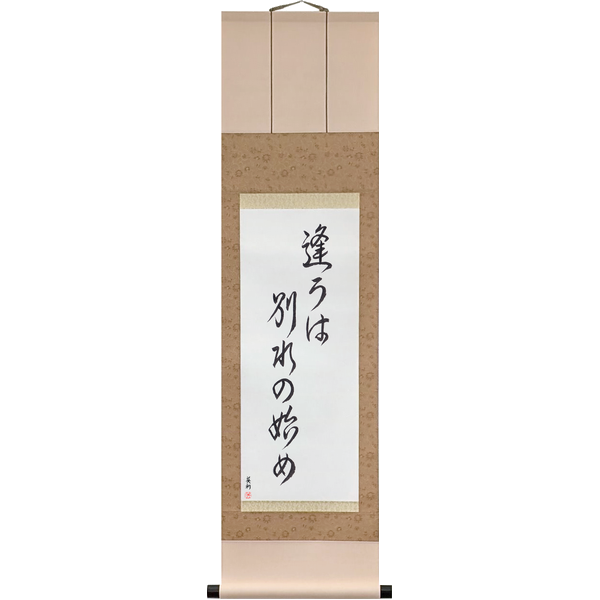
Sold as Meeting is only the beginning of separation · Read au wa wakare no hajime · Oldest witness the Buddha's last sermon, in Chinese translation, where he tells the grieving monks that to meet and never part cannot be had; the Japanese sentence first in a love poem of 1232 and on the stage by 1693 · Sense every meeting already holds its parting; said, in the old sources, to stop grieving.
The words
逢う, au, is to meet, and in the oldest Japanese witnesses it is the lovers' meeting: the sentence begins its Japanese life in poems about the parting at dawn after one night. 別れ, wakare, is parting; 始め, hajime, is beginning. A variant has 基, motoi, foundation, in place of 始め. The 1910 proverb dictionary's gloss is the plainest: 逢ふといふことあれば、既に別るゝことあるを豫期せざるべからず, where there is meeting, parting is already to be expected. Under the Japanese sentence is a Chinese line, 合者離之始, what is joined is the beginning of what parts, and under that a Buddhist term, 会者定離, e-sha-jō-ri, those who meet are fixed to part, which every Japanese book treats as scripture. It is not; the sutras say it in other words, below. The house title's only is not in the Japanese.
A history, from the earliest witness
The Buddha's last sermon, in the Chinese of 鳩摩羅什 (Kumārajīva), about 400. 遺教經 (佛垂般涅槃略說教誡經). The dying Buddha to the monks: 汝等比丘,勿懷憂惱。若我住世一劫會亦當滅,會而不離終不可得 … 是故當知,世皆無常,會必有離,勿懷憂也, monks, do not grieve. Were I to stay in the world an aeon, the meeting would still end; to meet and never part cannot be had. Know therefore that all the world is impermanent and meeting must have parting, and do not grieve. The 涅槃經 (大般涅槃經) has the same thought in verse, to the layman 純陀 who has offered the last meal and begs the Buddha to stay: 夫盛必有衰,合會有別離, what flourishes must decline; what comes together has its parting. [CBETA, T12n0389_p1112b07 to 13 and T12n0374_p0373a26 to b01, at cbdata.dila.edu.tw/stable/juans?work=T0389&juan=1 and work=T0374&juan=2; text]
About 810. 白居易 (Bai Juyi), the poem 和夢遊春詩一百韻. A hundred-couplet answer to his friend 元稹's 夢遊春詩; Bai's own head note quotes 元稹's preface and says that his reply's final chapter returns to the Buddha's way, 其章旨卒歸於此, as the 法華經 and the 維摩經 lead through the burning house and the brothel back to the truth. In the stanza that tells the friend to take up the meditation sutras and read, 欲除憂惱病,當取禪經讀: 合者離之始,樂兮憂所伏, what is joined is the beginning of what parts; joy is where sorrow lies hidden. The Chinese line is a poet's paraphrase of the sutras, and it is the line the Japanese proverb translates. [zh.wikisource.org/wiki/和夢遊春詩一百韻; text; the stanza and preface read whole]
1232. 藤原定家, in the 洞院百首, a poem on the lover's parting at dawn. はじめよりあふはわかれと聞きながら暁知らで人を恋ひける, from the first I had heard that to meet is to part, and still I loved, not knowing the dawn. The 精選版日本国語大辞典 gives this as the first Japanese attestation. 藤原家隆, his contemporary, has the same figure: いつのまに年月のごと思ふらん逢ふは一夜のけさの別れを, when did it come to seem like months and years, this meeting of one night, this morning's parting. Every proverb dictionary from the Edo manuscript below to 1910 quotes 家隆's poem under the proverb. [the 日国 at kotobank.jp/word/会は別れ-2000309, text (the page kotobank.jp/word/逢うは別れの始め carries only the 大辞泉); 家隆 as quoted in 藤井乙男's 諺語大辞典, 1910, pid 862766, koma 33, by eye, text at lab.ndl.go.jp/dl/api/page/862766_33; neither poem opened in a poetry edition]
Thirteenth century. 平家物語, book ten. The four-character term enters Japanese: 生者必滅、会者定離はうき世の習にて候也, that the living must die and those who meet must part is the way of this floating world, said by a monk to 維盛 before his drowning. This is the 日国's first attestation of 会者定離. [the 日国 at kotobank.jp/word/会者定離; text; the passage not opened in a 平家 edition]
Fifteenth century. The Noh play 楊貴妃. よしそれとても、遁れえぬ會者定離とぞときく時は、逢ふこそ別れなりけれ, and even so, hearing that those who meet must part is not to be escaped, the meeting itself was the parting. The proverb's shape in a chorus. The wording is 藤井's quotation of the play; the 1908 typeset reads 遁れ得ぬ。會者定離ぞと聞く時は。 [藤井 1910, pid 862766, koma 33, text at lab.ndl.go.jp/dl/api/page/862766_33; 謡曲評釈, 1908, pid 876568, koma 70, OCR]
1693. 近松門左衛門, 蝉丸, a puppet play. The proverb form on the stage. The blind prince 蝉丸, told that his love is hopeless, throws down his biwa and plectrum: 『南無三寶叶はぬ事に迷ふたり』逢ふは別れの始め、獨りとゞまる道ならず、色も匂ひも一盛り、ア、思ふまじ歎かじと, "Heaven help me, I have lost my way over what cannot be"; to meet is the beginning of parting, and no one stays behind alone; color and scent have their one season; ah, I will not think of it, I will not grieve, and he sings his own poem on the Ōsaka barrier. Two acolytes then read the poem for him: 內には則ち會者定離哀別離苦の理、逢ふは別れの始めと示し, within it lies the truth that those who meet must part and that parting from the loved is suffering; it shows that to meet is the beginning of parting. The proverb is said to stop grieving, and the play calls it 悟, awakening. [大近松全集, 1923, pid 969896, koma 75, pages 128 to 129, by eye; text at lab.ndl.go.jp/dl/api/page/969896_75; the play's date is the reference books' and was not read from a leaf]
1772. 三千世界色修行, a book of the floating world. At a courtesan's deathbed: 會者定離のことはり、今にはじめぬ事ながら、さだめなき世のならひ、あふはわかれのはじめぞかし, the truth that those who meet must part, nothing new, the way of an uncertain world: to meet is the beginning of parting. A commonplace by now. [徳川文芸類聚, 1914, pid 945808, koma 140, OCR]
Before 1841. 日本俗諺集, an Edo manuscript collection of proverbs. The etymology written down: あふハ別の始 佛書ニ會者定離之說あり是より出たる諺なり 白氏文集曰合者離之始樂兮憂所伏, to meet is the beginning of parting: the Buddhist books have the teaching that those who meet must part, and the proverb comes from that; the collected works of Bai say, what is joined is the beginning of what parts, joy is where sorrow lies hidden. Then 家隆's poem. Two layers, Buddhist and Chinese, both right, and every Meiji dictionary copied them. [輪池叢書, volume 30, National Diet Library pid 2533175, koma 58, by eye; text at lab.ndl.go.jp/dl/api/page/2533175_58, where the OCR writes the katakana ハ as は; the manuscript is undated and anonymous, bound in a collection formed before 1841]
1910. 藤井乙男, 諺語大辞典. 【逢フハ別レノハジメ】 with the gloss above, 家隆's poem, the 涅槃經 line, 白居易's couplet and the Noh chorus; the variant 【逢フハ別レノモトヰ】 with a citation from a book of 1720; and 【會者定離】 with the 平家 line, the 童子教 and the 遺教經. [pid 862766, koma 33 and 571, pages 35 and 1104, by eye; text at lab.ndl.go.jp/dl/api/page/862766_33]
Today. デジタル大辞泉: 《白居易「和夢遊春詩一百韻」の「合うは離るるの始め」から》会った人とはいつか必ず別れなければならない。無常のたとえ. ことわざを知る辞典 has 中里介山 turning it round to console: 会うは別れのはじめ、別れは会うことのはじめなんだから、歎くことはねえだあね, meeting is the beginning of parting, and parting the beginning of meeting, so there is nothing to grieve about. [kotobank.jp/word/逢うは別れの始め and kotobank.jp/word/会うは別れの始め; text]
The sense across time
One sense and one use, from the deathbed sermon to the puppet stage to the modern novel: everything that meets parts, and therefore do not grieve. The sutra says 勿懷憂, 近松's prince says 思ふまじ歎かじ, and 介山's character says 歎くことはねえだあね. It is a sentence of consolation and resignation. The modern reading that turns it toward gratitude, that meetings are precious because they end, is the 一期一会 reading, and it is newer than every witness above; the older feeling stands beside it, not against it. The only movement is register: in the poets it is the lover's dawn parting; on the stage it is a blind man giving up his music; in the dictionaries it is 無常, impermanence, plain.
What is not a source
The four characters 会者定離 are not in the Buddhist canon. A search of the whole Taishō and Zokuzōkyō at CBETA returns nothing for them; 丁福保's 佛學大辭典 gives four sutra sources for the term and none carries it, each saying 會必有離, 合會有別離 or 合會有離 instead. The 日国's citation of the Lotus Sutra's 譬喩品 for 愛別離苦、是故会者定離 checks only as far as 愛別離苦; the rest is not there. The four-character form is a Japanese, or at least extra-canonical, crystallization of what the sutras say, first found in the 平家物語. [cbdata.dila.edu.tw/stable/search?q=會者定離 returns 0; zh.wikisource.org/wiki/佛學大辭典/會者定離; T09n0262_p0013a22 at cbdata.dila.edu.tw/stable/juans?work=T0262&juan=2; text]
The text in English
1898. 井上十吉, 英語学講義録, the composition exercises, page 56. Meeting is the beginning of parting. Flat and exact, on a leaf that also renders after a rain the soil hardens and even a monkey sometimes falls from a tree. The first English opened, and the best. [pid 869647, koma 31, by eye; text at lab.ndl.go.jp/dl/api/page/869647_31] Hepburn's dictionary of 1872 has the verb and no proverb; the 1946 Standard has the four-character form as We never meet but we part and not the proverb; no other dictionary on the shelf from 1872 to 1946 renders it. 1996. Guy Zona, Even Withered Trees Give Prosperity to the Mountain, Simon and Schuster, page 77. Meeting is the beginning of parting. 井上's line to the word, a century on, in a collection that names no source. [the text layer; a printed book, checkable by a reader who holds it] Not in Buchanan (1965), Galef (1987, 2000) or Trimnell (2004). Today. JMdict: we meet only to part; meeting is the first step to parting. The ことわざを知る辞典 offers The best of friends must part. The house title, Meeting is only the beginning of separation, carries JMdict's only into the Japanese, which has no only; what a rendering must keep is the plain equation of 1898, meeting and parting as one thing, and the tone, which is consolation rather than warning.
A reading
The page is right and has nothing under it. Buddhist teaching is correct, and the sources give it an address worth printing: the Buddha, dying, telling the monks not to grieve because to meet and never part cannot be had. The proverb's Japanese life began not there but in bed, in poems about the dawn parting after one night, and its stage debut is a blind prince's line as he gives up his music. So the page's bittersweet rather than sad: because meetings end, they are precious is a modern reading, and a good one; the older witnesses say do not grieve, this is the rule, which is what the sutra says too. I would keep the page's sentence and set the older feeling beside it. Two things no dictionary will tell the buyer: the four characters every Japanese book treats as scripture are in no sutra, and the only in the English title is the dictionary's, not the proverb's. Signed, 典, 2026-09-05.
How this was read
By eye: the Edo manuscript's entry and 近松's page, both re-read on the day of writing; 藤井's two entries; 井上's 1898 leaf. By text at the address: the two sutra passages and the canon search at CBETA; 白居易's poem with its preface at Wikisource; the kotobank entries for the proverb, its modern spelling and 会者定離; the four pages above at the National Diet Library's page API; the Noh chorus, the 1772 book, the fourteen Meiji and Shōwa lexica and the bilingual shelf by OCR; the four English proverb books in their text layers. Not opened: 定家's and 家隆's poems in a poetry edition; the 平家物語 passage in an edition; the 1720 book behind the 基 variant; the 童子教; 太田全斎's 諺苑 of 1797, which the manuscript may copy; a dated leaf for 近松's play. Every address in this history is a text address except Zona's page, which a reader checks by holding the book. The full apparatus, with every address, is in the account.
References
Each witness is cited in the account above, at the frame or entry where it was read. A linked list follows when the record for this text is completed.