

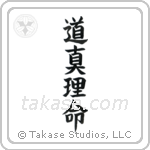
道真理命 michi shinri inochi John 14:6 The Way, The Truth, The Life
道真理命 (michi shinri inochi) is John 14:6 cut to its three nouns: the way, the truth and the life. These are the characters of Japan's colloquial Bible, whose New Testament came out in 1954. Before it, the Protestant Bibles and hymns read the middle word makoto.
Abstract
道真理命, michi shinri inochi, is John 14:6 reduced to its three nouns, in the characters of Japan's colloquial Bible, whose New Testament appeared in 1954. Of the Japanese Bibles read for this study, none wrote these characters before it: the Meiji New Testament of 1880 had 途・眞・生命 and the 1917 revision 道・眞理・生命, both with the ruby michi, makoto, inochi. That makoto was this verse's reading, not the word's: the same 1917 page reads 眞理 as shinri eleven verses later, and so does the Catholic New Testament of 1910 in this verse. The colloquial Bible gave the phrase its characters, and read as written its middle word is shinri.
Overview
The sense. One: the three things Jesus says he is; the phrase keeps the nouns and drops the sentence around them, as the Latin motto via, veritas, vita does.
The words. 道 is michi, the way. The 日本国語大辞典 enters it under one headword with three other spellings, 道・路・途・径, and under the way a person goes (人の進むあり方) lists the course one must follow and the teaching of gods, buddhas and sages [1]. The Meiji New Testament wrote it 途; the 1917 revision wrote it 道 (1880 to 1936; 1917 to 1931).
真理 is shinri, truth. デジタル大辞泉's first sense is the right course of things, unchanging at any time (いつどんなときにも変わることのない、正しい物事の筋道). The word is old in Japan: the 精選版 quotes it from the 懐風藻 of 751 in its Buddhist sense, the true and unchanging principle, enters it in the 落葉集 of 1598, and first quotes it in the ordinary sense, what is truly so, from 1810 [2]. The Japanese Bibles of the nineteenth century heard this verse otherwise: Gützlaff's John wrote ホントノコト, the true thing, and the Meiji New Testament a single character, 眞, read makoto (1837; 1880 to 1936).
命 is inochi, life, the oldest of the three in Japanese, 伊能知 in the 古事記 of 712. The Bibles before the war wrote it 生命 and read it inochi; the colloquial Bible wrote 命; the 新改訳 writes いのち in kana (1954 to 2018). The 精選版 has one more sense, from the 色道大鏡 of 1678: lovers tattooed the single character 命, or a name with 命, on the upper arm, pledging themselves for two lives and three [3].
The text in English. The verse is in every English Bible read for this study, from Wycliffe on, and its three nouns stand alone as a Latin motto.
The historical record
To 1611. The Greek, the Vulgate and the English Bibles. The verse is John 14:6. Thomas has asked how they can know the way, and Jesus answers: Ἐγώ εἰμι ἡ ὁδὸς καὶ ἡ ἀλήθεια καὶ ἡ ζωή, I am the way and the truth and the life [4]. The Vulgate reads ego sum via et veritas et vita [5], and English has had the three nouns in the same order since the Wycliffe Bible (Y am weie, treuthe, and lijf, in the text its site dates 1382) [6], Tyndale (I am ye waye ye truthe and ye life, 1534) [7] and the King James Bible (I am the way, the truth, and the life, 1611) [8][9].
1837. Gützlaff's katakana John. The first Japanese version of John, Karl Gützlaff's 約翰福音之伝, has no characters at all. Its verse 6 reads ワシガミチワ・ホントノコトワ、井ノチワ: michi, the way; honto no koto, the true thing; inochi, life. The page read is the typeset edition Doshisha printed from the copy the American Board gave it on 18 August 1938, not the print of 1837 [10]. デジタル大辞泉, the 精選版 and the 世界大百科事典 date the print 1837; the Britannica entry says about 1839 to 1840 [11].
1852. A Chinese Bible with the same characters. The Delegates' Version wrote 我卽途也、眞理也、生命也 [12]. The Japanese New Testament of 1880 shares two of its three nouns, 途 and 生命, and writes the middle one 眞.
1880 to 1936. The Meiji New Testament: 途なり眞なり生命なり. The New Testament finished in 1880 [9] reads 我は途なり眞なり生命なり, and in an annotated printing of 1904 the ruby says michi, makoto, inochi [13]. The annotator's note under the verse says that the way between God and man is not moral commandments alone, that God is the source of truth and of life, and that Christ is both; in the note's own prose, 神は眞理の源泉, 眞理 carries the ruby しんり [13]. A household anthology of 1896 quotes the chapter as a running passage in this wording [14], and the Protestant hymnal of 1910 sets the verse, in it, as the epigraph of hymn 172, Thou art the Way, to Thee alone [15]. In a local mirror of 10,529 of the National Diet Library's digitized books, the 1880 wording is in 30 books, 29 of them dated, from 1893 to 1936 [16].
1893 to 1931. Writers who wrote 眞理. Before the revision, writers quoting the verse put the two-character 眞理 into the Meiji wording. 三谷久太郎's apologetic of 1893 has 「我は途なり眞理なり生命なり」 in a passage it translates in excerpt (摘譯) from Horace Bushnell's Nature and the Supernatural, page 289 [17]. 井口弥寿男 in 1911 writes 「我は途なり眞理なり生命なり」 with the ruby まこと on 眞理 [18]. 倉長巍's lectures on John of 1916 list 『我は途也、眞理也、生命也』, with the ruby みちなり, まことなり, いのちなり, among the Gospel's I am sayings, and note in passing that the Logos of John 1 is translated 道; the same page gives 眞理 the ruby しんり twice in his own prose [19]. The mirror has 途 with 眞理 in 10 books, from 1893 to 1931, and 道 with 眞 in 8, from 1894 to 1926 [16].
1910. Three books, three wordings. The 1910 hymnal's epigraph keeps the Bible's 眞, but its fourth stanza sings 眞理 with the ruby まこと: 眞理(まこと)と生命(いのち)と / いよいよ分明(さやか)に / 道(みち)なるきみを / さとらせたまへ, make us know ever more clearly thee, the truth and the life and the way [15]. Émile Raguet's Catholic New Testament, the work of a Belgian-born priest of the Paris Foreign Missions Society who translated from the Vulgate, reads 我は道なり、眞理なり、生命なり with the ruby みち, しんり, せいめい, the Sino-Japanese readings shinri and seimei [20][21]. And 日高善一's translation of The Imitation of Christ prints 『我は道なり、眞理なり、生命なり』 without ruby, the wording of the Protestant revision seven years before it [22].
1917 to 1931. The revision, and the hymns. The 1917 revision changed two characters and kept the readings: in a printing of 1927, われは道(みち)なり、眞理(まこと)なり、生命(いのち)なり. The same page reads the word otherwise eleven verses later, これは眞理(しんり)の御靈なり, this is the Spirit of truth (14:17) [23]. The mirror has the revised wording in 36 books, from 1910 to 1964 [16]. Two later hymnals carry the stanza. The 古今聖歌集 of 1922 heads hymn 174, Thou art the Way, by Thee alone, with the revised verse and sings it in kana: まことと いのちと / みちなる エスを / さとる みめぐみを / いやまし たまへ, increase the grace to know Jesus, the truth and the life and the way [24]. The 讃美歌 of 1931 sings 眞理(まこと)と生命(いのち)と / いよいよさやかに / 道(みち)なる主(しゅ)を / 知らせたまへ, make known ever more clearly the Lord, the truth and the life and the way [25]. 金子白夢 in 1922 quotes the revised verse without its commas and reads it as Christ himself being what religion is: 「我は道なり眞理なり生命なり」(約十四ノ六)と仰せられた「基督其者」が宗教それ自體である [26].
1912 to 1954. The colloquial sentence, with 生命. Prose put the verse into the colloquial である form decades before a Bible did. The earliest of the 1,241 items the National Diet Library's full text gives for 眞理であり、生命 is the preface of 加藤玄智's 『神人乃木将軍』 of 1912, where the author, who calls himself a scholar of religion, applies the formula and its Latin to General Nogi after his suicide: 道であり眞理であり生命である —— "Via, Veritas, Vita" [27][28]. In that index the sentence with 生命 is in print from 1912, and the sentence with 命 from 1954 [28].
1954 to 2018. The colloquial Bible, and after. The colloquial Bible of the Japan Bible Society, New Testament 1954 and whole Bible 1955 [9], writes わたしは道であり、真理であり、命である [29][30]. Those are the phrase's three words, character for character: 道, 真理, 命. The National Diet Library's full text has the sentence in 1,279 items, the earliest three of 1954 [28]. The 新共同訳 of 1987 has the same three nouns, わたしは道であり、真理であり、命である, and so does the 聖書協会共同訳 of 2018, 私は道であり、真理であり、命である [30][31][32]. The 新改訳, in its 2017 text, writes the third in kana: わたしが道であり、真理であり、いのちなのです [33].
The sense across time. One sense, and the commentators read here reach for the same thing: the 1904 annotator, that God is the source of truth and of life and Christ is both; 倉長巍 in 1916, the verse among the Gospel's I am sayings; 金子白夢 in 1922, Christ himself as religion [13][19][26]. What moved is the reading of the middle word. In the Protestant Bibles and hymns read here, the verse's 眞 and 眞理 carry the ruby makoto from 1880 to 1931, while the same word is shinri in the 1904 note, in 倉長's prose, in John 14:17 of the 1917 revision and in the Catholic New Testament of 1910 [13][19][20][23]. The texts of the colloquial Bible and its successors read here give no reading for the word, and read as written it is the dictionary's shinri [2].
What is not a source. The four characters together. The National Diet Library's full-text index, which ignores punctuation, returns 193 items for 道真理命, from 1957 to 2018; in its text the three nouns are lifted from the verse with separators, as 道、真理、命 or 道・真理・命, and run together only once, in a list of new books in a trade journal of 1988 [28]. CiNii Research has 11 titles carrying the three nouns, among them 私は道・真理・命 (1995) [34]. The mirror of the library's books has no 道真理命 [16], and kotobank has no headword for it. In the sources searched, Japanese lifts the three words with commas, dots or brackets; the four characters without a separator are this phrase's arrangement. Nor is the Japanese 道 the Chinese 道路: the Union Version of 1919 wrote 道路 for the way [35], and the Catholic 思高 Bible keeps it [36], but the 道 of the 1917 revision is the word it already uses in verses 4 and 5 for the way Thomas asks about [23].
The phrase in English
1885 to 1915. Japan in English. Missionary English carried the verse into writing about Japan. Henry Faulds, in Nine Years in Nipon (1885), gives the Path in sayings he renders, and explains in a note: I prefer to follow this rendering, leaving "way" for the teaching of Him who is "the Way, the Truth, and the Life." [37] Harada Tasuku's The Faith of Japan (1914) quotes the verse in a chapter headed Michi: the Way of Humanity, on the way of Jesus who called Himself "the Way, the Truth, and the Life" [38]. William Charles Allen's A Quaker Diary in the Orient (1915) records a local evangelist at Ishioka, visited on 27 October 1914, who named his children from Bible texts: from I am the Way, the Truth and the Life, the Japanese name for "Way" was applied to a girl, and that of "Truth" to a boy [39].
1894 and after. The Latin motto. The three nouns stand alone in Latin as a motto: the University of Glasgow's arms carry Via, Veritas, Vita [40], and James Drummond took the words as the title of his Hibbert Lectures of 1894, Via, Veritas, Vita [41]. In 1912 the Latin stands beside the Japanese in 加藤玄智's preface (1912 to 1954) [27].
A reading
The phrase is not a paraphrase but a reduction, and an honorable one: the three nouns in the Greek order, as the Latin motto has them. What the record adds is that the four characters have a date, and that the reading of the middle one has a history. I read makoto as a choice made for this verse: the Protestant translators and hymn-writers gave a native word to the truth that names Christ, while the same characters stayed shinri where the word named truth itself, the Spirit of truth in 14:17 and the source of truth in the 1904 note. That is my reading; no translator read here says so. Shinri is what the characters say unglossed today; michi, makoto, inochi, three native words, is how the Protestant Bible and its hymns gave this verse in Japanese from 1880 until the colloquial Bible.
References
- 「道」・「路」・「途」・「径」, 精選版日本国語大辞典, at kotobank. https://kotobank.jp/word/道
- 「真理」, デジタル大辞泉・精選版日本国語大辞典, at kotobank. https://kotobank.jp/word/真理
- 「命」, 精選版日本国語大辞典, at kotobank. https://kotobank.jp/word/命
- Greek New Testament (Nestle 1904 and seven other editions), John 14:6, at biblehub. https://biblehub.com/text/john/14-6.htm
- The Vulgate, John 14, at vulgate.org. https://vulgate.org/nt/gospel/john_14.htm
- The Wycliffe Bible (1382, as the site dates the text), John 14, at textusreceptusbibles.com. https://www.textusreceptusbibles.com/Wycliffe/43/14
- The Tyndale New Testament (1534), John 14, at textusreceptusbibles.com. https://www.textusreceptusbibles.com/Tyndale/43/14
- The King James Bible (1611), John 14:6, at biblehub. https://biblehub.com/john/14-6.htm
- 「聖書」, 世界大百科事典・百科事典マイペディア, at kotobank. https://kotobank.jp/word/聖書-85965
- ギュツラフ 訳, 『約翰福音之伝』, the typeset edition printed by Doshisha from the copy given in 1938, p. 45 (chapter 14); the preface, p. 1. Doshisha University repository. https://doshisha.repo.nii.ac.jp/record/10605/files/160101.pdf
- 「ギュツラフ」, デジタル大辞泉・精選版日本国語大辞典・世界大百科事典・ブリタニカ国際大百科事典 小項目事典, at kotobank. https://kotobank.jp/word/ギュツラフ
- 聖經 (委辦譯本), 1852, 約翰福音 14, at Wikisource. https://zh.wikisource.org/wiki/聖經_(委辦譯本或稱代表譯本)/約翰福音
- 三浦徹 編, 『新約全書 : 略註』, 1904, p. 374 and the note beneath verse 6, scan 218, National Diet Library. https://dl.ndl.go.jp/pid/825539/1/218
- 大月隆 編, 『吾家の憲法』, 1896, p. 208, scan 111, National Diet Library. https://dl.ndl.go.jp/pid/758680/1/111
- 『讃美歌』, 1910, hymn 172, scan 120, National Diet Library. https://dl.ndl.go.jp/pid/825386/1/120
- A local mirror of 10,529 of the National Diet Library's digitized books, searched on the verse's Meiji, revised and mixed wordings and on 道真理命; the counts and every book are held in the research record, and each book opens at the library's Digital Collections. https://dl.ndl.go.jp/
- 三谷久太郎, 『基督教之根拠』, 1893, p. 140 (the excerpt from Bushnell, p. 141), scan 78, National Diet Library. https://dl.ndl.go.jp/pid/824306/1/78
- 井口弥寿男, 『基督教の研究』, 1911, p. 342, scan 181, National Diet Library. https://dl.ndl.go.jp/pid/824305/1/181
- 倉長巍, 『約翰伝五十講』, 1916, p. 4, scan 11, National Diet Library. https://dl.ndl.go.jp/pid/944159/1/11
- ラゲ 訳, 『我主イエズスキリストの新約聖書』, 1910, p. 333, scan 182; the title page with its deposit stamp, scan 1. National Diet Library. https://dl.ndl.go.jp/pid/825725/1/182
- 「ラゲ」, ブリタニカ国際大百科事典 小項目事典・デジタル版 日本人名大辞典+Plus, at kotobank. https://kotobank.jp/word/ラゲ
- 日高善一 訳, 『基督の模倣』, 1910, p. 269, scan 144, National Diet Library. https://dl.ndl.go.jp/pid/824397/1/144
- 『新約聖書』 (the 1917 revision), printing of 1927, pp. 276–277, scan 142, National Diet Library. https://dl.ndl.go.jp/pid/1053815/1/142
- 『古今聖歌集 : 譜附』, 1922, hymn 174, scan 111, National Diet Library. https://dl.ndl.go.jp/pid/941747/1/111
- 『讃美歌』, 1931, hymn 254, scan 82, National Diet Library. https://dl.ndl.go.jp/pid/1908158/1/82
- 金子白夢, 『神秘の宗教』, 1922, p. 211, scan 66, National Diet Library. https://dl.ndl.go.jp/pid/1885764/1/66
- 加藤玄智, 『神人乃木将軍』, 1912, 小序 p. 3, scan 7, National Diet Library. https://dl.ndl.go.jp/pid/946212/1/7
- National Diet Library Digital Collections, full-text search, every access tier, oldest first, 10 October 2026, for 道真理命 (and its forms with commas and dots, which return the same 193 items), for 眞理であり、生命 and for 道であり、真理であり、命である. https://dl.ndl.go.jp/search/searchResult?keyword=道真理命
- 口語訳 (1954–55), John 14, at wordproject.org. https://www.wordproject.org/bibles/jp/43/14.htm
- 日本聖書協会, 聖書本文検索, John 14:6 in the 口語訳, the 新共同訳 and the 聖書協会共同訳. https://www.bible.or.jp/read/vers_search.html
- 「共同訳聖書」, ブリタニカ国際大百科事典 小項目事典, at kotobank. https://kotobank.jp/word/共同訳聖書-52963
- 日本聖書協会, 「聖書 聖書協会共同訳 翻訳事業」. https://www.bible.or.jp/know/know31.html
- 新改訳2017, John 14:6, at 聖書入門.com. https://seishonyumon.com/words/2616/
- CiNii Research, search for 道、真理、命, 10 October 2026. https://cir.nii.ac.jp/opensearch/all?q=道、真理、命&format=json
- 聖經 (和合本), 1919, 約翰福音 14, at Wikisource. https://zh.wikisource.org/wiki/聖經_(和合本)/約翰福音
- 思高聖經, John 14, at ccreadbible.org. https://www.ccreadbible.org/chinesebible/sigao/John_bible_Ch_14_.html
- Henry Faulds, Nine Years in Nipon: Sketches of Japanese Life and Manners, 1885, p. 256 note, at the Internet Archive. https://archive.org/details/cu31924023514338
- Tasuku Harada, The Faith of Japan, 1914, pp. 66–67, at the Internet Archive. https://archive.org/details/faithofjapan00hara
- William Charles Allen, A Quaker Diary in the Orient, 1915, pp. 29–30, at the Internet Archive. https://archive.org/details/aquakerdiaryino00allegoog
- "Symbolism on and around campus", The Glasgow Guardian, 26 November 2014. https://archive.glasgowguardian.co.uk/2014/11/26/symbolism-on-and-around-campus/
- James Drummond, Via, Veritas, Vita: Lectures on Christianity in Its Most Simple and Intelligible Form (the Hibbert Lectures, 1894), at the Internet Archive. https://archive.org/details/cu31924008788436