

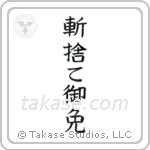
斬捨て御免 kirisute gomen Kirisute Gomen
斬捨て御免 (kirisute gomen) names the Edo-period samurai's privilege of cutting down an insolent commoner without punishment. In the printed books searched for this study, the name first appears in 1873, after the shogunate's rule had ended. Within a few years it was a figure for arbitrary power.
Abstract
斬捨て御免, kirisute gomen, is the Japanese dictionaries' name for an Edo-period privilege: a samurai who could not avoid cutting down a townsman or farmer for abuse or insolence was not punished, provided an inquiry found the facts clear. The rule is in the shogunate's criminal code, dated to 1742, where four Meiji editions print it as an earlier precedent added to the article on killing and wounding; the name is younger, and in the printed books searched for this study it first appears in Fukuzawa Yukichi 福澤諭吉's pamphlet of 1873, already in the past tense. Within a few years the word was a figure for arbitrary power, a commoner's life likened to tofu or a daikon, and a reference work of 1901 and a legal historian of 1925 disagreed on whether the law had ever set it down. In the English searched for this study it arrives in 1916, and in 1964 a character in a Bond novel asks Bond whether he has heard it.
Overview
The sense. The 精選版日本国語大辞典 gives one sense: 江戸時代、武士に与えられていた特権の一つ。町人、農民などが武士に対し雑言など無礼を働いた場合、武士が止むを得ず切り殺しても処罰されなかった, one of the privileges given to the samurai in the Edo period: when a townsman or farmer offered a samurai abuse or other insolence, the samurai who had no choice but to cut him down was not punished. It adds the limits: みだりに切り殺したときや、無礼の証拠の説明ができないときは処罰された, one who killed wantonly, or who could not show proof of the insolence, was punished [1]. JMdict marks the word as a historical term: right of samurai to kill commoners for perceived affronts (Edo period) [2]. Neither gives a second, figurative sense; the use of the word for any power that cuts and is excused, which runs through the Meiji books below, is a usage, not a sense the dictionaries record.
The words. 切る or 斬る is to cut, 斬 being the character for cutting a person down. 捨てる is to throw away, to leave, so 切捨 or 斬捨 is to cut someone down and leave him. 御免 is the word the whole turns on. The デジタル大辞泉 gives its first sense as 正式に免許・認可することを、その決定を下す者を敬っていう語, a formal license or permission, said in honor of the one who grants it, with the example 天下ご免, licensed by the realm; the 精選版日本国語大辞典's note on the word says it began as 免, permission, with the honorific 御, and that the apology gomen grew from it later [3]. So the compound is a license granted from above: cutting down, licensed. The dictionaries head the word 切捨御免 and 斬捨御免, without okurigana; 切り捨て御免 and the 斬捨て御免 on the scroll write the second verb out; JMdict lists all five as one word [1][2]. The ブリタニカ国際大百科事典 gives 打捨, 討捨 and 伐捨 as other names for the thing, and the 日国 gives 無礼討, killing for insolence [4][1].
The text in English. JMdict's right of samurai to kill commoners for perceived affronts [2]. Twentieth-century English mostly kept the romaji and glossed it, permission to cut down and leave, permission to kill and depart, permission to kill, exemption to cut down and discard (§ The word in English).
The historical record
1742 and before. The rule in the shogunate's code. The 公事方御定書, the shogunate's criminal code, is dated to 寛保2, 1742, the year, in the 世界大百科's account, its colophon was written; the compiling went on into the next year [5]. Four Meiji editions print the rule as an item of the article on killing and wounding, here in the edition of Naitō Chisō 内藤耻叟 of 1889: (從前々之例) 一足輕躰に候とも輕き町人百姓之身として法外之雜言等不届之仕形不得止事切殺候もの … 吟味之上於無紛は 無搆, (by earlier precedent) Item: one, even of foot-soldier standing, who cannot avoid cutting down a townsman or farmer of low standing for outrageous abuse or other insolent conduct: if on inquiry there is no doubt of it, no penalty [6]. The tag in parentheses is the code's own note on where an item came from. Itō Shinobu 伊東忍's edition of 1884 sets it in the band above the item as 追加 · 從前之例; the Ministry of Justice's 徳川禁令考 of 1894–95 as 追加 · 從前々之例; a 1905 edition as 從前々之例追加, at the close of the article numbered 71 [7][8][9]. All four say by earlier precedent, and three add an addition. None gives the item a year, so the code dates the rule only as older than itself. The code went on growing after 1742: the 世界大百科 and the 山川 say entries headed 追加 were written in until 1754, and the 日本大百科全書 says new precedents stopped being added in 1745 [5]. The tag does not say when this item was entered. The historian Miura Hiroyuki 三浦周行, in the fourth edition of his 『法制史の研究』 (1925), prints the same item as 第七十一條の追加, the addition to article 71 [10].
In practice. The 改訂新版世界大百科事典 describes a privilege the domains also allowed, which the shogunate wrote into the code from precedent; the circumstances had to be clear, so a witness was indispensable; in practice a custom arose of cutting without finishing the man, it was restrained, and it was not freely exercised [1]. The 山川日本史小辞典 says the same: a witness was required, and a samurai who could not prove his case at the inquiry was tried and punished [1]. G. Cameron Hurst III, writing in 1998, says historians have identified no more than a handful of cases in the two and a half centuries of Tokugawa rule [11]. Japanese Wikipedia, citing pages 15 to 18 of Taniguchi Shinko 谷口眞子's article 「切捨御免」 in 歴史と地理 for 2005, says the word is not of the Edo period: 「切捨御免」という言葉は江戸時代のものではなく、史料においては「手討」「打捨」などと表現されている, the word kirisute gomen is not of the Edo period; in the sources it is expressed as teuchi, uchisute and the like [12].
1862 to 1871. The end of the rule. The 世界大百科 says the privilege broke down after the opening of the ports, as at the Namamugi incident of 1862, when men of the Satsuma domain killed and wounded four mounted Englishmen for disturbing the procession of Shimazu Hisamitsu 島津久光 [1][13]. The Meiji government kept it in the provisional criminal code of 1868 and left it out of the 新律綱領 of 1870 [1]. On 明治4年8月17日, in 1871, the Council of State published this: 士族ノ輩舊來武門ノ流弊ニ泥ミ動モスレハ下民ヘ對シ瑣屑ノ不敬ヲ咎メ甚シキハコレヲ刃殺スル等御維新ノ今日右樣ノ所爲ハ無之筈ニ候ヘ共僻邑遠陬ニ至リ自然心得違ノ者有之候テハ不相濟事ニ候條右地方官ニ於テ篤ク告諭可致事, men of samurai family, steeped in an abuse handed down from the military houses, are apt to fault the common people for trifling disrespect, and at worst to kill them with the blade; in the Restoration of today such acts ought not to occur, but should there be men in remote places who mistake this, it would not do; local officials are to admonish them earnestly [14]. The 世界大百科 reads the order as confirming the abolition [1]. In its own words it is an admonition: it names the practice an abuse, and it does not name it 切捨御免.
1873. Fukuzawa Yukichi, 『學問ノスヽメ』, part two, the pamphlet. The oldest print of the word in the National Diet Library's full text and the other collections searched for this study, two years after the order and already in the past tense: 旧幕府ノ時代ニハ士民ノ區別甚シク士族ハ妄ニ權威ヲ振ヒ百姓町人ヲ取扱フヿ目ノ下ノ罪人ノ如クシ或ハ切捨御免ナドノ法アリ此法ニ據レバ平民ノ生命ハ我生命ニ非ズシテ借物ニ異ナラズ, in the time of the old shogunate the gap between samurai and commoner was extreme; the samurai threw their authority about and handled farmers and townsmen like criminals beneath their eyes, and there were laws such as kirisute gomen, under which a commoner's life was not his own but no different from a thing on loan [15]. The pamphlet sets 切捨 at the foot of one column and 御免 at the head of the next, which is why a search of its text for the word does not find it.
1874. The same book, part six. On the dignity of national law: 古ハ日本ニテ百姓町人ノ輩士分ノ者ニ對シテ無禮ヲ加フレバ切捨御免ト云フ法アリコハ政府ヨリ公ニ私裁ヲ許シタルモノナリ, in old Japan, when farmers or townsmen were insolent to a man of samurai rank, there was a law called kirisute gomen; this was the government publicly licensing private justice [16]. Fukuzawa sets it beside the vendetta of the forty-seven rōnin as another case of a man taking the law into his own hands.
1874 to 1875. Ogawa Tameji 小川為治, 『開化問答』, a dialogue on civilization. The 日国's earliest example of the word [1]. The page reads: 御用だとか御免だとかいふ文字を附けて石でも材木でも人間より貴くなり又武士にハ切捨御免抔といふ法がありて百姓丁人を切殺し, put the words by appointment or by license on a stone or a log, and it outranked a human being; and the samurai had a law called kirisute gomen or the like, and cut down farmers and townsmen [17]. The word is printed with its reading, きりすてごめん. The same sentence uses 御免 for the license that made a stone or a log outrank a person.
1875. Fukuzawa, 『文明論之概略』. Fukuzawa quotes the code itself, as the Tokugawa law books: 徳川ノ律書ニ足輕体ニ候共輕キ町人百姓ノ分トシテ法外ノ雜言等不届ノ仕方ニテ不得止切殺シ候者ハ吟味ノ上紛無之候ハヾ無構事トアリ此律ニ據レバ百姓町人ハ常ニ幾千万人ノ敵ニ接スルガ如ク其無事ナルハ幸ニシテ免カルヽノミ, the Tokugawa law books say that one, even of foot-soldier standing, who cannot avoid cutting down a townsman or farmer of low standing for outrageous abuse or other insolent conduct, shall, if on inquiry there is no doubt, bear no penalty. By this law, farmers and townsmen lived as if facing tens of millions of enemies, and came through unharmed only by luck [18]. He does not use the word 切捨御免 on this page.
1876. Nakajima Katsuyoshi 中島勝義, ed., 『俗夢驚談』, a political polemic. The word as a figure for official tyranny: 其甚ダシキニ至テハ切捨御免等ノ特例ヲ設ケ官吏タル者ハ我々人民ヲ切ルコト恰モ豆腐カ大根ノ如クニ思ヒ, at the worst they set up special privileges such as kirisute gomen, so that an official thought cutting one of us people down was like cutting tofu or a daikon [19].
1878. Takada Yoshitoshi 高田義甫, 『勧善義解』. A dialogue on bowing low to anyone who wears two swords: 偶マ少シ無禮スルト切捨御免ダト出カケラレ, the moment you are a little rude, out they come with kirisute gomen [20]. The word is printed with the reading キリステゴメン beside it.
1879. Uchida Yūkichi 内田勇吉, 『民権一班浪津社談』, a people's-rights tract. 猶甚シキハ切捨御免ト云ヿアリ徳川氏ノ律書ニ足輕体ニ候共町人百姓ノ分トシテ法外ノ雜言等不屆ノ仕方ニテ不得止切殺シ候者ハ吟味ノ上紛レ無之候ハヽ無搆事トアリ, worse still was what they called kirisute gomen: the law book of the Tokugawa says that one, even of foot-soldier standing, who cannot avoid cutting down a townsman or farmer for outrageous abuse or other insolent conduct, shall, if on inquiry there is no doubt, bear no penalty [21]. The wording tracks the code's clause closely, with small differences from the printed editions.
1881. Watanabe Shūjirō 渡辺修二郎, 『民情如何』. 往時行はれたる切捨御免の掟の如き今より之を追想するも實に我々をして悚然たらしむるに足れり … 此時に當りて平民の生命は輕きこと毛の如く低きこと大根の如く旦夕を保つ能はざりしなり, the rule of kirisute gomen as it was once practiced is enough to make us shudder even to recall … in those days a commoner's life was light as a hair and low as a daikon, and could not be kept from morning to evening [22]. He calls it 此野蠻法, this barbarous law, and says it was licensed mostly in the great domains (多く大藩に限りしと云ふ), as a report [22].
1886. Takashima Kaemon 高島嘉右衛門, 『高島易断』. The other spelling, 斬捨御免, in a commentary on the Book of Changes: 直ニ之ヲ斬殺ス。之ヲ斬捨御免ト稱シ。政府問ハザルノ大法タリ。, he cut the man down on the spot; this was called kirisute gomen, and it was a great law the government did not call to account [23]. The word is printed with the reading キリステゴメン beside it, so 斬 here is read kiri.
1901. 『日本社会事彙』, a reference work. The entry キリステゴメム opens: 切捨御免と云ふ事。別に明文あるには非ず。俗に云く。御三家(尾張。紀伊。水戸)は。切捨御免なりと。又云く。佐竹侯も之を許されたりとか傳ふ。, what is called kirisute gomen: there is no particular written text. It is commonly said that the three Tokugawa branch houses (Owari, Kii, Mito) had kirisute gomen; it is also said that Lord Satake was allowed it [24]. It goes on to say that a samurai who cut down an insolent townsman or lower samurai was not liable if he reported it to the local official, and sets the word beside 無禮打.
1925. Miura Hiroyuki, 『法制史の研究』, read in its fourth edition. The legal historian reads the code the other way: 幕府の刑法たる御定書の中には … 足輕程の卑き身分の侍に對しても無禮を働いたならば斬殺しても其罪を問はぬといふ所謂切捨御免の一條が立派に規定されて居る, in the shogunate's criminal code … there is a clause, the so-called kirisute gomen, fully set down, by which a townsman or farmer who was insolent even to a samurai as low as a foot soldier might be cut down and the samurai not charged [10]. The 1901 entry says there is no written text; Miura says the code sets it down plainly. Both are right about different things: the code has the rule and not the name, and Miura's 所謂, so-called, marks the name as his readers' word, not the code's.
Today. The 日国 and four encyclopedias at one address treat the word as the name of an Edo institution, each stressing its limits; the 日本大百科全書 calls it the symbolic expression of the samurai's privilege, and the 旺文社日本史事典 an unwritten rule that lasted into the first years of Meiji [1]. JMdict marks it a historical term [2].
The word in English
1872. J. C. Hepburn, 『和英語林集成』, second edition. No entry for the compound; the verb: KIRI-SUTE,-ru,-ta, キリステル, 切捨, t.v. To cut and throw away, to kill and leave [25].
1896. Brinkley's dictionary. The noun, still without 御免: Kirisute, n. Killing and throwing away, slaying a person and leaving him [26].
1916. J. E. de Becker, Elements of Japanese Law. The oldest English carrying the term in the full text of the English books searched for this study, among laws repealed after the Restoration: the law authorizing a certain class of men (the samurai) to cut down people in the streets with impunity (kirisute-gomen) under certain conditions [27]. De Becker credits the Japanese jurist Nakamura Shingo's Hōgaku tsūron for his materials.
1940. E. Herbert Norman, Japan's Emergence as a Modern State. There was even written into the Tokugawa administrative code the famous right of kiri-sute-gomen, that is the privilege of a samurai to cut down a commoner with impunity; his glossary: Kiri-sute-gomen "Permission to cut down and leave." [28] The first English gloss of 御免 as permission in these sources.
1964. Ian Fleming, You Only Live Twice. Bond is asked: Have you ever heard the Japanese expression "kiri-sute gomen"?' Bond groaned. 'Spare me the Lafcadio [29].
1973 to 1993. The martial-arts books and the encyclopedia. Ratti and Westbrook: according to Article 71 of the criminal code (Osadamegaki), he had the freedom and even the duty to cut down on the spot (kirisutegomen) [30]. Warner and Draeger, 1982: kiri-sute gomen (permission to kill and depart) [31]. The Kodansha encyclopedia, 1993: (permission to kill). A privilege enjoyed by the samurai class during the Edo period [32]. The code's clause, in the four editions read, and the dictionaries do not make it a duty; Japanese Wikipedia argues that it was one, since a samurai who let a public insult pass could be severely punished as a coward, and cites the clause for it [12].
1998 to 2014. The historians. Hurst, 1998: "exemption to cut down and discard" (kirisute gomen), with the note that historians have been able to identify no more than a handful of cases [11]. Dilworth's translation of Fukuzawa's part two, 2012: They enacted such notorious laws as that which gave a samurai the right to cut down a commoner [33]. Benesch, 2014, uses the other name: The institution of rudeness-killing (burei-uchi) did permit samurai to kill commoners for perceived slights, but the obvious social disorder that this practice was likely to cause meant that it was rarely applied [34].
Today. JMdict's gloss is right of samurai to kill commoners for perceived affronts (Edo period) [2]. English has kept the romaji since 1916 and glossed it each time; the glosses split on 御免, as permission, exemption or impunity.
A reading
The rule is Edo's and the name is Meiji's, as far as these books reach, and the name was given by the men who had just watched the rule end.
The code never says kirisute gomen. It says that a foot soldier who cannot avoid cutting down an insolent townsman bears no penalty after an inquiry, and it files that under earlier precedent. The name appears two years after the government's order, in Fukuzawa's past tense, and within a decade it means a commoner's life as tofu, a daikon, a hair. 御免 is the hinge. Read as the dictionaries' first sense, a license given from above, the compound says exactly what the reformers hated in it: not that the samurai was forgiven, but that the state had licensed private justice in advance, which is Fukuzawa's own sentence.
The historians' limits are real, and the word has always outrun them. That is a fact about the word, not a mistake in it. It names what the law looked like from the street, and that is why it survived the law by a century and a half.
Notes
The editions quoted for the code are Meiji typeset printings; the 1742 manuscript itself is not quoted here. Kana in the 1881 tract are printed in the type's variant forms and are given in their usual forms. Fukuzawa's pamphlets are cited at their first printings, part two licensed in 明治6年11月 (1873) and part six in 明治7年2月 (1874).
The searches that date the word cover printed books, almost all from 1868 on; the Edo-period books are not in the full text searched, so oldest in this history is the oldest found in those books.
Sources not seen
谷口眞子 (Taniguchi Shinko), 「切捨御免」, 歴史と地理 no. 585, 2005, 賢問愚問 column; and 谷口眞子, 「『切捨御免』像の転換がもたらした近世武士の再定位」, 日本歴史 no. 900, 2023, pp. 116–122, both listed in CiNii Research (https://cir.nii.ac.jp/). They are the scholarship on when the word arose and what the Edo sources call the act; either would settle the sentence that the word is not of the Edo period, which this history now carries at second hand.
G. Cameron Hurst III, "Death, Honor, and Loyality: The Bushidō Ideal", Philosophy East and West 40, no. 4 (October 1990), pp. 511 ff., doi:10.2307/1399355. The page Hurst cites in 1998 for a handful of cases; it would show the cases he counted.
David A. Dilworth and Umeyo Hirano, trans., Fukuzawa Yukichi's An Encouragement of Learning, Sophia University, 1969. The first English of part two; it would show whether the right to cut down a commoner is the 1969 wording or the 2012 revision's.
A reader with access to any of these is invited to write to Takase Studios at Tim@Takase.com.
References
- 「切捨御免」, 精選版日本国語大辞典 · 改訂新版世界大百科事典 · 日本大百科全書 · 山川日本史小辞典 · 旺文社日本史事典, at kotobank. https://kotobank.jp/word/切捨御免-1159878
- JMdict (EDRDG), 「切り捨て御免」, at jisho.org. https://jisho.org/api/v1/search/words?keyword=切捨御免
- 「御免」, デジタル大辞泉 · 精選版日本国語大辞典, at kotobank. https://kotobank.jp/word/御免-504799
- 「斬捨御免」, ブリタニカ国際大百科事典, at kotobank. https://kotobank.jp/word/斬捨御免-53661
- 「公事方御定書」, at kotobank. https://kotobank.jp/word/公事方御定書-55187
- 内藤耻叟 校, 『御定書百ケ条』, 1889, p. 117, scan 70. https://dl.ndl.go.jp/pid/994261/1/70
- 伊東忍 校, 『徳川百ケ条 : 頭書・参考』, 明17.5 (1884), p. 61, scan 39. https://dl.ndl.go.jp/pid/787027/1/39
- 司法省, 『徳川禁令考』, 後聚 巻二十九, 明27–28 (1894–95), p. 660, scan 334. https://dl.ndl.go.jp/pid/787019/1/334
- 『御定書百箇条』, 日本大学, 明38 (1905) in the library's record, p. 60, scan 39. https://dl.ndl.go.jp/pid/786837/1/39
- 三浦周行, 『法制史の研究』, 岩波書店, 正編 4版, 大正14 (1925) in the library's record, p. 126, scan 72, and p. 1335, scan 680. https://dl.ndl.go.jp/pid/1113267/1/72 · https://dl.ndl.go.jp/pid/1113267/1/680
- Hurst, G. Cameron, III, Armed Martial Arts of Japan: Swordsmanship and Archery, Yale University Press, 1998, p. 65 and p. 211 n. 32.
- 「切捨御免」, Japanese Wikipedia, citing 谷口眞子 2005. https://ja.wikipedia.org/wiki/切捨御免
- 「生麦事件」, at kotobank. https://kotobank.jp/word/生麦事件-108461
- 内閣官報局, 『法令全書』 明治4年, 太政官 第四百十二, 八月十七日, pp. 324–325, scan 199. https://dl.ndl.go.jp/pid/787951/1/199
- 福澤諭吉, 『學問ノスヽメ』 二編, 明治6年11月 (1873), scan 7. https://dl.ndl.go.jp/pid/13116285/1/7
- 福澤諭吉, 『學問ノスヽメ』 六編, 明治7年2月 (1874), scans 7–8. https://dl.ndl.go.jp/pid/13116290/1/7
- 小川為治, 『開化問答』 初編巻上, 明7–8 (1874–75), p. 15, scan 21. https://dl.ndl.go.jp/pid/798420/1/21
- 福澤諭吉, 『文明論之概略』 巻之五, 1875, scan 66. https://dl.ndl.go.jp/pid/993903/1/66
- 中島勝義 編, 『俗夢驚談』, 1876, scan 8. https://dl.ndl.go.jp/pid/783427/1/8
- 高田義甫, 『勧善義解』, 明11.5 (1878), p. 17, scan 13. https://dl.ndl.go.jp/pid/755062/1/13
- 内田勇吉, 『民権一班浪津社談』, 1879, p. 49, scan 29. https://dl.ndl.go.jp/pid/783708/1/29
- 渡辺修次郎, 『民情如何』, 明14.8 (1881), p. 50, scan 29; the author's name as the book gives it, 渡辺修二郎 in the library's name heading. https://dl.ndl.go.jp/pid/798688/1/29
- 高島嘉右衛門, 『高島易断』 下経六, 1886, scan 34. https://dl.ndl.go.jp/pid/2937051/1/34
- 経済雑誌社 編, 『日本社会事彙』 上巻, 明治34 (1901), p. 1055, scan 536. https://dl.ndl.go.jp/pid/1801900/1/536
- J. C. Hepburn, 『和英語林集成』, 2nd ed., 1872, p. 245, scan 140. https://dl.ndl.go.jp/pid/993689/1/140
- Brinkley, F., An Unabridged Japanese-English Dictionary, 三省堂, 1896, s.v. Kirisute.
- de Becker, J. E., Elements of Japanese Law, Transactions of the Asiatic Society of Japan 44, part 2, 1916, chap. 9, "Classes of Laws", the section "General Laws and Special Laws". https://archive.org/details/in.gov.ignca.26058
- Norman, E. Herbert, Japan's Emergence as a Modern State, Institute of Pacific Relations, 1940, p. 18 and glossary p. 237. https://archive.org/details/dli.ernet.13615
- Fleming, Ian, You Only Live Twice, Jonathan Cape, 1964; quoted from a 1965 printing. https://archive.org/details/bwb_Y0-ARS-194
- Ratti, Oscar, and Adele Westbrook, Secrets of the Samurai: A Survey of the Martial Arts of Feudal Japan, Tuttle, 1973, Part I, "The Bushi".
- Warner, Gordon, and Donn F. Draeger, Japanese Swordsmanship: Technique and Practice, 1982. https://archive.org/details/japaneseswordsma0000warn
- Japan: An Illustrated Encyclopedia, Kodansha, 1993, s.v. kirisute gomen.
- Fukuzawa Yukichi, An Encouragement of Learning, trans. David A. Dilworth, Columbia University Press, 2012, part two.
- Benesch, Oleg, Inventing the Way of the Samurai, Oxford University Press, 2014, pp. 19–20.