

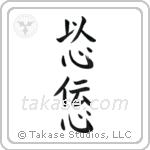
以心伝心 ishindenshin Telepathy
以心伝心 (ishindenshin) is the Japanese word for two people who understand each other without a word. In Zen it names the teaching a master passes to a student outside any text. This study follows it from Tang China and a letter by Kūkai 空海 in 813 to Edo's pleasure quarter and the word telepathy.
Abstract
以心伝心, ishindenshin, is the Japanese word for two people who understand each other without a word and the Zen word for an awakening passed from teacher to student outside any text; read as classical Chinese, its four characters say by mind, transmit mind. Among the texts read for this study, the oldest that carry it are Chinese, the sermons of the monk Shenhui 神会 (670–762) and the Dunhuang manuscript of the Platform Sutra, where the Fifth Patriarch tells Huineng 慧能 that the robe is handed down but the Dharma passes from mind to mind; the phrase was soon given to Bodhidharma 達磨, the master Huangbo Xiyun 黄檗希運 defined it as getting not a single thing, and the story now told as its origin, the Buddha holding up a flower and Kāśyapa smiling, is first told in 1036 and was doubted from the Song on. In Japan the monk Kūkai 空海 wrote it in 813, in a letter refusing to lend a book; outside Buddhist writing it is in the Confucian scholar Kiyohara Nobukata 清原宣賢 (1475–1550), of Confucius and his disciple, in a Yoshiwara guide of 1678, and in the comic fiction of the nineteenth century, where a man and a woman agree without a word, before the dictionary's first citation for the everyday sense, Fukuzawa Yukichi 福沢諭吉 in 1875. English glossed it communicating from mind to mind in 1896 and set it beside telepathy from 1915.
Overview
The sense. The dictionaries give two current senses. デジタル大辞泉: 仏語。仏法の奥義を、言葉や文字を借りず師の心から弟子の心に伝えること。主に禅宗で用いる, a Buddhist term: to pass the deepest meaning of the Dharma from the teacher's mind to the student's without the help of words or writing, used chiefly in Zen; and 無言のうちに心が通じ合うこと, for hearts to reach each other without a word, with the example 以心伝心の間柄, a relationship of unspoken understanding [1]. The 精選版 日本国語大辞典 gives the same two, the second as 無言のうちに心が互いに通じ合うこと。わざわざ口で説明しなくても、自然に相手に通じること, for hearts to reach each other without a word; for something to reach the other person naturally, with no need to explain it, and a third: 自由恋愛、自由結婚をいう、学生仲間の隠語, students' slang for free love and free marriage, from a dictionary of modern words of 1933 [1]. The 四字熟語を知る辞典 and the ことわざを知る辞典 lead with the everyday sense and give the Buddhist one as the original [1]. The 大辞泉 warns that 意心伝心 is a miswriting [1]. The 世界大百科事典 and the 日本大百科全書 tie the term to the story of the flower and to the Zen mottoes 不立文字, not setting up written words, and 教外別伝, a transmission outside the teachings, and the ブリタニカ国際大百科事典 calls it 唐の禅僧、慧能に始る言葉, a word that begins with the Tang Chan monk Huineng [1]. The historical record below tests both.
The words. 以 (i) is the classical Chinese by means of. 心 (shin) is the heart and mind. 伝 (den), written 傳 before the postwar reform, is to hand on. Then 心 again. Read as classical Chinese the four characters are a whole sentence, by mind, transmit mind, and the 四字熟語を知る辞典 explains the phrase as 「心を以て心に伝う」の意味, the sense of "by the mind, transmit to the mind" [1].
The text in English. JMdict gives telepathy; tacit understanding; thought transference; communion of mind with mind for the everyday word, and a separate Buddhist sense, non-verbal Zen Buddhist transmission to a disciple of the central tenets of Buddhism; the 研究社 新和英中辞典 gives tacit understanding and telepathy [2]. § The word in English follows these glosses back to the dictionaries that made them.
The historical record
Before 762, the sermons of Shenhui. Shenhui, a disciple of Huineng whose campaign did much to establish a Chan that took Bodhidharma for its founder, says in a sermon recovered from Dunhuang, 六代祖師以心傳心,離文字故。從上相承,亦復如是, the patriarchs of the six generations transmitted mind by mind, because it is apart from written words; the succession from the first has been the same [3]. Here the phrase is a claim about a lineage: what passes from patriarch to patriarch is not a text.
About 780, the Dunhuang Platform Sutra. The oldest text of the Platform Sutra, a Dunhuang manuscript whose text is dated to about 780 [4][5], tells how the Fifth Patriarch called Huineng to his room at midnight, expounded the Diamond Sutra to him, and gave him the Dharma and the robe: 衣將為信稟,代代相傳;法以心傳心,當令自悟, the robe is the token of faith and is handed down from generation to generation; the Dharma is transmitted mind by mind, and each must be made to awaken by himself [4]. So the encyclopedia's Huineng is a reading of the eighth-century telling of his life, not of a later recension.
781, the biography of the master of Caoxi. The 曹溪大師別傳, whose own reckoning runs to 781 and whose Japanese copy carried, by its copyist's note, the seal of Saichō 最澄 with the date 803, gives Huineng himself the question the sutra leaves unasked: 法無文字。以心傳心。以法傳法。用此袈裟何為, the Dharma has no written words; it passes mind by mind, Dharma by Dharma. What is this robe for? An imperial summons the biography prints says 朕聞如來以心傳心。囑付迦葉, we hear that the Tathāgata transmitted mind by mind and entrusted it to Kāśyapa [6]. The question about the robe stays with the phrase from here on.
Chengguan 澄観 (738–839) and Zongmi 宗密 (780–841). Two masters of the Huayan school, whose works are not dated here, use the phrase as a thing already said. Chengguan writes in his commentary on the chapter of Samantabhadra's vows 故曰:以心傳心,不在文字, so it is said: mind transmits mind; it is not in written words; in his sub-commentary on the Huayan sutra he takes up 以心傳心之旨, the purport of mind transmitting mind, to reconcile the Northern and Southern schools of Chan, 會南北二宗之禪門, and gives the phrase to Bodhidharma, 達磨以心傳心 [7]. Zongmi explains why Bodhidharma said it: finding that Chinese students took names and numbers for understanding, 故但以心傳心不立文字。顯宗破執。故有斯言。非離文字說解脫也, so he only transmitted mind by mind and set up no written words, to show the essence and break their attachment; that is why he said it. It is not that liberation is taught apart from words [8]. The first commentator to explain the phrase also limits it.
813, Kūkai. The oldest Japanese use found for this study is the monk Kūkai's. When the monk Saichō asked to borrow the 理趣釈経, a commentary on the 理趣経, Kūkai refused, and his reply, in his collected writings, the 性霊集, says 又秘藏奥旨不貴得文唯在以心傳心文是糟粕文是瓦礫, the deep meaning of the secret teaching is not prized for getting the text; it lies only in transmitting mind by mind. The text is dregs; the text is rubble, as an early Edo print of the collection has it [9]. The letter's date, the eleventh month of Kōnin 4, 813, is given by Toganoo Shōun 栂尾祥雲's handbook of the Shingon school (1918), which tells the same story [10]. The collection was compiled about 835, and its last three volumes, lost, were gathered again in 1079 [11]. Kūkai uses the phrase to keep a book from leaving his hands.
857, the Essentials of Mind Transmission. The 黃檗山斷際禪師傳心法要, the teaching of Huangbo Xiyun, who died between 847 and 860, as the statesman Pei Xiu 裴休 heard it in 842 and 848 and wrote it down, with Pei Xiu's preface dated 857 [12]:
云既無依執。當何相承。師云。以心傳心。云若心相傳。云何言心亦無。師云。不得一法名為傳心。
If there is nothing to depend on or hold to, how is the succession carried on? The master said: mind transmits mind. If mind transmits mind, how can you also say there is no mind? The master said: to get not a single thing is what is called transmitting mind [12]. The sharpest statement of the phrase, and it says that nothing is handed over.
Undated, the Bloodstream Sermon. The 血脈論, a text carried under Bodhidharma's name, pairs the phrase with the motto it travels with: 前佛後佛以心傳心。不立文字, the buddhas before and the buddhas after transmit mind by mind and set up no written words [13].
952, the 祖堂集. In this Chan history, Bodhidharma, asked whether his teaching has a written record, answers 我法以心傳心,不立文字, my Dharma passes mind by mind and sets up no written words, and his disciple Huike 慧可 asks the robe question now in his own mouth: 法既以心傳心,復無文字,用此袈裟何為, if the Dharma passes mind by mind and has no written words, what is this robe for? [14].
1004, the Transmission of the Lamp. In the great lamp record of the Song the phrase does three jobs [15]. It is a verdict, 以心傳心此為正見, mind transmitting mind: this is right view. It is the lineage claim, 佛滅後付法於迦葉以心傳心, after his extinction the Buddha entrusted the Dharma to Kāśyapa mind by mind, with the objection following at once that if all beings are the Buddha's only child the transmission ought to reach them all. And it is a question put to the master Xuefeng 雪峰:
只如古德豈不是以心傳心。雪峯曰。兼不立文字語句。曰只如不立文字語句師如何傳。雪峯良久。師禮謝。
Did the ancient worthies not transmit mind by mind? Xuefeng said: and they set up no words or phrases either. If there are no words or phrases, how does the master transmit? Xuefeng was silent for a long while. The monk bowed his thanks [15].
1036, the flower. The story now told as the phrase's origin is first told, by the scholarship's account, in the 天聖廣燈錄 of 1036 [16][17]: 如來在靈山說法,諸天献華,世尊持華示眾,迦葉微笑。世尊告眾曰:吾有正法眼藏,涅槃妙心,付囑摩訶迦葉, the Tathāgata was preaching on Vulture Peak; the gods offered flowers; the World-Honored One held up a flower to the assembly, and Kāśyapa smiled. The World-Honored One told the assembly: I have the treasury of the true Dharma eye, the wondrous mind of nirvāṇa, and I entrust it to Mahākāśyapa [16]. Ishii Shūdō 石井修道 places the story's formation between the lamp record of 1004 and this one, carried by the Rinzai monks [17]. The phrase is close to three centuries older than the story given as its origin.
1101, the four characters for the story. The flower and the smile become a four-character expression in a lamp record presented to the throne in 1101, where a master says of them 直饒靈山會上拈花微笑,筭來猶涉離微, even the flower held up and the smile at the assembly on Vulture Peak, reckoned up, still wade in 離微, the detached and the subtle, and sets beside them an old farmer who ploughs deep and sows shallow, each in its season [18].
The eleventh century, Wang Anshi asks for the scripture. The 人天眼目, whose preface is dated 1188, prints in its fifth fascicle a miscellany, the 宗門雜錄, which the Taishō edition marks as an added record [19]. It tells how the statesman Wang Anshi 王安石 (1021–1086) asked the Chan master Fohui Quan 佛慧泉 where the flower story comes from:
王荊公問佛慧泉禪師云。禪家所謂世尊拈花。出在何典。泉云。藏經亦不載。公曰。余頃在翰苑。偶見大梵天王問佛決疑經三卷。因閱之。經文所載甚詳。
Wang Anshi asked the Chan master Fohui Quan: what the Chan people call "the World-Honored One held up a flower", in what scripture is it? Quan said: the canon does not carry it either. The duke said: some time ago, in the Hanlin academy, I happened on a Sutra of Brahmā's Questions to the Buddha in three fascicles and read it; the sutra gives the story in full [19]. Wang adds that the sutra deals with emperors' service of the Buddha and was therefore kept secret, so the world had not heard of it [19].
1163 and before, Dahui. The master Dahui Zonggao 大慧宗杲 (1089–1163) wrote a verse on the story, printed in the lamp record 聯燈會要, whose preface is dated 1189: 拈起一枝花,風流出當家。若言付心法,天下事如麻, holding up one flower: the grace of the master of the house. If you say a mind-dharma was handed over, the affairs of the world are a tangle of hemp [20].
1228, the Gateless Gate, case 6. The 無門關 of Wumen Huikai 無門慧開 tells the story in the form everyone knows [21]:
世尊昔在靈山會上。拈花示眾。是時眾皆默然。惟迦葉尊者破顏微笑。世尊云。吾有正法眼藏、涅槃妙心、實相無相、微妙法門。不立文字、教外別傳。付囑摩訶迦葉。
Long ago, at the assembly on Vulture Peak, the World-Honored One held up a flower and showed it to the assembly. All were silent. Only the venerable Kāśyapa broke into a smile. The World-Honored One said: I have the treasury of the true Dharma eye, the wondrous mind of nirvāṇa, the true form of no-form, the subtle gate of the Dharma; not setting up written words, a transmission outside the teachings, I entrust it to Mahākāśyapa [21]. Ishii traces Wumen's wording to the 宗門統要集 of 1093, not to the sutra [17]. The phrase 以心傳心 is not in the 無門關 [21]. And Wumen's comment mocks the case he chose: 黃面瞿曇傍若無人。壓良為賤。懸羊頭賣狗肉。…只如當時大眾都笑。正法眼藏作麼生傳。設使迦葉不笑。正法眼藏又作麼生傳, the yellow-faced Gautama behaves as if no one were there; he forces the free into servitude; he hangs out a sheep's head and sells dog meat. … Had the whole assembly laughed, how would the treasury of the true Dharma eye have been transmitted? Had Kāśyapa not smiled, how then? [21].
1231 to 1253, Dōgen. Dōgen 道元 writes the phrase twice in the 正法眼蔵. In the chapter 葛藤, Twining Vines, the passage the 日本国語大辞典 cites as its first Japanese example: 胡蘆藤をまつふは、佛祖の佛祖を參究し、佛祖の佛祖を證契するなり、たとへばこれ以心傳心なり, the gourd vine twining the gourd vine is buddhas and ancestors studying buddhas and ancestors, buddhas and ancestors confirming buddhas and ancestors: it is, for example, mind transmitting mind [1][22]. And in 無情説法, The Insentient Preach the Dharma: この道著の皮肉骨髓あり、以心傳心のみにあらず、以心傳心は、初心晩學の辨肎なり, this saying has skin, flesh, bone and marrow; it is not only mind transmitting mind. Mind transmitting mind is what beginners and late learners grasp and assent to, in a printing of 1926; the printing of 1885 writes the same word 辨肯 [22]. For Dōgen the phrase is true and is where understanding begins.
1265, Nichiren. The four characters for the flower story are in Japanese by the thirteenth century: Nichiren 日蓮 writes 釈尊金棺より御足を出し拈華微笑して、此法門を迦葉に付属ありしより已来, since Śākyamuni put out his feet from the golden coffin and, holding up a flower and smiling, entrusted this teaching to Kāśyapa, in the 聖愚問答鈔 of 1265, as the 日本国語大辞典 quotes it [23].
The fourteenth century, the Ming lecturers and Song Lian. The 山菴雜錄 of the monk Wuyun 無慍, a book whose latest date is 1376, reports that 今講者以為經無此事,詆其妄傳, the lecturers of today hold that the scriptures have no such thing, and condemn it as a false transmission, and that others said Wang Anshi had found the sutra in the imperial library and that it was kept out of the canon because it touched on what must not be spoken [24]. The scholar Song Lian 宋濂 (1310–1381) writes in a preface that he has seen it: 予觀《大梵天王問佛決疑經》所載,梵王以金色波羅夷花獻佛,請為說法。佛拈花示眾, I have looked at what the Sutra of Brahmā's Questions records: Brahmā offered the Buddha a golden flower and asked him to preach; the Buddha held up the flower to the assembly [25].
The sutra. What survives under the title is two texts, in two fascicles and in one, kept in the supplement to the canon, and both tell the flower story [26]. The 日本大百科全書 calls the story 北宋代の偽経『大梵天王問仏決疑経』に初めてみえる話, a story first seen in the Sutra of Brahmā's Questions, an apocryphal sutra of the Northern Song [27]. Ishii, reviewing the scholarship from the Edo monks Menzan 面山 and Tainin 諦忍 to Nukariya Kaiten 忽滑谷快天 (1905), concludes, as an interim report he says he will revise if the evidence requires, that the one-fascicle text also, 一巻本もまた, was composed in Japan in the Edo period, the also setting it beside the two-fascicle text [17]. On that judgment, the texts that survive are not the book Wang Anshi described.
Before 1550, Kiyohara Nobukata on Confucius. The Confucian scholar Kiyohara Nobukata, lecturing on the preface to Zhu Xi's commentary on the Great Learning, uses the phrase of Confucius and his disciple Zengzi: 參ハ魯鈍ナレトモ孔子道ヲ以心傳心ス一貫ノ道ヲハ曾子カ一唯メ傳タリ, Shen (Zengzi) was slow-witted, but Confucius passed him the Way mind by mind; the one thread of the Way Zengzi received with a single "yes"; and later, 以心傳心ハ紙墨ノ上ニハナケレ共, mind-to-mind is not on paper and ink [28]. The lectures are read here in a print of 1630 [28]. The phrase has left Buddhist writing: it is the way a teacher reaches a student.
1678, a guide to the Yoshiwara. The painter Hishikawa Moronobu 菱川師宣's picture book of the licensed quarter, 吉原恋の道引 (1678), has the four characters in the cursive text above a picture of a party in the quarter [29].
1741, Mujaku Dōchū collects the argument. The Zen scholar Mujaku Dōchū 無著道忠 (1653–1744), in his lexicon of Zen things, 禪林象器箋 (completed 1741), gathers the case against the flower story: Wang Anshi's question, the lecturers' condemnation, and Song Lian's claim to have seen the sutra [30].
1817, Sanba. Shikitei Sanba 式亭三馬 lays the Zen mottoes over a courtesan in a picture book of 1817: 不立文字のきれぶみあれバ、直指人心のゆびきりあり。以心傳心の格子頭。見性成佛の床の内。, where there is the break-up letter of "not setting up written words", there is the finger-cut vow of "pointing directly at the mind"; the lattice of "mind to mind"; the bed of "seeing one's nature and becoming a buddha" [31]. Each Zen motto is matched to a piece of the trade.
1860–61, Robun. In Kanagaki Robun 仮名垣魯文's comic tale of a pilgrimage to Mount Fuji, 滑稽富士詣, a man and a woman agree without a word: 御意のよしと異義に及ばず納得の以心傳心, as you please, no objection: agreed, mind to mind, with いしんでんしん in ruby beside the characters [32].
1875, Fukuzawa Yukichi. The 日本国語大辞典 cites Fukuzawa's An Outline of a Theory of Civilization (文明論之概略) as the first example of the everyday sense [1]. In book three he writes that the teacher's work ends with teaching, and that beyond it there is only each man's own effort, reading the ancients and imitating the conduct of the living; the 1926 collected edition prints the passage without punctuation [33]:
教師の働は唯これまでにて他に道を傳るの術なし此上は唯人々の工夫にて或は古人の書を讀み或は今人の言行を聞見して其德行に倣ふ可きのみ所謂以心傳心なるものにて或はこれを德義の風化と云ふ風化は固より無形の事なれば其これに化すると化せざるとに就ては試驗の法ある可らず
The teacher's work ends there; he has no other art for passing on the Way. Beyond it there is only each man's own effort, reading the books of the ancients or hearing and seeing what men of today say and do, and imitating their conduct. This is what is called mind to mind, or what some call moral influence. Influence being formless, there can be no test of whether it has taken or not [33]. The first edition of 1875 has the same passage in katakana [33]. The phrase had been used outside Buddhist writing for three centuries by then, and of two people agreeing without a word since at least Robun's tale; what Fukuzawa adds is the doubt.
1905 to 1967, the novelists. Natsume Sōseki 夏目漱石's cat, watching three men eat sweets in silence, reflects 禅家で無言の問答をやるのが以心伝心であるなら、この無言の芝居も明かに以心伝心の幕である, if the Zen people's wordless exchanges are mind-to-mind, this wordless play is plainly an act in mind-to-mind too, in 吾輩は猫である (1905–06) [34][1]. The 四字熟語を知る辞典 quotes Ibuse Masuji 井伏鱒二 (1956–57) and Kaga Otohiko 加賀乙彦 (1967) for the everyday sense [1].
The 1870s to the 1940s, in print. In the National Diet Library's full-text index of its public-domain books, which stops in the 1940s, the phrase is in more books each decade from the 1870s to a peak in the 1930s [35]. The students' slang of 1933 for a love match falls at that peak [1].
What is not a source. The Gateless Gate is the source of the flower story as it is told today and not of the phrase, which it does not contain [21]. The flower story is not the phrase's origin: the phrase is in Shenhui and the Dunhuang sutra, and the story is first told in 1036 [3][4][16][17]. The 大梵天王問佛決疑經 that survives is not the sutra Wang Anshi said he read [17][19]. 拈華微笑 is the story's name, not a source for 以心伝心, though the dictionaries list it as a near-synonym [1].
The word in English
1896, Brinkley. Brinkley's An Unabridged Japanese-English Dictionary: Ishin-denshin, いしんでんしん, 以心傳心, n. ① Communicating from mind to mind. ② Mutual conception or understanding [36]. The two senses of the Japanese word, and no telepathy.
1913, Nukariya. Nukariya Kaiten's The Religion of the Samurai gives the founding story with the phrase: According to the tradition of this sect Shakya Muni transmitted his mysterious doctrine from mind to mind to his eldest disciple, Mahākāśyapa [37].
1915 and 1918, telepathy. The English word telepathy was coined by the British researcher F. W. H. Myers at the end of the nineteenth century, in place of thought-transference, and the 日本国語大辞典's first example of テレパシー in Japanese is Sōseki's 行人 (1912–13) [38]. Saitō Hidesaburō 斎藤秀三郎's Idiomological English-Japanese Dictionary of 1915 gives 以心傳心 as one Japanese for the new English word: Telepathy (テレパツィ)【名】傳心術、讀心術、以心傳心, and again for thought-transference = telepathy [39]. Three years later Takenobu Yoshitarō 武信由太郎's Japanese-English dictionary turns it around: ishindenshin (以心傳心). n. Spiritual communication; meta-psychosis; telepathy, with the example 以心傳心で解つて居るのです, There is a tacit understanding between us [40]. From 1918 the gloss and the example pull apart: the gloss offers parapsychology, and the example sentence gives the Japanese.
1942, Kenkyūsha. The revised Takenobu dictionary keeps the order: Metapsychosis; telepathy; thought-transference; sympathy; tacit understanding, with 以心傳心的に telepathically; tacitly, and a fuller form of the same example, お互の心は以心傳心で解って居るのです, There is a tacit understanding between us [41].
1958, Blofeld. John Blofeld's The Zen Teaching of Huang Po gives Huangbo's exchange of 857: It is a transmission of Mind with Mind, and Obtaining no Dharma whatever is called Mind transmission [42].
1966, Nelson. Andrew Nelson's character dictionary, in its revised edition, enters the word under 以: ishin-denshin telepathy; sympathy, quiet understanding [43].
1967, Yampolsky. Philip Yampolsky's translation of the Dunhuang Platform Sutra: The robe is the proof and is to be handed down from generation to generation. My Dharma must be transmitted from mind to mind. You must make people awaken to themselves [5].
1990, Aitken. Robert Aitken's The Gateless Barrier renders the end of case 6 It is not established upon words and phrases. It is a special transmission outside tradition. I now entrust this to Mahākāśyapa, and Wumen's comment He sells dog flesh under the sign of mutton [44]. The English of case 6, like the Chinese, has no mind to mind in it.
Today. JMdict leads with telepathy, then tacit understanding, thought transference and communion of mind with mind [2], the order Takenobu set in 1918. The house title, Telepathy, is JMdict's first gloss. Word for word the four characters say by mind, transmit mind, and in a Japanese sentence today they mean an understanding two people reach without words; the 日本大百科全書 defines telepathy as perceiving another person's thoughts, perceptions or feelings with no sensory cue at all [38], which names something received, where the Japanese word names something shared. Tacit understanding keeps the everyday sense, and mind to mind keeps the words.
A reading
This is the most successful phrase in Japanese for a thing its own tradition kept saying could not be handed over.
Look at who says so. Huineng asks what the robe is for, if the Dharma has no words. Zongmi, explaining why Bodhidharma said it, adds that liberation is not taught apart from words. Huangbo: to get not a single thing is what transmitting mind is. Xuefeng, asked how a wordless teaching passes, says nothing for a long time, and the monk thanks him for the answer. Wang Anshi asks which scripture the flower story is in and is told the canon does not carry it; Dahui says that if a mind-dharma was handed over, the world is a tangle of hemp; Wumen asks what would have been transmitted had nobody smiled. Dōgen puts the phrase where understanding begins, not where it ends. Kūkai uses it to refuse a loan: the meaning is not in the book, so the book stays with him. Fukuzawa uses it for the influence no test can detect.
And the phrase went everywhere anyway: to a Confucian lecturer on the one thread between Confucius and Zengzi, to a picture book of the Yoshiwara, to Sanba's courtesan and Robun's couple, and to the ordinary sentence a Japanese speaker says today about two people who need no words.
I read the refusals as the meaning, not as an obstacle to it. What the word names is not a transfer but a recognition: two people arriving at the same place, with no evidence that it happened except that both of them know. That is the shape of the story it was later given. The Buddha says nothing and holds up a flower; the only proof is one man's face changing. It is not a word about powers. It is a word about company, right for two people who have been together long enough that it is simply true, and for a teacher and a student, which is where it started.
Notes
Every witness cited above from before 1946 writes the older form 以心傳心; 伝 for 傳 is ordinary modern orthography, not a variant. A commentary on Kūkai's collection printed in 1942, 性霊集講義, reads 以心得心 where the early print reads 以心傳心 [9].
Saitō's pages are read in the 1918 printing of the 1915 dictionary, which has the same pagination [39].
Ishindenshin takes no macron.
References
- 「以心伝心」, デジタル大辞泉 · 精選版日本国語大辞典 · 改訂新版世界大百科事典 · 日本大百科全書 · 四字熟語を知る辞典 · ことわざを知る辞典 · ブリタニカ国際大百科事典, at kotobank. https://kotobank.jp/word/以心伝心
- JMdict (EDRDG), 「以心伝心」, at jisho.org. https://jisho.org/api/v1/search/words?keyword=以心伝心 · Weblio 和英辞典, 「以心伝心」: 研究社新和英中辞典. https://ejje.weblio.jp/content/以心伝心
- 神會, 南陽和上頓教解脫禪門直了性壇語, in 胡適 校, 新校定的敦煌寫本神會和尚遺著兩種, CBETA B0142, line B25n0142_p0014a06. https://cbdata.dila.edu.tw/stable/lines?linehead=B25n0142_p0014a06&after=2 · his dates, 「神会」, 改訂新版世界大百科事典, at kotobank. https://kotobank.jp/word/神会
- 南宗頓教最上大乘摩訶般若波羅蜜經六祖惠能大師於韶州大梵寺施法壇經 (敦煌本), CBETA T2007, line T48n2007_p0338a17. https://cbdata.dila.edu.tw/stable/lines?linehead=T48n2007_p0338a16&after=3
- Yampolsky, Philip B., The Platform Sutra of the Sixth Patriarch, Columbia University Press, 1967; reissue 2012 with a foreword by Morten Schlütter (the text dating to ca. 780), section 9.
- 曹溪大師別傳, CBETA X1598, lines X86n1598_p0050a23 (Huineng's question), p0051c04 (the summons), p0052c17 (建中二年, 781), p0054a23 (貞元十九, 803). https://cbdata.dila.edu.tw/stable/juans?work=X1598&juan=1
- 澄觀, 華嚴經行願品疏, CBETA X0227 j2, line X05n0227_p0064a23 · 大方廣佛華嚴經隨疏演義鈔, CBETA T1736 j2, line T36n1736_p0017a08, and j8, line T36n1736_p0062b01. https://cbdata.dila.edu.tw/stable/juans?work=X0227&juan=2 · https://cbdata.dila.edu.tw/stable/juans?work=T1736&juan=2 · https://cbdata.dila.edu.tw/stable/juans?work=T1736&juan=8 · his dates, 「澄観」, at kotobank. https://kotobank.jp/word/澄観
- 宗密, 禪源諸詮集都序, CBETA T2015, line T48n2015_p0400b19. https://cbdata.dila.edu.tw/stable/lines?linehead=T48n2015_p0400b17&after=3 · his dates, 「宗密」, at kotobank. https://kotobank.jp/word/宗密
- 空海, 遍照發揮性靈集, 濟暹 補, 慶長–元和年間 (1596–1624) print, volume 5, scan 54. https://dl.ndl.go.jp/pid/2543949/1/54 · 坂田光全, 性霊集講義, 1942, scan 218. https://dl.ndl.go.jp/pid/1040615/1/218
- 栂尾祥雲, 真言宗綱要, 六大新報社, 1918, scan 23. https://dl.ndl.go.jp/pid/957818/1/23
- 「性霊集」, デジタル大辞泉, at kotobank. https://kotobank.jp/word/性霊集
- 裴休 集, 黃檗山斷際禪師傳心法要, CBETA T2012A, lines T48n2012Ap0379c13 (the preface's date) and T48n2012Ap0383a24. https://cbdata.dila.edu.tw/stable/juans?work=T2012A&juan=1 · 「黄檗希運」, デジタル大辞泉・精選版日本国語大辞典, at kotobank. https://kotobank.jp/word/黄檗希運
- 少室六門, 血脈論, CBETA T2009, line T48n2009_p0373b13. https://cbdata.dila.edu.tw/stable/lines?linehead=T48n2009_p0373b12&after=3
- 靜・筠 編, 祖堂集, 卷2, CBETA B0144, lines B25n0144_p0335a13 and p0335b05. https://cbdata.dila.edu.tw/stable/juans?work=B0144&juan=2 · its date, 「祖堂集」, 改訂新版世界大百科事典, at kotobank. https://kotobank.jp/word/祖堂集
- 道原, 景德傳燈錄, CBETA T2076, j9 (T51n2076_p0272a05), j13 (p0307c10), j18 (p0348c09). https://cbdata.dila.edu.tw/stable/juans?work=T2076&juan=9 · https://cbdata.dila.edu.tw/stable/juans?work=T2076&juan=13 · https://cbdata.dila.edu.tw/stable/juans?work=T2076&juan=18 · its date, 「景徳伝灯録」, デジタル大辞泉, at kotobank. https://kotobank.jp/word/景徳伝灯録
- 李遵勗 編, 天聖廣燈錄, 卷2, CBETA X1553, line X78n1553_p0428c02. https://cbdata.dila.edu.tw/stable/juans?work=X1553&juan=2
- 石井修道, 「『大梵天王問仏決疑経』をめぐって」, 駒澤大学佛教学部論集 31, 2000, pp. 187–224 (p. 190, the story's formation and the 無門關's source; p. 217, the one-fascicle text). https://komazawa-u.repo.nii.ac.jp/records/2001799
- 惟白 集, 建中靖國續燈錄, 卷12, CBETA X1556, line X78n1556_p0718c18; the imperial preface dated 建中靖國元年 (1101), X78n1556_p0641a19. https://cbdata.dila.edu.tw/stable/juans?work=X1556&juan=12 · https://cbdata.dila.edu.tw/stable/juans?work=X1556&juan=1
- 智昭 集, 人天眼目, 卷5, 宗門雜錄, CBETA T2006, line T48n2006_p0325b06; the preface (1188) in j1; the apparatus 首題新加錄 at the end of j5. https://cbdata.dila.edu.tw/stable/juans?work=T2006&juan=5 · Wang Anshi's dates, 「王安石」, at kotobank. https://kotobank.jp/word/王安石
- 悟明 集, 聯燈會要, 卷1, CBETA X1557, lines X79n1557_p0014a06–a09; the preface dated 淳熙己酉 (1189), X79n1557_p0011b08. https://cbdata.dila.edu.tw/stable/juans?work=X1557&juan=1 · Dahui's dates, 「大慧宗杲」, 改訂新版世界大百科事典, at kotobank. https://kotobank.jp/word/大慧宗杲
- 無門慧開, 無門關, 第六則 世尊拈花, 1228, CBETA T2005, lines T48n2005_p0293c12–25. https://cbdata.dila.edu.tw/stable/juans?work=T2005&juan=1 · its date, 「無門関」, at kotobank. https://kotobank.jp/word/無門関
- 道元, 正法眼蔵, 鴻盟社, 1926, 葛藤 (scan 235) and 無情説法 (scan 266). https://dl.ndl.go.jp/pid/1018721/1/235 · https://dl.ndl.go.jp/pid/1018721/1/266 · 大内青巒 校, 正法眼蔵, 鴻盟社, 1885, 無情説法 (scan 268). https://dl.ndl.go.jp/pid/823075/1/268
- 「拈華微笑」, 精選版日本国語大辞典, at kotobank. https://kotobank.jp/word/拈華微笑
- 無慍, 山菴雜錄, 卷下, CBETA X1616, line X87n1616_p0133b13. https://cbdata.dila.edu.tw/stable/juans?work=X1616&juan=2
- 宋濂, 護法錄, 卷7, 瑞巖和尚語錄序, CBETA JB110, line J21nB110_p0663b07. https://cbdata.dila.edu.tw/stable/juans?work=JB110&juan=7 · his dates, 「宋濂」, at kotobank. https://kotobank.jp/word/宋濂
- 大梵天王問佛決疑經, CBETA X0026 (two fascicles), line X01n0026_p0419a05, and X0027 (one fascicle), line X01n0027_p0441c24. https://cbdata.dila.edu.tw/stable/juans?work=X0026&juan=1 · https://cbdata.dila.edu.tw/stable/juans?work=X0027&juan=1
- 「拈華微笑」, 日本大百科全書 (石井修道), at kotobank. https://kotobank.jp/word/拈華微笑
- 清原宣賢, 大学章句抄, 中道舎, 寛永七年 (1630) print, scans 2 and 19. https://dl.ndl.go.jp/pid/11891926/1/2 · https://dl.ndl.go.jp/pid/11891926/1/19 · his dates, 「清原宣賢」, at kotobank. https://kotobank.jp/word/清原宣賢
- 菱川師宣, 吉原恋の道引, scan 22. https://dl.ndl.go.jp/pid/2542793/1/22 · its date, 「菱川師宣」, 山川 日本史小辞典, at kotobank. https://kotobank.jp/word/菱川師宣
- 無著道忠, 禪林象器箋, 第五類 靈像門, CBETA B0103, j5, line B19n0103_p0108b09. https://cbdata.dila.edu.tw/stable/juans?work=B0103&juan=5 · its date, 「禅林象器箋」, 精選版日本国語大辞典, at kotobank. https://kotobank.jp/word/禅林象器箋 · Mujaku's dates, 「無著道忠」, at kotobank. https://kotobank.jp/word/無著道忠
- 式亭三馬, 五色潮来艶合奏, 歌川国貞 画, 仙鶴堂, 文化十四年 (1817), scan 5. https://dl.ndl.go.jp/pid/10301206/1/5
- 仮名垣魯文, 滑稽富士詣, 万延元年–文久元年 (1860–1861), volume 10, scan 11. https://dl.ndl.go.jp/pid/2554725/1/11
- 福沢諭吉, 文明論之概略, 巻之三, 1875, first edition (scans 20–21) · 福沢全集, 1926 (scan 73). https://dl.ndl.go.jp/pid/993901/1/20 · https://dl.ndl.go.jp/pid/979054/1/73
- 夏目漱石, 吾輩は猫である, 青空文庫 (card 789). https://www.aozora.gr.jp/cards/000148/card789.html
- National Diet Library, 次世代デジタルライブラリー, full-text search for 以心伝心, counted by decade, 7 September 2026. https://lab.ndl.go.jp/dl/
- Brinkley, F., An Unabridged Japanese-English Dictionary, 三省堂, 1896, pp. 454–455, scan 246. https://dl.ndl.go.jp/pid/903159/1/246
- Nukariya, Kaiten, The Religion of the Samurai, Luzac, 1913, p. 3.
- 「テレパシー」, 日本大百科全書・精選版日本国語大辞典, at kotobank. https://kotobank.jp/word/テレパシー
- Saitō, Hidesaburō, Idiomological English-Japanese Dictionary (熟語本位英和中辭典), 正則英語學校出版部日英社, 1915, pp. 1359 and 1383; read in the 1918 printing, scans 687 and 699. https://dl.ndl.go.jp/pid/1681530/1/687 · https://dl.ndl.go.jp/pid/1681530/1/699
- 武信由太郎, Takenobu's Japanese-English Dictionary (武信和英大辭典), 研究社, 1918, p. 639, scan 328. https://dl.ndl.go.jp/pid/1681541/1/328
- Kenkyusha's New Japanese-English Dictionary, Takenobu Yoshitarō, ed., Harvard University Press, 1942 (a reproduction of the 1939 printing), p. 640.
- Blofeld, John, trans., The Zen Teaching of Huang Po: On the Transmission of Mind, Grove Press, 1958, p. 59.
- Nelson, Andrew N., The Modern Reader's Japanese-English Character Dictionary, second edition (revised), Tuttle, 1966, read in a later printing, filed as 1974, p. 128, entry 348 以.
- Aitken, Robert, The Gateless Barrier: The Wu-men Kuan (Mumonkan), North Point Press, 1990, case 6.