

梅遠近南すべく北すべく · ume ochikochi minami subeku kita subeku · Plum blossoms here and there; south would do, and north would do
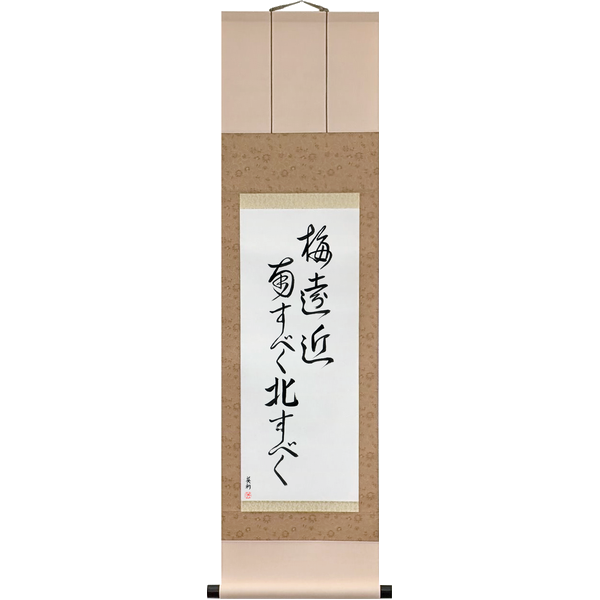
Sold as Buson's, with English in Blyth's shape and a page story that the poet is torn between south, where the plum is in full bloom, and north, where it is just opening · Read ume ochikochi minami subeku kita subeku · Oldest witness Buson's own 句集 of 1784, read at the leaf, where the verse stands in the spring section without a headnote; no witness dates it · Sense plum blossoms far and near, so that going south would do and going north would do. A sentence that ends in the air, which a 1935 school rhetoric made its textbook case of the unsaid close, and which Blyth called a feeling without words to express it in any language, yet expressed. The page's dilemma is carried by no witness.
The text as brushed, and its variants
The scroll carries 梅遠近南すべく北すべく, and the second and third phrases are stable in every witness. The first phrase is 梅遠近 in the 1784 句集, read at the leaf in cursive kanji, and in seven of the nine later witnesses; 梅をちこち in a 1940 school reader, which fixes the reading ochikochi in kana; and 梅園を, the plum garden, in one 1934 anthology, which the leaf confirms is what that print carries, an editor's variant or misprint and not the scanner's. The 1799 gazetteer writes すへく without the dakuten, as its kana do throughout. One witness of 1899 carries only the phrase 南すべく北すべく, extended to 朱すべく黑すべく in an essay on schooling, which is evidence for the phrase's life as a saying and not for the poem. The meter is six, six, five, seventeen in all: う・め・お・ち・こ・ち, み・な・み・す・べ・く, き・た・す・べ・く; the page's note that a reading minnami would make the middle phrase seven is the same count from the other side.
The attribution, as a dated thread
Buson's, at every witness that names a poet, and from his own book. The 蕪村句集 of 1784, published by 几董 the year after Buson's death from the poet's late self-selection, carries the verse in 巻之上 春之部 among the plum verses, after 小豆賣小家の梅のつぼみがち and before the headnote 早春 that belongs to the next verse; it has no headnote of its own. 半田良平 in 1925 prints it as the last of seventeen plum verses and closes them 右十七句、句集; 藤井紫影 in 1935 prints it inside a section headed 蕪村句集. No witness dates the composition, and no headnote or occasion travels with it. Its earliest witness after the 句集 is not a haiku book but a Kyoto gazetteer of 1799, which closes a run of plum verses on the 梅溪 near Fushimi with it and the poet's name inline: fifteen years after the 句集 the verse was already attached to a plum-viewing place.
The words
遠近, read をちこち · ochikochi, is here and there, far and near, the classical adverb written with two kanji as a 熟字訓; the 1940 reader spells it out. 南すべく · 北すべく is 南す and 北す, to go south, to go north, each with べく, the 連用形 of べし, should, may, would do, and nothing after: the sentence hangs. The 1935 rhetoric names the figure, 断叙法, the truncated statement, and supplies the missing close, 「何方にても心のまゝなり」とでも言つたやうな語句が略されてゐる, a phrase like "either way, as the heart pleases" is left out; Blyth reads the same hang, anywhere will do. As words the line says: Plum, far and near; one could go south, one could go north.
A history, from the earliest witness
1784. 蕪村句集, 前編 巻之上 春之部, edited by 几董. 梅遠近 南すへく北すへく, in cursive kanji and unmarked kana, in the 梅 run without a headnote. Read by eye at the National Institute of Japanese Literature's copy in an earlier session. [NIJL 国書データベース biblio 300106341, canvas 7, right page, column 2, read by eye; the crop kept in the account]
1799. 秋里籬島, 都林泉名勝図会, the illustrated gazetteer of Kyoto's gardens. Under 伏見山 and its 梅溪, after a run of Chinese-style plum verses by 梅華仙, 六如 and others, the column 梅遠近南すへく北すへく 蕪村 closes the leaf, both へ in the same 部-form kana and neither with a dakuten (the OCR layer reads 南すべく for the first). The earliest print of the verse opened, and a plum-viewing place's. [NDL pid 9369511, koma 181, read by eye; text at lab.ndl.go.jp/dl/api/page/9369511_181]
1899, 1909, 1913. An essay on schooling; 沼波瓊音, 俳句の作り方; 大町桂月, 文章大辞林. The phrase 南すべく北すべく leaned on as a saying his readers know, and stretched to 朱すべく黑すべく; 沼波's list of plum verses that carry のどか, beside 梅が香にのつと日の出る山路哉; 桂月's dictionary of prose with the verse and (蕪村) after it. [NDL pid 813462, koma 4; pid 994608, koma 22; pid 951697, koma 34; OCR; text at lab.ndl.go.jp/dl/api/page/994608_22]
1925. 蕪村三千句; 半田良平, 蕪村俳句全集 季題別. Both print the verse; 半田 prints it last of the seventeen 句集 plum verses and closes them (右十七句、句集), the editor's statement of where it comes from. [NDL pid 924926, koma 15, OCR; pid 964212, koma 17, printed page 20, read by eye; text at lab.ndl.go.jp/dl/api/page/964212_17]
1931, 1934, 1935. A school entrance examination; an anthology by season; 藤井紫影, 名家俳句集. The examination sets the verse for interpretation; the 1934 anthology prints 梅園を南すべく北すべく 蕪村, its 園を on the leaf; 藤井 prints the received text inside his 蕪村句集 section without a note. [NDL pid 1457666, koma 121, OCR; pid 1056180, koma 112, printed page 4, read by eye; pid 1259717, koma 220, OCR; text at lab.ndl.go.jp/dl/api/page/1056180_112 and 1259717_220]
1935. 小原国芳 (ed.), 児童百科大辞典, the volume 文藝の基礎學, under (ク) 断叙法. 梅遠近南すべく北すべく(蕪村)これなどでも、終りに「何方にても心のまゝなり」とでも言つたやうな語句が略されてゐるのである, the verse as the textbook case of the unsaid close, beside a 枕草子 sentence and a verse of 素堂 (the 枕草子 is in the OCR layer of the koma; 素堂 is not, on this koma or its neighbors, and stands on the by-eye reading). [NDL pid 1720361, koma 114, printed pages 196–197, read by eye; text at lab.ndl.go.jp/dl/api/page/1720361_114]
1940. 慶応義塾大学 (ed.), 国語教程, a reader. 梅をちこち南すべく北すべく, second on a page of famous verses, after 涼しや朝草門に荷ひこむ, the pair signed 蕪村 beneath; the first word in kana. [NDL pid 1056675, koma 24, printed page 36, read by eye; text at lab.ndl.go.jp/dl/api/page/1056675_24]
Today. The archive lists sixty-six books carrying the verse before 1945, twelve of them opened for the account. kotobank's page for 与謝蕪村 gives the poet's dates and works and does not quote the verse. [harvest_index.py lookup --id 248 --year-to 1945; kotobank 与謝蕪村, read as text]
The sense, across three centuries
The verse has had one reading, and it is the one its grammar forces. The 1799 gazetteer used it for a place where plum is everywhere; 沼波 in 1909 filed it under のどか, the leisurely spring mood; the 1899 essayist could stretch its second half into a saying because everyone knew it meant either way; the 1935 rhetoric said outright that the omitted close is as the heart pleases; a 1931 examination could set it because a schoolchild could read it. Blyth in the essay printed in 1994 heard the newness of spring, and yet … the luxury, the bounty, the universality of the season; in truth, anywhere will do in these days of renewed life and beauty. Nobody opened has read a dilemma into it. The page's story, that the blossoms open earlier in the south so that south means full bloom and north means first bloom and the poet must weigh the two, is a botanical inference laid over the verse, and the two readers who gloss it, the 1935 rhetorician and Blyth, say the opposite: the blossoms are everywhere and both roads are good.
What is not a source
The page's dilemma is carried by no witness. The 1934 梅園を is one editor's and stands against the 句集's own 遠近. The 1899 essay is a witness to the phrase's life as a proverb, not to the poem. No witness dates the verse; the 岩波 or 講談社 critical editions would say whether any manuscript does, and they were not opened.
The verse in English
The bilingual dictionaries of the Meiji shelf were not checked for this verse. Henderson, Miyamori, Keene, Sato, Shirane, Hass, Reichhold, Carter and Aitken were searched on the shelf and do not carry it; Ueda's Path of Flowering Thorn is on the shelf since the eighth delivery and does not carry it (its far and near is the waterfall verse); Sawa and Shiffert's Haiku Master Buson is on the shelf and carries it, page 62, as § The verse in English gives (the s39 sentence that said neither was on the shelf was written before the delivery). (SUPERSEDED s90, 2026-09-14: both are on the shelf since the eighth delivery; Sawa and Shiffert carry it, Ueda does not; read below in § Supersession 2026-09-14.)
1952 and 1994. R. H. Blyth, Haiku, volume 4, Appendix I, Hokuseido Press; The Genius of Haiku, British Haiku Society and Hokuseido Press, pages 92–93. The romaji alone in the 1952 appendix; in the posthumous essay, Ume ochikochi minami subeku kita subeku — Plum-blossoms here and there, / It is good to go north, / Good to go south, offered as an example of the delicacy of the haiku poet, where the feeling is quite a nameless one, without words to express it in any language, yet expressed, faultlessly and unequivocally, and the sentence on renewed life quoted above. The one translator on the shelf. [docs/research/papers, Blyth 1952 vol. 4 and Blyth 1994, pages 92–93 by the text layer's page numbers, read as text; no ASIN collected]
Today. The house page prints Plum blossoms everywhere / I should go south / I should go north, Blyth's shape with should for his good to and everywhere for his here and there; the rendering is defensible, should carrying the edge of べし. A rendering of this line has one thing to keep: it must not close. Blyth's does not, and neither does the page's.
A reading
I read the verse as the 1935 rhetoric and Blyth read it, and as its grammar reads it: plum everywhere, so both roads are good and the sentence can stop in the air. That is the reading I sign, and it is the better story for a design: not a man deciding between two trips but a spring in which any direction is right. The page's story of full bloom in the south and first bloom in the north has no witness and contradicts the two glosses on record; it should not stand as written, and the history is what its rewrite should cite. The text as brushed is the 句集's own, 遠近 in kanji; the 1934 園を is one print's; the romaji stands; the translation can stay. Signed, 典, 2026-09-05.
Supersession 2026-09-14 (s90)
The layer after Blyth. The English join built this session finds the verse in one book shelved since the tenth, opened at its page and read as text.
- 2007. Yuki Sawa and Edith Marcombe Shiffert, Haiku Master Buson, White Pine Press (first published 1978), page 62: Plum flowers far and near. / Shall I go to the south? / Shall I go north?, romaji Ume ochi-kochi minami subeku kita subeku, in a run of plum verses. [shelf, pdfpage 65]
Ueda's Path of Flowering Thorn (1998) is on the shelf and does not carry this verse in its text layer. Blyth's rendering stands as the earliest English found; Sawa and Shiffert's is the only other, and it keeps the two すべく as two questions, which is the reading this history signed.
How this was read
By eye at width 3600: the 1799 gazetteer at its 梅溪 leaf, where the closing column was read; the 1934 anthology at its spring page, where 園を was read on the leaf; 半田 1925 at the 梅 section and its tag; the 1935 rhetoric at 断叙法; the 1940 reader at its first page of verses. The 1784 句集 by eye at NIJL in an earlier session. By OCR from the archive's text layer: the 1899 essay, 沼波 1909, 桂月 1913, the 1925 三千句, the 1931 examination, 藤井 1935. By text layer from the shelf: Blyth in two books. Not opened: a critical edition of Buson for any date; Ueda; Sawa and Shiffert; a 歳時記 for the verse's standing as an example; fifty-four books the archive lists. A bracket of the form pid P, koma N resolves as text at lab.ndl.go.jp/dl/api/page/P_N and as an image at dl.ndl.go.jp/api/iiif/P/R<N, seven digits>/full/3600,/0/default.jpg; the five leaves read by eye were fetched at that address. The full apparatus, with every address, is in the account.
Supersession 2026-09-14 (s92)
A read-only worker resolved this account's addresses (citation_checks_2026-09-14/history_ume_ochikochi_248_2026-09-05.check.md): 27 claims, all twelve NDL komas and the Blyth and Sawa quotations at the address. Corrected above: the s39 sentence saying Ueda's and Sawa and Shiffert's books were not on the shelf, both delivered since, one of them cited in the same account; the 素堂 verse beside the 1935 textbook example is not in the OCR of koma 114 or its neighbors and now says it rests on the by-eye reading. Not yet read by a person.
References
Each witness is cited in the account above, at the frame or entry where it was read. A linked list follows when the record for this text is completed.