

手折らるゝ人に薫るや梅の花 · taoraruru hito ni kaoru ya ume no hana · To the one who breaks its branch, the plum gives its scent
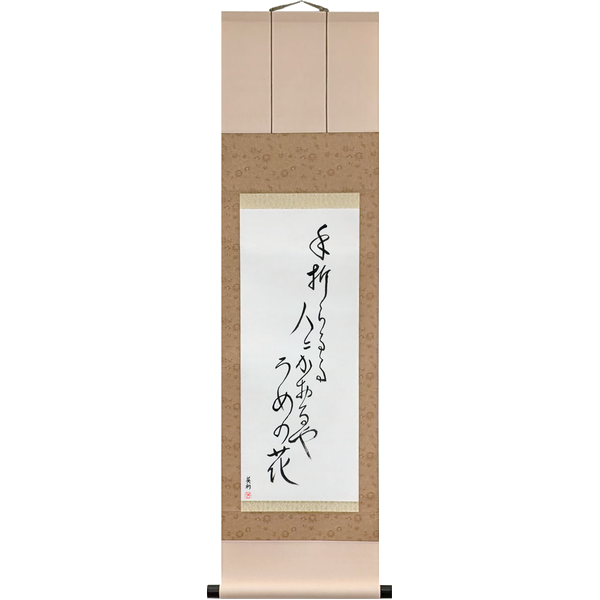
Sold as Chiyojo's, with the English To the person breaking off the branch / giving its fragrance / the plum blossom and no headnote · Read taoraruru hito ni kaoru ya ume no hana · Oldest witness her own collection, 千代尼句集, printed in 1764 with her preface, read on its plum leaf: the small headnote 仇を恩にて報するといふ事を, on the matter of repaying enmity with kindness, above 手折らるゝ人に薫るや梅の花 · Sense to the one who breaks its branch, the plum blossom gives its scent; the headnote is the verse's title, and the page does not carry it.
The text as brushed, and its variants
The scroll carries 手折らるゝ人に薫るや梅の花, and the record carries one text in a handful of writings. 薫 / 薰 / 香 / かをる / かほる. The 1764 print writes the verb in a cursive I read as 薫; the 1799 guide 薫; the Meiji collections 薰, the old form; a 1909 Christian magazine 香る; the 1909 grammarian, a 1909 maxim book and a 1926 one spell it かをる or かほる. 梅の花 / 梅花 / うめの花 / 梅のはな are writings; the 1799 guide and two of the collections print 梅花, read the same at five. 手をらるゝ in a 1913 dictionary of maxims is the verb in kana. The undated manuscript 俳諧漫画's 手切 is an OCR shape or a scribe's and was not opened. There is no variant of sense; the record disagrees on nothing but spelling. The meter is five, seven, five: た・お・ら・る・る, ひ・と・に・か・お・る・や, う・め・の・は・な. The headnote travels with the verse: in the 1764 print, in the 1799 guide, in every collection that prints her section, in Miyamori's Japanese and as Blyth's prescript; the scroll and the page carry the verse alone.
The attribution, as a dated thread
Chiyo's, on her own book. The 千代尼句集 was compiled by 既白 and printed in 1764 with her preface, eleven years before her death, and its plum section carries the verse with the headnote above it and 追悼 heading the next verse, the order every later typeset keeps; that is the attribution settled, and it was settled on the leaf this session. The 1799 Kyoto garden guide prints it second in a run of seven plum verses with the poets' names in a column at the foot, one name to a column: かゝ 千代 under the first verse, 仝, ditto, under this one, then 大江丸, 二柳, 嘯山, 唯然, 定雅. An 1881 Shingon preacher says 古人, an ancient, which is a preacher's vagueness; the critic 静斎 in 1899 says 千代; the 1903, 1919, 1922 and 1927 collections print it in her section under the headnote; the 1909 magazine and the two 1909 maxim books name her; three grammar textbooks of 1925–1934 set it as their first exercise sentence with 千代女 after it; the 1930 life of three nuns prints it in its 千代尼句抄. Miyamori in 1932, Yasuda in 1947, Blyth in 1963 and again in the 1981 printing of his Haiku, and Haldane in 2006 give it to her; none argues it. The dictionary's warning that several of her most famous verses are hers without proof does not name this one, and her own book answers it.
The words
手折らるゝ人に is to the person by whom it is broken off: 手折る, to break off by hand, in the passive らるゝ, which makes the plum the subject and the breaker the recipient. 薫るや is it gives its scent, with the や of exclamation. 梅の花 is the plum blossom, the first flower of spring and a season word for it. As words the line says: to the one who breaks off its branch, the plum gives its scent. The underside, from 武島羽衣's 1909 textbook of interpretation, which uses this verse as its type case of 裏面, the reverse face, of a sentence: 手折る is 害を加ふる, to do harm; かをる is 善を以てむくゆ, to repay with good; 梅の花 is 君子, the gentleman; and the reader has the verse only when both faces are held at once. The headnote says the same in eleven characters.
A history, from the earliest witness
1764. 千代尼句集, compiled by 無外庵既白, with the poet's preface (宝暦14). Read on its plum leaf, the left page of canvas 17 of the 愛知教育大学 copy: a run of 梅 verses, then the small headnote 仇を恩にて報するといふ事を, then 手折らるゝ人に薫るや梅の花, then the small heading 追悼 and 梅ちるや松のゆふべも秋の声. My transcription of the woodblock hand normalizes kana. [NIJL 国書データベース, 千代尼句集 WID 372758 (sixty-seven holdings, eighteen with images), copy BID 100041085, canvas 17 of its IIIF manifest, read by eye at width 2600]
1799. 秋里籬島, 都林泉名勝図会, volume 3, the last leaf. Seven plum verses close the volume: 梅か香やことに月夜の面白く / 仇を恩にて報するといふ事を 手折らるゝ人に薫るや梅花 / 我袖のわか袖ならすむめの花 / 眼のさめる伏水のむめのさかりかな / 梅か香や山も葛屋も動くかと / むめのはなあの月なから折はやな / 無かしみし夜のおもむきや梅の月, with the names at the foot, one under each column, and かゝ, Kaga, above 千代. The verse is hers by the 仝 beneath it, read by eye where the OCR could not pair the names. [NDL pid 9369511, koma 185, read by eye at widths 2400 and 6000; text at lab.ndl.go.jp/dl/api/page/9369511_185]
1881. 服部鑁海, 真言宗在家勤行法則和解, a lay manual of Shingon practice. 疑謗の逆緣まずも此教に進ひ奉れハ。往生得脱の利益蒙らる … 此意を古人グ觧し易く 手折らるゝ人に薰るや梅の花 かく詠まれてある, even those who doubt and slander the teaching, once they come to it, gain rebirth and release; an ancient put this meaning where it is easily grasped, in the verse. The verse as doctrine, and the poet unnamed. [NDL pid 819460, koma 31, OCR]
1899. 福島静斎, 静斎遺稿. Read on its leaf: 千代が仇を恩にて報ふるといふ事をば「手折らるゝ人に薰るや梅の花」とは輕妙といふべし、「稻妻やきのふは東けふは西」とは其角の句中にても秀れたる者なりとかや、而も「萍やけふは向の岸に咲く」といふに及ばざる者は他なし、餘情に乏しければなり (the OCR layer reads 事をは and 手折らる〓), Chiyo's verse on repaying enmity with kindness may be called light and deft; Kikaku's lightning verse is said to be among the finest of his, and yet nothing falls as short of the duckweed verse as it does, for want of resonance. The judgment of 餘情 is on Kikaku's verse, not hers; hers gets 輕妙 and a full stop. [NDL pid 898705, koma 75, printed page 122, read by eye; text at lab.ndl.go.jp/dl/api/page/898705_75]
1903–1927. The women's collections. 永井孤秋's 女流俳家全集 (1903), 古谷知新's 女流文学全集 (1919), 勝峰晋風's 閨秀俳家全集 (1922) and his 日本俳書大系 volume (1927) each print it in her section under the headnote, 仇を恩にて報ずるといふ事を 手折らるゝ人に薰るや梅のはな / うめの花 / 梅花; 安藤和風's 閨秀俳句選 (1905) prints it without the headnote after 薰れよと梅折入れつ御所文庫. [NDL pid 875137, koma 11; pid 957686, koma 245; pid 970129, koma 62; pid 1179392, koma 85; pid 874986, koma 46; OCR, each koma confirmed by the reader or on the fulltext zip]
1909. 武島羽衣, 国語解釈法; and the moralists. 武島: 例せば手折らるゝ人にかをるや梅の花。といふ句において「手折る」は裏面においては「害を加ふる」といふ事なり、「かをる」は「善を以てむくゆ」といふ事、また「梅の花」は「君子」などいふ意味と心得てはじめてこの句の表面の意は … 裏面においては君子は善を以て惡にむくゆといふ意なる事知られて作者の眞意のくまなく知らるゝならずや, the passage glossed above. The same year 櫟林集, a Christian magazine, quotes 手折らるゝ人に香るや梅の花(千代) in an essay on a woman's 高潔, and 金声玉言, a book of maxims, lists ○手折らるゝ人にかほるや梅の花。(加賀の千代) between Seneca and 貝原益軒 under the conduct of society; 格言大観 (1913) and 東西格言国民座右銘 (1926) keep it among the maxims, 修養十二ケ月 (1916) closes a sermon on eternity and greed with it, 牛 (1918) makes it the secret of pleasing others, 心学道話集 (1927) sets it beside 踏れても咲く蒲公英の笑顔哉 under 堪忍, forbearance. [NDL pid 868076, koma 56; pid 898662, koma 46; pid 755191, koma 130; pid 906263, koma 51; pid 917288, koma 156; pid 955825, koma 28; pid 954825, koma 63; pid 1186670, koma 178; OCR]
1925–1934. The grammar textbooks. 富山房's 最新女子文典 (1925, 1934) and 最新日本文典 (1926, two printings) set the verse as the first sentence of an exercise on auxiliary verbs: 左の文中の助動詞を指摘しなさい。一、手折らるゝ人に薰るや梅の花。-千代女 二、尾を振る犬は打たれず。…; the passive らるゝ is the point. [NDL pid 917606, koma 19; pid 1027356; pid 925304, koma 20; pid 925305; OCR]
1930. 貞心と千代と蓮月, 春秋社, three nuns; reprinted 1932, 1939, 1949. Its 千代尼句抄 prints 梅さくや寒い〳〵が癖になり / 仇を恩にて報ずるといふ事を 手折らるゝ人に薰るや梅の花 / 追悼 梅ちるやまつのゆふべも秋の聲, the order of her 1764 book. [NDL pid 1212531, koma 152, OCR]
1940. 俳句の作り方味い方入門, 洛東書院. 手折らるゝ人に薰るや梅の花 … 俗間に有名なのであります, famous among ordinary people, in a page on the women poets. [NDL pid 1116343, koma 99, OCR]
Today. The harvest index lists twenty-six books carrying the verse; the NDL full-text search returns thirty-eight for 手折らるゝ人に, thirty for 薫るや梅の花, two for 手折らるる人に and one for 手折らるゝ人にかをる. [harvest_index.py lookup --id 263 --year-to 1945; lab.ndl.go.jp/dl/api/book/search, four keywords, 2026-09-05]
The sense, across two and a half centuries
The poet titled it, and the title is the sense: 仇を恩にて報する, repay enmity with kindness. The 1799 guide kept the title; the 1881 preacher made it doctrine, the gain of the Law even for its slanderers; 武島 in 1909 made it the textbook case of a verse with a reverse face; the maxim books of 1909–1926 filed it among rules of conduct; the grammar books of 1925–1934 among passives. 静斎 in 1899: 輕妙, light and deft. Miyamori in 1932: This didactic verse is generally considered to be of little merit. Blyth in 1963: moralistic but less successful, and the joke, the moral of this seems to be Break off flowering branches! 堀切實 on the poet, in the dictionary: her style generally popular, prized in her day for its clever play of wit. The 1940 primer: famous among ordinary people. The critics and the public have disagreed about this verse for a century, and the public has the 1764 book on its side: she chose to title it.
What is not a source
The page's English is a house rendering in the Japanese order, verbatim to no one, and needs no credit. Shiki's manuscript copy of the 発句類題全集 (1889) surfaces in the search for 薫るや梅の花 but carries a different verse, 明る戸に旭薫るや梅の花, and is not a witness. The undated manuscript 俳諧漫画 was not opened. Nothing in the record dates the verse; her second collection, 松の声 (1771), was not opened.
The verse in English
The bilingual dictionaries of the Meiji shelf were not checked. Sato, Rexroth and Hass do not carry it on the shelf.
1932. Asatarō Miyamori, An Anthology of Haiku Ancient and Modern, Maruzen, Tokyo, page 430, no. 388, THE PLUM-BLOSSOM (Good for Evil). 梅の花 (仇を恩にて報するということを) 手折らるゝ 人に薫るや 梅の花 千代尼; The plum-blossoms give their perfume / To the man who broke off the branch. Chiyo-Ni, with the sentence quoted above. [docs/research/papers, Miyamori 1932, printed page 430, text layer; no ASIN collected]
1947. Kenneth Yasuda, A Pepper-Pod, Tuttle, PLUM-BLOSSOM. Chiyo (1701-1775) — Taoraruru / Hito ni kaoru ya / Ume no hana; the English above it in the text layer, headed PLUM-BLOSSOM (Good for Evil): Flowers give their perfume / To the one who breaks the branch / From the plum in bloom (s43 said the text layer had not captured it, which was wrong). [docs/research/papers, Yasuda 1947, text layer; no ASIN collected]
1963, 1981. R. H. Blyth. A History of Haiku, volume 1, Hokuseido, Women Haiku Writers: The following also is moralistic but less successful; it was written in reference to the saying "Return good for evil": Taoraruru / hito ni kaoru ya / ume no hana — The flower of the plum / Gives its scent / To him who breaks off the branch; and Haiku, volume 1, 1981 printing, SPRING: The flowering branch of the plum / Gives its scent / To him who broke it off. This has the prescript, "In regard to requiting evil with good." Chiyo-ni. [docs/research/papers, Blyth 1963 and 1981, text layer; no ASIN collected]
2006, via Delphi 2022. Michael Haldane. taoraruru / hito ni kaoru ya / ume no hana — fragrant / to the hand that breaks – / plum-blossom, in the Chiyo-ni section of Delphi's Bashō and the Haikuists, translated by Haldane, 2006. [docs/research/papers, Delphi 2022, text layer; no ASIN collected]
Today. The house page's To the person breaking off the branch / giving its fragrance / the plum blossom stands as a rendering of the verse. What it lacks is the title: a rendering of this haiku has one thing to keep, the headnote in Japanese and in English, on repaying enmity with kindness, without which the reader has a plum and not an emblem.
A reading
I read the verse as she titled it and as the 1909 grammarian taught it: a sentence with two faces, a plum that scents the hand that broke it and a gentleman who repays harm with good, and the verse is the fit between them. That is what a maxim book wants and what a critic of 餘情 does not, and both are right about what they are looking at; 静斎's 輕妙 is the fairest word, light and deft, a verse that does exactly one thing. The attribution is hers by her own book, read this session, and the page may say so. The text stands; the scroll's 薫 is the 1764 and 1799 form. What the page must add is the headnote, in Japanese and in English, because the design is being bought as the emblem and the emblem is in the title. What need not go on the page is the critics' verdict; the account holds it. Signed, 典, 2026-09-06, s43.
Eri
Nothing to ask.
How this was read
By eye at width 2600 from NIJL, through the IIIF manifest of the 千代尼句集 of 1764 (BID 100041085), canvas 17, located by contact sheets of canvases 1–66. By eye at widths 2400 and 6000 from NDL: the 1799 guide at koma 185, the leaf and its name column; at width 2400 the 1899 静斎 at koma 75. By OCR from the archive's text layer, per the account and the reader: the 1881–1940 witnesses. As text: kotobank on the poet, the NDL full-text search on four spellings, the NIJL work and holdings records (千代尼句集 WID 372758; 松の声 WID 1046884, twenty holdings, seven with images), the shelf's text layers for Miyamori, Yasuda, Blyth and Haldane. Not opened: 松の声 (1771); the other copies of the 1764 print; the manuscript 俳諧漫画; the 1904 日露戦争勝閧集 and the other search returns whose zips are not on disk. A bracket of the form pid P, koma N resolves as text at lab.ndl.go.jp/dl/api/page/P_N and as an image at dl.ndl.go.jp/api/iiif/P/R<N, seven digits>/full/3600,/0/default.jpg; an NIJL canvas resolves through kokusho.nijl.ac.jp/biblio/<BID>/manifest. The full apparatus, with every address, is in the account.
Supersession 2026-09-14 (s92)
A read-only worker resolved this account's addresses (citation_checks_2026-09-14/history_taoraruru_263_2026-09-06.check.md): 27 openable claims, all at the address, the s43 koma corrections included. Corrected above: Yasuda's A Pepper-Pod carries its English rendering four lines above the romaji, which s43 said the text layer had not captured. Sato's String of Beads has no Chiyo, as the account says. Not yet read by a person.
References
Each witness is cited in the account above, at the frame or entry where it was read. A linked list follows when the record for this text is completed.