

白露をこぼさぬ萩のうねりかな · shiratsuyu wo kobosanu hagi no uneri kana · The bush clover sways and spills not one white drop of dew
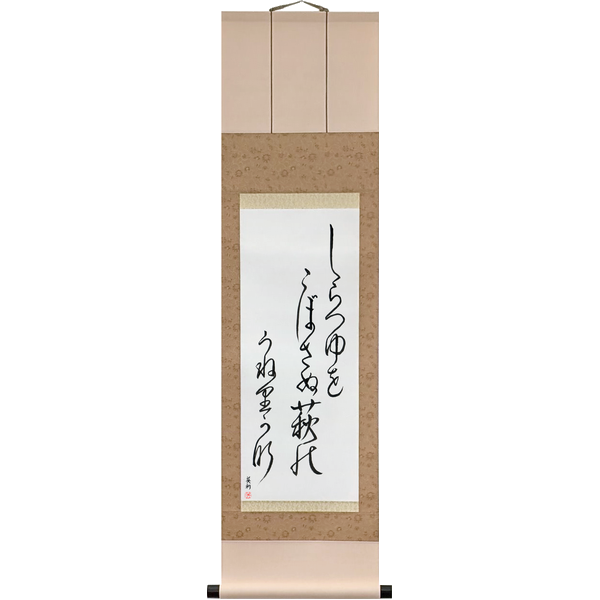
Sold as Bashō's, with no English and a house note on 萩 and 白露 as autumn words and the restraint the verse turns on · Read shiratsuyu wo kobosanu hagi no uneri kana · Oldest witnesses the 1696 芭蕉庵小文庫, read on its leaf, しら露もこぼさぬ; the 1698 泊船集, read on its leaf, しら露をこぼさぬ; a letter in Bashō's name sending this morning's verse as 白露も; and 杉風's own headnote, quoted by the 江戸名所図会, over 白露もこぼれぬ · Sense the bush clover sways and does not spill its dew. An inscription on a painting, in the autumn of 1693 by the oldest dating the record holds, and the one verse in the catalogue whose particle the sources contest, from the poet's own generation on.
The text as brushed, and its variants
The scroll carries 白露をこぼさぬ萩のうねりかな, and the record carries three forms on two words, all three from the Genroku years.
The particle. を: in 風国's 泊船集 of 1698, read on the leaf of the 光丘文庫 copy (しら露をこぼさぬ萩のうねりかな, in the 萩 run of the autumn book, no headnote); in two more early books the 1932 and 1947 critical editions name beside it, 翁草 and 木枯, not opened; in the 芭蕉句選 of 1739 by the testimony of its Edo commentator 積翠, who heads his entry with the を form; in the 一葉集 of 1827, whose hokku section prints 畫賛 しら露をこほさぬ萩のうねり哉; and from there in nearly every Meiji and Taishō anthology, in the school readers, in Shiki's list of the master's finely wrought verses, and in Miyamori, Yasuda, Blyth, Haldane and Aitken. も: in the 1696 芭蕉庵小文庫, the first collection after the poet's death, read on the leaf of the 八戸 copy (しら露もこぼさぬ萩のうねり哉, under 仝 for the poet, in the run that opens 不破にて); in the letter to 去来 in both its transmitted versions; in 其角's 三上吟 of 1700 as 積翠 quotes it; in 類柑子 (1707) by the 1928 index, the 1947 edition and 積翠, who reports its headnote 自畫賛; in 白雄's 寂栞, read in the 1928 typeset; in 蝶夢's 芭蕉翁発句集 of 1774, read on the Edo leaf under the headnote 畫讃; in Shiki's essay on bush clover in the same 1893 book that lists the を form elsewhere; in the 1925 and 1934 editions; as the first form in 潁原's apparatus of 1932 and 1947; and in Fitzsimons. The verb. こぼさぬ, does not spill, the clover the agent, everywhere but 杉風's collection and the 名所図会 that quotes it, which read こぼれぬ, is not spilled; 潁原 took that for the poet's first draft. The 1885 いろは文庫's こやさぬ is the scanner's. A fourth form, 月かげをこぼさぬ, moonlight for dew, is reported from a book called 鳩の水 by 積翠 and, from him, by 潁原, who never saw the book. The sense holds across all of them: the clover moves and the dew stays. The meter is five, seven, five: し・ら・つ・ゆ・を, こ・ぼ・さ・ぬ・は・ぎ・の, う・ね・り・か・な.
So the answer to the question this history was reopened for. The scroll's を is neither the house's slip nor a Meiji editor's. It is 風国's text of 1698, two years after the 小文庫, and it became the received text of the eighteenth and nineteenth centuries and of the English translators. The poet's own hand as the tradition preserves it, the first posthumous collection, 其角's memorial anthology and the eighteenth-century selections of 蝶夢 read も. The poem changed once, early, between two disciples' books; which of the two the poet meant last is the one thing the record does not settle, and the century's leading Bashō philologist, 潁原退蔵, argued in 1948 that を was Bashō's own improvement on a first draft. The reading below says where I stand.
The attribution, as a dated thread
Bashō's, from the first print. The 1696 小文庫 sets the verse under 仝 after はせを at the head of the run; 泊船集 sets it among the master's hokku; 三上吟 tells of the poet inscribing it on a picture; every later Japanese witness prints 芭蕉; Aston, Miyamori, Yasuda, Blyth, Haldane, Aitken and Fitzsimons all give it to him. The one witness that could be read otherwise cannot be, now that its leaf is open: the 江戸名所図会's 採茶庵 entry quotes 杉風句集, 予閑居採茶庵それかかきねに秋萩をうつしうゑて初秋の風ほのかに露かきわたしたるゆふへ (the leaf writes か for が without a dakuten), in my retreat 採茶庵 I transplanted autumn clover to its hedge, and one evening when the first autumn wind and the dew lay over it, then 白露もこぼれぬ萩のうねりかな with はせを beneath it, then このあはれにひかれて, drawn by that feeling, and 萩うゑてひとり見ならふやま路かな with 杉風 beneath.
The date is 1693 on two witnesses and 1691 on one. 杉風's headnote sets the verse in his garden at 深川 in early autumn and gives no year. 其角's 三上吟 (1700), the collection for the seventh memorial, says by 積翠's quotation that the poet had inscribed a picture with the verse seven years before, 七とせ先の畫讃, which 積翠 reckons to 1693 or 1694 and Fitzsimons, with the modern editors, to the autumn of 1693. Against that stands the letter: 前日は寛々閑對不淺存候。然ば其角も一兩日中には東武歸國申候。左候はゞ今夕餞別一會いたし遣し度候條、丈草など被仰合、暮前より御來駕まち入候, the other day's long talk was a pleasure; 其角 goes back east within a day or two, so I would give him a farewell gathering this evening; please come before dusk, with 丈草 and the others, dated 長月十一日, to 落柿舎主人, with the postscript 尚々今朝の吟御目にかけ申候 and the verse, and here is this morning's verse, then 其角's reply 古庵や寝せず起さず萩の花. A second transmission of the same letter, from 芭蕉翁眞蹟拾遺, is dated 八月廿八日 and reads 古庭や寢もせず起ず萩の花. If the letter is the poet's, the verse was made in a morning in Kyoto or Ōtsu, with 去来, 丈草 and 其角 at hand, which is why 半田 dated it 1691 and 萩原 1694. Its own editors doubt it: 沼波 prints both versions with the note 此書簡何れか一方は傳寫の錯誤ならん, one of the two must be a copyist's error, and 勝峯 writes 其角が上方から歸つた年次と符合しない, it does not fit the year 其角 came back from the west. I hold 1693 and 杉風's garden, on 三上吟 and the headnote, and carry the letter as the dissenting document. 萩原's two placings, Iga in 1693 and 無名庵 in 1694, contradict each other and the letter alike.
The words
白露 is white dew, an autumn season word and a solar term. をこぼさぬ is does not spill it, the clover the agent; もこぼさぬ is does not spill even the dew, or the dew, too, it does not spill; もこぼれぬ is even the dew is not spilled. 潁原's 1948 reading of the difference: もこぼれぬ sounds like a figure of speech and loses the concreteness, をこぼさぬ puts the white dew on the branch before the eye. 萩 is bush clover, Lespedeza to Yasuda and Miyamori, one of the seven grasses of autumn, its long stems bending and swaying. うねり is the long undulation of a bough in wind; Blyth for all their swaying, Aitken despite their swaying, Fitzsimons swaying this way that. かな closes on the swaying. As words the line says: The white dew it does not spill: the swaying of the bush clover.
A history, from the earliest witness
1693, autumn, by the record's oldest dating. Bashō, at 杉風's 採茶庵 in 深川, an inscription on his own painting. The occasion from 杉風's headnote as the 名所図会 quotes it, from 三上吟's seven years before as 積翠 quotes it, and from the headnotes 畫讃 and 自畫賛 the eighteenth-century books give the verse. [江戸名所図会, 三上吟 via 積翠, and 蝶夢 1774, below]
Autumn, year unstated. The letter to 去来. Quoted whole above, in the 一葉集's text (1827) and the 眞蹟拾遺's, with 白露もこぼさぬ / しら露もこぼさぬ and the two editors' doubts. [一葉集 消息之部, 1925 typeset, NDL pid 1018232, koma 233, printed page 455, read by eye; 勝峯 芭蕉書翰集 1934, pid 1186973, koma 114, printed page 222, read by eye; 沼波 芭蕉全集 1928, pid 1145736, koma 245, printed pages 446–447, both versions, read by eye; the 俳書堂 芭蕉書簡集 1916 and 1926, pids 953368 koma 13 and 1019496 koma 14, OCR; text at lab.ndl.go.jp/dl/api/page/1018232_233]
1696. 史邦 (ed.), 芭蕉庵小文庫, the first collection after the poet's death. In the lower volume, after the prose piece 閉關之説 and before 更科姨捨月之辨, a run of autumn hokku: 盆過て宵闇くらし虫の聲 ばせを, 牛部屋に蚊の聲よわし秋の風 仝, 雀子の髭も黒むやあきのかぜ 式之, then under the headnote 不破にて: あき風や藪もはたけも不破の関 はせを, はつ嵐ふけども青し栗のいが 仝, 初茸やまだ日数へぬ秋の露 仝, しら露もこぼさぬ萩のうねり哉 仝, ひよろひよろと猶露けしや女郎花 仝, 弓かためとる頃なれやふぢばかま 支老, 玉かづらなまりも床し爪根花 史邦. No headnote of its own. Read by eye in the 八戸市立図書館 copy; the kana forms are my normalization of the woodblock hand (the leaf writes 志ら露 and こほさぬ). The same text in the 1916 博文館 typeset. [NIJL 国書データベース, 芭蕉庵小文庫 WID 412113, copy BID 100059391, canvas 50 of its IIIF manifest, read by eye; the 1916 typeset at NDL pid 950169, koma 251, printed pages 470–471, read by eye; text at lab.ndl.go.jp/dl/api/page/950169_251]
1698. 風国 (ed.), 泊船集, the fourth book, autumn. Under the section head 荻萩: 七株の萩の手もとや星のあき, かゞ小松にて しほらしき名や小松ふし萩すゝき, 萩はらや一夜はやどせ山の犬 with its note on 續みなしぐり and 笈日記, 小萩ちれますほの小貝こさかづき, しら露をこぼさぬ萩のうねりかな, then をみなへし and ひよろひよろと猶露けしやをみなへし. No headnote, no name: a run of the master's own hokku. Read by eye in the 酒田市 光丘文庫 copy, folios 廿八 and 廿九 of the book; the same text in the 1909 寸珍叢書 typeset, read by eye. The を is 風国's, then, and not a Meiji typesetter's. [NIJL 国書データベース, 泊船集 WID 411132, copy BID 100012993, canvases 69–70 of its IIIF manifest, read by eye; the 1909 typeset at NDL pid 875664, koma 47, printed pages 76–77, read by eye; text at lab.ndl.go.jp/dl/api/page/875664_47]
1700. 其角 (ed.), 三上吟, the seventh-memorial collection, as quoted by 積翠 in his 芭蕉句選年考. Under the entry 白露をこぼさぬ萩のうねり哉: 元祿六七年の句なるか。三上吟集に「白露もこぼさぬ萩のうねり哉」とからびたるあらましを畫賛してたうびける。七とせ先の畫讃と有り ○按するに此三上吟は芭蕉七回忌の句なり … ○類柑子に自畫賛と有りて、白菊もと見えたり ○鳩の水には、月かげをと五文字あり, a verse of 1693 or 1694? 三上吟 has 白露もこぼさぬ, with a passage on his inscribing a picture with it, said to be seven years before; 三上吟 being the seventh-memorial book, that makes it 1693 or 1694; 類柑子 has it with the headnote 自畫賛 and, as I read it, 白菊も; 鳩の水 has 月かげを for the first five. 三上吟 itself is not opened; the 1947 edition confirms that its 專吟 headnote carries the も form. [芭蕉句選年考, 1911 typeset, NDL pid 991655, koma 33, printed pages 48–49, read by eye; text at lab.ndl.go.jp/dl/api/page/991655_33. 三上吟: NIJL WID 1172378, three holdings, not opened]
1707 and after. 類柑子, 杉風's collection, 寂栞. 類柑子 (其角's circle, 1707): 白露もこぼさぬ萩のうねり哉 under 自畫讃, by the 1928 index, the 1947 apparatus and 積翠, not opened. 杉風's own collection: 白露もこぼれぬ萩のうねり哉 under his headnote, by the 1928 index and the 名所図会's quotation, not opened; 潁原's source tag under that form is a single character I could not resolve at the page's resolution. 白雄's 俳諧寂栞, in the 1928 typeset: among the master's verses a beginner should recite, 春もやゝ氣色とゝのふ月と梅, ほとゝぎす大竹原をもる月夜, 白露もこぼさぬ萩のうねりかな, 煤はきや暮行やどの高鼾, with 道に入より此四句を常に吟じて、初學はまどひ安き故なり。旦暮の龜鑑とすべし (s41 quoted 日暮 for the source's 旦暮 and dropped the middle clause). [1928 index, NDL pid 1179400, koma 187, read by eye; 寂栞 in 日本俳書大系, pid 1179396, koma 182, printed page 329, read by eye; text at lab.ndl.go.jp/dl/api/page/1179396_182]
1739 and 1774. The two selections that made the popular text. 芭蕉句選 (1739) is not opened; 積翠's commentary on it heads this verse with を, so that is the text he had before him. 蝶夢's 芭蕉翁発句集 (1774), read on the Edo leaf: 畫讃 / 白露もこほさぬ萩のうねりかな, between 牛部屋に蚊の聲よはき殘暑哉 and 霧雨の空を芙蓉の天気哉. So the two most-read eighteenth-century selections disagreed, and both forms had Edo currency. [芭蕉翁発句集 2巻, NDL pid 2540314, koma 62, read by eye; text at lab.ndl.go.jp/dl/api/page/2540314_62]
1827. 仏兮 and 湖中, 俳諧一葉集, in both its parts. The hokku section: いろの濱 小萩ちれますほの小がひ小さかづき, 畫賛 しら露をこほさぬ萩のうねり哉, ひとつ家に遊女も寢たり萩と月; and in the letters section the letter to 去来 with しら露もこぼさぬ. One book carrying both forms, the を as the poem and the も as the poet's own words; and the nineteenth century read the poem. [1925 typeset, NDL pid 1018232, koma 24, printed page 37, and koma 233, printed page 455, both read by eye; text at lab.ndl.go.jp/dl/api/page/1018232_24]
Edo, 1834–36. 斎藤長秋, 江戸名所図会, the 採茶庵 entry, quoting 杉風句集. The headnote and the two verses with their two names, as quoted above; the same in a second Edo printing and in the 1927 有朋堂 typeset. [NDL pid 2559057, koma 19, read by eye; text at lab.ndl.go.jp/dl/api/page/2559057_19. The other printings at pid 2563397, koma 18, and pid 1174161, komas 21–23, OCR]
1885. 為永春水, いろは文庫, a gesaku. 蕉翁 asked for a verse at a gathering, and this one; reception, not record. [NDL pid 877754, koma 27, OCR; text at lab.ndl.go.jp/dl/api/page/877754_27]
1893. 正岡子規, 獺祭書屋俳話, twice, once each way. In the essay 萩: 白露もこぼさぬ萩のうねりかな 芭蕉 / 實によくも萩の風姿を形容したりけりと坐ろに歎賞せらる, how well it renders the bearing of the clover; one cannot help admiring it. In 芭蕉雜談, among the finely wrought verses, 繊巧なる者には: 白露をこぼさぬ萩のうねりかな, between 眉掃を俤にして紅の花 and 行秋や手をひろげたる栗のいが. [The 1902 printing, NDL pid 875218, koma 30, printed pages 48–49, and koma 59, printed pages 104–105, both read by eye; text at lab.ndl.go.jp/dl/api/page/875218_30 and 875218_59; the 1893 and 1895 printings at pids 992734 and 875217]
1904–1935. The commentaries and anthologies. 鳴雪's 評釈 (1904) and 竹冷's 講義 (1911) gloss the を form under 讃; 大町桂月's 文章大辞林 (1913), 島田's 1927 全集, the 1933 児童百科大辞典 under 露と霜, all を; 半田's 1925 season-and-year edition, ○白露もこぼさぬ萩のうねり哉 (元四); 藤井紫影's 1935 名家俳句集, 畫讃 白露もこぼさぬ萩のうねりかな. [NDL pids 875663 koma 24, 875654 koma 43, 951697 koma 130, 1194541 koma 48, 1720353 koma 281, 1259717 koma 82, OCR; 920858 koma 29, printed page 46, read by eye; text at lab.ndl.go.jp/dl/api/page/920858_29]
1926, 1942. 萩原蘿月, 詩人芭蕉; 芭蕉の精神. The two unsourced placings: 其とし伊賀にて名殘の畫賛は、白露もこぼさぬ萩のうねりかななどとある, and, of the ninth month of 1694, 十一日、其角送別の會を無名庵に開く。白露をこぼさぬ萩のうねりかな座右之銘も此頃の作であつた, the second built on the letter. [NDL pid 968903, koma 366; pid 1899874, koma 139; OCR; text at lab.ndl.go.jp/dl/api/page/968903_366 and 1899874_139]
1928. 勝峯晋風, 俳諧全句索引, the index to the 日本俳書大系. Under シラツユ, seven lines for this verse and none with を: (類聚)白露もこぼさぬ萩のうねりかな, (書翰)しら露もこぼさぬ萩のうねり哉, (書翰)白露もこぼさぬ萩のうねり哉, (小文)しら露もこぼさぬ萩のうねり哉, (杉風)白露もこぼれぬ萩のうねり哉, (類柑)白露もこぼさぬ萩のうねり哉, (寂栞)白露もこぼさぬ萩のうねりかな, each with its volume and page in the series. The index reports what the series prints, which is the Genroku books and not the popular selections. [NDL pid 1179400, koma 187, read by eye; text at lab.ndl.go.jp/dl/api/page/1179400_187, where the OCR reads 白雪 and 寂棄 for 白露 and 寂栞]
1932, 1947, 1948. 潁原退蔵, the critical editions and the essay. The 1932 校註 芭蕉俳句集 prints the forms as separate lines, each with its witnesses: しら露もこぼさぬ萩のうねり哉 (小文庫・三上吟), 白露をこぼさぬ萩のうねりかな (泊船集・翁草・木枯), then 杉風's headnote over 白露もこぼれぬ萩のうねり哉, then 月かげをこぼさぬ萩のうねりかな (鳩の水), with the notes ○予間居云々—これは杉風の文である and ○月かげを—芭蕉句選年考による. The 1947 新校 芭蕉俳句全集 keeps the order and adds 自畫讃 白露もこぼさぬ萩のうねり哉 (類柑子) and the note ○しら露も 三上吟所載專吟の句の前書にはこの句形で見え. Then, in 俳句周辺 (1948), 潁原 writes the verse as 白露をこぼさぬ萩のうねり哉 and argues: この句も初案は「白露もこぼれぬ」であつたらしい。… 然るにそれが「白露もこぼれぬ」では比喩的な表現にも聞えて、その具象性は甚だ弱くなるのである。そこで芭蕉は、「白露をこぼさぬ」と改めたのであらう, this verse too seems to have had 白露もこぼれぬ as its first draft; but in that form it sounds figurative and loses its concreteness, so Bashō, I suppose, revised it to 白露をこぼさぬ. The scholar who set も first in his apparatus took を for the poet's last word in his prose. [NDL pid 1170439, koma 82, printed pages 148–149; pid 1128353, komas 96–97, printed pages 169–170; pid 1128206, koma 94, printed pages 182–183; all read by eye; text at lab.ndl.go.jp/dl/api/page/1170439_82, 1128353_97 and 1128206_94]
1934. 芭蕉名句集 (俳句研究会). Under 萩, the three forms in sequence, 白露もこぼさぬ, 白露もこぼれぬ, 白露をこぼさぬ. [NDL pid 1053042, koma 90, printed page 159, read by eye; text at lab.ndl.go.jp/dl/api/page/1053042_90]
Today. The archive lists a hundred and seventy-three books carrying the verse; the NDL full-text search returns a hundred and ten books for the を spelling, forty-seven for もこぼさぬ and eight for もこぼれぬ. kotobank's page for 松尾芭蕉 does not quote the verse. The modern critical editions after 潁原 were not opened. [harvest_index.py lookup --id 260 --year-to 1945; lab.ndl.go.jp/dl/api/book/search, three keywords, 2026-09-05; kotobank 松尾芭蕉, read as text]
The sense, across three centuries
The Japanese record comments twice before the translators. 積翠 dates and sources the verse and does not read it. Shiki reads it in 1893 as a perfect rendering of the plant's bearing, 萩の風姿, and files it among the master's finely wrought verses, 繊巧, beside 落ちさまに水こぼしけり花椿, the camellia that spills its water as it falls: the two verses that turn on spilling, one that does and one that does not. 潁原 in 1948 reads the choice of particle itself, を against も, as the poet's move from figure to thing. In English, Aston, quoted by Miyamori, made it an exclamation: Ah! the waving lespedeza, / Which spills not a drop / Of the clear dew! Miyamori called it a beautiful verse quite worthy of the graceful flower. Blyth gave it a picture, the bushes move in waves, but the white and red blossoms do not drop the dew or rain that they hold, and added, this verse is to some extent a picture, but only a poet could paint it, and only a poet could see it, which is the closest anyone in English has come to saying that the verse was written on one. The page's own sentence, the poem turns on one restraint: the clover moves, and the dew still does not fall, is Shiki's reading and Blyth's, in the house's words.
What is not a source
The を of the scroll is not the poet's letter's or the 1696 print's; it is 泊船集's, and it is a text with an early and honest witness, two years younger than the earliest. The 杉風 collection's こぼれぬ is the host's text, or the poet's first draft, not the poem as the poet's own books carry it. 萩原's two placings in 1694 have no source and contradict each other. The letter dates nothing by year, and its two editors doubt it. The 名所図会's layout, read from the OCR at s26, seemed to leave the first verse to 杉風; the leaf gives it to はせを. The s41 draft named the 小文庫's compiler 文邦; he is 史邦, and the error was mine.
The verse in English
The bilingual dictionaries of the Meiji shelf were not checked for this verse. Henderson, Hass and Watson were searched on the shelf and do not carry it. (SUPERSEDED s90, 2026-09-14: the eighth delivery carries it in Stryk, Barnhill and Reichhold; read below in § Supersession 2026-09-14.)
1899. W. G. Aston, as quoted by Miyamori 1932. Ah! the waving lespedeza, / Which spills not a drop / Of the clear dew! The earliest English rendering found; Aston's own book is not on the shelf and the year is recall from Miyamori's practice of quoting his History of Japanese Literature. [Miyamori 1932, page 209, read by eye from the PDF]
1932. Asatarō Miyamori, An Anthology of Haiku Ancient and Modern, Maruzen, Tokyo, page 209, no. 106, 畫讃, On a Picture. 白露をこぼさぬ萩のうねりかな 芭蕉; Shira-tsuyu wo / Kobosanu hagi no / Uneri kana; The lespedeza flowers sway and sway, / But not enough to shake down their white dews. With the note on the plant and Aston's lines beneath. [docs/research/book_originals, Miyamori 1932, page 209 read by eye from the PDF; no ASIN collected]
1947. Kenneth Yasuda, A Pepper-Pod, Knopf; Tuttle. Shiratsuyu wo / Kobosanu hagi no / Unerikana, Bashō; Lespedezas sway but drop / Not white dews from them. [docs/research/papers, Yasuda 1947, read as text; no ASIN collected]
1952. R. H. Blyth, Haiku, volume 4, Autumn-Winter, Hokuseido Press, Tokyo, page 101, LESPEDEZA. 白露をこぼさぬ萩のうねりかな 芭蕉; Shira-tsuyu wo kobosanu hagi no uneri kana; The flowers of the bush-clover / Do not let fall, for all their swaying, / Their drops of bright dew. With the paragraph quoted above. [docs/research/book_originals, Blyth 1952 vol. 4, page 101 read by eye from the PDF; no ASIN collected]
2006. Michael Haldane, in Bashō and the Haikuists, Delphi Classics, 2022. without spilling / white dew – the swaying / lespedeza, with the romaji shira tsuyu o / kobosanu hagi no / uneri kana. [docs/research/papers, Delphi Classics 2022, read as text; no ASIN collected]
2011. Robert Aitken, The River of Heaven, Counterpoint, THE BUSH CLOVER. shiratsuyu wo / kobosanu hagi no / uneri kana; The bush clover flowers / don't let their white dew fall / despite their swaying. [docs/research/papers, Aitken 2011, read as text; no ASIN collected]
2022. Andrew Fitzsimons, Bashō: The Complete Haiku of Matsuo Bashō, University of California Press, no. 805. Glistening dewdrops / from bush clover unfallen / swaying this way that; shiratsuyu mo / kobosanu hagi no / uneri kana; Autumn, 1693. Written at the hut of Sanpū; source 芭蕉庵小文庫 (1696); listed among the poems on Bashō's own paintings. The one English text on the も form. [docs/research/papers, Fitzsimons 2022, read as text; no ASIN collected]
Today. The house page carries no English. A rendering of this line has one thing to keep: the swaying comes last, after the dew has already not fallen.
A reading
I read the verse as a painting's inscription, which is what 三上吟, 類柑子 and 蝶夢 called it and what Blyth felt without knowing: the clover in its long sway, and the dew held. The restraint the page names is the poem, and the page says it well.
On the particle I now hold a settled account and an unsettled judgment. The account: を is 風国's, printed in 1698 on a leaf I have read, and it is the text the world has read since, from 芭蕉句選 through 一葉集 to Blyth; も is the poet's own book of 1696, his letter, his disciple's memorial book of 1700, and every critical apparatus's first line. The judgment: I count も the better-attested and set it first, as 潁原 did in his editions, because three independent early instruments agree on it and one disagrees. But 潁原's 1948 argument is a real one, that a poet who wrote もこぼれぬ first and をこぼさぬ last was moving from figure to thing, and I cannot refute it from the sources, only note that it skips the middle form もこぼさぬ, which is the one his own apparatus puts first. So: the scroll brushes a text that is early, honest and received, and that the discipline's own master defended as the poet's final word. It is not a mistake. A new piece could follow も on the authority of the 小文庫 and the letter, and that would be a choice between two Genroku texts, not a correction. What the page should add is the occasion, which the sources give it: 1693, 杉風's garden at 深川, the clover he had moved to the hedge, a picture Bashō painted and wrote on; and, if the page wants it, one sentence that the poet's own book of 1696 reads も where the scroll reads を. Signed, 典, 2026-09-05, s42.
Eri
No question is owed on the scroll: its を is a Genroku text and the received one. If a new piece of this verse is ever brushed, the choice is hers between the two: を, 泊船集 1698, the text of 芭蕉句選, 一葉集, Shiki's list, Miyamori, Yasuda and Blyth, and the one 潁原 defended in 1948; も, the 小文庫 1696, the letter, 三上吟 1700, 類柑子, 蝶夢 1774, and the first line of every critical edition. Tim carries it if and when it matters; nothing is asked now.
Supersession 2026-09-14 (s90)
The layer after 1952. The English join built this session finds the verse in three books shelved since the tenth, each opened at its page and read as text. Locators are the PDF's page index.
- 1985. Lucien Stryk, On Love and Barley: Haiku of Bashō, University of Hawaii Press, number 108: Though bush-clover always stirs, / not one dewdrop falls. [shelf, pdfpage 48]
- 2004. David Landis Barnhill, Bashō's Haiku, SUNY Press, number 636, page 139, under Autumn 1693: without dropping / its bright white dew, / a bush clover sways, romaji shiratsuyu mo / kobosanu hagi no / uneri kana. ⚠ 本文: Barnhill's text reads 白露も, which is also the form of the 1696 小文庫, the letter, 三上吟, 類柑子 and 寂栞 in § A history; the scroll's 白露を is the form the account adopts from its own witnesses for it (s90 wrote every witness reads を, which its own body contradicts); his source edition was not checked and the variant is recorded, not adopted. [shelf, pdfpage 157, 328]
- 2008. Jane Reichhold, Bashō: The Complete Haiku, Kodansha USA, number 849, headed At the house of Hōshō Sadayū at a three-poet party: glistening dew / not spilling from bush clover / still it sways, the lines disentangled from an OCR that interleaves two poems on the page; the page itself was not opened as an image. [shelf, pdfpage 206]
Also on the new shelf: Miyamori's 1932 page reprinted unchanged in the Dover Classic Haiku (2002), page 163, with Aston's lines beside his own. Henderson 1934 and 1958 and Ueda 1992 carry other 白露 verses of Bashō, not this one; Sato 1981 has the 萩 verse of the same party, Dew, scatter if you will, not this one.
What it changes. The reading stands. The layer gains its first renderings after Blyth and Aitken, and one variant of the particle to be settled at Barnhill's source when it is next opened.
How this was read
By eye at NIJL from the IIIF manifests, at width 3000: the 1696 芭蕉庵小文庫, 八戸市立図書館 copy, canvas 50, the 不破にて run; the 1698 泊船集, 酒田市 光丘文庫 copy, canvases 69 and 70, the 荻萩 run; located by contact sheets of canvases 27–61 and 34–95 and confirmed against the 1916 and 1909 typesets. By eye at width 3600 from NDL: the 江戸名所図会 at its 採茶庵 leaf (s41); the 1928 index leaf; the 1696 text in the 1916 博文館 全集; the 1909 泊船集 typeset; the letter in the 1925 一葉集, in 勝峯 1934 and in 沼波 1928 (both versions); 積翠's 年考 in the 1911 typeset; 寂栞 in the 1928 series; 蝶夢's 1774 leaf; the 1925 一葉集 hokku page; Shiki 1893 on two pages; 潁原 1932, 1947 and 1948; 半田 1925; the 1934 名句集; and from the shelf's PDFs Miyamori's page 209 and Blyth's page 101. By OCR from the archive's text layer: the second 名所図会 printing and the 1927 typeset, the 1885 gesaku, 鳴雪 1904, 竹冷 1911, the four anthologies, 萩原's two books, the 俳書堂 letter editions, 勝峯's 1931 一代集. By text layer from the shelf: Yasuda, Haldane, Aitken, Fitzsimons. As text: kotobank, the NDL full-text search, the NIJL work and holdings records. Not opened: 三上吟 itself; 類柑子; 杉風's collection; 翁草 and 木枯; 芭蕉句選 (1739) as a print; 鳩の水; 萩の露 (1693); Aston's own book; the modern critical editions after 1947; a hundred and fifty-odd books the archive lists. A bracket of the form pid P, koma N resolves as text at lab.ndl.go.jp/dl/api/page/P_N and as an image at dl.ndl.go.jp/api/iiif/P/R<N, seven digits>/full/3600,/0/default.jpg; an NIJL canvas resolves through kokusho.nijl.ac.jp/biblio/<BID>/manifest. The full apparatus, with every address, is in the account.
Supersession 2026-09-14 (s92)
A read-only worker resolved this account's addresses (citation_checks_2026-09-14/history_shiratsuyu_260_2026-09-05.check.md): 44 claims, the NDL komas and the shelf quotations overwhelmingly at the address. Corrected above: 寂栞's closing note reads 旦暮の龜鑑 and carries a clause s41 had dropped; the s90 ⚠ note on Barnhill's も said every witness reads を, which the account's own § A history contradicts, and now says what the body says. The worker's doubt about Sato's Dew, scatter if you will rests on its having only the 1996 book; the line is in From the Country of Eight Islands (Anchor 1981), on the shelf, as the account cites. Not yet read by a person.
References
Each witness is cited in the account above, at the frame or entry where it was read. A linked list follows when the record for this text is completed.