

三千の俳句を閲し柿二つ · sanzen no haiku wo kemishi kaki futatsu · Three thousand haiku read through, and two persimmons
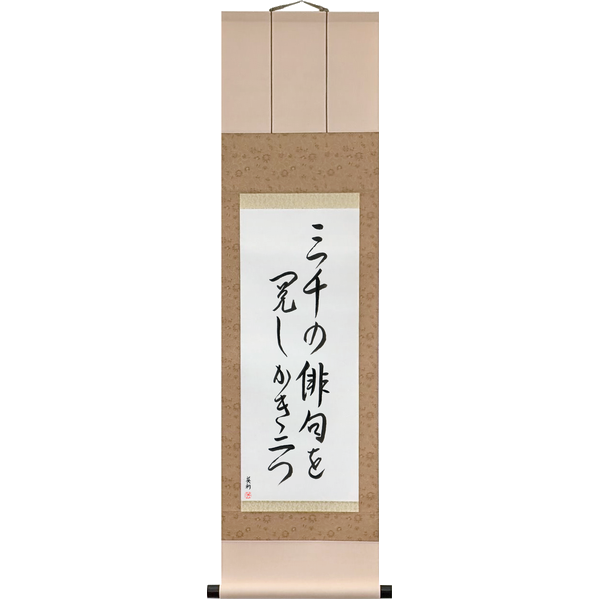
Sold as Shiki's, with no English and a house note that he read other people's haiku by the thousand as a newspaper selector and that the persimmon returns through his poems · Read sanzen no haiku wo kemishi kaki futatsu · Oldest witness Shiki's own collection as his disciple 虚子 printed it in 1915, where the verse carries the headnote 或日夜にかけて俳句凾の底を叩きて and the year column reads 1897; Watson dates it 1897 autumn · Sense a day and a night at the bottom of the box of submitted haiku, three thousand read, and two persimmons at the end of it. The one verse in the catalogue whose story every later teller took from a novel, and the novel was the disciple's.
The text as brushed, and its variants
The scroll carries 三千の俳句を閲し柿二つ, and every witness has these words. The only split is in the form of one character: 閲 in the modern books and on the scroll, 閱 in every prewar print's text layer, one character in old and new form; on the 1915 leaf the glyph is the old one to the eye and the difference is a font's. Two text-layer readings are noise: the 1915 novel's OCR reads 俄句 for 俳句, and 岩城's 1925 OCR reads 一一つ for 二つ; both leaves, opened at width 3600, print 俳 and 二. No witness varies a word. The meter is five, seven, five, さ・ん・ぜ・ん・の, は・い・く・を・け・み・し, か・き・ふ・た・つ (s41 counted the middle line as eight against its own kana); the verb 閲す has two readings, けみす from the Japanese and えっす from the Chinese, and the English translators split on it below.
The attribution, as a dated thread
Shiki's at every witness, with no rival. The thread runs: his own papers, edited by 虚子 and printed in 1915 as 子規遺稿, where the verse sits under 柿 in the 植物 section of 子規句集 with its headnote and a year; 虚子's novel 柿二つ of the same year, which sets the verse in a night of October 1897; 岩城 in 1925 and 1926, a school textbook's notes on the novel in 1930, 貝島 in 1937 and 宇野 in 1938, all naming 子規; Blyth in 1950 and 1952; Watson in 1997. The date is 1897. The 1915 遺稿 dates the verse by its year column: the verse two above it, つり鐘の蔕のところが澁かりき, carries 三〇, 明治三十年, and the two beneath, 御佛に供へあまりの柿十五 and this one, carry 同, the same. Watson prints it under 1897 AUTUMN. The account written before this leaf was opened said no witness dated the verse; the leaf does, and so does Watson.
The words
三千の俳句 is three thousand haiku, a round count, the box's worth. 閲し is 閲する, to look through, to examine, the selector's verb; Blyth examining, Watson checked. 柿二つ is two persimmons, the reward or the ration at the end. The headnote, which the scroll and the page do not carry and Shiki's own papers do, is 或日夜にかけて俳句凾の底を叩きて, one day, on into the night, striking the bottom of the haiku box: the box by his bed where the verses sent to the newspaper 日本 for selection were kept, and the sound of the last of them. Watson renders the headnote Working All Day and into the Night to Clear Out My Haiku Box. As words the line says: Three thousand haiku looked through; two persimmons.
A history, from the earliest witness
1897. 正岡子規, in his own record, with its headnote. The verse under 柿, 明治三十年 by the year column of his collection as printed in 1915. Not opened in the autograph. [『子規遺稿』1915, page 114; see below]
1915. 高浜虚子 (ed.), 子規遺稿, 子規句集, 籾山書店. Printed pages 114–115, the 植物 section, heading 柿: the persimmon verses in order with their years in a right-hand column, 柿くへば鐘が鳴るなり法隆寺 under the headnote 法隆寺の茶店に憩ひて with 二八; 柿くふや道灌山の婆が茶屋 二九; three verses 同; つり鐘の蔕のところが澁かりき under its headnote with 三〇; 御佛に供へあまりの柿十五 under 愚庵より柿をおくられて, 同; then 或日夜にかけて俳句凾の底を叩きて / 三千の俳句を閱し柿二つ, 同. The verse with its headnote and its year, in the poet's own collection. [NDL pid 937217, koma 71, printed pages 114–115, read by eye; text at lab.ndl.go.jp/dl/api/page/937217_71]
1915. 高浜虚子, 柿二つ, a novel, 新橋堂; reprinted 春陽堂 1932. Printed pages 24–25. Shiki writes to 愚庵, 十月二十八日, 愚庵禪師御もと, with three verses for the fifteen persimmons sent, 御佛に供へあまりの柿十五, 柿熟す愚庵に猿も弟子も無し, and, since the persimmons were of the kind called 釣鐘, 釣鐘の蔕のところが澁かりき; signs 根岸 病庵主; and the narrator adds 此句は三句共紙に臨んで考へた句であつた, all three were composed at the paper. He turns down the lamp. 頭の興奮は容易に收まりさうにもなかつた, the excitement in his head would not easily settle; his mind is still on the day's work, and the verse comes: 三千の俳句を閱し柿二つ. He keeps a diary in a 博文館 book, ten verses a day, and thinks to add this one tomorrow; 疲勞が一時に出て來るやうに思はれて頭がぐら〳〵した。彼は初めて熱の高いことを覺えたのであつた, fatigue seemed to come over him all at once and his head swam; for the first time he noticed how high his fever was. The scene every later account tells. [NDL pid 954165, koma 21, printed pages 24–25, read by eye; text at lab.ndl.go.jp/dl/api/page/954165_21. The 1932 printing at pid 1108188, koma 10, OCR]
1925. 岩城準太郎, 明治大正の国文学. Pages 40–41, in a chapter on the reform of verse: Shiki's state of mind then was complex, 恐らく虛子が小說「柿二つ」に描いたやうな心持があつたであらうと思へる, probably as 虚子 painted it in his novel; then: 「三千の俳句を閱し柿二つ」の句は、「日本」の募集俳句を閱してゐた時の實感を詠んだものであるが、子規の生活と事業とが微妙に表現せられてゐる。自分は此の句を讀む每に、根岸草廬の病子規の風姿を想起する, the verse sings the actual feeling of reading through the haiku submitted to 日本, and Shiki's life and his work are delicately expressed in it together; every time I read it I see the sick Shiki in his 根岸 hut. He names the novel as his source. [NDL pid 968884, koma 35, printed pages 40–41, read by eye; text at lab.ndl.go.jp/dl/api/page/968884_35. The verse again, unglossed, among four representative hokku in his 新講日本文学史 of 1926, pid 968873, koma 161, OCR]
1930. 平林治徳, 女子国文大綱 巻二 備考, a school textbook's notes. The novel's source given, 東京朝日新聞に連載 … 大正四年五月、新橋堂から單行本, and the scene retold in the book's own words: 日記に每日の出來事を句にして書いてゐたが、今三千の俳句を閱しの句を案出した。その時始めて熱の高いことを知つた, he had been setting each day's happenings as verses in his diary; now he composed the verse; then for the first time he knew his fever was high (the novel's ten a day is not repeated here); the sentence before it retells the persimmons, 蔕の所が少し澁いのに、頓着せずすつかり食つて終つた, then for the first time he knew his fever was high. [NDL pid 1037204, komas 68–69, OCR; text at lab.ndl.go.jp/dl/api/page/1037204_69]
1937. 貝島慶太郎, 富士を仰ぎて, an essay 秋三題, 柿. Pages 4–5: after his own persimmon-and-crow verse, 子規も柿が好物であつたらしい。彼の句に 三千の俳句を閱し柿二つ と言ふのがある。そして、その前書に 或日夜にかけて俳句の凾の底を叩きて, Shiki too, it seems, loved persimmons; he has the verse …, and its headnote reads …. The headnote quoted whole, with の between 俳句 and 凾 where the 1915 leaf has none. [NDL pid 1257511, koma 11, printed pages 4–5, read by eye; text at lab.ndl.go.jp/dl/api/page/1257511_11]
1938. 宇野浩二, 一途の道. The persimmon verses that Shiki liked best: 柿食へば鐘が鳴るなり法隆寺, which 宇野 dates 明治二十八年, then this verse, 樽柿を握るところを寫生かな and the 釣鐘 verse, かういふ平凡なやうで眞似の出來ない句, verses that seem ordinary and cannot be imitated. [NDL pid 1230227, koma 170, OCR; text at lab.ndl.go.jp/dl/api/page/1230227_170]
Today. The archive lists twenty books carrying the verse before 1945, eight of them opened for the account. kotobank's page for 正岡子規 gives the poet's dates, his post at the newspaper 日本, and 寒山落木, and does not quote the verse. [harvest_index.py lookup --id 257 --year-to 1945; kotobank 正岡子規, read as text]
The sense, across a century
The verse has been read one way, and the way comes from one man. 虚子, who edited the papers and wrote the novel, gave it a night: the persimmons from 愚庵, the letter, the box, the fever. 岩城 in 1925 took the scene from the novel by name and made the verse the picture of Shiki's life and work in one; the 1930 textbook and Blyth in 1952 retell the novel's night; 貝島 in 1937 reads it as a persimmon lover's verse and quotes the headnote; 宇野 in 1938 files it among the plain verses no one else could write. Blyth: With no more than the above words we should be obliged to draw very freely upon our fancy to understand the connection, but fortunately Kyoshi has described the matter quite minutely, and then the box, the bed, the persimmons as a kind of reward. Watson in 1997 gives the headnote in English and lets the verse stand. What the readers agree on is what the headnote already says: the box, emptied, and the fruit.
What is not a source
The fever is the novel's. Shiki's own headnote has the day and the night and the box; it has no persimmons from 愚庵 and no temperature, and the 1915 collection sets the 愚庵 verse and this one side by side without connecting them. The novel is by the man who edited the papers, and every later telling, 岩城's, the textbook's, Blyth's, leans on it; so the anecdote has one witness however many books repeat it. The date is not in dispute: 1897 by the year column and by Watson. The page's note that Shiki read haiku by the thousand for the newspapers is what 岩城 and kotobank say, and stands.
The verse in English
The bilingual dictionaries of the Meiji shelf were not checked for this verse. Miyamori, Buchanan, Hass and Beilenson were searched on the shelf and do not carry it; Henderson does, page 165, below, and the s41 sentence that listed him with the others was wrong.
1950. R. H. Blyth, Haiku, volume 2, Spring, Hokuseido Press, Tokyo, page 100, SKY AND ELEMENTS. Under Shiki's 薫風や千山のみどり寺一つ, on the meaning of numbers in haiku: There is another verse by Shiki, afterwards explained, which has this similar contrast: 三千の俳句を閲し柿二つ, Sanzen no haiku wo etsushi kaki futatsu, Examining / Three thousand haiku,— / Two persimmons. The verb romanized etsushi, its Chinese reading. [docs/research/book_originals, Blyth 1950 vol. 2, page 100 read by eye from the PDF; no ASIN collected]
1952. R. H. Blyth, Haiku, volume 4, Autumn-Winter, Hokuseido Press, Tokyo, page 133, PERSIMMONS. 三千の俳句を閲し柿二つ, Sanzen no haiku wo kemishi kaki futatsu, Examining / Three thousand haiku: / Two persimmons. Shiki. The verb now kemishi; the dash of 1950 now a colon; then the paragraph from 虚子 quoted above. [docs/research/book_originals, Blyth 1952 vol. 4, page 133 read by eye from the PDF, where the text layer's page count says 134; no ASIN collected]
1958. Harold G. Henderson, An Introduction to Haiku, Doubleday Anchor. In the Shiki chapter, as one of his poems of the period whose humor needs the story: Haiku! Reading through / three thousand, I have here / persimmons—two!, with the romaji Sanzen-no haiku wo etsushi kaki futatsu and his word-for-word gloss. [docs/research/papers, Henderson 1958, page 165 by the running head, read as text]
1997. Burton Watson, Masaoka Shiki: Selected Poems, Columbia University Press, page 62, no. 91. Under 1897 AUTUMN, with the headnote as title: Working All Day and into the Night to Clear Out My Haiku Box. / I checked / three thousand haiku / on two persimmons; the romaji at the foot, sanzen no / haiku o kemishi / kaki futatsu. The one translator who gives the headnote and the date. [docs/research/book_originals, Watson 1997, page 62 read by eye from the PDF; no ASIN collected]
Today. The house page carries no English. A rendering of this line has two things to keep: the count first, the two persimmons last, and nothing between them but the verb.
A reading
I read the verse with its headnote, which is Shiki's and better than any gloss: a day and a night knocking at the bottom of the box, and at the end two persimmons, the reward a sick man allows himself. 虚子's night is a novelist's and it is probably true, since he was in the house; but the verse does not need the fever, and the page should not carry it. What the page should carry is the headnote, and it could carry Blyth's or Watson's three lines, credited, since it carries none now. The romaji stands: kemishi is Watson's and Blyth's second choice, and Blyth's etsushi of 1950 is the other reading of the same character, not a different word. The text, the poet and the date stand, and the scroll needs no change. Signed, 典, 2026-09-05.
How this was read
By eye at width 3600: the 1915 子規遺稿 at pages 114–115, where the headnote, the verse and the year column were read; the 1915 novel at pages 24–25; 岩城 1925 at pages 40–41; 貝島 1937 at pages 4–5; and from the shelf's PDFs, Blyth's pages of 1950 and 1952 and Watson's page 62. By OCR from the archive's text layer: the 1932 printing of the novel, 岩城 1926, the 1930 textbook, 宇野 1938. As text: kotobank. Not opened: Shiki's autograph 寒山落木 and 俳句稿 at this verse; the 1975 講談社 全集; twelve books the archive lists; the reading 虚子 himself gave the verb, if he wrote it down. A bracket of the form pid P, koma N resolves as text at lab.ndl.go.jp/dl/api/page/P_N and as an image at dl.ndl.go.jp/api/iiif/P/R<N, seven digits>/full/3600,/0/default.jpg; the four leaves read by eye were fetched at that address. The full apparatus, with every address, is in the account.
Supersession 2026-09-14 (s92)
A read-only worker resolved this account's addresses (citation_checks_2026-09-14/history_sanzen_no_haiku_257_2026-09-05.check.md): 29 claims, the NDL komas and the Blyth and Watson quotations at the address. Corrected above, each re-opened by me: Henderson 1958 carries the verse at page 165, where s41 said he did not, and reads the verb えっす; the meter is five, seven, five, where s41 had called the middle line long by one against its own kana. The worker's row on a fever gloss misattached to the persimmon sentence does not hold: in § A history the gloss sits on the 疲勞 sentence, which the koma OCR shows carries 熱の高い. The 1922 novel's 柿二つ and the verse's 二 stand on the by-eye reading the account already marks against the OCR's 一つ and 一一つ. Not yet read by a person.
References
Each witness is cited in the account above, at the frame or entry where it was read. A linked list follows when the record for this text is completed.