

遅き日のつもりて遠き昔かな · osoki hi no tsumorite tōki mukashi kana · The long slow days piling up, and how far away the past
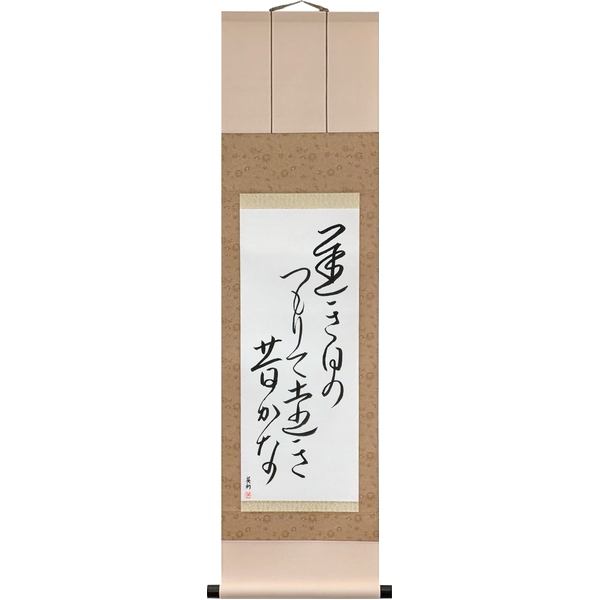
Sold as Buson's, with English that is Shirane's rendering unpunctuated and a note quoted from his anthology with his name on it · Read osoki hi no tsumorite tōki mukashi kana · Oldest witness an undated Edo almanac's 遲日 column, then Shiki's 1889 copy of the canon; the source every editor names is Buson's own 句集 of 1784, not opened as a leaf; Shirane dates the verse 1775, Carter files it among poems of unknown date · Sense the long days of late spring, piling up one on another, and the past grown far away. A verse under the headnote 懐旧, longing for the past, in every collection that prints one, and the tradition names its two parents: an old waka about days that pile into age, and another about snow piling on a peak.
The text as brushed, and its variants
The scroll carries 遅き日のつもりて遠き昔かな, and the witnesses write one text three ways. The last word is 哉 in Shiki's 1889 copy and かな in the printed collections; 昔 is kanji in most and むかし in 藤井's 1935 edition; the Edo almanac writes とほき in kana and stops the column at むかし, with 蕪村 beneath it and no かな, which is the almanac's abbreviation and not the scanner's, since the leaf was read. One text-layer reading is not a variant: the OCR of one 1889 copy reads 遠きもる哉 for 遠き昔哉. The meter is five, seven, five: お・そ・き・ひ・の, つ・も・り・て・と・お・き, む・か・し・か・な.
The attribution, as a dated thread
Buson's at every witness that names a poet, with no rival: the almanac writes 蕪村 under the column, Shiki's copy names him, and the three collections of 1925 and 1935 print the verse in his 句集 section with the headnote 懷舊. The source is his own 蕪村句集 of 1784, by 半田良平's tag, 右三句、句集, which covers this verse and the two 遲日 verses before it, and by the closing colophon of 藤井's 1935 section; the 句集 has not been opened as a leaf here. The date is Shirane's: this poem was composed in 1775, in his 2002 anthology, with no Japanese witness opened giving one, and Carter's 1991 anthology files the verse under Poems of Unknown Date; the two disagree and the account carries Shirane's as his. The page quotes Shirane's note on the verse and credits him and his book for it; the English lines above the note are his too, with his punctuation removed and one line broken in two, and the page does not say so. That credit is 照's under her s317 ruling and needs no ruling from anyone else.
The words
遅き日, also 遅日, is the long day of late spring, the season word; Shirane: a late-spring day when the sun sets late and the day seems to last forever; the almanac files the verse under 遲日 beside a 万葉集 poem and a 詞 entry on the same theme. つもりて is piling up, said of days as of snow, and the tradition gives it two parents: 業平's 大方は月をもめでじこれぞこの積れば人の老いとなるもの, I will not even praise the moon; it is this that, piling up, becomes a man's age, and 家隆's 高砂の尾上の鹿の啼かぬ日もつもりはてぬる峰の白雪, even on days the deer of 高砂's peak does not cry, the white snow of the summit piles to its end; 木村架空 puts both in Buson's own mouth in 1920. 遠き昔 is the far past, and かな the exclamation. Blyth hears the sounds: osoki, tsumori, mukashi; no, na, the k and t of the passing of time. As words the line says: The slow days, piling up; how far away, the past.
A history, from the earliest witness
1784. 蕪村句集, the poet's own collection, edited by 几董. Not opened; the source every editor names. [半田 1925 tag; 藤井 1935 colophon; see below]
Edo, undated. 鳥飼洞斎, 月令博物筌, an almanac of the seasons by topic. Under 遲日, after a 六百番歌合 poem, a 万葉集 poem, a 詞 entry and 重五's haikai verse 傘張の…, the column 俳 遅き日のつもりてとほきむかし 蕪村: the verse without its かな, the poet beneath it. The earliest print opened. [NDL pid 2557809, koma 6, read by eye; text at lab.ndl.go.jp/dl/api/page/2557809_6]
1889. 正岡子規, 発句類題全集, his manuscript anthology by topic, two copies. One copy under the small headnote 懐旧, 遅き日のつもりて遠き昔哉, with a parenthesized attribution at the foot of the column that neither the OCR nor the eye settles; the other names 蕪村 and its OCR reads もる for 昔. [NDL pid 2586392, koma 111, read by eye; pid 2586444, koma 208, OCR; text at lab.ndl.go.jp/dl/api/page/2586392_111 and 2586444_208]
1920. 木村架空, 蕪村夢物語; 野口米次郎, 日本の美術. 架空 stages the verse as a conversation: 碧梧桐氏曰はく、はる〳〵昔を懷ふ情で、主觀的の句である, a feeling of longing for the far-off past; a subjective verse; 鳴雪氏曰はく、私の大好きな句である, a verse I love; and Buson himself in a dream, 蕪村曰はく、この句には生みの親がある, this verse has parents, the two waka quoted above. 野口, in the same year, recalls comparing it to Walter Savage Landor in his Oxford lecture on haiku. The OCR at koma 9 lists the verse beside 山鳥の尾を踏む春の入日哉 without the heading 西山遲日, which belongs to that verse at koma 91. [NDL pid 947592, komas 9 and 93; pid 981161, komas 127–128; OCR; text at lab.ndl.go.jp/dl/api/page/947592_93 and 981161_127]
1925. 蕪村三千句; 半田良平, 蕪村俳句全集 季題別. The 三千句 prints the spring run under the section heading 遲日: first 山鳥の尾をふむ春の入日かな with the headnote 西山遲日, then 遲き日や雉子の下り居る橋の上 with none, then 懷舊 over 遲き日のつもりて遠き昔かな, then the other long-day verses. 半田 prints the same three under 遲日 in the same order and closes them with 右三句、句集, the source tag that says where the verse comes from. [NDL pid 924926, koma 6, printed page 6, read by eye; pid 964212, koma 11, printed page 9, read by eye; text at lab.ndl.go.jp/dl/api/page/924926_6 and 964212_11]
1935. 藤井紫影, 名家俳句集, the 蕪村句集 section. 西山遲日 山鳥の尾をふむ春の入日哉, 遲き日や雉子の下りゐる橋の上, then 懷舊 遲き日のつもりて遠きむかしかな, and next 春の海終日のたり〳〵哉. The section closes with 蕪村句集 on the following leaf. [NDL pid 1259717, koma 222, printed pages 396–397, read by eye; text at lab.ndl.go.jp/dl/api/page/1259717_222]
Today. The archive lists forty books carrying the verse before 1945, ten of them opened for the account. kotobank's page for 与謝蕪村 gives the poet's dates and does not quote the verse. [harvest_index.py lookup --id 247 --year-to 1945; kotobank 与謝蕪村, read as text]
The sense, across three centuries
The headnote has done the reading since the 句集: 懐旧, longing for the past. 碧梧桐 called it subjective and 鳴雪 called it beloved, and the tradition, through 架空's dream-Buson, gave it two waka for parents, so that the piling of days into age and of snow onto a peak stands behind the piling of the long days here. 野口 in 1920 heard Landor in it. Blyth in 1950 heard Tennyson, O Death in Life, the days that are no more, quoted without his name, and said the bitterness is in the sounds; in 1963 he came back to the sounds again. Shirane in 2002 read the long day as what reminds the poet of youth, far away, and of the many springs since. Two things stand at the end of that. The verse has never had two meanings, only two temperatures: Blyth's bitterness and the collections' plainer 懐旧. And its date is not settled in English, Shirane saying 1775 and Carter saying unknown.
What is not a source
The two waka are the tradition's parents for the verse, staged by 架空 in 1920 in Buson's voice; they are a reading, not a record of what Buson had in mind. The heading 西山遲日 belongs to the neighboring verse in every collection, and a text layer that puts it over this one has read across a column. The 1775 date rests on Shirane alone among what was opened.
The verse in English
The bilingual dictionaries of the Meiji shelf were not checked for this verse. Henderson, Miyamori, Keene, Sato, Hass and Reichhold were searched on the shelf and do not carry it; Ueda's Path of Flowering Thorn is not on the shelf. (SUPERSEDED s90, 2026-09-14: Keene carries it in World Within Walls; Katō and Sawa and Shiffert carry it; Ueda's Path is on the shelf and does not; read below in § Supersession 2026-09-14.)
1949, 1950 and 1963. R. H. Blyth, Haiku, volume 1, Eastern Culture, page 368; volume 2, Spring, page 45; A History of Haiku, volume 1, page 261, Hokuseido Press, Tokyo. Slow days passing, accumulating,— / How distant they are, / The things of the past!, in the first two; the 1963 History re-cuts it, Slow days passing, / Accumulating,— / How distant past things!; in the first, under the technique of haiku, the k sounds used to portray the bitterness of the passing of time; in the second, Thinking of long ago, all one spring day—this day, too, now belongs to the old, forgotten, far-off things. It is as remote, as irrevocable, as the most distant ages. O Death in Life, the days that are no more!, Tennyson's line unnamed, and the bitterness of the feeling comes out in the onomatopoeia. [docs/research/papers, Blyth 1949 vol. 1, 1950 vol. 2 and 1963 History vol. 1, read as text; page numbers from the text layers; no ASIN collected]
1991. Steven D. Carter, Traditional Japanese Poetry: An Anthology, Stanford University Press, page 394, no. 983. Under Poems of Unknown Date, headed SPRING: Days getting longer / and memories building, going / far into the past. [docs/research/papers, Carter 1991, read as text; no ASIN collected]
2002. Haruo Shirane, Early Modern Japanese Literature: An Anthology, 1600–1900, Columbia University Press, page 545, under Literati Meditations. Longing for the past: / osoki hi no / tsumorite toki / mukashi kana / The long, slow days of spring / piling up—so far away, the past!, and note 16: "Long day" (osoki hi) is a late-spring day when the sun sets late and the day seems to last forever, reminding the poet both of the past, of youth, which seems so far away, and of the many springs and years that have come and gone since that time. This poem was composed in 1775. [docs/research/papers, Shirane 2002, read as text; no ASIN collected]
2006. Michael Haldane, in Bashō and the Haikuists, Delphi Classics, 2022. lingering days / accumulate the distance / of the past, the romaji misprinted osoko hi no. [docs/research/papers, Delphi Classics 2022, the Buson section, read as text; no ASIN collected]
Today. The house page prints The long slow days of spring / piling up, so far away / the past, which is Shirane's line with its dashes and comma removed and broken in two, and credits Shirane and his book for the note beneath it, not for the lines. A rendering of this line has one thing to keep, and everyone from Blyth to Haldane has kept it: the piling comes before the distance.
A reading
I read the verse under its headnote, as every collection prints it: not Blyth's bitterness, which is Tennyson's, but the mild vertigo of a day so long it makes the years visible. The tradition's two parents are worth telling on a page, above all 業平's 積れば人の老いとなるもの, which is the whole verse in a waka's last line. The date I carry as Shirane's, since Carter declines to give one and no Japanese witness opened does. The text, the attribution and the romaji stand, and the scroll needs no change; the page's English is Shirane's and 照's credit line will say so. Signed, 典, 2026-09-05.
Supersession 2026-09-14 (s90)
The layer after 1963. The English join built this session finds the verse in three works shelved since the tenth, each opened at its page and read as text.
- 1976. Donald Keene, World Within Walls, Grove Press, page 343: Long, slow spring days, / Piling up, take me far away / Into the past., headed Recalling the Past, cited as the verse Hagiwara Sakutarō used to prove his thesis of Buson as a poet of nostalgia, with Keene's note that the mood is strengthened by the repetition of the o sounds. The 1982 Konishi judgment this history carries from Ueda has its English precedent here. [shelf, pdfpage 361]
- 1983. Katō Shūichi, A History of Japanese Literature, volume 2, The Years of Isolation, translated by Don Sanderson, Kodansha International and Macmillan, printed page 126 in both editions (s39 gave 150 and 144, the PDF indexes); again in the 1997 abridged edition: Slow days build up / The distant past., as the example of nostalgia understood as the discovery of the past in the present, paired with the kite in yesterday's sky. [shelf, Kodansha pdfpage 150; Macmillan pdfpage 144; 1997 EPUB text, line 3179]
- 2007. Yuki Sawa and Edith Marcombe Shiffert, Haiku Master Buson, White Pine Press (first published 1978), page 36: Lengthening days / accummulate—farther off / the days of long ago!, headed Yearning for the Past and tagged (Kaikyu), the 懐旧 of the source; the spelling is the book's. [shelf, pdfpage 39]
Ueda's Path of Flowering Thorn (1998) is on the shelf and does not carry this verse in its text layer; it carries the other 遅き日 hokku, the pheasant on the bridge, at page 143.
What it changes. Nothing in the reading; the layer now runs Blyth 1949, Keene 1976, Sawa and Shiffert 1978, Katō 1983, Carter 1991, Shirane 2002, Haldane 2006, and two of the three new witnesses read the verse through Hagiwara's nostalgia, which is the frame this history set against Shiki's.
How this was read
By eye at width 3600: the Edo almanac at its 遲日 column, where とほきむかし, 蕪村 and the absence of かな were read; Shiki's 1889 copy at 懐旧; the 1925 三千句 and 半田 at their headnotes and 半田's tag; 藤井 1935 at the verse and its neighbors. By OCR from the archive's text layer: the other 1889 copy, 架空 and 野口 in 1920. By text layer from the shelf: Blyth in three books, Carter, Shirane, Haldane. Not opened: the 蕪村句集 of 1784, the source; Ueda's Path of Flowering Thorn; Shirane's source for 1775; the parenthesized attribution at the foot of Shiki's 懐旧 column; thirty books the archive lists. A bracket of the form pid P, koma N resolves as text at lab.ndl.go.jp/dl/api/page/P_N and as an image at dl.ndl.go.jp/api/iiif/P/R<N, seven digits>/full/3600,/0/default.jpg; the five leaves read by eye were fetched at that address. The full apparatus, with every address, is in the account.
Supersession 2026-09-14 (s92)
A read-only worker resolved this account's addresses (citation_checks_2026-09-14/history_osoki_hi_247_2026-09-05.check.md): 42 claims, every NDL koma at the address. Corrected above, each re-opened by me: Blyth's 1963 History of Haiku re-cuts the rendering rather than repeating it; Katō's passage is on printed page 126 in both the Kodansha and the Macmillan text (s39 cited the PDF indexes 150 and 144); Sawa and Shiffert print three lines, and Shirane breaks after spring, where the account had joined lines. Not yet read by a person.
References
Each witness is cited in the account above, at the frame or entry where it was read. A linked list follows when the record for this text is completed.