

蝸牛そろそろ登れ富士の山 · katatsuburi sorosoro nobore fuji no yama · Snail: slowly, slowly, climb Mount Fuji
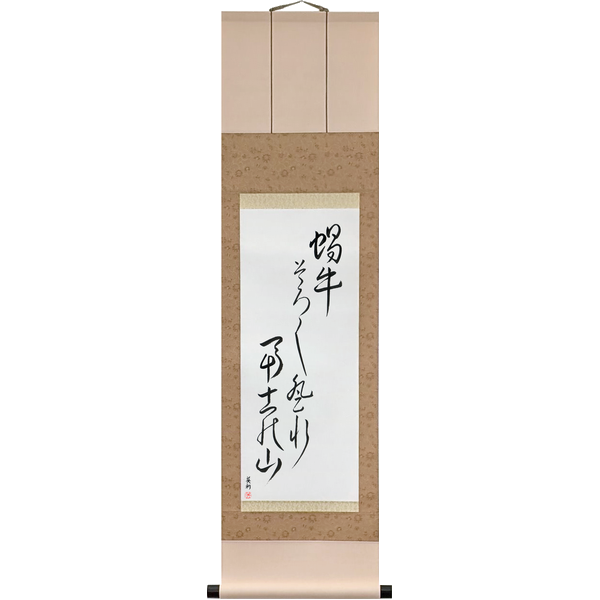
Sold as Issa's, with the English Snail / ever so slowly climb / Mt Fuji and a note that haiku books read 蝸牛 katatsuburi where modern Japanese says katatsumuri · Read katatsuburi sorosoro nobore fuji no yama · Oldest witness the 1902 一茶俳句全集, the first collected edition of Issa's verse, read on its leaf: 蝸牛そろ〳〵のぼれ不二の山, the fourth verse under the heading 蝸牛; nothing older was found, in the poet's hand, in his own books, or in any Edo print · Sense snail: slowly, slowly, climb Mount Fuji.
The text as brushed, and its variants
The scroll carries 蝸牛そろそろ登れ富士の山, and the record carries one text written four ways at once. 蝸牛 / かたつぶり. The 1902 edition, the 1925 dated edition and the 1908–1912 moral readers write the kanji; the 1910 preacher's dictionary, the 1914 有朋堂 text, the 1921 and 1926 editions, the 1928 index and the 1927 travel essay write かたつぶり in kana, and every one that spells it spells it katatsuburi, the older form of the word, not katatsumuri, the modern one. The page's note says exactly this and adds that the design brushes the kanji, so the calligraphy is the same under either reading; that is correct, and it is the best sentence on the page. そろ〳〵 / そろそろ. Every Japanese book prints the adverb with the iteration mark; the scroll spells it out, as the 1908 reader's OCR does. 登れ / のぼれ. The 1902 and 1925 editions write のぼれ; the readers, the 1914, 1921 and 1926 editions and the index write 登れ. 富士の山 / 不二の山. The 1902, 1910, 1914 and 1925 books and one of the 1921 edition's two printings write 不二, the old spelling of the mountain's name; the readers, the 1926 edition, the index and the essay write 富士, which is the scroll's form. There is no variant of sense; the record disagrees on nothing but spelling. The meter is five, seven, five: か・た・つ・ぶ・り, そ・ろ・そ・ろ・の・ぼ・れ, ふ・じ・の・や・ま. The only served design brushes the catalogue's form.
The attribution, as a dated thread
Issa's, in every collected edition of his verse from the first, 1902, and in nothing older that was found. The NDL's full-text search over its digitized library returns no book before 1902 for either spelling, and the 1928 index of the 日本俳書大系 sources the verse only to the series' own selection (俳句選抄), not to an Edo text. The 1829 一茶発句集, the one collection printed in the poet's lifetime, is digitized at NIJL; its summer section, fifty-eight verses over five leaves, was read at width 2600 and the verse was not found in it, in a cursive I read imperfectly, so that is not a witness against. The 1925 dated edition, which tags each verse with the year of the diary it comes from, leaves this one untagged between verses of 文化12 and 文化10 (1815, 1813): the editor had no date for it, and I have none. Miyamori in 1932 gave it to Issa in English with Porter's older rendering beside his, Blyth from 1942 in three books, Hass in 1994, Hamill in 1997, Lanoue in 2017; each names Issa and none argues it. So the attribution is a Japanese editorial one, unbroken since 1902, carried into English by every translator, and not yet grounded in the poet's own diaries, which were not opened.
The words
蝸牛 is the snail, katatsuburi or katatsumuri, a summer season word (the dictionary the account cites gives 季語・夏); the meter takes either reading at five. そろそろ is slowly, little by little, the adverb doubled; 登れ the imperative, climb. 富士の山 is Mount Fuji by its full name, the mountain of Fuji, and 不二, not-two, is the old spelling that the 1902 and 1925 editions keep. As words the line says: Snail, slowly, slowly, climb Mount Fuji. Blyth's but slowly, slowly, Miyamori's very, very slowly and Hamill's you climb but slowly, slowly are all そろそろ; none of them adds anything the Japanese does not hold except the but.
A history, from the earliest witness
1902. 一茶俳句全集, 内外出版協会, Tokyo; the summer book, under 蝸牛. The first collected edition, the snail verses in a run: 夕立や大肌ぬいで蝸牛 / 並んだぞ豆粒程の蝸牛 / 雨一見の蝸牛にて候 / 蝸牛そろ〳〵のぼれ不二の山 / 朝燒が喜ばしいか蝸牛 / 俚俗蝸牛をでいろといふ 此雨のふるにどつちへでいろかな / 犬いけんして曰 蝸牛見よ〳〵己が影法師 / 柴の戶や錠の代りに蝸牛, printed page 153. No headnote, no date. The leaf prints 夕立, 雨一見 and 曰 where the OCR layer reads タ立, 雨見 and 日, and the iteration marks it renders 〓〓. [NDL pid 874848, koma 79, printed page 153, read by eye; text at lab.ndl.go.jp/dl/api/page/874848_79]
1908–1912. The moral readers. 竹原久之助's manual for elementary teachers (1908) sets the verse under 謙遜, modesty, and 愼表裏之行 beside さがすには足元からぞ茸狩 and 一步づゝつい頂へ富士まふで, one step at a time and you are at the summit, with the poets' names in a run of ciphers at the block's end; the civic reader 斯民之友 (1911, reprinted 1912) sets it under 登高自卑, climb high from low, between 名を知るも足元からず草の花 (so its OCR; the 1908 manual's OCR reads からぞ) and 學ぶ身はうれしき秋の夜長哉. Lessons, not poetry books; none names the poet at the line. [NDL pid 810395, koma 29; pid 897939, koma 11; pid 1084225, koma 13; OCR, each koma confirmed by the reader]
1910. 布教新辞典, 森江書店, the entry イツサ. A preacher's dictionary lists the poet's 名句 (the OCR's text, with its 〓〓 for the iteration marks written 〳〵 here): 蓬萊に南無〳〵といふ子供哉 · 玉川やまづ御先ヘと飛ぶ蛙 · … · かたつぶりそろ〳〵登れ不二の山 · かたみ子や母が來るとて手をたゝく · 露の世は露の世ながら去ながら. The first book found that puts the verse under the poet's name in prose. [NDL pid 818595, koma 44, OCR]
1914–1935. The Issa editions. The 有朋堂文庫's 名家俳句集 (1914, reprinted 1922, 1927, 1935) prints it in its 一茶發句集 as かたつぶりそろ〳〵登れ不二の山 after 柴の戶や錠の替りにかたつぶり (OCR throughout this paragraph except where marked, the iteration marks written 〳〵 for the OCR's 〓〓); the 新選一茶全集 (1921) prints it twice, in the summer collection and again in a run of Fuji verses (菜の花のまつばづれなる富士の山 / かたつぶりそろ〳〵登れ不二の山 / 河豚喰はぬ人には見せな富士の山); the 一茶選集 (1925), the 一茶発句集 (1926), the 一茶蕪村名句全集 (1926), the 一茶叢書 (1930) and the 一茶名句集 (1934) carry it in the same company. The dated edition of 1925, 一茶俳句集 季題別年代考, read on its leaf: under 蝸牛, 朝燒がよろこばしいか蝸牛 (文化二) / 柴の戶や錠の代りに蝸牛 (文化十二) / 夕月や大肌ぬいでかたつむり / 一本、夕立や (the OCR layer reads 一木) / 里俗かたつむりをでいろといふ 此雨の降るにどつちへでいろかな / 蝸牛そろ〳〵のぼれ不二の山, and then the next heading; no year against it. Its 1935 successor prints the same. [NDL pid 1913599, koma 436; pid 970100, komas 28 and 218; pid 977663, koma 61; pid 1019188, komas 25 and 86; pid 968909, koma 130; pid 1186739, koma 161; pid 1032569, koma 77; pid 1034501, koma 24; OCR. pid 917542, koma 25, read by eye; text at lab.ndl.go.jp/dl/api/page/917542_25]
1928. 俳諧全句索引, the index to the 日本俳書大系. Read on its leaf: 一茶 / カタツ (選抄) かたつぶりそろ〳〵登れ富士の山… (一茶二九) (the OCR layer reads カカツ and 一一九), between かたゝがひ幸あり武庫の郭公 and 蝸牛見よ〳〵おのが影法師. The source tag 選抄 is the series' own 俳句選抄, its editors' selection from the collected verse, so the index gives no older book. [NDL pid 1179400, koma 262, read by eye; the key at koma 12; text at lab.ndl.go.jp/dl/api/page/1179400_262]
1920–1933. On the road, as a saying. A walker in 名所ところどころ (1920), facing one more hill, decides to go 「かたつぶりそろ〳〵登れ」で; 谷口梨花's 汽車の窓から (1927), on the Fuji climb: 呼吸は靜に、步調は極めて緩かに、遲速を念頭に置かず、「かたつぶりそろそろ登れ富士の山」の調子で行かねばならぬ, breathe quietly, keep the pace very slow, put speed out of your mind, and go at the tempo of "snail, slowly, slowly, climb Mount Fuji"; 景観を尋ねて (1933) quotes it among Fuji verses. In each the verse is advice, and the poet is not named. [NDL pid 1915562, koma 52, OCR; pids 962112 and 1209902, the search return]
Today. The harvest index lists four books carrying the verse; the NDL full-text search returns sixteen for かたつぶりそろ and twenty-six for 蝸牛そろ, the oldest 1902. [harvest_index.py lookup --id 271; lab.ndl.go.jp/dl/api/book/search, five keywords, 2026-09-05]
The sense, across a century
The Meiji readers read it as a lesson in modesty and perseverance, and put a companion verse beside it to make sure: one step at a time and you are at the summit. Miyamori in 1932: Needless to say, this is a didactive verse teaching that even a dull-witted man can achieve a great thing with diligence and perseverance. Be slow but sure. Blyth in 1942 turned it: act according to your nature, snail; act according to God's will; be a snail!; and in 1952 gave both readings and chose: Issa may have meant this, as commentators explain, as a contemptuous reference to themselves, little by little, you may attain something enough. I wish to take it differently, however, as of universal application. The walkers of the 1920s took it the readers' way, as pace. No Japanese commentary on the verse itself was found; the dated edition has nothing to say about it but its place among the snails.
What is not a source
No witness in the poet's hand, in his diaries or in an Edo print was found; the 1829 発句集 was read and does not show it to my eye. The page's English is Timothy L. Jackowski's, so credited in the store, in the Japanese order, verbatim to no one on the shelf. Delphi's 2022 anthology carries katatsumuri only in its list of season words.
The verse in English
The bilingual dictionaries of the Meiji shelf were not checked. Henderson carries it, page 152, below; the s43 sentence said he did not.
1932. Asatarō Miyamori, An Anthology of Haiku Ancient and Modern, Maruzen, Tokyo, page 533, no. 534, THE SNAIL. 蝸牛 そろそろ登れ 富士の山; Oh, snail, climb Mount Fuji, / Very, very slowly. Issa; and, quoted beside it, William N. Porter's earlier rendering, The snail does all he can, / Yet very, very, sluggishly, / He climbs Great Fujisan, with the paragraph quoted above. [docs/research/papers, Miyamori 1932, printed pages 533–534, text layer; no ASIN collected]
1942, 1949, 1952. R. H. Blyth. Zen in English Literature and Oriental Classics, Hokuseido, page 107: O snail, / Climb Mt. Fuji, / But slowly, slowly, with be a snail!; Haiku, volume 1, 1949, page 222, the same lines; Haiku, volume 3, Summer–Autumn, 1952, BEASTS, page 250: Katatsumuri / sorosoro nobore / fuji no yama — O snail, / Climb Mount Fuji, / But slowly, slowly! Issa, with the two readings above. [docs/research/papers, Blyth 1942, 1949, 1952, text layer; no ASIN collected]
1958. Harold G. Henderson, An Introduction to Haiku, Doubleday Anchor. Under the title The Snail: Snail, my little man, / slowly, oh, very slowly / climb up Fujisan!, with his word-for-word gloss beneath. [docs/research/papers, Henderson 1958, page 152 by the text layer's marker, read as text]
1994. Robert Hass, The Essential Haiku, Ecco, page 155. Climb Mount Fuji, / O snail, / but slowly, slowly. [docs/research/papers, Hass 1994, text layer; no ASIN collected]
1997. Sam Hamill, The Spring of My Life and Selected Haiku, Shambhala. O summer snail, / you climb but slowly, slowly / to Fuji's summit, with the romaji Katatsumuri / soro soro nobore / fuji no yama; the page number is not carried by the shelf's text layer. [docs/research/papers, Hamill 1997, text layer; no ASIN collected]
2017. David G. Lanoue, Write Like Issa, HaikuGuy, page 113. The verse in romaji, katatsuburi soro-soro nobore fuji no yama, the older reading, among the book's numbered examples. [docs/research/papers, Lanoue 2017, text layer; no ASIN collected]
Today. The house page's Snail / ever so slowly climb / Mt Fuji stands, and so does its note on the two readings. A rendering has two things to keep: the imperative, which makes the line an address to the snail and not a picture of one, and the doubled adverb.
A reading
I read the verse as the walkers of the 1920s did, and as the readers of 1908 did before them: as pace. The snail is told to climb the highest mountain in the country and told how, and the how is the whole of the verse; そろそろ is not slowly as a limit but as a method. Blyth's second reading, the snail told to be a snail, is the same thing said from inside. What the record does not give is the one thing a buyer might want most: the poet's own moment, a date, a diary page. Every Japanese book that carries the verse is an edition or a lesson; the oldest is 1902, seventy-five years after Issa died; the dated edition has no year for it; and the one book printed in his lifetime does not show it to me. I do not doubt the attribution, since no witness names anyone else and every collected edition prints it; I say only that it rests on the editors, not yet on the poet's hand, and that the diaries are where it would be settled. The page's note on katatsuburi against katatsumuri is right and should stay. Signed, 典, 2026-09-06, s43.
Eri
Nothing to ask. She brushed the kanji, and the page's note says why that settles the reading question for the calligraphy.
How this was read
By eye at width 2400 from NDL: the 1902 edition at koma 79, the 1925 dated edition at koma 25, the 1928 index at koma 262. By eye at width 2600 from NIJL, through the IIIF manifest of the 一茶発句集 of 1829 (BID 100005293), canvases 21–25, the summer section, located by contact sheets of canvases 1–59; the verse not found. By OCR from the archive's text layer, per the account and the reader: the three moral readers, the 1910 dictionary, the 1914–1935 editions, the 1927 essay. As text: kotobank, the NDL full-text search on five spellings, the NIJL work and holdings records, the shelf's text layers for Miyamori, Blyth, Hass, Hamill and Lanoue. Not opened: Issa's 句帖 and diaries in any edition; the 1829 print beyond its summer section; Hamill's page; the 1920 and 1933 books beyond the search return. A bracket of the form pid P, koma N resolves as text at lab.ndl.go.jp/dl/api/page/P_N and as an image at dl.ndl.go.jp/api/iiif/P/R<N, seven digits>/full/3600,/0/default.jpg; an NIJL canvas resolves through kokusho.nijl.ac.jp/biblio/<BID>/manifest. The full apparatus, with every address, is in the account.
Supersession 2026-09-14 (s92)
A read-only worker resolved this account's addresses (citation_checks_2026-09-14/history_katatsuburi_271_2026-09-06.check.md): 43 claims, 23 at the address, 15 it could not open (undelivered komas, the NIJL images, live searches, tool runs). Corrected above, each re-opened by me: Henderson 1958 carries the verse at page 152, where s43 said he did not; Blyth's vol. 3 entry is on page 250 (the marker before it), not near 249; the house title is Tim's and credited in the store. Two of the worker's differs rows are its own confusion, checked by me from the zips: pid 1034501 koma 24 carries the same 文化-tagged run as pid 917542 koma 25 (文化十一, 文化二 in both), as the account says, and pid 1186739 koma 161 is the untagged 士英・呂芳 text, which is what same company meant. The worker's suggestion that the 士英・呂芳 fifty-eight-verse group reproduces the 1829 発句集 is an inference from a colophon, not a reading of the NIJL images, and the account's hedged by-eye null stands as hedged. Not yet read by a person.
References
Each witness is cited in the account above, at the frame or entry where it was read. A linked list follows when the record for this text is completed.