

稲妻にこぼるる音や竹の露 · inazuma ni koboruru oto ya take no tsuyu · Lightning, and the sound of dew spilling from the bamboo
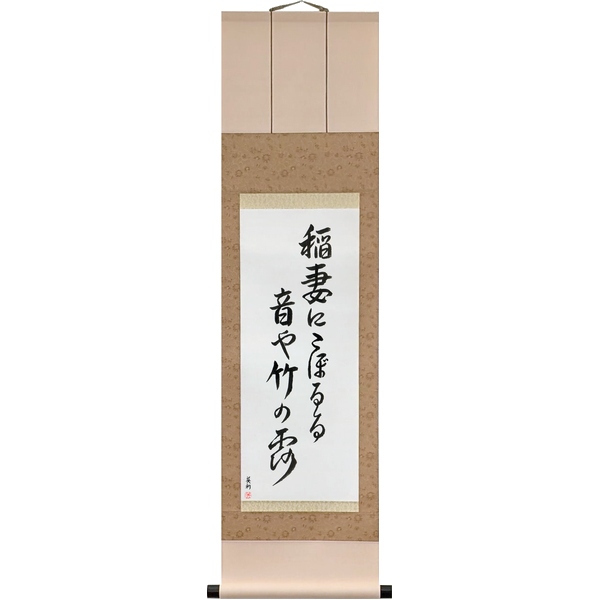
Sold as A flash of lightning / The sound of raindrops / Falling down the bamboo, under Buson's name and no translator's · Read inazuma ni koboruru oto ya take no tsuyu · Oldest witness the 蕪村句集 of 1784, the selection printed in the last winter of the poet's life, read at the leaf · Sense at a flash of lightning, the sound of dew spilling from the bamboo leaves. The word is dew, 露, in the poet's own book and in every witness but two; the page's raindrops is nobody's reading.
The text as brushed, and its variants
The scroll carries 稲妻にこぼるる音や竹の露, and the last word is the one that matters. The 蕪村句集 of 1784, opened at the leaf, prints 稲妻にこぼるゝ音や竹の露 in its autumn section, the 雨 radical over 路 unmistakable in the cursive at full resolution, in a run of four lightning verses. Six later witnesses agree: the 1906 annotated edition, いな妻にこぼるゝ音や竹の露; the anthologies and manuals of 1909 and 1910, 稻妻にこほるゝ or こぼるゝおとや竹の露; the 1932 prefectural history; 藤井紫影's 1935 edition of the 句集, 稻妻にこぼるゝ音や竹の露. Two witnesses read otherwise. The 蕪村三千句 of 1925 and 半田良平's dated edition of the same year both print 稲妻にこぼるゝ音や竹の聲, the bamboo's voice, and 半田 tags the group 右四句、句集, claiming the 1784 book as his source for it; the leaf shows he was wrong about the word, and the two 1925 books, set in the same year and agreeing against every other witness, are probably one instrument, whether a shared slip or a shared manuscript reading. The first two phrases vary only in writing: 稲妻, 稻妻 and いな妻; こぼるる, こぼるゝ and the OCR's こほるゝ. The meter is five, seven, five: い・な・ず・ま・に, こ・ぼ・る・る・お・と・や, た・け・の・つ・ゆ.
The attribution, as a dated thread
Buson's, and never anyone else's. The 蕪村句集 that carries it was published under 几董's name in 1784 with a postscript dated 天明四甲辰之冬十二月, the twelfth month of 1784, which falls in January or February 1785 by the Western calendar; the encyclopedia entry on kotobank, following 清水孝之, holds that the selection was Buson's own, made in his last years from his own verse-books, and that 几董 copied it faithfully to print. So the book is as close to the poet's hand as print comes. Shiki's manuscript compilation of classified verses, copied in 1889, has the verse under lightning with the poet's name garbled in the OCR; every printed edition from 1906 files it as Buson's; the 1928 index, the 1932 history and the 1935 edition likewise. The English record is Blyth's alone. No date of composition is given by any witness.
The words
稲妻 is lightning, the autumn season word; Buson's lightning verses travel together in the 句集, 八丈かけて, 一網打つや, 堅田泊り, and this one. こぼるる音 is the sound of something spilling over, こぼる being what dew does from a leaf and tears from an eye; the sound is small and it is the whole poem. や cuts the line after the sound and holds it. 竹の露 is the dew on the bamboo, shaken loose by the flash or by the thunder that is not named. As words the line says: At the lightning, the sound of spilling: the dew on the bamboo. The page's raindrops is not in the Japanese. 露 is dew, no witness has rain, and the delicacy the verse depends on is that a flash of lightning shakes loose something as small as dew, in a grove quiet enough for it to be heard.
A history, from the earliest witness
1784. 蕪村句集, 前編 巻之下, 秋之部, edited by 几董, the poet's own late selection. The verse stands in the lightning run, after いなづまや堅田泊りの宵の空 and before the headnote 春夜に句をとはれて that opens the next; it reads 稲妻にこぼるゝ音や竹の露. [NIJL 国書データベース biblio 300106341, canvas 44, right page, second column, read by eye at full resolution; the leaf is an image and has no text address]
1889. 正岡子規, 発句類題全集, a manuscript compilation of verses by topic. The verse in the lightning topic with a garbled name in the text layer; the leaf has not been seen. [NDL pid 2586419, koma 7, OCR; text at lab.ndl.go.jp/dl/api/page/2586419_7]
1906. 岩本梓石, 蕪村俳句全集 標註, an annotated edition. いな妻にこぼるゝ音や竹の露, in the autumn section; the note at this verse is not separable from the text layer. [NDL pid 875714, koma 78, OCR; text at lab.ndl.go.jp/dl/api/page/875714_78]
1909 and 1910. 古今名家愛吟集; 沼波瓊音, 俳句の作り方; 護竹軒主人, 閑日月. Three anthologies and manuals, each with the verse in an autumn column under Buson, 稻妻にこほるゝ音や竹の露 and 稻妻にこぼるゝおとや竹の露 with furigana. [NDL pid 872345, koma 100; pid 994608, koma 83; pid 888988, koma 21; OCR; text at lab.ndl.go.jp/dl/api/page/872345_100, 994608_83, 888988_21]
1925. 蕪村三千句 and 半田良平, 蕪村俳句全集 季題別, two collected editions. The 三千句 prints 稻妻にこぼるゝ音や竹の聲 and 半田 prints 稻妻にこぼるる音や竹の聲, the old 稻 in both and the repeat mark only in the first, read by eye in both; 半田 closes the group of four with 右四句、句集. The only witnesses to 聲. [NDL pid 924926, koma 47, printed page 89, and pid 964212, koma 31, printed page 48, both read by eye; text at lab.ndl.go.jp/dl/api/page/924926_47 and 964212_31]
1932 and 1935. 広島県誌; 藤井紫影, 名家俳句集. The prefectural history quotes the verse inside a biographical notice; 藤井's edition of the 句集 prints it in place, 稻妻にこぼるゝ音や竹の露. [NDL pid 1030141, koma 583; pid 1259717, koma 233, where the OCR layer prints 〓 for the repeat mark; OCR; text at lab.ndl.go.jp/dl/api/page/1030141_583 and 1259717_233]
Today. The Nipponica entry on kotobank, 蕪村, gives the poet's dates 1716–1783 and the judgment on the 句集 quoted above. The archive holds ten books that carry the verse before 1945, eight of them with 露. [kotobank 蕪村, read as text; harvest_index.py lookup --id 244 --year-to 1945 --located-only, re-derived 2026-09-05]
The sense, across two centuries
The tradition has one reading and it is Blyth's, because no Japanese commentary among what was opened stops at this verse: the grove, the flash, the whole of nature drawn tight for an instant, and in that tension a sound so small it is heard only then. Blyth writes that the drip-drip of dew … felt so deeply, it can be called hearing. The 1925 variant makes a different poem, quieter about the dew and louder about the bamboo, the grove's own voice at the flash; it is a good poem and it is not Buson's, on the evidence of his own book. The page's raindrops makes a third poem, in which a shower is falling and lightning is part of a storm, and that poem is nobody's.
What is not a source
The three other lightning verses of the 句集 run, 稻妻や八丈かけて, 稻妻に一網打つやいせの海 and いなづまや堅田泊りの宵の空, are this verse's neighbors in Buson's own ordering and the reason 半田 could tag the group as 句集; they are its company, not its kin. The 1925 聲, being two books of one year against the poet's own print, is a variant to be explained by 潁原's apparatus, not a reading to be weighed against 露. The house page's raindrops descends from nothing in the record.
The verse in English
The bilingual dictionaries of the Meiji shelf were not checked for this verse. Miyamori, Henderson and Hass were searched on the shelf and do not carry it.
1952. R. H. Blyth, Haiku, volume 3, Summer–Autumn, Hokuseido Press, Tokyo, under LIGHTNING, page 69. A flash of lightning! / The sound of the dew / Dripping down the bamboos, with the commentary on tension and hearing quoted above. [docs/research/papers, Blyth 1952 vol. 3, page 69 by the account's reading of the text layer, read as text; no ASIN collected]
Today. The house English, A flash of lightning / The sound of raindrops / Falling down the bamboo, is Blyth's three lines in shape and in his first line to the word, with raindrops put where he has the dew and falling where he has dripping. A rendering of this line has one thing to keep, and the page has changed it: the word is dew. Crediting Blyth restores it; a house rendering must keep it.
1998. Makoto Ueda, The Path of Flowering Thorn: The Life and Poetry of Yosa Buson, Stanford University Press. at a flash / of lightning, the sound of dew / falling from a bamboo, with the romaji and the edition reference (1: 577). [docs/research/papers, Ueda 1998, read as text; page 30 by the text layer's marker]
2007. Sawa, Haiku Master Buson, White Pine Press. With the lightning, / a sound of dripping down! / Dew on the bamboo. [docs/research/papers, Sawa 2007, page 130 by the text layer's marker, read as text]
A reading
The 1784 leaf settles what the account once held open, and it settles it for 露: the design brushes the text of the poet's own selection, and the 1925 聲 goes into the apparatus as the shared reading of two Taishō editions, not as a rival. What the page must change is not the Japanese but the English. Raindrops is wrong for 露 in every witness and in Blyth, and it is wrong for the poem: rain would drown the sound the verse exists to hear. I read the verse as a poem about the threshold of hearing. Lightning is the loudest thing in the sky and it makes no sound here; what is heard is dew, the quietest thing in the grove, and it is heard because the flash has made the listener still. Blyth's dripping down the bamboos keeps that; the page's raindrops falling loses it. The scroll needs no change; the English needs one word, or Blyth's name. Signed, 典, 2026-09-05.
How this was read
By eye: the 1784 句集 at canvas 44 of the NIJL images, at full resolution, where 露 was read; the two 1925 editions at their lightning runs, at width 3600, where 聲 was read in both. By OCR from the archive's text layer: Shiki's 1889 manuscript, the 1906 annotated edition, the three anthologies of 1909 and 1910, the 1932 history, the 1935 edition, and the 1896 俳諧拾万集, which was searched at seven komas and does not carry the verse. By text layer from the shelf: Blyth; the kotobank entry. Not opened: 佐藤紅緑's 1904 評釈 and 潁原退蔵's 1925 全集 at this verse, which is where a commentary and the origin of 聲 would be found; the 1889 and 1906 leaves as images; the 句集's postscript at canvas 74, present as a crop and not re-read this session; Blyth's printed page. The 1784 witness is an image at NIJL and checks by eye alone; the NDL witnesses each carry a text address beside the image. A bracket of the form pid P, koma N resolves as text at lab.ndl.go.jp/dl/api/page/P_N and as an image at dl.ndl.go.jp/api/iiif/P/R<N, seven digits>/full/3600,/0/default.jpg. The full apparatus, with every address and the crop's path, is in the account.
Supersession 2026-09-14 (s92)
A read-only worker was run on this account (citation_checks_2026-09-14/history_inazuma_ni_koboruru_244_2026-09-05.check.md), but the driver that fed it paired several komas with the wrong book numbers, so its four does not resolve rows and its 露-for-聲 finding are artifacts of the wrong page, not of this account. Every NDL address was re-opened by me the same turn from the zips: pid 2586419 koma 7, 875714 koma 78, 872345 koma 100, 994608 koma 83, 888988 koma 21, 1259717 koma 233 each carry the verse with 露; pid 924926 koma 47 (page markers 88–89) and pid 964212 koma 31 (48–49) each carry it with 聲, as § A history states. Added above: two English renderings on the shelf the s39 search did not open, Ueda 1998 and Sawa 2007. Marked: the 1935 藤井 OCR prints 〓 for the repeat mark the account gives as ゝ. Not yet read by a person.
References
Each witness is cited in the account above, at the frame or entry where it was read. A linked list follows when the record for this text is completed.