

池と川ひとつになりぬ春の雨 · ike to kawa hitotsu ni narinu haru no ame · The pond and the stream have become one. Spring rain
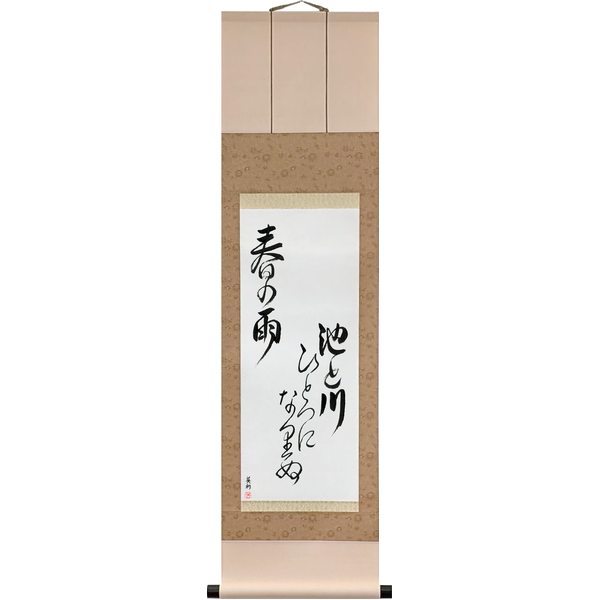
Sold as In the spring rain / The pond and the river / Have become one, under Buson's name and no translator's · Read ike to kawa hitotsu ni narinu haru no ame · Oldest witness the poet's posthumous papers, the 蕪村遺稿, which the archive holds only in twentieth-century print; the earliest print on the desk is 1902 · Sense a soft, continuous spring rain has raised the water until a garden pond and the stream beside it have lost their boundary. In 1903 three men of Shiki's circle argued in a Tokyo sitting room whether that can be spring rain at all, and the argument is the verse's history.
The text as brushed, and its variants
The scroll carries 池と川ひとつになりぬ春の雨, and so does every edition of Buson opened: the 1902 全集, the 1904 評釈, the 1906 標註, the 1907 lecture record, the 1921 annotated edition, the two 1925 editions, the 1925 三千句, the 1935 dated edition and the 1928 index. One witness differs by a particle. A haikai dictionary of 1909 prints, under its entry for spring rain, 池と川とひとつになりぬ春の雨, with a second と after 川, and its poet's name as the OCR reads it is 無村 for 蕪村; the leaf has not been seen as an image, and the extra と is as likely the scanner's as the printer's. Nothing in the sense turns on it. The meter is five, seven, five: い・け・と・か・わ, ひ・と・つ・に・な・り・ぬ, は・る・の・あ・め.
The attribution, as a dated thread
Every witness that names a poet names Buson, and the editions place the verse not in the 蕪村句集 of 1784, the selection printed in his lifetime's last year, but in the 蕪村遺稿, the posthumous gathering of what the 句集 left out. The 1907 lecture record says so at its head, 蕪村遺稿春之部四丁表より一枚, one leaf from the fourth leaf, recto, of the spring section of the 遺稿; and 半田良平's dated editions of 1925 and 1935 close the group before this verse with the tag 右十四句、句集 and the group it opens with 右十一句、遺稿. No witness dates the composition, and the 遺稿 itself has not been opened; its leaf is the one address that would show whether a headnote sits with the verse. The English record is Blyth's alone and he does not doubt it.
The words
池と川 is a pond and a stream, and the whole of the 1903 quarrel is about how big they are: 碧梧桐 hears a pond and a river, 虚子 a field-brook hidden in the grass and a little pond beside it. ひとつになりぬ is have become one; ぬ is the perfective, the thing has happened and is finished, quietly. 春の雨 is the spring rain, the season word: the soft, continuous, warm rain of spring, not the 五月雨 of early summer that floods rivers. 佐藤紅緑 in 1904 puts the whole distinction in a sentence, 五月雨は大きく烈しい感じで春雨は小さく緩やかな感じである, the summer rain is a large, violent feeling and the spring rain a small, gentle one. The verse's device is that a large-sounding event, two waters become one, is placed under a small-sounding season word, and the reader has to decide which one governs. As words the line says: The pond and the stream have become one; spring rain.
A history, from the earliest witness
1902. 山田三子, 蕪村俳句全集, a collected edition. The verse in the spring section, no note. The earliest print on the desk. [NDL pid 875715, koma 15, OCR; text at lab.ndl.go.jp/dl/api/page/875715_15]
1903, printed 1907. 内藤鳴雪, 河東碧梧桐, 高浜虚子, 蕪村遺稿講義, the record of a reading meeting, written up by 虚子. The fourth session, headed 明治三十六年七月二十日老梅居に會する者、主翁、碧梧桐、虚子, those gathered at 老梅居 on 20 July 1903: the master of the house, 碧梧桐, 虚子, reads one leaf of the 遺稿's spring section (the text layer's column order is scrambled at this header; the phrases are given in reading order). 虚子 opens with the plain sense: 池の側に川がある。春雨の降り續いた爲に水がまして、池の水と川の水とが一つになつてぬまつてしまつた、といふのである, so printed, with a stray ぬまつて the compositor left in (the text layer also breaks the sentence and drops in a stray とり; quoted in reading order), there is a stream beside the pond; the spring rain has gone on so long that the water has risen and the pond's water and the stream's have become one. 碧梧桐 objects: 池と川といふと大きな感じで其水が一つになつてしまつた、といふのは五月雨の頃には見る景色だが、春雨の景色とは思へぬ, a pond and a river sound large, and their waters becoming one is a scene of the summer rains; I cannot think it a spring-rain scene. 虚子 answers with the size of the waters, この池や川は大きいのでは無い。草隱れに流れて居る野川と其傍に在る小さい池とを想像すれば、春雨の趣きによくなつてゐると思ふ, this pond and stream are not large; imagine a field-brook running hidden in the grass and a little pond beside it, and it suits the feeling of spring rain well, cites the Chinese line 春水滿四澤, spring waters fill the four marshes, which he says has come up often in these sessions, and adds that the slow, drawn-out cadence of the verse is spring rain's, not the summer rain's. 碧梧桐 concedes the cadence and keeps the objection: 調子の延びてゐて春雨らしいといふ點には異論は無いが「池と川」といふとどうしても大きい感じになる、其を小さいものと解するのは無理ではあるまいか, I do not dispute that the drawn-out cadence is spring-like, but "pond and river" cannot help sounding large, and is it not forced to read them as small? The record moves to the next verse without a ruling. [NDL pid 875701, komas 31–32, printed pages 54–57, read by eye; text at lab.ndl.go.jp/dl/api/page/875701_31 and 875701_32]
1904. 佐藤紅緑, 蕪村俳句評釈, a commentary. The fullest reading on the record, and it takes 虚子's side without naming him. 面白い趣向である、此の池は庭の池である池尻に籬かあつて山吹がそろ〳〵咲きかけて居る、平常は此の籬を通して池の水が小川に落合つて居るのだが、春雨のために水嵩が增して此の池と小川との區別がなくなり, an interesting conception: this pond is a garden pond, with a fence at its outlet and the yamabuki just coming into bloom; ordinarily the pond's water falls through the fence into a small stream, but the spring rain has raised the water until the distinction between pond and stream is gone. Then he sets the reader an exercise: 若し之れを五月雨にしたらば如何であらうか、「池と川ひとつになりぬ五月雨」此の點が考ふべき處ろである, what if one made it summer rain, "pond and stream become one: summer rain"? That is the point to think about. His answer follows on the next leaf: the summer rain is 大きく烈しい, large and violent, the spring rain 小さく緩やか, small and gentle; 五月雨は男の如く春雨は女の如くである, the summer rain is like a man, the spring rain like a woman; and the verse's phrase, 池と川ひとつになりぬといふも即ちなをざりの感じで五月雨の如く思ひ切つた感じでない, "pond and stream become one" has exactly that casual feeling, not the decisive feeling of the summer rain. Written a year after the 1903 sitting and printed three years before its record, the commentary answers the same question the sitting had left open. [NDL pid 875716, komas 41–42, printed pages 72–75, read by eye; text at lab.ndl.go.jp/dl/api/page/875716_41 and 875716_42]
1906. 岩本梓石, 蕪村俳句全集 標註, an annotated edition. The verse in the spring-rain run without a gloss. [NDL pid 875714, koma 16, OCR; text at lab.ndl.go.jp/dl/api/page/875714_16]
1909. 武田桜桃, 俳諧辞典, a haikai dictionary. Under はるさめ, as an example: 池と川とひとつになりぬ春の雨, the one witness with the second と, and the poet's name garbled in the OCR. [NDL pid 875374, koma 63, OCR, not seen as an image; text at lab.ndl.go.jp/dl/api/page/875374_63]
1920. 木村架空, 蕪村夢物語, a critic's book in which Buson answers his readers in a dream. The 1903 exchange is restaged and then the dream-Buson rules on it: 作者の意は矢張り碧氏のいふ通りの池と川とであるが、それが強ち接近して居るのでもなし。又双方の水が合流したのでもない。旣に冬からの減水も、春雨の降る頃は舊に復して、河水も池水も水量が略ば平均した樣を云つたものだ, the author did mean a pond and a river as 碧梧桐 says, but they are not necessarily side by side, nor have their waters merged; the winter's low water has come back to its old level with the spring rain, and the verse says that the river's water and the pond's are now about level. A third reading: not adjacent, not merged, but equal again. [NDL pid 947592, komas 191–192, OCR; text at lab.ndl.go.jp/dl/api/page/947592_191 and 947592_192]
1921. 長谷川零余子, 蕪村俳句全集 校註解釈, an annotated edition. The verse in the run, no footnote. [NDL pid 968346, komas 20–21, OCR; text at lab.ndl.go.jp/dl/api/page/968346_20]
1925. 潁原退蔵, 蕪村全集, the scholarly edition, and the 蕪村三千句 of the same year. The verse in the apparatus run of the one and the spring section of the other; the text layer at 潁原's koma yields notes for the neighboring verses and none legible at this one, and the leaf has not been seen. [NDL pid 1018320, koma 36; pid 924926, koma 7; both OCR; text at lab.ndl.go.jp/dl/api/page/1018320_36 and 924926_7]
1925 and 1935. 半田良平, 蕪村俳句全集 季題別 and 季題別年代附, the collected verse by season word. Under 春雨, after the tag 右十四句、句集 closes the 句集 verses, the 遺稿 group opens with 春雨や珠數落したる潦 and 春雨にぬれつゝ屋根の手毬かな; this verse is its third, and the group closes eight verses after it with 右十一句、遺稿. The source tag is the editor's and is the record's plainest statement of where the verse comes from. [NDL pid 964212, koma 13, and pid 1090303, koma 11, OCR; text at lab.ndl.go.jp/dl/api/page/964212_13 and 1090303_11]
1928. 勝峰晋風, 日本俳書大系, the index volume. The verse filed under イケト with its source volume. [NDL pid 1179400, koma 212, OCR; text at lab.ndl.go.jp/dl/api/page/1179400_212]
Today. The Nipponica entry on kotobank gives the poet's dates, 1716–1783, and does not mention the verse. The archive that holds these witnesses returns nineteen books for it before 1945, of which twelve were opened for the account. [kotobank 蕪村, read as text; harvest_index.py lookup --id 245 --year-to 1945, 19 of 19 located, re-derived 2026-09-05]
The sense, across a century
One line and three readings, and they disagree about size rather than meaning. Everyone agrees the waters have joined; the question is whether the joining is small enough to be spring. 碧梧桐 in 1903 says no: a pond and a river becoming one is a flood, and floods are the summer rains'. 虚子 the same afternoon says yes: make the waters small, a field-brook and a garden pond, and the season word governs. 紅緑 in 1904 says yes with the whole weight of the season word behind him: the spring rain is small, gentle, casual, feminine, and the verse's ひとつになりぬ has that casualness and none of the summer rain's decision. 架空 in 1920 finds a way past the quarrel: the waters have not flooded together, they have come back level after the winter's low, and the oneness is of height rather than of body. Blyth in 1952 reads none of this and hears a metaphysics, the omnipresence and omnipotence of water … what seemed three different things, lake, stream, and rain, are intrinsically one. The Japanese readers were arguing about a garden; the English one about the world. The tradition's own answer, if the weight of the record is the answer, is 紅緑's: the season word decides, and the verse is soft.
What is not a source
The Chinese line 虚子 quotes, 春水滿四澤, spring waters fill the four marshes, is the opening of a quatrain on the four seasons in the Chinese tradition and was, by his own words, a standing reference at these sittings; it is a parallel he reached for, not a source Buson names, and it has not been opened here. 紅緑's three Buson summer-rain verses, うき草も沈む許りよ五月雨, さみだれに見えずなりぬる徑かな and 五月雨や滄海を衝く濁水, are the contrast he sets the verse against, not its kin. 架空's dream-Buson is a critic speaking in the poet's voice and is a witness to 1920, not to Buson. None of these is a source for the verse; they are the company the argument keeps.
The verse in English
The bilingual dictionaries of the Meiji shelf were not checked for this verse; a haiku does not travel through them. Miyamori 1932, Buchanan, Henderson, Ueda, Keene, Sato, Shirane, Hass and Reichhold were searched on the shelf and do not carry it.
1952. R. H. Blyth, Haiku, volume 4, Hokuseido Press, Tokyo, in the volume's opening section on Buson. In the spring rain, / The pond and the river / Have become one, with the sentence before it, The above and all the remaining verses of this second section are by Buson, and the commentary quoted above on the omnipotence of water. The romaji the account gives, Ike to kawa / hitotsu ni narinu / haru no ame, is garbled in the text layer at this address and legible only in the volume's index; the English lines are legible at the address. [docs/research/papers, Blyth 1952 vol. 4, read as text; the account gives the printed page as 462 and the file's text layer does not confirm a page number; no ASIN collected]
1994. R. H. Blyth, The Genius of Haiku, British Haiku Society and Hokuseido Press, pages 101–102 (the verse at the foot of 101, the comment opening 102, by the file's page markers). The same three lines reprinted. [docs/research/papers, Blyth 1994, page 102 by the file's page marker, read as text; no ASIN collected]
Today. The house English is Blyth's three lines exactly, in his order, without his name. A rendering of this line has to keep the two waters and their joining as finished, ひとつになりぬ, and it has to keep the season word soft; Blyth's lines do both and add nothing, which is why they have been copied. A house rendering that wanted to differ from his could only put the rain last, where the Japanese has it.
A reading
I side with 紅緑 and 架空 against 碧梧桐, and I think 碧梧桐 was the better reader for objecting. The verse sets a large event under a small season word on purpose, and the reader who feels the strain between them is feeling the poem; the reader who resolves it, as 虚子 did by shrinking the waters and 架空 by leveling them, is explaining it. The season word governs, because in this form it always does: the rain is spring's, so the joining is soft, and ひとつになりぬ is a quiet completion, a boundary that has dissolved without force. Blyth's omnipotence of water overshoots a garden pond; his three lines do not, and the page that sells the verse should say they are his or brush a rendering of its own. Text, attribution and romaji stand, and the scroll needs no change. The story the page could tell is the 1903 sitting: three men of Shiki's circle arguing over whether a pond can join a river in spring. Signed, 典, 2026-09-05.
How this was read
By eye at width 3600: the 1907 lecture record at both its leaves, pages 54–57; the 1904 評釈 at both its leaves, pages 72–75. By OCR from the archive's text layer: the 1902, 1906, 1921 and both 1925 editions, the 1909 dictionary, the 1920 dream-book, 半田's two printings, the 1928 index. By text layer from the shelf: Blyth's two printings; the kotobank entry. Not opened: the 蕪村遺稿 itself, as manuscript or facsimile, at 春之部四丁表, which would show the verse in its source and any headnote with it; 潁原's apparatus at this verse as an image; the 1909 dictionary as an image, where the second と would be confirmed or not; the Chinese quatrain 虚子 cites, at its source; Ueda's The Path of Flowering Thorn of 1998, where a dated translation might sit; any witness before 1902, none being in the archive; Blyth's printed page in volume 4. A bracket of the form pid P, koma N resolves as text at lab.ndl.go.jp/dl/api/page/P_N and as an image at dl.ndl.go.jp/api/iiif/P/R<N, seven digits>/full/3600,/0/default.jpg; the four leaves read by eye were fetched at that address. The full apparatus, with every address, is in the account.
Supersession 2026-09-14 (s92)
A read-only worker resolved this account's addresses (citation_checks_2026-09-14/history_ike_to_kawa_245_2026-09-05.check.md): 27 claims, 15 at the address, 7 it could not open (komas beyond the first of each cited range were not delivered to it; live URLs; tool runs). Corrected above: Blyth's Genius of Haiku places the verse at the foot of page 101 with the comment on 102; two OCR-order smoothings in the 1907 記事 are now said to be smoothings; the 潁原 koma is legible for its neighbors and only silent at this verse, which is narrower than garbled past use. Not yet read by a person.
References
Each witness is cited in the account above, at the frame or entry where it was read. A linked list follows when the record for this text is completed.