

人も見ぬ春や鏡のうらの梅 · hito mo minu haru ya kagami no ura no ume · A spring no one sees, the plum on the back of the mirror
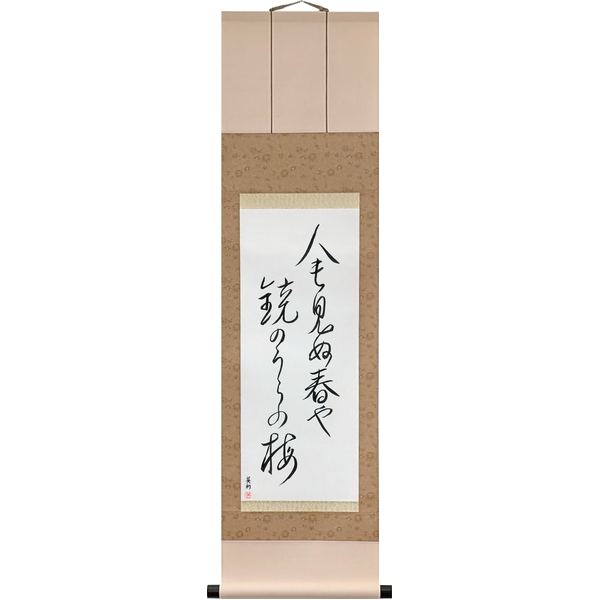
Sold as Bashō's, with a page note that old mirrors carried their design cast on the reverse, the side no one looks at · Read hito mo minu haru ya kagami no ura no ume · Oldest witness two undated Edo commentaries and the 1774 蝶夢 collection, which files it under 1693; Shirane and Fitzsimons date it to the New Year of 1692; the source every editor points to is Bashō's disciples' books · Sense a spring no one sees: the plum blossoms cast in bronze on the back of a mirror. A New Year's verse that two centuries of readers have taken for a figure of the good that goes unseen, and that the Edo manual made its example of 幽玄.
The text as brushed, and its variants
The scroll carries 人も見ぬ春や鏡のうらの梅, and every witness has this wording; the writing splits only in the kana. 鏡 is kanji in every leaf read, かゝみ in the 1909 芭蕉句選; 見ぬ is kanji everywhere but the 1935 typeset's みぬ. One text-layer reading would have changed the poem and does not: the OCR of the 1774 蝶夢 collection reads 夢のうら, the back of a dream, and the leaf, opened at width 3600, reads 鏡 in a cursive hand; the 夢 was the scanner's. Another text-layer reading is noise: Shiki's 1889 copy reads すや for 春や in the OCR, and the leaf was not settled by eye. No witness varies a word. The meter is five, seven, five: ひ・と・も・み・ぬ, は・る・や・か・が・み・の, う・ら・の・う・め.
The attribution, as a dated thread
Bashō's at every witness that names a poet, with no rival: 蝶夢's 1774 collection, assembled by his colophon from the disciples' books; 籬島's 1795 俳翼, which prints it in the section 其角述 芭蕉翁四季発句, the master's verses as 其角 told them; the 1783 第一義集 and the Edo 師走嚢, which gloss it as the master's; the 1909 句選, Shiki's copy, the anthologies of 1927 and 1935. The date is a year in dispute between the witnesses. 蝶夢 files it under 元禄六酉年, 1693; Shirane writes that Bashō composed [it] at the beginning of 1692 (Genroku 5), at the age of 49, and his index gives First Month, Genroku 5; Fitzsimons dates it Spring 1692. Neither side has been checked at a source. The 1783 compiler heads the verse 目前分明, plain before the eyes, which is his and not the poet's. The Edo manual 有也無也関 classes it as 幽玄躰.
The words
人も見ぬ春 is a spring that no one at all sees, the も making it not even people. 鏡のうら is the back of a mirror: a bronze mirror's reverse carried its cast design, plum among the commonest, and the page says this and it is right. 梅 is the plum, the first flower, and here the spring on the side no one turns over. The Edo readers made the object a figure. 師走嚢: 我身の徳を見知る人もなきは畢竟鏡のうらに梅の花なと鋳付たるはあれと … うらに有梅は見る人もなきことく世にしられぬもの, that no one knows one's own virtue is, in the end, like the plum cast on the back of a mirror: the plum on the back has no one to see it, a thing unknown to the world. The 1783 第一義集 sets the other readings aside, 此句さま〳〵説ありといへども。皆もて穏当ならず, this verse has various explanations, none of them sound, and reads it through the I Ching's hexagram 艮, 艮其背不獲其身、行其庭不見其人, stopping at the back, one does not get the body; walking the courtyard, one does not see the person, and 程子 on stopping where one should: 鏡の面にうつる物は誰も見るべし。見れどもそれと気をつけざれば, what shows on the face of the mirror everyone sees, and seeing it no one attends to it; the back is the place to stop. As words the line says: A spring no one sees: the plum on the back of the mirror.
A history, from the earliest witness
1692 or 1693. Bashō, a New Year's verse. Not opened at a source; the two dates are the witnesses' below. [Shirane 1998, page 50; 蝶夢 1774; see below]
Edo, undated. 梅門, 師走嚢, a commentary. The verse glossed as the unrecognized virtue, in the words quoted above; the leaf is cursive and the OCR is followed. [NDL pid 2540341, koma 13, OCR; text at lab.ndl.go.jp/dl/api/page/2540341_13]
Edo, undated. 幻住庵俳諧有也無也関, a haikai manual. In its eight styles of the hokku, 発句八躰之事, the verse stands first, directly under that heading and before the first style name, 幽玄躰, the style of the deep and dim. Whether the name belongs to this verse turns on whether the manual's names close their groups or head them, and the next leaf answers: the last name, 風曲躰, is followed by two verses and then the closing 右發句八躰の事, so the names head their groups, 幽玄躰 names the three verses after this one (やがて死ぬ気色は見えず蝉の声, 古池や蛙飛込水のおと, 梅の木に猶やどり木や梅の花), and this verse opens the list with no name of its own. 梅が香にのつと日の出る山路哉 stands eight verses down, the last under 無心躰. My s40 reading gave this verse to 幽玄躰; the next leaf refutes that. [NDL pid 2539775, koma 15, read by eye; text at lab.ndl.go.jp/dl/api/page/2539775_15]
1774. 五升庵蝶夢, 芭蕉翁発句集. Under 元禄六酉年, on a leaf of that year's spring verses, 人も見ぬ春や鏡のうらの梅, the 鏡 read against the OCR's 夢. [NDL pid 2540314, koma 70, read by eye; text at lab.ndl.go.jp/dl/api/page/2540314_70]
1783. 鼻中庵三力, 俳諧第一義集, a Zen reading of the haikai canon. Under the compiler's headnote 目前分明, the verse, then two leaves of gloss: the other readings dismissed, the hexagram 艮 and 程子 quoted, and the reading that the plain front is what everyone sees and no one notices, so the back is where to rest. [NDL pid 2568262, komas 9–10, read by eye; text at lab.ndl.go.jp/dl/api/page/2568262_9 and 2568262_10]
1795. 秋里籬島, 俳翼, a small book of haikai relics. In the section 其角述 芭蕉翁四季発句, the verse, followed by a headnote for 乙州's departure to Edo and 梅若菜鞠子の宿のとろろ汁. [NDL pid 2541278, koma 10, read by eye; text at lab.ndl.go.jp/dl/api/page/2541278_10]
1889. 正岡子規, 発句類題全集, his manuscript copy. The verse in a mixed list; the OCR reads すや for 春や and the leaf was not settled. [NDL pid 2586392, koma 164, OCR; text at lab.ndl.go.jp/dl/api/page/2586392_164]
1909. 芭蕉句選, a verse list by season appended to a 菅菰抄 typeset. 春之部, page 143: 人も見ぬ春やかゝみのうらの梅, two verses under 梅か香にのつと日の出る山路哉, with 山里は萬歲おそしむめの花 between them; the leaf's margin note on another verse points the reader to 泊船集. [NDL pid 888896, koma 82, printed page 143, read by eye; text at lab.ndl.go.jp/dl/api/page/888896_82]
1927, 1935. 島田青峰, 芭蕉俳句紀行全集; 蝶夢's collection in the 有朋堂 typeset. The verse in the 1927 全集, and in the 1935 typeset of the 1774 collection as 人もみぬ春や鏡のうらの梅, with 鏡, which is how the OCR's 夢 was first doubted. [NDL pid 1194541, koma 27; pid 1259717, komas 65–66; OCR; text at lab.ndl.go.jp/dl/api/page/1259717_66]
Today. The archive lists eighty-six books carrying the verse before 1945, nine of them opened for the account. kotobank's page for 松尾芭蕉 gives the poet's dates and does not quote the verse. [harvest_index.py lookup --id 243 --year-to 1945; kotobank 松尾芭蕉-16739, read as text]
The sense, across three centuries
The verse has been read one way since the Edo commentaries, and the way is a figure: the good that goes unseen. 師走嚢 said it plainly, the virtue no one knows; the 1783 compiler dressed it in the I Ching and made the unseen back the place of rest; the manual set it at the head of its eight styles. Shirane in 1998 gave it two layers at once: as a 歳旦吟, a New Year's verse, it celebrates the new year with the plum that blooms in the first month, and as a verse written when Bashō had shut his gate even to his disciples, the plum hidden behind the mirror is his own wish for retreat. 潁原退蔵, through Ueda and Fitzsimons, made the same point as an aesthetic, Bashō was always attracted to inconspicuous beauty. Blyth, in an essay printed after his death, heard Keats: a world of art which hardly belongs to this world except as a kind of perversion of it, a sort of back-of-the-mirror which our mind holds up to nature, and said Bashō, like Wordsworth, wanted the real one. Nobody has read it any other way.
What is not a source
The OCR's 夢 was never a variant; the leaf reads 鏡. The date is in dispute between 蝶夢 and the two modern scholars and neither has been read at a source. The compiler's headnote of 1783 is his. The page's note on mirror backs is right about the object and is not a reading of the verse; the readings are above.
The verse in English
The bilingual dictionaries of the Meiji shelf were not checked for this verse. Miyamori, Buchanan, Henderson and Hass were searched on the shelf and do not carry it.
1952. R. H. Blyth, Haiku, volume 4, Appendix, Hokuseido Press, Tokyo. The romaji in the appendix only, keyed to the preface; the four volumes were grepped and do not translate it. [docs/research/papers, Blyth 1952 vol. 4, read as text; no ASIN collected]
1994. R. H. Blyth, The Genius of Haiku, British Haiku Society and Hokuseido Press, page 99. A spring unseen of men,— / On the back of the mirror / A flowering plum-tree, with the Keats and Wordsworth paragraph quoted above. The one Blyth rendering, in a posthumous collection. [docs/research/papers, Blyth 1994, page 99 by the text layer's page number, read as text; no ASIN collected]
1998. Haruo Shirane, Traces of Dreams, Stanford University Press, page 50. a spring no one sees / plum blossoms / on the back of a mirror, with the 歳旦吟 reading, the retreat reading, and the date: at the beginning of 1692 (Genroku 5), at the age of 49. [docs/research/papers, Shirane 1998, page 50 by the text layer's running head, read as text; no ASIN collected]
2006. Michael Haldane, in Bashō and the Haikuists, Delphi Classics, 2022. unseen Spring – / at the mirror's reverse, / the blossoming plum. [docs/research/papers, Delphi Classics 2022, the Bashō section, read as text; no ASIN collected]
2022. Andrew Fitzsimons, Bashō: The Complete Haiku of Matsuo Bashō, University of California Press, no. 752. A spring no one sees / On the back of a mirror / blossoms of ume, dated Spring 1692, with 潁原's sentence through Ueda, page 335. [docs/research/papers, Fitzsimons 2022, read as text; no ASIN collected]
Today. The house page carries no English rendering. A rendering of this line has one thing to keep: the plum is last, and it is on the back.
A reading
I read the verse as the tradition has from 師走嚢 to 潁原: the object is a bronze mirror's reverse, and the object is a person, the good that no one turns the mirror over to see. Shirane's two layers are the fullest account, a New Year's verse and a hermit's, and they do not compete; I would put the New Year in a page's sentence, because it is what the verse was for. The date I would give as 1692 with Shirane and Fitzsimons, naming 蝶夢's 1693 beside it, until one is read at a source. The 1774 leaf reads 鏡 and the OCR's dream is gone. The text, the attribution and the romaji stand, and the scroll needs no change; the page could carry the reading in one sentence, and it should. Signed, 典, 2026-09-05.
How this was read
By eye at width 3600: the 1774 蝶夢 at the verse, where 鏡 was read; the 1783 第一義集 at both its leaves, where 目前分明 and the opening of the gloss were read and the OCR followed for the rest; the 1795 俳翼 at its 其角述 leaf; the Edo manual's eight styles; the 1909 芭蕉句選. Opened and not settled: 師走嚢 and Shiki's 1889 copy, both cursive, the OCR followed. By OCR from the archive's text layer: the 1927 全集 and the 1935 typeset. By text layer from the shelf: Blyth in two books, Shirane, Haldane, Fitzsimons. Not opened: the source the disciples' books rest on; Ueda's Bashō and His Interpreters, page 335; the 泊船集 of 1698; the dates of the two Edo commentaries; seventy-seven books the archive lists. A bracket of the form pid P, koma N resolves as text at lab.ndl.go.jp/dl/api/page/P_N and as an image at dl.ndl.go.jp/api/iiif/P/R<N, seven digits>/full/3600,/0/default.jpg; the seven leaves read by eye were fetched at that address. The full apparatus, with every address, is in the account.
Supersession 2026-09-14 (s92)
A read-only worker resolved this account's addresses (citation_checks_2026-09-14/history_hito_mo_minu_243_2026-09-05.check.md): 31 claims, 20 at the address, 8 it could not open (by-eye leaves, undelivered komas, live URLs, tool runs). Corrected above: Haldane's third line, the blossoming plum, is in the Delphi text layer two lines below where the s39 reading stopped, and is now quoted. Re-opened by me this turn where the worker lacked the koma: the 1783 sentence 鏡の面にうつる物は誰も見るべし is on pid 2568262 koma 10 as cited; the 1935 verse and the 安永五年 colophon are on pid 1259717 koma 66 as cited. Not yet read by a person.
References
Each witness is cited in the account above, at the frame or entry where it was read. A linked list follows when the record for this text is completed.