

古池や蛙飛込水の音 · furu ike ya kawazu tobikomu mizu no oto · The old pond. A frog jumps in, the sound of water
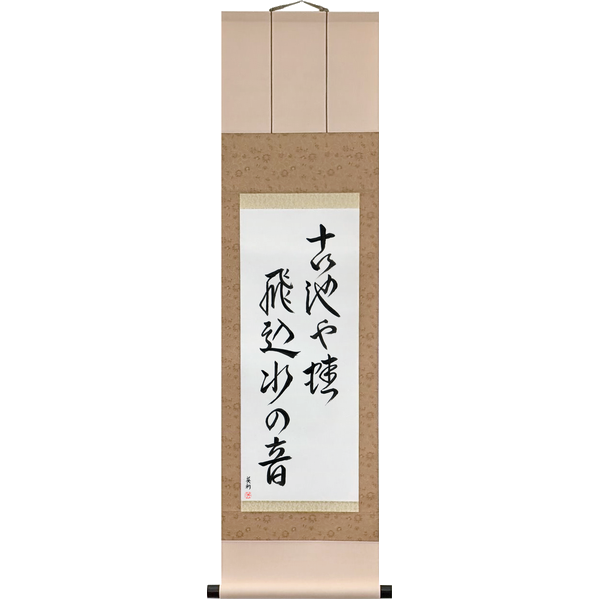
Sold as Bashō's frog, with English the page says is Blyth's and a link to a survey of thirty-one translations · Read furu ike ya kawazu tobikomu mizu no oto · Oldest witness the spring of 1686, in the frog contest 蛙合 and the anthology 春の日 of that year, by Shirane's citation; the earliest print opened is a collected edition of 1774 · Sense an old pond, a frog's leap, the sound of the water. The most famous verse in the language, whose text has never been in doubt and whose story has: the Zen enlightenment at the pond is a legend two generations younger than the poem, and the poet's own drafts are the better story.
The text as brushed, and its variants
The scroll carries 古池や蛙飛込水の音, and the middle word is the only thing the witnesses write differently. The Edo editions and the modern critical text write 飛こむ: the 1774 発句集, the 1783 第一義集, the 1795 俳翼, Bakin's 栞草 in its 1892 typesets, and NKBT 45 as Shirane's grammar cites it. The 1909 Zen lectures write 飛込む; the anthologies of 1911, 1927 and 1930 write 飛び込む, the full modern okurigana the page's own note calls the full form. The design's 飛込, with no okurigana at all, is in no verse witness opened, but it is what 三力's 1783 commentary writes when it names the word in prose, 飛込ハ蛙なり, so the tradition itself uses the form. One reading in the text layer is not a variant. The OCR of the 1774 manuscript-hand edition reads 古池へ, into the old pond; the leaf, opened at width 3600, reads や in a cursive hand, and the へ is the scanner's. No witness varies the sense. The meter is five, seven, five: ふ・る・い・け・や, か・わ・ず・と・び・こ・む, み・ず・の・お・と.
The attribution, as a dated thread
The verse is Bashō's from its first appearance and no one has ever said otherwise. Shirane dates it to the spring of 1686 on two printed witnesses of that year: 春の日, the anthology of the Bashō school, and 蛙合, the frog contest edited by 仙化 in the third month, where the verse stands on the left of the first round against 仙化's own frog on a floating leaf, in a contest of twenty-four rounds and forty-one poets. Neither has been opened here. The 1774 発句集 sets the verse among neighbors dated 貞享三 and 貞享四, 1686 and 1687, which agrees. Everything after that is about how the verse came to be, and there the record splits into a haikai story and a Zen story. The haikai story is the drafts: 其角 proposing 山吹や, yellow roses, as the first line, which would have tied the frog to its classical association with the mountain rose, and Bashō choosing 古池や instead; Shirane carries it according to one source, unnamed at the page read, and Hass, from Miner, has Bashō revising it several times, beginning with the frog leaping in the past tense. The Zen story is 佛頂, the abbot of 根本寺 at 鹿島 with whom Bashō studied, and a kōan exchange; its earliest attestation among what was opened is 1795, in a form that is not yet a dialogue, and its full form is a Zen abbot's lecture of 1930. The 其角 element is common to both stories and is the one piece with a footing in the haikai record. The English translators, from the ten Miyamori collected in 1932 to Hass in 1994, all give the verse to Bashō, and the ones who tell the Zen story doubt it as they tell it.
The words
古池 is an old pond, and や sets it down as a thing in itself before anything happens in it. Blyth: the old pond is there; it exists in its own right … as we see by the particle ya; Shirane's grammar of classical Japanese uses the line as its textbook instance of that や. 蛙 is kawazu, the classical word for the frog, a spring season word; the 1927 全集 files the verse under it, and the 1686 contest was a contest on that topic. 飛込 is to leap in. 水の音 is the sound of the water, and 三力 in 1783 lays the whole verse out in three sentences: 音ハ水なり。飛込ハ蛙なり。所ハ古池也, the sound is the water's; the leaping is the frog's; the place is the old pond. Hass: the trick for translation is the last phrase … translators have tried water-sound, plop, splash, glub. Miyamori: the verse appeals to the ear, not to the eye. As words the line says: The old pond. A frog leaps in: the sound of the water.
A history, from the earliest witness
1686. 蛙合, the frog contest edited by 仙化, and 春の日. The first printings, by Shirane; not opened. The contest's first round pairs this verse, on the left, with 仙化's frog on a floating leaf. [Shirane 1998, pages 14–17, read as text]
1774. 五升庵蝶夢, 芭蕉翁発句集, the collected verse in a cursive hand. 古池や蛙飛こむ水の音, in a run of verses whose neighbors are dated 貞享三 and 四; the text layer's へ for や is the scanner's. [NDL pid 2540314, koma 22, read by eye; text at lab.ndl.go.jp/dl/api/page/2540314_22]
1783. 鼻中庵三力, 俳諧第一義集, a Zen reading of the haikai canon. The book's second volume opens on this verse under the headnote 水音大悟, great awakening at the sound of water, which is the compiler's and not the poet's, with furigana over every character, and a gloss that begins 轉る處實に能迷なり意味説とありといへども道躰の句, turned over, it truly baffles; though its meaning is said to be explained, it is a verse of the Way's own body (the leaf's furigana read トウタイ over 道躰 and カスカ over the character the OCR layer reads as 迷; the OCR layer has the sentence in modern forms, 転る処実に能迷なり意味説とありといへとも道体の; the s39 text of this sentence was misread by eye), and reaches the three sentences quoted above, 音ハ水なり。飛込ハ蛙なり。所ハ古池也, the ハ katakana on the leaf where the OCR layer writes は; know the first of them, he says, and you know the master's heart. The book is titled for the Zen 第一義 and reads the whole canon as kōan. [NDL pid 2568263, komas 2–3, read by eye; text at lab.ndl.go.jp/dl/api/page/2568263_2 and 2568263_3]
1795. 秋里籬島, 俳翼, a small book of haikai relics. On the right-hand page a single large character, 禪, with a short line of kanbun beneath it and the signature 釈氏佛頂書, so printed, written by the monk Butchō; on the left, 古池や蛙飛こむ水の音 芭蕉翁, and the note: 右此法語ハ鹿嶌根本寺佛頂和尚の真跡にして芭蕉翁に示し給ふ也於是古池の句あり (the OCR layer reads は for ハ and 鹿嶋 for 鹿嶌), the dharma-words on the right are in the true hand of the abbot Butchō of 根本寺 at 鹿島 and were shown to the old master Bashō; upon this the old-pond verse came to be; then the provenance of the master's lifelong personal effects, 蕉翁生涯隨身の…, the character after の smudged on the leaf and the OCR layer reading 道具志波後 for the run, through 粟津正秀 to a Kyoto hermitage where they are kept as a family treasure. The earliest attestation on the desk of the Butchō story, and it is a relic-provenance with the verse attached, not yet a dialogue. [NDL pid 2541278, koma 7, read by eye; text at lab.ndl.go.jp/dl/api/page/2541278_7]
Edo text, printed 1892. 滝沢馬琴, 俳諧歳時記栞草, two typesets. Inside the deathbed speech Bakin quotes from 支考's and 去来's notes: Bashō says that from this verse, when he raised his own style in it, every verse after was a death-verse. The speech is 花屋日記 material and is evidence for how the verse was regarded, not for anything the poet said; that the 花屋日記 is a later composition is the discipline's judgment, marked here as recall. [NDL pid 875335, koma 92, OCR; text at lab.ndl.go.jp/dl/api/page/875335_92]
1909. 釈宗演, 無門関講義, a Zen abbot's lectures on the Gateless Gate. 古池や蛙飛込む水の音と云ふ意味が分らぬと頌の意味は分らぬ, without understanding the meaning of "the old pond", one cannot understand the meaning of a Zen verse; and, 鳥渡した發句位は誰でも知てをる, everyone knows at least a hokku or two, "the old pond" …, its meaning received by every Japanese as if by heredity. [NDL pid 899779, komas 49 and 59, OCR; text at lab.ndl.go.jp/dl/api/page/899779_49 and 899779_59]
1911, 1927. 日本文学史講義; 島田青峰, 芭蕉俳句紀行全集. The verse in the literary-history lecture with 物言へば唇寒し秋のかせ, and in the 全集 under the season word 蛙, both in the full modern form 飛び込む. [NDL pid 903544, koma 79; pid 1194541, koma 24; OCR; text at lab.ndl.go.jp/dl/api/page/903544_79 and 1194541_24]
1930. 釈宗演全集, the abbot's collected works. The Butchō story in its full form: Butchō asks 靑苔未だ生せず、春雨未だ來らざる時如何, what of the time before the moss grows and the spring rain comes?, and Bashō answers with the last twelve syllables only, 蛙飛び込む水の音; then he commands his disciples to supply the first five, and 淋しさや and 宵暗や come from unnamed pupils, 山吹や from 其角, and 古池や from Bashō himself; since it came about this way it of course contains Zen meaning. Told by a Zen abbot to a Zen audience, two hundred and forty-four years after the verse. [NDL pid 1181336, komas 157–158, OCR under furigana noise; text at lab.ndl.go.jp/dl/api/page/1181336_157]
Today. The archive lists nine hundred and ninety-five books carrying the verse before 1945, nine of them opened for the account. kotobank returns no entry for the verse itself. [harvest_index.py lookup --id 252 --year-to 1945 --located-only]
The sense, across three centuries
The text has one sense and the tradition has spent three centuries deciding what to make of it. 支考 in 1719, as Shirane carries him, said that although it appears that the poem possesses absolutely no emotion, Bashō has managed to suggest 寂しさ, the quiet loneliness, and made it the type of the Bashō style. 三力 in 1783 made it a kōan and said the sound is the water's and the leap the frog's and the place the pond's, and that this is enough. 宗演 in 1909 said no Japanese needs it explained. Miyamori in 1932 said it is a verse for the ear. Blyth heard the whole garden, the whole universe contained in one single plop, and made a grammar of it: the pond, the leap and the sound coexistent, that is, coeternal, not cause and effect. Hass in 1994 said the story of the Zen monk is a story, repeated in many books about Basho, and that the translation problem is 水の音 and the real fact is the drafts. Shirane in 1998 read the verse as work done against the classical frog, the singing frog of the 古今集 beside its yellow roses, and said the loneliness the disciples heard is the recluse's ear. Two things stand at the end of that. The verse is a sound, and everyone since 三力 has said so. And the enlightenment at the pond is a legend the translators themselves doubt: Blyth, of very doubtful authenticity, and in a way spoils the simplicity and apparent spontaneity of the original; Hass, achieved instant enlightenment, etc.
What is not a source
The Butchō story is a legend, told in three forms that do not agree: a relic with a verse attached in 1795, a kōan dialogue with the disciples' drafts in 1930, and a set of drafts without a monk in Shirane and Hass. The 1930 telling supplies numbers and names the 1795 one lacks, which is what a legend does as it grows. The one element with a footing in the haikai record is 其角's 山吹や, and even that stands on Shirane's unnamed one source. The headnote 水音大悟 is the 1783 compiler's. Bakin's deathbed speech is the 花屋日記's. The survey of thirty-one translations the page links, and Sato's hundred frogs, are reception, not sources. The verse's sources are the two books of 1686, which have not been opened.
The verse in English
The bilingual dictionaries of the Meiji shelf were not checked for this verse. Henderson was searched on the shelf and does not carry it; Ueda, Keene, Reichhold and Sato's One Hundred Frogs are not on the shelf. (SUPERSEDED s90, 2026-09-14: all four are on the shelf since the eighth delivery, Henderson carries it in three books, and the layer after 1932 is read below in § Supersession 2026-09-14.)
1932. 宮森麻太郎 Asatarō Miyamori, An Anthology of Haiku Ancient and Modern, Maruzen, Tokyo, no. 20, printed pages 130–133. His own two renderings and, on one spread, ten more collected from Nitobe, Saitō, Toyoda, Chamberlain, Page, Walsh, Noguchi, Porter, Aston and Revon in French, with the note that the verse appeals to the ear. The first anthology of the verse's English. [docs/research/papers, Miyamori 1932, printed pages 130–133 by the running heads of the file's page-marked layer, read as text (s39 cited 20–21, which is the item number); no ASIN collected]
1949 to 1964. R. H. Blyth, Haiku, volumes 1, 2 and 4, and A History of Haiku, volume 2, Hokuseido Press, Tokyo. The old pond; / A frog jumps in,— / The sound of the water, in the spring volume near its page 205 and in three other books; the single plop, the coeternal grammar, and the doubt about the Zen account. [docs/research/papers, Blyth 1949, the 1981 Heian reprint of vol. 2, 1952 vol. 4, and 1964 History vol. 2, read as text; no ASIN collected]
1994. Robert Hass, The Essential Haiku, Ecco Press, pages 17 and 257. The old pond—/ a frog jumps in, / sound of water, and the note on 水の音, the drafts and the legend. [docs/research/papers, Hass 1994, pages 17 and 257 by the file's page numbers, read as text; no ASIN collected]
1998 and 2005. Haruo Shirane, Traces of Dreams, Stanford University Press, pages 14–17, 51 and 76–77, and Classical Japanese: A Grammar, Columbia University Press. an old pond … / a frog leaps in, / the sound of water; the dating to 1686 and the contest; the reading against the classical frog; and the verse as the grammar's example of や, with the critical text 古池や蛙飛こむ水の音 cited to NKBT 45:37. [docs/research/papers, Shirane 1998 and 2005, read as text; no ASIN collected]
Today. The house page says its English is Blyth's and links a survey of thirty-one renderings. Whether the lines on the page are Blyth's to the word was not checked; the catalogue row carries no English field, and the live page was not opened for it. A rendering of this line has one thing to keep, and every translator knows it: the last phrase is a sound, and the verse ends on it.
A reading
I read the verse as 三力 did in 1783 and as Hass did in 1994, which is the same reading two hundred years apart: the sound is the water's, the leap is the frog's, the place is the pond, and that is the poem. What I would put on a page is not the enlightenment but the contest, because it is true and because it is better. In the spring of 1686 forty-one poets sat down to write about frogs, and this verse was set on the left of the first round against a frog on a floating leaf; and in the same year, if the one anecdote with a haikai footing is right, 其角 wanted the first line to be yellow roses, the pretty association every reader expected, and Bashō chose an old pond instead. That is the whole revolution of the verse, done in five syllables, and a legend about a Zen master asking about moss is smaller than it. The Zen story should be told as legend, with its 1795 and 1930 tellings, or not told; it should not be told as fact, and the house page, which tells no story, tells no false one. The design's 飛込 is the tightest of four writings of one word and has a footing in 1783 prose; the 1774 へ is a scanner's ghost, now seen off by the leaf. Text, attribution and romaji stand, and the scroll needs no change. Signed, 典, 2026-09-05.
Supersession 2026-09-14 (s90)
The layer after 1932. The s39 draft said Henderson did not carry the verse and that Ueda, Keene, Reichhold and Sato's One Hundred Frogs were not on the shelf. Henderson carries it in three books, and the other four have been on the shelf since the eighth delivery of 2026-09-12; the English join built this session finds the verse in 108 books shelved since the tenth. The ones that render or read it were opened at their pages and read as text. Locators are the PDF's page index, with the printed page where the page shows it.
- 1934. Harold G. Henderson, The Bamboo Broom, Houghton Mifflin, Boston, page 33: the haiku that Bashō himself considered the standard for his new style: An ancient pond; / Plash of the water / When a frog jumps in. Again, re-lineated, in his Handbook of Japanese Grammar (Routledge, 1945) as the example of exclamatory や: An ancient pond! / And the plash of the water / When a frog jumps in! [shelf, pdfpage 51; 1945 EPUB text, line 12114]
- 1950. D. T. Suzuki, Essays in Zen Buddhism, Second Series, Rider, London: 'Tis an ancient pond, / A frog leaps in— / Oh, the sound of water!, and It was this sound that awakened him to the truth of Zen Buddhism. The Zen account, from the man who fixed it in English. [shelf, pdfpage 227]
- 1958. Henderson, An Introduction to Haiku, Doubleday Anchor, pages 19–20: Early in 1686 Bashō wrote what is probably the best-known haiku in the Japanese language; the literal Old pond: / frog jump-in / water-sound.; the account of the composition, the last two lines were the first to be composed … The circumstances seem well attested, Bashō in his garden with friends, the sound necessarily during a period of silence, and then, if this story is correct, the closest possible English: Old pond— / and a frog-jump-in / water-sound. [shelf, pdfpage 31–32]
- 1959. D. T. Suzuki, Zen and Japanese Culture, Princeton University Press (Bollingen), pages 227–228 and 238–239: Furu ike ya! / Kawazu tobikomu, / Mizu no oto. — The old pond, ah! / A frog jumps in: / The water's sound!, said to have been the start of his revolutionary movement; then the Bucchō story told in full, and the reading in which the sound was heard by Bashō as filling the entire universe and the poet was "resurrected." The source most later English writers argue with. [shelf, pdfpage 315–317, 326–328]
- 1960. R. H. Blyth, Japanese Life and Character in Senryu, Hokuseido Press: the Japanese printed 古池や蛙飛びこむ水の音, romaji, and his 1949 rendering, as the model of a senryū. [shelf, page marker 026]
- 1962. R. H. Blyth, Zen and Zen Classics, volume 5, Hokuseido Press: The old pond! / A frog-jumps-in sound / Of the water., with the grammar spelled out: "A frog jumps in" is not a clause but an adjectival phrase qualifying "sound." [shelf, pdfpage 102]
- 1963. R. H. Blyth, A History of Haiku, volume 1, Hokuseido Press, pages 12–13: the coeternal reading in full (The old pond continues in time; the jumping in and the sound of the water are timeless), and the date, Bashō wrote Furu-ike ya, the foundation of the Bashō School, in 1686. [shelf, pdfpage 29–30, 118]
- 1966. Nobuyuki Yuasa, The Narrow Road to the Deep North and Other Travel Sketches, Penguin, pages 9 and 32: four lines, Breaking the silence / Of an ancient pond, / A frog jumped into water — / A deep resonance., given twice, the second time with a comment by one of his disciples, Shikō's account. [shelf, pdfpage 11, 34]
- 1967. John C. H. Wu, The Golden Age of Zen: An old pond. / A frog jumps in,— / Plop!, read as a Chinese couplet: The old pond corresponds to "An eternity of endless space," while the frog jumping in … is equivalent to "A day of wind and moon." [shelf, EPUB text, line 2652]
- 1976. Donald Keene, World Within Walls, Grove Press, pages 88–89: The ancient pond— / A frog jumps in, / The sound of the water., Shikō's Kuzu no Matsubara (1692) account with Kikaku's yellow roses, and the caution: If this account can be trusted, the verse may have been written as far back as 1682, though not published until 1686. It is hard to imagine, however, that such a masterpiece would have been left in manuscript for four years. [shelf, pdfpage 106–107]
- 1982. Makoto Ueda, Matsuo Bashō, Kodansha International, page 53: The old pond— / A frog leaps in, / And a splash. [shelf, pdfpage 51]
- 1982. Janine Beichman, Masaoka Shiki, Twayne, note 6: The old pond! / A frog jumps in— / the sound of water., and the fact that the Old Pond Church (古池教会) dedicated to Bashō's worship was at one point recognized by the government (Keene 2013 gives the year, 1885). [shelf, pdfpage 172, 63]
- 1983. Hiroaki Sato, One Hundred Frogs: From Renga to Haiku to English, Weatherhill, chapter 7, pages 147–148: the book began as a collection of English translations of this verse, from a list of about twenty that Kyoko Selden sent him; far more translations have been found than I had expected. His own: An old pond: a frog jumps in—the sound of water. His argument that 蛙 may be plural (Sanpū's stocked ponds; Kyorai's croaking paddy in the same 蛙合), with the 蛙合 pairing against Senka's Innocently a frog squats on a floating leaf; and the correction that 水の音 is not, as sometimes translated, onomatopoeic. The list of renderings itself, the book's second half, was not read. [shelf, pdfpage 177–178]
- 1985. Lucien Stryk, On Love and Barley, University of Hawaii Press, number 153: Old pond, / leap-splash— / a frog. The rendering the Oxford Dictionary of Quotations (8th edition, 2014) prints under Bashō. [shelf, pdfpage 58; ODQ pdfpage 97]
- 1985. William J. Higginson, The Haiku Handbook, McGraw-Hill, page 9: old pond . . . / a frog leaps in / water's sound, the dots marking the kireji, and the note that Bashō moved from frogs' songs to frogs' actions. [shelf, pdfpage 25, 119]
- 1992. Makoto Ueda, Bashō and His Interpreters, Stanford University Press, page 140: the old pond— / a frog jumps in, / water's sound, and the commentators, Shiki first: no poem can be simpler than this; it is why this poem is impossible to imitate. Page 8: Hearn saw more than one frog in this poem. [shelf, pdfpage 150–152, 19]
- 1994. John Stevens, The Sword of No-Sword, Shambhala, page 72: The old pond: / a frog leaps in / the sound of water., under Tesshū's calligraphy of the verse on a Zeshin painting. [shelf, pdfpage 85]
- 1996 and 2018. Hiroaki Sato, Bashō's Narrow Road (Stone Bridge Press) and On Haiku (New Directions): one line, An old pond: a frog jumps into the water the sound in Bashō's Narrow Road, and jumps in the water in On Haiku; the 1996 note that the pond may have been one of the manmade ponds of Sanpū's fish business, and the 1868 hoax, a forged old pond tradition published by Kitsuda Shunkō; the 2018 reading of the verse as a host's self-deprecation to his guests. [shelf, 1996 pdfpage 42, 142; 2018 EPUB text, lines 333–339, 855]
- 1998. Sam Hamill, The Essential Bashō, Shambhala, page 117: At the ancient pond / a frog plunges into / the sound of water. [shelf, pdfpage 150]
- 2003. Cid Corman, One Man's Moon, Gnomon Press, page 18: old pond / frog leaping / splash, with his note that the verse could even be written as one word. [shelf, pdfpage 11, 32]
- 2004. David Landis Barnhill, Bashō's Haiku, SUNY Press, number 180, and introduction pages 9 and 12–13: old pond— / a frog jumps in, / water's sound, dated 1686; and the deliberately prosaic alternative he sets against it, sitting by an old pond / a frog jumps in / giving off the sound of water, to show what statement does to the image. [shelf, pdfpage 26, 31, 72, 202]
- 2008. Jane Reichhold, Bashō: The Complete Haiku, Kodansha USA, number 152, notes: old pond / a frog jumps into / the sound of water; her note dates it 1681–82—spring and says it was first published in a selection of single verses in Haru no Hi (Spring Day), against the 1686 of Henderson, Blyth, Keene, Shirane and this history. Her Shikō paraphrase has Bashō calling 山吹 elegant but too showy and 古池 simple and truthful. [shelf, pdfpage 63, 264, 404]
- 2009 and 2012. Stephen Addiss, Haiku: An Anthology of Japanese Poems and The Art of Haiku, Shambhala: the literal Old pond— / a frog jumps in / the sound of water with the word-by-word gloss; the parodies of Bōsai and Sengai (Old pond— / something has PLOP / just jumped in; Old pond— / Bashō jumps in / the sound of water); Nobutane's comparison with Hakuin's one hand; and Hakuin's own inscription on a Bashō portrait, he heard a frog jump into the water and dropped off mind and body. [shelf, EPUB text, 2009 lines 99–209; 2012 lines 1805, 3201]
- 2013. Donald Keene, The Winter Sun Shines In: A Life of Masaoka Shiki, Columbia University Press, pages 97–99: Shiki's essay in English: The meaning of the verse about the old pond is nothing more than what appears on the surface. It has no other meaning … it hides nothing, covers nothing, does not use the slightest artifice, contains not one ambiguous word. Then Shikō's 1692 account in Keene's rendering, and Keene's own dissent: it is hard to agree that Bashō's only aim was to achieve realism … "the yellow roses" that Kikaku had proposed would have ruined the poem. [shelf, pdfpage 107–109]
What the layer changes. Nothing in the text, the date or the reading. The history dated the verse to the spring of 1686 and the frog contest; every witness above agrees except Reichhold, whose 1681–82 is recorded as the divergence it is. The reading I signed, 三力's and Hass's, that the sound is the water's and that is the poem, is Shiki's in Keene's English and Ueda's, and the Zen account has its source named in English now: Suzuki 1950 and 1959. Sato's plural frog and his not onomatopoeic belong in the sense paragraph, and the page's claim that its English is Blyth's now has thirty-odd other lines beside it to be measured against.
How this was read
By eye at width 3600: the 1774 edition at the verse, where や was read; the 1783 第一義集 at its title leaf and the leaf after, where 水音大悟 and the three sentences were read; the 1795 俳翼 at the Butchō leaf, where the 禪 and the note were read. By OCR from the archive's text layer: the 1892 typesets of Bakin, the 1909 lectures at two places, the 1911 and 1927 anthologies, the 1930 collected works. By text layer from the shelf: Miyamori, Blyth in four books, Hass and Shirane in two. Not opened: 春の日 and 蛙合 of 1686, the first printings, where the text is settled and the contest's first round would be read; NKBT 45:37, the critical text and its apparatus on the drafts; Miner's Japanese Linked Poetry at page 96, the source Hass names for the revisions; Shirane's one source for 其角's 山吹や; the 花屋日記 in any edition; Sato's hundred frogs; the live page's English lines; nine hundred and eighty-six books the archive lists. A bracket of the form pid P, koma N resolves as text at lab.ndl.go.jp/dl/api/page/P_N and as an image at dl.ndl.go.jp/api/iiif/P/R<N, seven digits>/full/3600,/0/default.jpg; the three leaves read by eye were fetched at that address. The full apparatus, with every address, is in the account.
Supersession 2026-09-14 (s92)
A read-only worker resolved every address in this account against the koma text files and the shelf (citation_checks_2026-09-14/history_furu_ike_252_2026-09-05.check.md), and each difference was re-opened by me the same turn. Corrected above: the 1892 栞草 deathbed passage is at koma 92 only — koma 83, which s39 called a second typeset of it, is the end of the autumn section and carries none of it (both koma files grepped for 古池, 辭世, 蛙); Miyamori's old-pond entry is item no. 20 on printed pages 130–133, not pages 20–21 (the running heads of the page-marked text layer); Keene's sentence ends left in manuscript for four years, where s39 had a bracketed paraphrase; Sato's two books differ by one word, into (1996) and in (2018), and s39 quoted the 2018 form for both. Not opened by the worker and standing on the s39 reading: the 1909 無門関講義 (pid 899779) and the 1930 釈宗演全集 (pid 1181336), whose zips are not on the shelf; the harvest sweep and the kotobank 404, which are tool runs. Thirty-three English renderings quoted in § The verse in English were found verbatim in their shelf files. Not yet read by a person.
References
Each witness is cited in the account above, at the frame or entry where it was read. A linked list follows when the record for this text is completed.