

不動心 fudōshin Steadfast
不動心 (fudōshin) is a mind that nothing outside it can move. It is not a still mind, and the texts that use it keep saying so. This study follows it from Mencius and the sutras to a sword manual of 1632, a Hong Kong dictionary and a judo book of 1908.
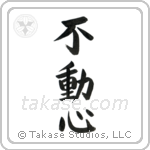
Abstract
不動心, fudōshin, three characters — not, move, heart — is a mind that nothing outside it can move, a spirit that does not waver. The phrase is Mencius's, from the fourth century BC, and it is in the Chinese Buddhist sutras by the turn of the fifth century AD; Yagyū Munenori, who made it the sword tradition's word in 1632, credits it to the buddhas, and an English–Chinese dictionary printed in Hong Kong in the 1860s set it beside apathy, which is how it came to stand in Japanese for the Stoic ἀπάθεια. The sources that explain the word keep refusing the reading that it means being like a stone: Mencius, Munenori, the Zen priest Takuan, whose own word is a different one, a Meiji judo teacher who would have renamed it a movable mind, and D. T. Suzuki. Others took the stone reading at its word, and an 1887 manual of jūjutsu calls its method for a steady mind a stone tied to it as a weight.
Overview
The sense. A mind that nothing outside it can move; a spirit that does not waver. Of the dictionaries at kotobank, デジタル大辞泉 carries 不動心 as its own entry, and it is brief: 他によって動かされることのない心。動揺することのない精神 — a heart not moved by anything outside it; a spirit that does not waver [1]. The 精選版 日本国語大辞典 at kotobank has no entry for the compound [1].
The words. 不 (fu) is the negative: not. 動 (dō) is to move. 心 (shin) is the heart, the mind, the spirit — one word in Japanese for all three. Together, the mind that does not move. The 精選版 日本国語大辞典 does define the first half: 不動 in the sense of a settled conviction is attested in Kūkai's collected writings by 1079, and in Dōgen's Shōbōgenzō between 1231 and 1253 in the sense of a thing that simply does not move [2].
The text in English. JMdict gives two senses: imperturbability, steadfastness, and — marked as martial arts — a cool head in an emergency, keeping one's calm [3]. The house's title, Steadfast, is the first of those word for word.
The historical record
Fourth century BC, Mencius, Gongsun Chou I. In one of the most famous passages in the book, the disciple asks whether high office would perturb his master's mind. Mencius answers: 「否。我四十不動心。」 — No. At forty, I attained an unmoved mind. James Legge, translating in 1861, gave it as an unperturbed mind [4][5]. What follows matters, because it is the whole meaning of the phrase and almost nobody carries it forward. The disciple asks whether there is a way to such a mind. Mencius weighs two kinds of courage — one man who flinched at nothing, another who simply had no fear — and sets above both the courage of Zengzi: if on self-examination I find I am upright, I will go against thousands. Then he names what he is actually good at: nourishing the vast, flowing 氣, which he says is supremely great and supremely strong, is grown by accumulated right action and not seized by an occasional one, and is ruined by forcing. The chapter ends with the farmer of Song who pulled up his seedlings to help them grow, and killed them. So the founding text does not describe a still mind. It describes a mind that cannot be moved because of what has been put under it — and it names the failure as forcing, not as agitation.
The turn of the fifth century AD, the Buddhist sutras in Chinese. The same three characters are in the sutras as they were put into Chinese. The Madhyama Āgama, translated in the Eastern Jin between 397 and 398, describes the mind made pure by concentration, pliant and well settled, and says that it gains the unmoved mind, 得不動心 [6]. The Avataṃsaka Sūtra, translated between 418 and 420, gives the bodhisattva ten ways of raising it: 菩薩摩訶薩有十種發不動心 [7]. So the phrase has a second root beside Mencius's, and it is the one Munenori would name.
In Japan, the Chinese books. In Japan the phrase is read first in Chinese books, the Confucian classics and their commentaries and the Buddhist canon, and the Meiji school editions of the Four Books, printed with Japanese reading marks, carry the Mencius line into the classroom [8].
About 1367, a commentary on The Tale of Genji. Japanese prose meets the phrase as a gloss. 四辻善成's 河海抄, which the dictionary dates to about 1367, explains the word いはき in The Tale of Genji two ways. One is wood and stone, which feel nothing, with Bai Juyi's line that people are not wood and stone, 人非木石皆有情; the other, his own proposal, is 磐城, a rock fortress, and of that reading he writes: 「若此儀か不動の心也」 — perhaps this is the sense: an unmoved heart [9]. The commentary of 能登永閑, 万水一露 (1545 by the dictionary; read in its print of 1663), copies the gloss in three characters: 「若此義歟不動心也」, and records 一条兼良's commentary of 1472 rejecting the rock-fortress reading [10]. It is a gloss on a native word, not yet a word anyone uses of a person.
1632, Yagyū Munenori's Heihō Kadensho. The sword tradition's 不動心 is Munenori's, and it is in his own book, the sword manual he completed in 1632 [11][12]. It uses it twice. The first time he is discussing no-mind, and he says: 「諸佛の不動心といへる事、實に殊勝に覺ゆ」 — this thing called the fudōshin of the buddhas strikes me as truly excellent. Note where he thinks it comes from: the buddhas, not Mencius, and the sutras bear him out. The second time he is explaining footwork, and someone is flicking a fan at a man's eyes:
「不動心と云は常のごとくにして、目のあたりへ物がくれば、何となく目まぢする也、是が動轉せぬ位也 … うごくまいとするは、うごいたる物也、うごくはうごかぬ道理也、水車はめぐるが常也、めぐらずは常にたがふた者也、人の目まぢは常也、目まぢせぬは心がうごくなり」
What is called fudōshin is being just as you always are: when something comes at your eyes, you blink without thinking about it, and that is the state of not being shaken. … Trying not to move is itself having moved. Moving is the principle of not moving. A waterwheel's normal condition is to turn; not turning is what departs from normal. A man's blink is normal; not blinking means the mind has moved.
The man who did not blink is the one who has been rattled. That is the tradition's own definition, in the tradition's own book, and it is the opposite of what the English word immovable suggests [11].
About 1638, Takuan Sōhō, the Fudōchi Shinmyōroku. Takuan's word is a different word, and this is where the internet gets it wrong. The Zen priest wrote a famous letter to Munenori on swordsmanship and Zen, which the national dictionary dates to about 1638, after Munenori's book — and his term is 不動智, immovable wisdom, not 不動心 [13][12]. In the Diet Library's full-text search of two printings of the letter, 不動智 occurs throughout and 不動心 not once. He heads his definition 「諸佛不動智と申す事」, the thing called the immovable wisdom of the buddhas, and the definition is worth having beside Munenori's:
「不動とは、うごかずといふ文字にて候。智は智慧の智にて候。不動と申し候ても、石か木かのやうに無性なる義理にてはなく候。向ふへも左へも右へも、十方八方へ心は動き度きやうに動きながら、卒度も止らぬ心を不動智と申し候。」
Fudō is the character meaning does-not-move. Chi is the chi of wisdom. But when I say fudō, I do not mean being insentient like a stone or a tree. The mind moves as it pleases — ahead, to the left, to the right, in all ten directions — and never stops for an instant: that is what I call fudōchi.
He takes the word from the deity Fudō Myōō, the Immovable Wisdom King, and says that what does not move in him is the place in a person's one mind that does not move — and that not moving means not sticking. He also names Mencius in the same letter, for another phrase: 「求放心と申すは、孟子が申したるにて候」, seeking the strayed mind is what Mencius said [13]. The sword-Zen tradition was reading the book the phrase came from, even while thinking of the phrase as Buddhist.
By 1770, a manuscript on iai. A text on drawing the sword, with a colophon of autumn 1770, in the manuscript いなくき, ties the word to the Supreme Ultimate, 太極: 「太極は元来動ぬ物ゆへ術の不動心の工夫は太極の工夫なり」 — since the Supreme Ultimate is by nature unmoving, the practice of fudōshin in the art is the practice of the Supreme Ultimate. A note added in red ink gives the account of iai to 伊澤十郎左衛門 [14].
1836 to 1872, a popular novel. In いろは文庫, a long retelling of the Chūshingura in the colloquial of late Edo, a character says that however weak a man was born, once his training has built up and his 不動心 sits firm, 「どんな大敵に捕かこまれても恟ともする物じやアない」 — surround him with any great enemy and he will not flinch. The part is the tenth, written by the second Tamenaga Shunsui, and is read here in its printing of 1883 [15].
1887, a manual of jūjutsu, sword and staff. The martial reading is built in the Meiji and Taishō presses, and it fuses the two words. An 1887 manual says 「唯其動心ヲ押鎭ムルアリ之ヲ鎭ムレハ乃チ素ノ不動心ナリ」 — there is only the suppressing of the moved mind; suppress it and you have the original fudōshin — and it names its method for doing so 附石, a stone tied on: 「附石トハ心ノ重リニ附シタル石ト云義ナリ」, a stone fixed to the mind as its weight [16]. That is the frame Munenori refuses, in the manual's own image.
1866 to 1883, the English–Chinese dictionaries. Beside all of that, the three characters became a translation word, and they came into that role from Hong Kong. W. Lobscheid's English and Chinese Dictionary, published there in four parts between 1866 and 1869, gives under Apathy, want of feelings, a row of Chinese renderings with 不動心 among them [17]. Japanese editions followed. 永峰秀樹's 華英字典 of 1881 puts 不動心 under Equanimity [18], and 井上哲次郎's revision of Lobscheid in 1883 keeps it under Apathy and gives 不動心的 under Apathetic [19].
1905, a judo primer. By 1905 a judo primer can say that what the jūjutsu men call fudōshin, or no-self and no-mind, is nothing other than the mind's true body — and then refuse the word: 「不動心と云ふよりは寧ろ易動心と稱する方適當なるに似たり」, it would seem more fitting to call it not an unmoved mind but an easily moved one, because a mind fixed on one point cannot turn when it must [20]. Its author, Arima Sumitomo, put the same argument into his own English three years later: the fudo-shin, or immovable mind, is rather a misnomer. It would be far better to say, a movable mind [21].
1905, a Dictionary of Philosophy, and 1907, a self-cultivation book. In 1905 朝永三十郎's Dictionary of Philosophy makes the Stoic sense a headword: 「不動心。希 Ἀπάθεια. 獨、佛 Apathie. 英 Apathy.」 It explains the Greek, notes that some translate it 無情, and describes the Stoic sage, who lives by reason and is not moved by anything outer things do to feeling: 「斯る狀態は即ち不動心也」, such a condition is fudōshin [22]. The entry's sentences travel. 加藤咄堂's self-cultivation book of 1907 repeats one of them almost word for word [23], and a kanji dictionary of 1910 condenses another into its definition: 「外物が感情に及ぼす影響に動かされざる理性の生活」, a life of reason not moved by the influence outer things have on feeling [24]. The 1907 book also shows the word's lives side by side on three facing pages: first the mind past praise and blame, 「これをこれ不動心といふ」; then the Stoics, 「此に云ふ所の不動心とは彼のストア派の……アパタイアと略ぼ同義にして」, the fudōshin we speak of here is much the same as the Stoics' apatheia; and then Takuan's definition of 不動智, quoted at length under its own name [23]. That mixture, not the martial sense alone, is what the word is in Japanese print. In the Diet Library's full-text index, classified by title, the Confucian-flavored books that use it outnumber the budō books ten to one [8].
1917, a kendo handbook. A 1917 kendo handbook welds the two words outright: 「是レ之ヲ寂然タル不動心ト謂フ。佛法ニ所謂不動明王ノ智ナリ」 — this is what we call the still fudōshin; it is what Buddhism calls the wisdom of Fudō Myōō [25].
1925, a history of kendo. In 1925 a history of kendo prints the sentence the whole internet now repeats: 「武藏の所謂平常心、澤庵禪師の所謂不動心」 — Musashi's so-called everyday mind, Takuan's so-called fudōshin. Both attributions are wrong, and both are a century old [26].
1938, a schoolbook. One 1938 schoolbook is the strangest witness of all. A judo textbook for Toyama prefecture's schools gives 不動心 a section of its own, in a chapter of the same name. It defines it as 「心が清明で氣が總身に滿ち、如何なる事の變にも驚き懼れない心膽を以て、身體を働かせ技術を驅使する大丈夫の心」 — the mind of a great man, clear and bright, his 氣 filling his whole body, who works his body and drives his technique with a courage that no turn of events can startle; it says 「不動心は又勇の一つである」, fudōshin is also a form of courage; and it gives three rules for cultivating it: 「一、成功を豫期せざること。二、心に忘却せざること。三、他力を加へて助長せざること。」 — do not anticipate success; do not let the mind forget it; do not add outside force to help it along [27]. Those three are Mencius, clause for clause, from the very passage where the phrase was born — do not aim at it, do not forget it, do not help it grow — together with his supremely great and supremely strong, nourished by uprightness and unharmed, which the book gives as 氣を害する事なく至剛に養ふ. Mencius is not named in the chapter, and the Diet Library's full-text search does not find his name anywhere in the book. Twenty-three centuries of carriage, the cargo intact and the label lost.
1973 to 2025, the postwar Japanese record. A Daitoku-ji priest ran a popular series of books on it from 1973. In 1985 the Meditations of Marcus Aurelius appeared in Japanese under the title 『不動心』 — the Stoic strand surfacing as a book cover. In February 2007 the baseball player Hideki Matsui published a memoir under the same title. A shōgi grandmaster wrote Win! Fudōshin in 2010, and a 2012 business book teaches fudōshin and heijōshin together. In 2025 a report on the Honinbō go title match said simply: cornered, and still fudōshin [28]. Scholars keep both roots open: a 2014 paper asks whether nirvāṇa is apatheia, and a 2024 paper follows Mencius's at forty, an unmoved mind into Song and Yuan Daoist thought [29][30].
The word in English
1861, James Legge's Mencius. There is one English lineage that nobody joins to the others: Legge's unperturbed mind of 1861, for the Mencius line [5].
1908 and 1913, the judo and jūjutsu books. The romanized word is in English print by 1908. Arima's Judo: Japanese Physical Culture, published in Tokyo that year, calls fudo-shin one of the cant phrases of jujitsu men and proposes a movable mind instead [21]. In 1913 E. J. Harrison's The Fighting Spirit of Japan quotes a writer on jūjutsu — Imperturbability of mind in an emergency is called fudoshin — and prints a jūjutsu creed: I have no castle; I make fudoshin … my castle [31]. Arima's of 1908 is the earliest known English printing of the word [21][32].
1959, D. T. Suzuki, Zen and Japanese Culture. Suzuki discusses the word as Munenori's. He writes of the swordsman who has no thought of life and death:
"His is 'immovable mind' (fudō-shin). The fudō-shin is like the moon reflected in the stream. The waters are in motion all the time, but the moon retains its serenity. The mind moves in response to the ten thousand situations but remains ever the same."
Two things are worth noticing on that page. Suzuki gets the attribution right — he credits Munenori, not Takuan. And he immediately heads off the misreading: a reader might imagine, he says, that Munenori "wishes us to be reduced to a stage of mental atrophy or imbecility. But the fact is far from this." The phrase is not in his earlier 1938 book on the same subject; it enters his English with the 1959 expansion [33][34].
1985 to 2005, the translators, and the dojo. The romanized fudoshin, which is how the English-speaking world writes it, is in none of the scholarly translations. Hiroaki Sato, who translated Munenori's book — the one text that actually contains the word — renders it immovable mind — someone with an "immovable mind" will blink, unthinking — and never romanizes it [35]. William Scott Wilson's translation of Takuan [36], Thomas Cleary's [37], and Nobuko Hirose's Immovable Wisdom [38] carry immovable wisdom and fudōchi, and none of the four carries fudoshin. The romanized word came in through the judo and jūjutsu books and stayed in the dojo, not with the translators: it is thick in the martial-arts trade literature from the 1980s on, and the Internet Archive holds it in some five hundred books [32].
1935, a Greek novelist. Nikos Kazantzakis heard the word on a Japanese steamer in 1935, from an old man who told him, as a 2020 study reports it, that it was a Japanese word and no other language had it. He used it in his book of travel in Japan and China and in The Rock Garden, a novel he wrote in French in 1936; and in Zorba the Greek he glosses it with the Greek: 不動心 is ἀπάθεια and ἀταραξία [39]. So the word the old man said no other language had came back to the Greek of the Stoics.
Today. Immovable is a good gloss for the character and a poor one for the word. It recruits the reader's first guess, the one most of the sources push away. Steadfast, JMdict's first word, does not: a person can be steadfast at a run. What the word names is not stillness but the absence of a snag — the mind free to go anywhere and stuck nowhere, which is why the man who does not blink is the one who has been rattled.
What is not a source. Takuan did not write 不動心 [13]. He wrote 不動智, and the two are different words in his own text; the attribution to him is Japanese, and its earliest known printing is the kendo history of 1925 [26], not an English one. It is not a yojijukugo: it has three characters, and it is not in the idiom dictionaries. It is not primarily a karate word, whatever the English internet suggests. Both pre-war karate books in the Japanese public-domain corpus, four kendo manuals of 1922–41 and two judo books use it zero times [40]. The word is well attested in pre-war martial print; it is not universal in it.
A reading
Mencius builds this mind out of accumulated right action and warns that forcing it kills it. Munenori says trying not to move is having moved, and that a waterwheel which stops turning has betrayed its own nature. Takuan says it is not being insentient like a stone or a tree. Arima, teaching judo in 1905, says the word itself misleads and would call it a movable mind. Suzuki, handing it to English, stops to say he does not mean mental atrophy. They write across twenty-three centuries and from different traditions, and each of them takes the trouble to refuse the same reading. That reading is not only a modern guess. The Genji commentators reached for an unmoved heart beside wood and stone, the 1887 manual tied a stone to the mind, and the Stoic word the dictionaries matched it with is apathy. The refusals are an argument with something real.
And it belongs to several traditions, not one. Offered as a martial-arts term alone it is a part of the word; the phrase was old in two canons when Munenori took it up, and a Hong Kong dictionary handed it to the Stoics. It fits a sensei, and it fits a person who has been through something and did not bend, and those are not the same gift.
Notes
Fudōshin, with the macron, is the reading standard throughout.
References
- 「不動心」, デジタル大辞泉 · 精選版日本国語大辞典 (no headword for the compound), at kotobank. https://kotobank.jp/word/不動心
- 「不動」, 精選版日本国語大辞典, at kotobank. https://kotobank.jp/word/不動
- JMdict (EDRDG), 「不動心」, at jisho.org. https://jisho.org/api/v1/search/words?keyword=不動心
- 孟子, 公孫丑上, fourth century BC, at ctext.org. https://ctext.org/mengzi/gong-sun-chou-i
- James Legge, trans., The Chinese Classics, vol. II, The Works of Mencius, 1861, 公孫丑上, at ctext.org and the Internet Archive. https://archive.org/details/india.history.resource.71136
- 中阿含經, trans. 瞿曇僧伽提婆, Eastern Jin, 397–398, Taishō 26, vol. 1, 553b05, at CBETA. https://cbdata.dila.edu.tw/stable/lines?linehead=T01n0026_p0553b05
- 大方廣佛華嚴經, trans. 佛馱跋陀羅, Eastern Jin, 418–420, Taishō 278, vol. 9, 640c16, at CBETA. https://cbdata.dila.edu.tw/stable/lines?linehead=T09n0278_p0640c16
- National Diet Library Digital Collections, next-generation full-text search on 不動心, 2,351 books (362 classical), walked to 2,319 and counted by decade and by genre. https://lab.ndl.go.jp/dl/
- 四辻善成, 『河海抄』, manuscript, undated (the work about 1367, デジタル大辞泉 at kotobank), scan 15. https://dl.ndl.go.jp/pid/2570933/1/15 · https://kotobank.jp/word/河海抄
- 永閑, 『万水一露』, 村上平楽寺, 寛文3 (1663) (the work 1545, デジタル版 日本人名大辞典+Plus at kotobank, 能登永閑), scan 40. https://dl.ndl.go.jp/pid/2567507/1/40 · https://kotobank.jp/word/能登永閑
- 柳生宗矩, 『兵法家伝書』, 1632, in 福井久蔵編『秘籍大名文庫』第2, 厚生閣, 1937, scan 21 · scan 26. https://dl.ndl.go.jp/pid/1074542/1/21 · https://dl.ndl.go.jp/pid/1074542/1/26
- 「兵法家伝書」 (日本大百科全書: 1632) · 「不動智神妙録」 (精選版日本国語大辞典: 寛永一五年頃成立), at kotobank. https://kotobank.jp/word/兵法家伝書 · https://kotobank.jp/word/不動智神妙録
- 沢庵宗彭, 『不動智神妙録』, in 『秘籍大名文庫』第2 (1937), scan 53–54 · 62, and in 後藤亮一編『禅門法語全集』第1巻 (1921), scan 15–16. https://dl.ndl.go.jp/pid/1074542/1/53 · https://dl.ndl.go.jp/pid/1074542/1/62 · https://dl.ndl.go.jp/pid/968098/1/15
- 『いなくき』, manuscript, the iai text with its colophon 明和庚寅之秋 (1770), scan 51. https://dl.ndl.go.jp/pid/2566465/1/51
- 為永春水, 『いろは文庫』第10編, 北村孝次郎ほか, 明治16 (1883), scan 41; the work 1836–72 and the later parts by the second Shunsui, デジタル大辞泉 at kotobank. https://dl.ndl.go.jp/pid/877741/1/41 · https://kotobank.jp/word/いろは文庫
- 井口松之助, 『柔術剣棒図解秘訣』, 魁真楼, 明治20 (1887), scan 20. https://dl.ndl.go.jp/pid/860046/1/20
- W. Lobscheid, English and Chinese Dictionary, with the Punti and Mandarin Pronunciation, Hong Kong, Daily Press Office, 1866–1869, Part I, p. 67 (Apathy), at the Internet Archive. https://archive.org/details/englishchinesedi00lobsrich/page/n110
- 永峰秀樹訳, 『華英字典』, 竹雲書屋, 明治14 (1881), scan 57 (Equanimity). https://dl.ndl.go.jp/pid/869221/1/57
- 羅布存徳原著, 井上哲次郎訂増, 『英華字典』, 1883, scan 26, p. 44 (Apathetic, Apathy). https://dl.ndl.go.jp/pid/994614/1/26
- 有馬純臣, 『柔道大意』, 岡崎屋, 明治38 (1905), scan 25, pp. 24–25. https://dl.ndl.go.jp/pid/860055/1/25
- Sumitomo Arima, Judo: Japanese Physical Culture, Tokyo, Mitsumura, 1908, p. 33.
- 朝永三十郎, 『哲学辞典』, 宝文館, 明治38 (1905), scan 169, p. 321. https://dl.ndl.go.jp/pid/752945/1/169
- 加藤咄堂, 『人格の養成』, 東亜堂, 明治40 (1907), scans 68–69, pp. 123–125. https://dl.ndl.go.jp/pid/757256/1/68 · https://dl.ndl.go.jp/pid/757256/1/69
- 古川喜九郎編, 市村瓚次郎閲, 『熟語集成漢和大辞典』, 六盟館, 明治43 (1910), scan 32. https://dl.ndl.go.jp/pid/862961/1/32
- 児玉市蔵, 『剣道の栞』, 1917, scan 13. https://dl.ndl.go.jp/pid/948613/1/13
- 下川潮, 『剣道の発達』, 大日本武徳会, 1925, scan 189. https://dl.ndl.go.jp/pid/1017872/1/189
- 富山県学校武道研究会, 『学校柔道』, 1938, scans 89–91, pp. 154–158. https://dl.ndl.go.jp/pid/1457466/1/89 · https://dl.ndl.go.jp/pid/1457466/1/91
- National Diet Library catalogue, title search on 不動心, 121 records. https://ndlsearch.ndl.go.jp/
- 「「涅槃」(ニルヴァーナ)は「不動心」(アパティア)か」, 2014, at CiNii Research. https://cir.nii.ac.jp/crid/1520572358028108032
- 山田俊, 「宋元道家思想と『孟子』「四十不動心」句」, 熊本県立大学共通教育センター紀要, 2024. https://pu-kumamoto.repo.nii.ac.jp/records/2000746
- E. J. Harrison, The Fighting Spirit of Japan, London, T. Fisher Unwin, 1913, pp. 51, 167.
- Internet Archive full-text search, dated hits for the romanized fudoshin, some five hundred books. https://be-api.us.archive.org/ia-pub-fts-api
- D. T. Suzuki, Zen and Japanese Culture, Routledge, 1959, pp. 147–149, at the Internet Archive text layer. https://archive.org/details/in.gov.ignca.16794
- D. T. Suzuki, Zen Buddhism and Its Influence on Japanese Culture, 1938, which does not carry the phrase, at the Internet Archive text layer. https://archive.org/details/zenbuddhismitsin0000dais
- Hiroaki Sato, trans., The Sword and the Mind, Barnes & Noble, 1985.
- William Scott Wilson, trans., The Unfettered Mind: Writings from a Zen Master to a Master Swordsman, Kodansha, 1986.
- Thomas Cleary, trans., Soul of the Samurai, Tuttle, 2005.
- Nobuko Hirose, trans., Immovable Wisdom: The Art of Zen Strategy, Element, 1992, at the Internet Archive. https://archive.org/details/immovablewisdoma0000unse
- 福田耕佑, 「カザンザキス文学における日本描写 : 「心」、「桜」、「富士山」、「不動心」理解を中心に」, Propylaia 26, 2020, § 5.3 and note 92. https://hiroshima.repo.nii.ac.jp/records/2014737
- National Diet Library Digital Collections, presence test on 不動心 across eight pre-war martial-arts books (Funakoshi 1922, Motobu 1926, four kendo manuals 1922–41, two judo books), zero hits in each. https://lab.ndl.go.jp/dl/