

我事に於て後悔せず · ware koto ni oite kōkai sezu · In what I do, I do not regret
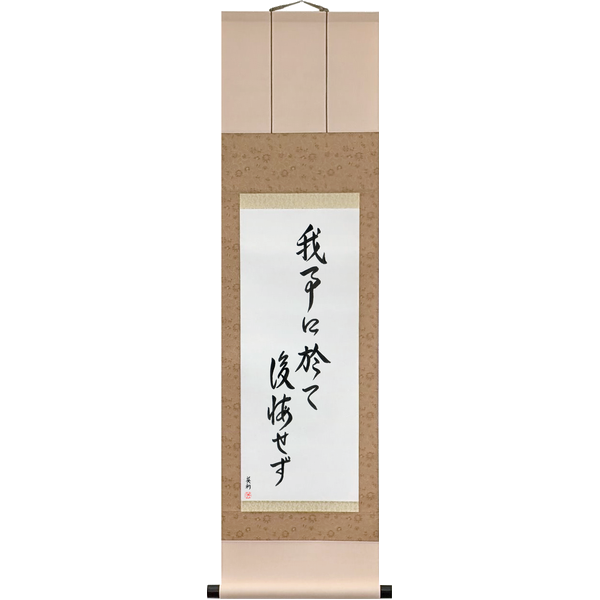
Sold as Do Not Regret What You Have Done · Read ware koto ni oite kōkai sezu · Oldest witness Miyamoto Musashi's own sheet, the 独行道, The Way Walked Alone, dated the twelfth day of the fifth month of 1645 and held by the Kumamoto Prefectural Museum of Art · Sense one article of a dying swordsman's account of his own conduct, written in the first person to one pupil; the English tradition turned the vow into a command, and the scroll's title is that tradition's.
The words
Seven characters and two kana, and the grammar is the whole story. 我事 is my affairs, what I myself do, with the genitive dropped in the written Edo manner. に於て is in, as regards; the manuscript, as transcribed, writes the particle in kana with the historical spelling, 尓おゐて, the same word. 後悔 is regret after the fact. せず is does not, and the manuscript has the object marker before it, 後悔をせず, does no regretting. Every one of the twenty-one articles on the sheet ends the same way, in the negative of something the writer does not do: 世々の道をそむく事なし, I do not turn from the way of the generations; 身尓たのしみをたくま[ず], I do not contrive pleasures for myself; 常尓兵法の道をはなれ[ず], I never leave the way of strategy. They are one man's statements about himself, dated, signed and sealed, and handed to one person. Nothing in the grammar is an imperative. The line as words: in what I do, no regret. The scroll writes the form the printed tradition has used since 1909, 我事に於て後悔せず, with 於 as a character and no を; the manuscript's kana particle is a fact of the sheet and not a different reading.
A history, from the earliest witness
1645. Miyamoto Musashi, 独行道, the autograph sheet. Twenty-one articles brushed on one sheet of paper, 16.8 by 97.3 centimeters, mounted as a hanging scroll, held by 熊本県立美術館 and designated a Kumamoto prefectural important cultural property. The colophon: 正保弐年 五月十二日 新免武藏 玄信(花押)「二天」(朱文額印) 寺尾孫之丞殿, the twelfth day of the fifth month of the second year of Shōhō, signed Shinmen Musashi Genshin with his cipher and a red seal reading 二天, addressed to his pupil Terao Magonojō. The sixth article, as the Japanese Wikisource transcription gives it: 一 我事尓おゐて後悔をせ[ず], the bracket the transcriber's on the last kana. By the received account Musashi died a week later, on the nineteenth of the same month; no source for the death date was opened, and the date on the sheet is what the sources opened give. [ja.wikisource.org/wiki/獨行道, under the traditional-character title, the shinjitai address not resolving; ja.wikipedia.org/wiki/独行道 for the holding and dimensions; text; the sheet itself not seen]
1909. The Miyamoto Musashi Memorial Society (宮本武蔵遺蹟顕彰会), Miyamoto Musashi, 金港堂. The earliest printed witness the National Diet Library's full-text search finds, and the form every later print follows. The biography opens with a character sketch and quotes the articles inside it: この人嘗て獨行道と稱し、自戒の文十九條を自署して云く, this man once wrote out under his own hand nineteen articles of self-admonition he called the Way Walked Alone, and among them 我事に於て後悔せず. It counts nineteen where the sheet's transcription has twenty-one, and its numbering at this article is itself unclear in the scan. What it makes of the list: 然れどもこの自戒の文を味はゞ、その心いかに潔く、いかに强く、いかに名利を厭ひ、いかに貪慾を惡みしかを知るべし, taste these articles and you will know how clean his heart was, how strong, how he shunned fame and profit and hated greed. [4]
1915 to the 1940s. The books on the sword, on Zen and on the soldier. From the memorial society's biography the line spreads through the Taishō and early Shōwa literature: Zen Talks for Swordsmen (剣客禅話, 1916), The Secret of the Martial Way (武道極意, 1925), Small Lessons for Soldiers (軍人小訓, 1927) and the rest, thirty-five books in the sweep, every one in the 於て spelling. Three books of 1926 to 1939 spell the particle out, 我事において後悔せず; none writes 於いて. [NDL pids 944046, 1018822, 1054744 among the 35; 913391, 1464684, 1262562 for the three; search snippets, OCR]
Today. No dictionary carries the line as a headword; the twenty-one articles are a text, not a proverb, and the Japanese reader meets them in editions of Musashi, and this history was written without one.
The sense across time
There is one sense, and it is a portrait rather than a maxim. The 1909 biographer reads the whole list as evidence of a character, and the article on regret is one item in that evidence: a man who says of himself that he does not look back. No Japanese commentary on the article itself was opened, and the two Japanese witnesses supply only the frame, which is the frame that matters: a swordsman near death, writing out his own way for one pupil. The mood has not changed in Japanese in three centuries. It changed in English.
What is not a source
The 1909 biography and the thirty-four books after it are one printed tradition descending from one sheet, not thirty-five witnesses to the text. The English lists of Musashi's twenty-one precepts that circulate on martial-arts and quotation sites are one witness however many pages repeat them, and none names its translator. The received story of Musashi's death a week after the sheet was not sourced here and is given as received.
The text in English
1974 and after. The translators, not opened. Victor Harris's translation of the Book of Five Rings (1974), which a search summary names as carrying the first full English 独行道; William Scott Wilson, The Lone Samurai (Kodansha International, 2004); Kenji Tokitsu, Miyamoto Musashi: His Life and Writings (translated by Kohn, Shambhala, 2004). Which of the three wrote the sentence on the scroll, or whether none did, is not known from anything opened for this history.
The circulating list. 6. Do not regret what you have done. Twenty-one lines in the imperative, on a martial-arts site with no translator credited, and the same twenty-one on every other page opened: Accept everything just the way it is; Never be jealous. Every one of the twenty-one first-person vows becomes a command in this list. [harmonybudo.com, the written-works page; text]
Today. The house title, Do Not Regret What You Have Done, is the circulating English word for word. It is the English tradition's choice and not the house's error, and what it does to the Japanese is plain: it makes an imperative of a vow. A rendering that kept the Japanese would keep the first person, In what I do, I do not regret, or more plainly I regret nothing I do.
A reading
The brushed form is the printed tradition's, and it is the right one for a scroll: it is what a Japanese reader has read since 1909, and it is the form thirty-five books carry. On the English, the honest translation is a vow, and a buyer who hangs Do Not Regret What You Have Done as advice is hanging what the English tradition made of Musashi, not what he wrote to his pupil. I would leave the title alone, because it is the sentence the buyer came looking for, and let this page say whose sentence it is. The romaji carries one macron, kōkai. Signed, 典, 2026-09-05.
How this was read
By text, at the address: the twenty-one articles and the colophon in the Wikisource transcription; the Japanese Wikipedia article for the sheet's date, holding and dimensions; the 1909 biography at one scan of the NDL page API; one uncredited web page carrying the English list; the catalogue rows. By search snippet only, not opened at the page: the thirty-four other books of the 於て sweep and the three of the において sweep. Not opened: the sheet itself, in the museum's photograph or facsimile, which would settle the count of articles, their order and the kana of this line; the 1909 scan as an image, which would settle whether nineteen is the print's or the OCR's; Harris, Wilson and Tokitsu at the article, which would say whose English the title is; any Japanese annotated edition of the 独行道; the live scroll page. Every address in this history is a text address except the three unopened translators, and a reader's AI can open the rest. The full apparatus, with every address, is in the account.
References
- The scroll (ours) (—) — S0021SSVB6A; cultural_works 979
- 独行道, Musashi's autograph, 熊本県立美術館, as transcribed (正保2 (1645), 5th month 12th day) — ja.wikisource.org/wiki/獨行道 (TEXT); the scroll not seen
- Japanese Wikipedia, 独行道 (current) — ja.wikipedia.org/wiki/独行道 (TEXT)
- 宮本武蔵遺蹟顕彰会 編『宮本武蔵』金港堂 (1909) — NDL pid 992019 koma 27, page API, OCR ↩
- 『剣客禅話』 · 『武道極意』 · 『軍人小訓』 and 32 others (1915–1940s) — NDL search, 35 books, snippets only
- three books (1926–1939) — NDL search, 3 books, snippets only
- — (—) — NDL search, 0 books