

生死有命富貴在天 · shisei mei ari, fūki ten ni ari · Life and death have their allotted span; wealth and rank rest with Heaven
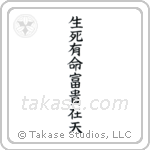
Sold as Death and Life Have Their Determined Appointments; Riches and Honors Depend upon Heaven · Read in Japanese shisei mei ari, fūki ten ni ari · Oldest witness the Analects, where a disciple quotes it as a saying he has heard; the scroll's word order is the one a Tang commentator used when he quoted the line, read here in two Edo printings of the 文選 · Sense how long you live and how high you rise are not yours to decide; so stop grieving over what you lack.
The words
Eight characters in two clauses of four. 死生 in the canon, 生死 on the scroll, are the same two characters, death and life or life and death; the canon's order is the older Chinese one and the scroll's is the compound Japanese and modern Chinese prefer. 有命, have their 命: 命 is the decree of Heaven, the lot one is given, and by extension one's span of life, which is why the Japanese reading says 命あり, have their allotted span, and why Legge, with a Calvinist ear, wrote determined appointment. 富貴 is wealth and rank together, the two things a man of the classical age wanted and could not command. 在天, rest with Heaven. The Japanese proverb form reads the line in kundoku: 死生命あり、富貴天にあり.
A history, from the earliest witness
The Analects, book 12, 顔淵, the passage on brothers. Not Confucius's words, and the page should not say they are. The disciple 司馬牛 grieves that everyone else has brothers and he alone has none, and 子夏 answers with something he has heard and then with his own consolation: 司馬牛憂曰:「人皆有兄弟,我獨亡。」子夏曰:「商聞之矣:死生有命,富貴在天。君子敬而無失,與人恭而有禮。四海之內,皆兄弟也。君子何患乎無兄弟也?」, Sima Niu said in his grief, "Other men all have brothers; I alone have none." Zixia said, "I have heard it said: death and life have their allotted span, wealth and rank rest with Heaven. If the gentleman is reverent and makes no slip, and is courteous and observes the rites with others, then all within the four seas are his brothers. What has the gentleman to fear from having no brothers?" The line is a proverb already when Zixia says it, 商聞之矣, I, Shang, have heard this, which is why the Japanese dictionaries call it 子夏のことば and none calls it Confucius's. An Edo print of the Analects carries the whole passage in the canon order with one variant in the last clause, 四海之内皆爲兄弟也 for the received 皆兄弟也. [ctext.org/analects/yan-yuan; text, with Legge's English on the same page. NDL pid 2574963, koma 9, an undated Edo print; OCR; text at lab.ndl.go.jp/dl/api/page/2574963_9]
The 文選 of the Liang, with Li Shan's Tang commentary, read in the printings of 1607 and 1625. 李康's essay 運命論, On Fate, in book 53 of the 文選, the anthology of 蕭統, quotes the line in its argument that the times, not merit, decide who rises: 子夏曰死生有命富貴在天, Zixia said: death and life have their allotted span, wealth and rank rest with Heaven, in the canon's order. The Tang commentator 李善's note on that sentence, printed in small double columns beneath it, cites the Analects, and cites it in the scroll's order: 善曰論語子夏曰商聞之生死有命冨貴在天, Shan says: the Analects, Zixia said, I have heard it, life and death have their allotted span, wealth and rank rest with Heaven. Both Japanese printings of the six-commentator edition, 1607 and 1625, print the main text with 死生 and the note with 生死, and they were read by eye for this, glyph by glyph on a crop, because the archive's OCR is known to shuffle the two runs and the account had held the note's order as unproven until the leaf was seen. So the scroll's order is not a modern slip: a Tang commentator wrote the line that way when quoting it, and every reader of the 文選 in Japan since the early Edo period has seen both orders on one leaf. Whether Chinese printings of Li Shan's note read the same was not checked; the claim is for the text as Japan received it. [3]
Fourteenth century, the 太平記, book 4, read in a printing of 1650. The line's Japanese life begins as a soldier's argument. 精選版日本国語大辞典 cites it as the first Japanese use, and the 1650 print of the chronicle has the speech: 只いたつらにごししよが死せん事を待ば死生命あり又は老少前後すごししよと我といつれをかさきとしる, if I merely wait idly for Wu Zixu to die: death and life have their allotted span, and old and young do not die in order; who knows whether Wu Zixu or I will go first? The speaker is arguing for attacking now rather than waiting for an enemy to die of age, and the line is his reason. Here the kundoku form 死生命あり is already the Japanese way to say it. [6]
1829. 浪化's haikai treatise 『俳諧正語抄』. A wanderer refuses to beg for his life: 曰死生命あり富貴天にあり人力の及ふ所にあらすされと妻子眷属のある身は残ての後悔を防んとほいなく命を乞求るもあらん我はしからす浮雲流水の孤客何の為に命を貪んや, he said: life and death have their allotted span, wealth and rank rest with Heaven, and human power does not reach them; a man with wife, children and kin might, against his will, beg for his life to spare those he leaves behind from regret; not I: a lone traveler of drifting cloud and flowing water, why should I covet life? The full pair in Japanese, used as a creed for facing death. [5]
Today. デジタル大辞泉, under the Japanese headword 死生命あり: 生死は天命によるもので、人の力ではどうすることもできない, life and death are Heaven's decree and beyond human power. 故事成語を知る辞典 reads the passage as consolation, そういうことで悩むのはやめよう、と呼びかけています, it is telling you to stop worrying over such things, and notes that the pair 富貴天にあり is often used with it. The canon order 死生有命富貴在天 is in some 250 digitized Japanese books to 1946; the scroll's order 生死有命富貴在天 in four; the Japanese form 死生命あり富貴天にあり in sixty. [6]
The sense across time
One sense, two uses. The sense is Zixia's: the length of a life and the height of a career are allotted, not earned, so a man should attend to what is his, reverence and courtesy, and let the rest go. The Chinese essay uses it to argue that fate, not merit, makes careers; the Japanese chronicle uses it to argue for acting now, since no one knows who dies first; the haikai master uses it to refuse to beg for his life. In Japan it became a proverb about facing death, not a proverb about money, which is what the page's footballer presumably meant by it.
What is not a source
The tattoo is not a source. The page says the design was taken from David Beckham's tattoo and correctly notes that the tattoo has 由 for the seventh character where the text has 在; the scroll has 在, so the scroll is the line and the tattoo is a copy of it with one wrong character. Wiktionary's listing of 生死有命 as an alternative form is a modern crowd entry and adds nothing to the two prints. 朱熹's Song commentary on the passage, the standard reading of 命 for every later East Asian schoolroom, was not opened.
The line in English
The house title is Legge's sentence, and Legge is the first witness.
1861. James Legge, The Chinese Classics, vol. 1, the Analects, as the Chinese Text Project prints it. Death and life have their determined appointment; riches and honors depend upon Heaven. Legge's determined appointment for 命 is the Calvinist word for a Confucian idea, and the house title keeps his sentence whole, as the Chinese Text Project prints it. [ctext.org/analects/yan-yuan; text; the printed page not opened]
Today. The house title is Legge's line; the page's romaji field is empty, and the Japanese reading shisei mei ari, fūki ten ni ari is the one to store, since that is how the line is read aloud in Japan. A rendering must keep both clauses as a pair, must keep 命 as an allotment rather than a plan, and must not call the line Confucius's.
A reading
The scroll sells eight characters in an order the canon does not use, and the honest history now says the order is older than the tattoo by more than a thousand years: a Tang commentator quoted the line that way, and two Edo printings of the 文選 put his 生死 six columns from the essay's 死生 on one leaf, which I read to be sure. The canon's order is still the received one and the counts say so. What the buyer should know is that the line is not Confucius's but a proverb his disciple quotes to console a man with no brothers; that in Japan it became a way of facing death, from a fourteenth-century soldier to an 1829 wanderer; and that the tattoo the page names has a wrong character the scroll does not. Romaji for the Japanese reading, shisei mei ari, fūki ten ni ari. Signed, 典, 2026-09-06.
How this was read
By eye, at the National Diet Library page images at width 3600 and on 2× crops: the 1607 and 1625 printings of the 文選 at the leaf, both runs. By OCR at the local harvest: the Edo print of the Analects, the 1650 print of the 太平記, the 1829 haikai treatise, and the heads of both 文選 volumes. By text at the address: the Analects with Legge at the Chinese Text Project; the kotobank page for the Japanese proverb, three dictionaries. Not opened: the 太平記 in a modern edition; a Chinese printing of Li Shan's note; 朱熹's commentary; Legge's printed page; the live product page. A leaf cited as pid P, koma N resolves as text at lab.ndl.go.jp/dl/api/page/P_N and as an image at dl.ndl.go.jp/api/iiif/P/R<N, seven digits>/full/3600,/0/default.jpg. The full apparatus, with every address, is in the account.
References
- The scroll (ours) (—) — S0018SSVB5A; cultural_works 977
- 論語 顔淵 (canon) — ctext (TEXT)
- 『文選』, Li Shan's commentary, 1625 printing (1625 (print)) — NDL pid 2544044 koma 18, OCR ↩
- 太平記 巻四 (14C) — 精選版日国, 初出; not opened
- 浪化『俳諧正語抄』 (1829) — NDL pid 2540297 koma 30, OCR ↩
- デジタル大辞泉 · 精選版日国 · 故事成語を知る辞典 (current) — kotobank 519827 ↩
- NDL corpus (to 1946) — counts