

常在戦場 · jōzai senjō · Always on the battlefield
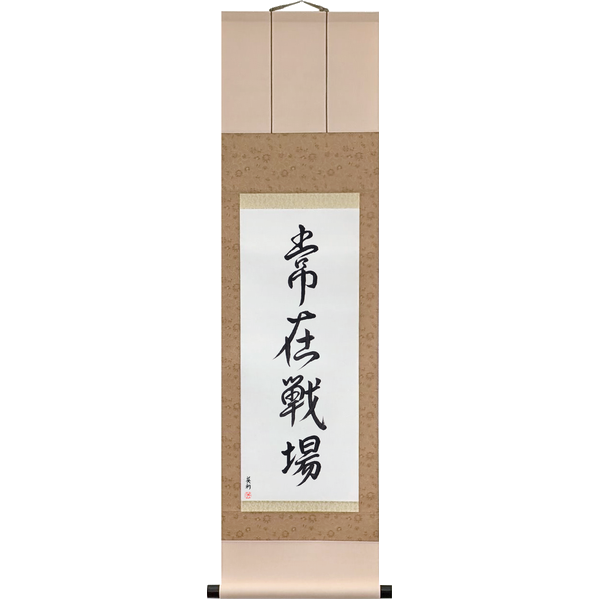
Sold as Always on the Battlefield · Read jōzai senjō, the Chinese reading of four characters that are a Chinese sentence · Oldest witness the 三國志, about the year 290, in the praise of a Wu general · Sense to live in peace with the readiness of a man in battle; the first rule of the 牧野 family, the creed of 長岡 domain for two and a half centuries, and the motto 山本五十六 brushed all his life.
The words
Four characters and one sentence: 常 always, 在 to be in, 戦場 the battlefield. The old books write 戰場 or 戰塲, and the modern 戦 is the form Eri brushes; the reading is the Chinese one throughout, jōzai senjō, and the one time the phrase was turned into Japanese it became a poem, 戰の庭にあるぞと常にただ思ふ心をたもて武士, keep a heart that thinks, always and only, "I am on the field of battle": that is a warrior. The dictionaries define it as a precept, act always with the readiness of one on a battlefield, and that is what it has meant at every witness; what changed was who was being told, a general's soldiers, a family's sons, a domain's samurai, a navy, a nation.
A history, from the earliest witness
About 290, 陳壽, 三國志, the Book of Wu, chapter 56, the biography of 朱然, read at the Chinese Wikisource transcription and in an 1885 Japanese typeset. 朱然 (182–249) held 江陵 for 孫權 against the Wei; the historian's closing appraisal of him is where the four characters stand. 然長不盈七尺,氣候分明。內行修潔,其所文采,惟施軍器,餘皆質素。終日欽欽,常在戰場,臨急膽定,尤過絕人。雖世無事,每朝夕嚴鼓,兵在營者,咸行裝就隊。以此玩敵,使不知所備,故出輒有功: He was under seven feet tall, his bearing clear and sharp. His private life was clean; the only ornament he allowed was on his weapons, and all else was plain. All day long he was watchful, as if always on the battlefield; in a crisis his nerve held, far past other men. Though the world was at peace, morning and evening he had the drums beaten, and every soldier in camp fell in dressed for battle. With this he confounded the enemy, who could not tell what he was preparing for, so that whenever he marched he won. The four characters are a description of a habit, not yet a maxim, and the Qing rhyme dictionary 佩文韻府 indexes the passage under 戰場, which is how an Edo reader would have found it as a phrase. [3]
The sixteenth century by tradition, the 牧野 family's wall-text from 牛久保 in 三河, read in the 1931 history of 長岡 city. The 牧野 held 牛久保 castle between the 今川, the 武田 and the 徳川, and a list of house rules called the 參州牛久保之壁書, the wall-text of 牛久保 in 三河, is the family's own account of what that made of them. Its first article is the four characters: 一常在戰塲の四字, item: the four characters "always on the battlefield". Then 弓矢御法と云ふ事, the way of bow and arrow; 禮義廉恥と云ふ事 (古語之由), propriety and shame, an old saying; the etiquette of attendance, of the saddle, of the road, of greeting the old, of the seat, of the eye and the hand; how to take a man who has barricaded himself, how to witness a seppuku and how to second one; 貧は士之常と云ふ事, poverty is the samurai's normal state; a samurai's manners bear on his lord's reputation; 百姓に似る共、町人に似るな, be like a farmer if you must, never like a townsman; 鼻は欠とも、義理は欠な, lose your nose before you fail a duty. Eighteen articles in the city history and in the 1931 biography of 河井継之助, which adds the family's own note that the retainers of the old lords held it in high regard, acted on it in all things and taught it to their sons; twenty-seven in two books of 1944. Its date is a guess in every witness, probably of the time of 牧野成定 (1525–1566), the grandfather of the first lord of 長岡. No manuscript was opened; none is in the National Diet Library's digital index. [5][6][8]
The eighteenth century, 高野常道, 昇平夜話, read in the 1923 edition. The 牧野 came to 長岡 in 1618 and the phrase became the domain's word for itself. 高野常道, called 餘慶, the domain's scholar, tutor to the ninth lord and, by a 1944 biographer's reckoning, an ancestor of 山本五十六 five generations back, wrote a book of Talks in Peacetime on why samurai go broke, and the four characters are his answer three times. 何程靜謐安泰の御代たりといへ共、武士の生立、本は貴賤上下を嫌ず、常在戰場と云文字を常に心頭に挾で身の榮耀を好ず、質素を宗とし: however calm and secure the age, a samurai is raised, high or low, to keep the characters "always on the battlefield" at the front of his mind, to take no pleasure in show, and to make plainness his rule. Debt comes when men rest in the long peace and forget the household teaching of 常在戰場. And he describes the cure: a camp-hut meeting every summer, a day of marching in armor, mounting, shooting, taking heads, and eating brown rice with miso in a tent, its purpose being that the samurai not forget the sense of 常在戰場. [9]
1787, 牧野忠精, the ninth lord, a dream and a poem, read in the 1915, 1917 and 1930 printings. On the second night of the first month of 天明 7 the lord dreamed he rode out to battle and came home to the rising sun. He wrote it down: 覺めてつらつらおもふ、かゝる事はゆめにしも限らじ、もののふたらんものは、常在戰場と云ふ心をこそ、しばしも忘るまじき事ぞ, waking, I thought it through: such a thing need not be only a dream; one who would be a warrior must not for a moment forget the heart called 常在戰場, and made the poem: 戰の庭にあるぞと常にただ思ふ心をたもて武士. It is the one Japanese sentence the four characters have ever been turned into, and the Nagaoka historian who printed it in 1915 adds: 『常在戰塲』との一語は、長岡武士の一信條なりしなり, the single phrase 常在戰場 was the one creed of the Nagaoka samurai. [10][10][10]
1938 to 1944, the war. Before 1915 no Japanese book in the National Diet Library's index prints the four characters; from 1938 they are everywhere. A publisher's blurb for wartime-system editions says the nation needs the vigor of 常在戰場 (eight books, 1938–41); a factory directory lists a company whose factory spirit is always on the battlefield; the commentary on the mobilization law, the judo hall's history of 嘉納治五郎, the Ministry of Education's readers. In 1943, after the admiral's death, the navy minister 米内光政 dictated a book titled 常在戦場: his forty years in the navy were from first to last one 常在戰場 spirit, and its editor lists the phrase among the elements of the 山本 spirit to be pressed on a hundred million people. The 1944 textbook explains where he had it: 山本五十六元帥は中學生時代からこの言葉を好み、後年揮毫するにもよくこの四字を以つてした, the admiral liked the phrase from his middle-school days and in later years often brushed these four characters, from the head of the old Nagaoka domain's precept, and it prints the poem, wrongly, under the founder 忠成's name. [13][12]
Today. 大辞泉: いつでも戦場にいる心構えで事をなせという心得を示す語, a term for the precept that one should act always with the readiness of one on a battlefield; no source, no date. JMdict enters it as a yojijukugo, being combat ready at all times. Neither names the 三國志, the 牧野, or the admiral. [kotobank; JMdict.]
The sense across time
One sense, from the Wu camp to the naval air station: readiness in peace, kept by discipline of the body and plainness of life. 陳壽 praises it in a general; the 牧野 rule it for their sons; 高野 makes it the cure for debt and drills it in a tent once a year; 忠精 dreams it; the admiral brushes it; the state prints it on everything. The phrase never meant war for its own sake. In every Japanese witness it is said of peace, and about what peace does to men who forget.
What is not a source
The 1944 textbook sets the phrase beside the 葉隠's 常住死身, to live as one already dead, and a 1944 Confucian daily-reader beside the proverb 油断大敵; those are neighbors on a page, not origins. The budō reception in English (below) attaches the phrase to 中山博道 and to 船越義珍; no Nagaoka witness mentions either, and the Nagaoka line does not run through them. The phrase is not in the Chinese classics as a maxim; it is a clause of one biography, and its life as a motto is Japanese.
The text in English
No Meiji dictionary opened enters it, and the American proverb collections have no place for it. 2001, John Stevens, Budo Secrets: Teachings of the Martial Arts Masters, Boston, Shambhala, ISBN 1570624461. A calligraphy of the four characters by the kendō master 中山博道, captioned Jozai Senjo, "Always Present on the Battlefield", and, of the karate founder 船越義珍, his personal motto was jozai senjo, "Always present on the battlefield of life, ready …". [snippet.] 2010, Denny Holzbauer, Truth for Fighters, ISBN 9781891116162. ALWAYS PRESENT ON THE BATTLEFIELD, with a section on its history. [snippet.] 2011, Takashi Inoguchi and Purnendra Jain, Japanese Politics Today, Palgrave Macmillan, ISBN 9780230117969. Of Diet members and their districts: they say "we are always on the battle field" (Jozai Senjo). [snippet.] 2015, Naval War College Review, vol. 68 no. 3. A citation of Kensuke Onishi's book NGO, Jozai Senjo, rendered Always Prepare Yourself as If You Are on a Battlefield. [snippet.] The Library of Congress's union catalog records the 1943 米内 book and a Nagaoka pamphlet, 『長岡藩風と常在戦場の精神』, The Nagaoka domain's character and the spirit of 常在戦場, by title. Agawa's biography of the admiral, the standard one in English, was not found carrying the phrase by the searches run and was not opened.
Today. Two English forms exist in print, Stevens's Always Present on the Battlefield and the plainer always on the battlefield, which the political-science book and the house both use. The house's title is its own literal rendering, made for Takase Studios; Stevens's credit stands for his. A rendering must keep always and battlefield and must not add ready or prepared, which the Japanese leaves the reader to supply.
A reading
The scroll is right and the page under it is nearly empty, and the story it could tell runs in a straight line for seventeen centuries. The four characters are the 三國志's, in praise of a general who beat the drums morning and evening in peacetime so that no one, least of all he, forgot the war. A samurai family in 三河 made them the first line of its house rules; the domain that family founded kept them for two and a half centuries as its one creed, in a scholar's book on debt, in a lord's dream, in a yearly day in armor eating camp rice; the admiral born there brushed them all his life, and the state, when he died, printed them on everything. A buyer should be told the source, the family, and the admiral, in that order, and that the Japanese poem exists. I propose no change to the design or the reading. Two cautions for anyone writing the page: the poem is 忠精's, of 1787, not 忠成's, whatever the 1944 textbook says; and the wall-text has eighteen articles or twenty-seven depending on who is counting, so give no number.
How this was read
As text: the 三國志 chapter at the Chinese Wikisource (the API's wikitext of 三國志/卷56); kotobank's one entry; JMdict through the gokanji database; the National Diet Library's full-text index on six spellings, every hit for the four characters listed and titled; the Internet Archive's full-text index on the romaji and two English renderings, snippets only, dated from the scans' records. By OCR at the National Diet Library's next-generation digital library, the scan number part of each address: the 1885 三国志 (pid 899859, scan 32); 高野's 昇平夜話 in the 1923 日本経済叢書 (pid 930919, scans 6–8, 22, 35, 62); 今泉's 北越名流遺芳 (pid 1185239, scan 16) and 長岡三百年の回顧 (pid 948596, scan 40, the columns scrambled); 福島 1930 (pid 1187521, scan 13); the 長岡市史 (pid 1176291, scans 131–132); the 河井継之助伝 (pid 1223547, scan 26); 流芳後世 (pid 1103043, scan 17); 米内's 常在戦場 (pid 1058250, scans 2–8); 渡辺's 史伝山本元帥 (pid 1058247, scans 14–15); the 定本国民座右銘 (pid 1039842, scan 14); the 文部省 textbook (pid 1460844, scan 36). A leaf named as pid P, scan N has its text at lab.ndl.go.jp/dl/api/page/P_N and its image at dl.ndl.go.jp/api/iiif/P/R<N as seven digits>/full/full/0/default.jpg. From the index alone, scan not derived: the 佩文韻府 printings, the 1938–44 slogan uses, the 1944 大東亜時局語. By eye: the scroll template. Not opened: any manuscript of the wall-text or of the 昇平夜話; the admiral's own hand; Agawa in Japanese or English; 中山博道's scroll at Stevens's page; a 日本国語大辞典 entry, if there is one.
References
- The design (ours) (—) — template M1130SSVB4A, by eye; cultural_works 549; whole_designs.csv:17
- 陳壽『三國志』吳書 卷56 朱然傳 (c. 290 (transcription)) — zh.wikisource 三國志/卷56, TEXT (the API's wikitext)
- 『三国志』巻52–57, 鈴木義宗 typeset (1885) — NDL pid 899859 scan 32, OCR; image R0000032 (200) ↩
- 『佩文韻府』(Qing, 1711), the 鳳文館 and 博文館 printings (1885 · 1890) — pids 895783 · 895780 · 895784 · 903615, Lab highlights; 塲 for 場
- 『參州牛久保之壁書』(also 參州以來御家風), the 牧野 family's wall-text, first article (Edo manuscript, dated by tradition to 牧野成定 (1525–1566); printed 1917–) — 長岡市 編『長岡市史』1931, NDL pid 1176291 scan 131 = pp. 198–199, OCR (the OCR runs the 一 marks together as 一一一一) ↩
- the same, in 今泉鐸次郎『河井継之助伝』 (1931) — pid 1223547 scan 26, OCR ↩
- the same, in 渡辺幾治郎『史伝山本元帥』 (1944) — pid 1058247 scans 14–15, OCR
- the same, counted as twenty-seven (1944) — 『定本国民座右銘』1944, pid 1039842 scan 14; 文部省『高等科修身編纂趣意書』1944, pid 1460844 scan 36; OCR ↩
- 高野常道『昇平夜話』下篇 (18th c. (the author tutor to 牧野忠精, lord 1766–1831); read in the 1923 edition) — 『日本経済叢書』續 第2巻, 大鐙閣 1923, NDL pid 930919 scans 22, 35, 62, OCR; the editor's 解題 (scans 6–8) names the author from 「長岡の史的囘顧」 and keeps one doubt (no signed copy seen) ↩
- 牧野忠精, the dream of 天明7 (1787) and its poem (1787; printed 1915) — 今泉鐸次郎『北越名流遺芳』1915, pid 1185239 scan 16, OCR (the fullest text: 福島 1930, pid 1187521 scan 13); also 今泉木舌『長岡三百年の回顧』1917, pid 948596 scan 40, OCR scrambled ↩
- 長岡市『流芳後世』 (1942) — pid 1103043 scan 17, OCR
- 文部省, on 山本五十六 (1944) — pid 1460844 scan 36, OCR ↩
- 米内光政 述『常在戦場』 (1943 (昭和18年9月)) — 大新社, pid 1058250 scans 4, 6–7, OCR; a whole book under the four characters ↩
- the wartime slogan (1938–1944) — Lab highlights and harvest komas, as cited above
- kotobank, 常在戦場 (current) — https://kotobank.jp/word/常在戦場-531590
- JMdict 2790470 (current) — gokanji.db
- The NDL Lab full-text index, pre-1945 (1642–1944) — `laball_常在戦場.tsv`
- John Stevens, *Budo Secrets: Teachings of the Martial Arts Masters*, Shambhala (2001 (ISBN 1570624461)) — archive.org `budosecretsteach0000unse`, snippet
- Inoguchi & Jain, *Japanese Politics Today*, Palgrave Macmillan (2011 (ISBN 9780230117969)) — `japanesepolitics0000unse_w1l3`, snippet
- Naval War College Review, summer 2015 (2015) — `sim_naval-war-college-review_…_2015_68_3`, snippet
- The National Union Catalog (1956 · 1982) — `nationalunioncat0015unse` · `nationalunioncat07libr`, snippets (titles only)
- The house (2026) — the live page