

文武両道 · bunbu ryōdō · Literary and military arts
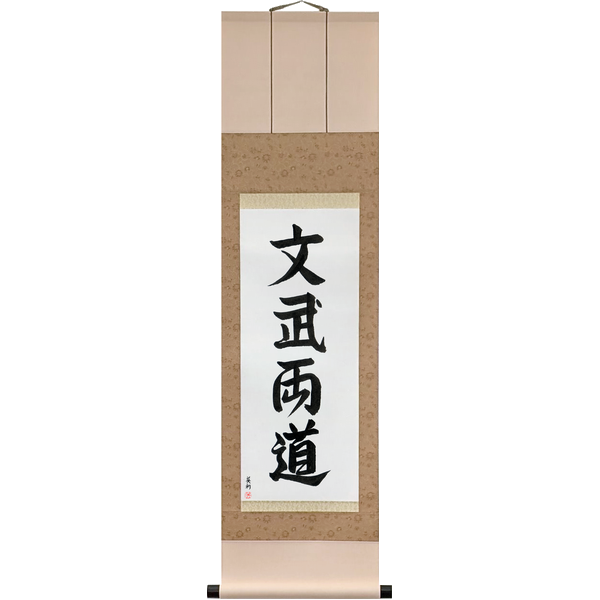
Sold as Literary and Military Arts · Read bunbu ryōdō, four characters, one Chinese reading · Oldest witness the Analects, where 文 and 武 are two kings; in Japan the 十訓抄 of 1252 for the two ways and Nichiren in 1265 for both ways · Sense letters and arms, the civil and the martial, held together; first a rule for governing a state, then a law for the warrior houses, then Musashi's definition of a samurai, and today a school's word for a student who is good at both books and sport.
The words
Four characters: 文 letters, the civil, 武 arms, the martial, 両 both (the old books write 兩), 道 way. The catalogue's glosses are right. The phrase has a twin, 文武二道, the two ways, thirteen years older in the dictionaries and commoner in old print, and a cousin in the shogunate's law, 文武弓馬之道, the ways of letters and arms, bow and horse. Under all three is the Chinese pair 文武, which in the Analects and the 禮記 is not two arts but two men, 文王 and 武王, the founding kings of Zhou, whose way is the model of good rule; in the Book of Songs the same two characters already praise a minister as civil and martial, and the Japanese word 文武, on record from 708, is that: the two halves of a court, its 文武百官, the civil and military officials. Both ways means keeping the two halves in one person.
A history, from the earliest witness
The Analects, book 19, and the 禮記, read at the Chinese Wikisource. A grandee of Wei asks 子貢 where Confucius learned. 文、武之道,未墜於地,在人: the way of Wen and Wu has not yet fallen to the ground; it lives in people; the worthy remember its great parts and the unworthy its small, so that there is no one who does not have something of the way of Wen and Wu. From whom did the master not learn? And what fixed teacher did he need? In the 禮記 Confucius explains a harvest festival by the same kings and the bow: 張而不弛,文武弗能也;弛而不張,文武弗為也。一張一弛,文武之道也, always strung and never slack, Wen and Wu could not manage; always slack and never strung, they would not do; strung and then slack, that is the way of Wen and Wu. The Japanese still quote 一張一弛 for the rhythm of work and rest, and the way of Wen and Wu is the ground the four characters stand on: two kings, one civil and one martial by name, whose way is the balance of the two. [zh.wikisource, 論語/子張第十九 and 禮記/雜記下, text.]
1252, the 十訓抄, tenth book, read in the 1893 edition. A collection of moral tales for the young, and the first Japanese book in the dictionaries' record to make the two characters two ways. Of the warrior it says that in a disordered age he comes first and is not inferior to letters, and then: 朝家には、文武二道を分ちて、左右の翅とせり。文事あれば必ず武備ある謂なり, the court divides the two ways of letters and arms and makes them its left and right wings; where there is civil order there is always military preparedness, and it gives the Chinese precedents, the twenty-eight generals honored in the 麒麟閣 and the sixteen clans of scholars under Shun. The two ways are a state's, not a man's. [4]
1265, Nichiren, the 聖愚問答鈔, second part, read in the 1904 edition of his writings. Arguing when a Buddhist should persuade gently and when he should rebuke, Nichiren reaches for the phrase as an analogy everyone will grant: 譬ば文武兩道を以て天下を治るに武を先とすべき時もあり文を旨とすべき時もあり。天下無爲にして國土靜かならん時は文を先とすべし。東夷南蠻西戎北狄蠶起して野心をさしはさまば武を先とすべき也, it is like governing the realm by both ways, letters and arms: there are times to put arms first and times to make letters the rule; when the realm is at rest and the land quiet, letters first; when the barbarians of the four quarters rise like silkworms with ambition in their hearts, arms first. To wear armor in peacetime is wrong, he goes on, and so is to set down your weapons on the battlefield and pick up the inkstone. This is the first both ways the dictionaries know, and it is a rule of timing. [5]
1412, 今川了俊's letter of precepts to his son, the 今川状, read as three Meiji and Taishō books quote it. The famous first article: 文道を知らずして武道終に勝利を得ざる事, without knowing the way of letters you will never in the end win by the way of arms. The letter was a copybook for centuries and a Kyoto book of 1773 could parody it. One American historian credits 了俊 with formulating the idea itself; the two texts above are a century and a half older than his letter, so what he formulated was the ideal for a warrior's son, not the words. [Lab highlights, 1902, 1907, 1916; not opened at the leaf.]
The fifteenth century, the Noh play Tadanori, read in a printed libretto of 1623. The ghost of 平忠度, the Taira general who was also a poet of the 千載集, is introduced: 中にも此忠度は文武二道をうけ給ひて世上に眼たかし, among them this Tadanori had received the two ways of letters and arms, and the world looked up to him. The two ways applied to one man, and to the man whom the tradition made the pattern of the poet-warrior. [7]
1615, the shogunate's first law for the warrior houses, the 武家諸法度, read in the 1892 collection of ancient laws. Article one: 一文武弓馬之道專可相嗜事。左文右武古之法也。不可不兼備矣。弓馬者是武家之要樞也。號兵爲凶器。不得已而用之。治不忘亂。何不勵修鍊乎, the ways of letters and arms, bow and horse, are to be pursued above all. Letters on the left and arms on the right is the ancient rule; neither may be lacking. Bow and horse are the pivot of the warrior house. Weapons are called instruments of ill omen and are used only when there is no choice; in order, do not forget disorder; how could one fail to train? The 1635 revision keeps the article word for word at its head, and by 1683 it reads letters, arms, loyalty and filial piety. The balance of the two ways was the law of the land for the whole Tokugawa peace. [8]
1645, Miyamoto Musashi, the 五輪書, the Book of Earth, read in the 1915 and 1939 typesets. After listing the ways men take, the Buddhist's, the Confucian's, the doctor's, the poet's, the tea master's, the archer's, Musashi says few take the way of strategy, and then: 先づ武士は文武二道といひて、二つの道を嗜む事、是道也。縱ひ此道不器用なりとも、武士たるものはおのれおのれが分際程は、兵の法をば勤むべき事也, first, a samurai is said to follow the two ways of letters and arms, and to cultivate both is the way; and even if he is clumsy at this one, a samurai must practice the art of war to the measure of his station. Then the reproach: as far as I can tell what samurai have in mind, they take the way to mean nothing more than knowing how to die. The page that sells this scroll names Musashi as the archetype; this is his sentence, and he writes the older twin, two ways. [9][9]
1626 to 1719, the Edo commonplace. The 太閤記 (1626, read in the 1646 print) has a chapter head a lord of a province uses both ways of letters and arms (国主兼用文武両道). A conduct book of 1695, the 万世家宝, opens its article on the samurai's frame of mind with the phrase already worn: 士は文武両道を嗜事古来の諚にして。文と武とは。車の両輪のごとし。文有て武を講ぜず。武あつて文を学ばずんば士の道にあらず。凡文武両道とばかりきゝて。其實を詳かにする事なし, that a samurai cultivates both ways of letters and arms is an old command; letters and arms are like the two wheels of a cart; letters without arms, arms without letters, is not the samurai's way; but people have only heard "both ways" and do not look into what it holds. A 1719 book on the way of love calls the poet-warrior 頼政 a master of both ways, as the world knows. [10][11][12]
Today. 大辞泉: 文事と武事との両方。また、勉学とスポーツの両面, both letters and arms; also, both study and sport, and the phrase's common use is the second: a newspaper in 1997 has one who excels in both academics and athletics, bunbu ryodo, and in 2011 a headline asks whether Japan has any. 谷崎 uses it of a lord's upbringing in 1935. The National Diet Library's index holds 3,761 books before 1945 with the four characters, 84 of them pre-modern, against 1,721 for two ways, 161 pre-modern: the older twin was the commoner one in old print and the one Eri brushes is the commoner now. [kotobank; the Japan Times; the index.]
The sense across time
One sense, moving from the state to the man to the schoolboy. In the 十訓抄 and in Nichiren the two ways are a court's two wings and a ruler's two seasons; in the Noh, the 今川 letter, the shogunate's law and Musashi they are a warrior's two duties, with the law's neither may be lacking and Musashi's complaint that most keep only one; in the Edo conduct books they are a commonplace, the two wheels of a cart; and in a modern school they are the report card and the playing field. The four characters have never meant a choice between the two; they have always meant the refusal to choose.
What is not a source
The Chinese classics give the pair 文武 and the way of Wen and Wu; they do not give 文武両道 or 文武二道 as a phrase, and the Chinese idiom for a man good at both is a different one, 文武双全. 山鹿素行, whom one English historian credits with originating the idea, wrote four centuries after the first two ways. The 今川 letter's way of letters and way of arms is a kinsman, not the source. And the English proverb about the pen and the sword, which most translators reach for, has its own history and is not this one.
The text in English
No Meiji dictionary opened enters it, and the American proverb collections do not carry it. 1971, Mishima Yukio in translation, Literature East & West 15.2 and London Magazine 11.1. His words from the year of his death, the very day of my action in order to realize my Bunbu Ryodo, glossed synthesis of culture arts and warrior arts in one journal and fusion of literary and military arts in the other: the phrase's first appearance in English found, as a dead man's program. [snippets.] 1976, Ueda Makoto, Modern Japanese Writers and the Nature of Literature, Stanford, ISBN 0804709041. In the Mishima chapter: derived from bunbu ryodo, the highest ethical principle for the samurai of the seventeenth and eighteenth centuries. [snippet.] 1984, John Stevens, The Sword of No-Sword: Life of the Master Warrior Tesshu, Shambhala, ISBN 0877732841. He well embodies the samurai ideal of Bunbu Ryodo, a student of the classics as well as the martial arts. [snippet.] 1988, Hatsumi Masaaki, Essence of Ninjutsu, ISBN 0809247240. Unification of literary and military arts, which he would rather read as moral and military. [snippet.] 1995, Fred Neff, Lessons from the Japanese Masters, ISBN 0822511649. Bunbu-ichi or Bunbu-Ryodo, the phrase beside its cousin 文武一致. [snippet.] 1996, Stanley Pranin, Daito-ryu Aikijujutsu, Aiki News, ISBN 9784900586185. 武田惣角 dismissing the dual path of the sword and the pen as nonsense. [snippet.] 1997, Jeffrey P. Mass, ed., The Origins of Japan's Medieval World, Stanford, ISBN 0804728941. The civil and military arts, with a chapter titled The Bunbu Ryodo Ideal and a doubt about crediting 今川了俊 with the idea. [snippets.] 1998, G. Cameron Hurst III, Armed Martial Arts of Japan, Yale, ISBN 0300049676. Bunbu ryodo (the civil and martial arts), tied to the first article of the 1615 law. [snippet.] 2002, Kiyota Minoru, The Shambhala Guide to Kendo, ISBN 1570629277. Integration of martial and liberal arts. [snippet.] 2016, Kiri Paramore, Japanese Confucianism, Cambridge, ISBN 9781107058651. The Dual Way of Scholar and Warrior, credited to 山鹿素行. [snippet.] 2023, Alexander Bennett, The Insider's Guide to the Japanese Martial Arts, Tuttle, ISBN 9784805317112. Skilled at arms and also in the arts … often mentioned in Japan today. [snippet.]
Today. The English forms divide by shelf: the historians say the civil and military arts, the martial-arts writers literary and martial, and nearly everyone reaches at some point for pen and sword. The house's title, Literary and Military Arts, is its own plain rendering, made for Takase Studios, and is closest to the historians'; the page's sword and the pen is the idiom. A rendering must keep both arts as arts and must not turn the phrase into a proverb about which is mightier.
A reading
The scroll is right and the page's two claims are right, and the page's best sentence is one it does not yet quote, Musashi's own: 先づ武士は文武二道といひて、二つの道を嗜む事、是道也. That grounds the archetype the page names, and it shows that he wrote the older twin, two ways, of the phrase Eri brushes. I would tell a buyer three things: that 文武 began as two kings and became the two halves of a court; that Japan made them two ways in 1252 and both ways in 1265, as a rule for governing before it was a compliment to a man; and that the shogunate wrote the balance into the first line of its first law for the samurai, and Musashi into the first pages of his book, each in its own words. The modern sense, books and sport, is what a Japanese parent means by it and should be said, not hidden. No change to the design, the reading or the title.
How this was read
As text: the Analects and the 禮記 at the Chinese Wikisource (the API's wikitext of 論語/子張第十九 and 禮記/雜記下); kotobank's entries for 文武両道, 文武二道 and 文武, whole; the National Diet Library's full-text index on twelve spellings, every hit for the sold form listed and its pre-modern facet screened by title; the Internet Archive's full-text index on the romaji and two English renderings, snippets only, dated from the scans' records. By OCR at the National Diet Library's next-generation digital library, the scan number part of each address: the 十訓抄校本 (pid 877559, scan 112); the 日蓮上人御遺文 (pid 823848, scan 302); the 1623 謡本 (pid 1288038, scan 9); the 日本古代法典 (pid 787034, scans 411 and 414); the 五輪書 in the 1939 原本 (pid 1071527, scan 4) and in the 1915 武術叢書 from the seat's harvest (pid 945805, scan 127); the 太閤記 (pid 2546252, scan 5); the 万世家宝 (pid 2533146, scan 5); the 艶道通鑑 (pid 2554358, scan 19). A leaf named as pid P, scan N has its text at lab.ndl.go.jp/dl/api/page/P_N and its image at dl.ndl.go.jp/api/iiif/P/R<N as seven digits>/full/full/0/default.jpg; the pre-1868 books answer a signed address only with -L. From the index alone, scan not derived: the 今川 letter's three quoters, the 国史大系 十訓抄, the 錦絵 caption. By eye: the scroll template. Not opened: any medieval manuscript; the 今川状 at a leaf; the law's original; Musashi in a Hosokawa-line copy; 山鹿素行; Mishima in Japanese; the English books at the page.
References
- The design (ours) (—) — template M1082SSVB5A, by eye; cultural_works 501; whole_designs.csv:396
- 論語 子張 19.22 (c. 5th–4th c. BC (transcription)) — zh.wikisource 論語/子張第十九, TEXT (the transcription punctuates 文、武 as two names)
- 禮記 雜記下 (Han compilation (transcription)) — zh.wikisource 禮記/雜記下, TEXT
- 十訓抄 第十 (1252 (read in the 1893 校本)) — NDL pid 877559 scan 112, OCR; the same sentence in 国史大系 15 (1901, pid 991105) by highlight ↩
- 日蓮『聖愚問答鈔』下 (1265 (read in the 1904 遺文)) — pid 823848 scan 302, OCR ↩
- 今川了俊『制詞』(今川状), first article (1412 (quoted 1902 · 1907 · 1916)) — Lab highlights: pids 1081803 (1902) · 758892 (1907) · 953988 (1916); NOT opened at the scan
- 謡曲『忠度』 (15th c. (read in the 元和9 = 1623 謡本)) — pid 1288038 scan 9, OCR; also 観世流謠曲百二十番 (pid 2570307) by highlight ↩
- 武家諸法度, 元和令, first article (1615 (read in the 1892 typeset)) — pid 787034 scans 411 and 414, OCR; the 1878 徳川十五代記 (pid 773019) glosses it 文武ノ術兼ネ修メザル可カラズ ↩
- 宮本武蔵『五輪書』地之巻 (1645 (read in the 1915 and 1939 typesets)) — harvest pid 945805 scan 127, OCR; pid 1071527 scan 4, OCR (the two typesets differ in orthography, not in sense) ↩
- 小瀬甫菴『太閤記』巻八, the table of contents (1626 (read in the 正保3 = 1646 print)) — pid 2546252 scan 5, OCR ↩
- 復信子『万世家宝』, 士の心持之事 (元禄8 (1695)) — pid 2533146 scan 5, OCR ↩
- 増穂残口『艶道通鑑』 (享保4 (1719)) — pid 2554358 scan 19, OCR ↩
- The house's own earlier reading: 錦絵 caption (19th c. (Lab classic)) — pid 1313264 (箕輪芳艶), highlight
- kotobank, 文武両道 (current) — https://kotobank.jp/word/文武両道-623528
- kotobank, 文武二道 · 文武 (current) — https://kotobank.jp/word/文武二道-2080973 · …/文武-623521
- The NDL Lab full-text index, pre-1945 (1600s–1944) — `laball_文武両道.tsv`; `labsearch_*.json`
- Mishima Yukio in English, *Literature East & West* 15.2 and *London Magazine* 11.1 (1971) — archive.org `sim_literature-east-and-west_1971-06_15_2` · `london-magazine-1954_april-may-1971_11_1`, snippets
- Ueda Makoto, *Modern Japanese Writers and the Nature of Literature*, Stanford (1976 (ISBN 0804709041)) — `modernjapanesewr00ueda`, snippet
- John Stevens, *The Sword of No-Sword: Life of the Master Warrior Tesshu*, Shambhala (1984 (ISBN 0877732841)) — `swordofnoswordli0000stev_u2g5`, snippet
- Hatsumi Masaaki, *Essence of Ninjutsu*, Contemporary Books (1988 (ISBN 0809247240)) — `essenceofninjuts00hats`, snippet
- *Handbook of Japanese Popular Culture*, Greenwood (1989 (ISBN 0313239223)) — `handbookofjapane0000unse`, snippet
- Fred Neff, *Lessons from the Japanese Masters*, Lerner (1995 (ISBN 0822511649)) — `lessonsfromjapan00neff_0`, snippet
- Stanley Pranin, *Daito-ryu Aikijujutsu*, Aiki News (1996 (ISBN 9784900586185)) — `daitoryuaikijuju0000unse`, snippet
- Jeffrey P. Mass, ed., *The Origins of Japan's Medieval World*, Stanford (1997 (ISBN 0804728941; pbk 2001, 0804743797)) — `originsofjapansm0000unse` · `originsofjapansm0000mass`, snippets
- G. Cameron Hurst III, *Armed Martial Arts of Japan*, Yale (1998 (ISBN 0300049676)) — `armedmartialarts0000hurs`, snippet
- Kiyota Minoru, *The Shambhala Guide to Kendo* (2002 (ISBN 1570629277)) — `shambhalaguideto00mino`, snippet
- Kiri Paramore, *Japanese Confucianism: A Cultural History*, Cambridge (2016 (ISBN 9781107058651)) — `japaneseconfucia0000para`, snippet
- Alexander Bennett, *The Insider's Guide to the Japanese Martial Arts*, Tuttle (2023 (ISBN 9784805317112)) — `insidersguidetoj0000alex`, snippet
- The Japan Times (1997-12-07 · 2011-06-20 · 2011-07-16) — `sim_japan-times_…`, snippets
- The house (2026) — the live page