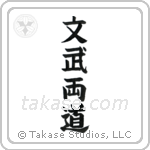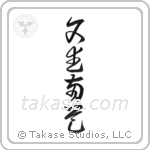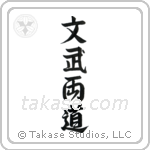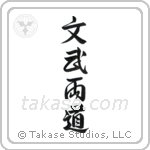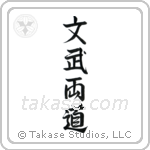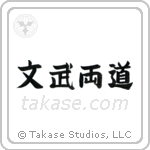

文武両道, read
bunbu ryōdō: both ways, letters and arms. The four characters name the civil and the martial held together in one person, the sword and the pen, and they have never meant a choice between the two, only the refusal to choose. Under them is the Chinese pair 文武, which in the Analects is not two arts but two kings, Wen and Wu, the founders of Zhou, one civil and one martial by name, whose way is the balance of the two. Japan made the pair
two ways in a book of moral tales for the young, where a court keeps letters and arms as its left and right wings, and
both ways in Nichiren, for whom governing is knowing when to put arms first and when letters. The shogunate wrote the balance into the opening article of its first law for the warrior houses, and Miyamoto Musashi, the swordsman and calligrapher who is the phrase's archetype, opens the Book of Earth with his own sentence on it, in the older form
two ways: a samurai is said to follow the two ways of letters and arms, and to cultivate both is the way; most samurai, he complains, take the way to mean only knowing how to die. In a Japanese school today the phrase is praise for a student good at both books and sport. The English title is the house's own rendering; historians say
the civil and military arts, and
the pen and the sword, the idiom everyone reaches for, must not turn the phrase into a proverb about which is mightier. 文武両道 is composed of the
kanji 文 (read bun) meaning "art; literature",
武 (read bu) meaning "military; arms; chivalry",
両 (read ryō) meaning "both; two" and
道 (read dō) meaning "the way; teachings".