Fine Japanese Calligraphy

The Art of Master Japanese Calligrapher Eri Takase

[p. 12]

I. OUTLINE OF THE HISTORY OF SUMO

[p. 15]
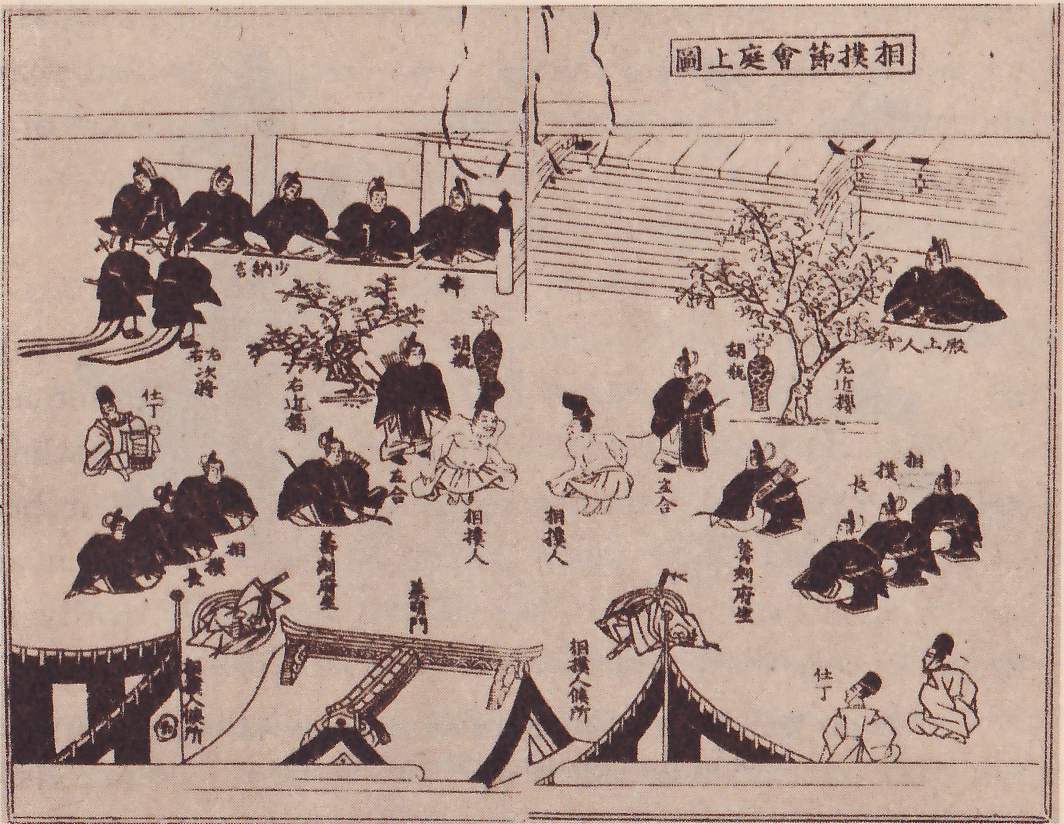
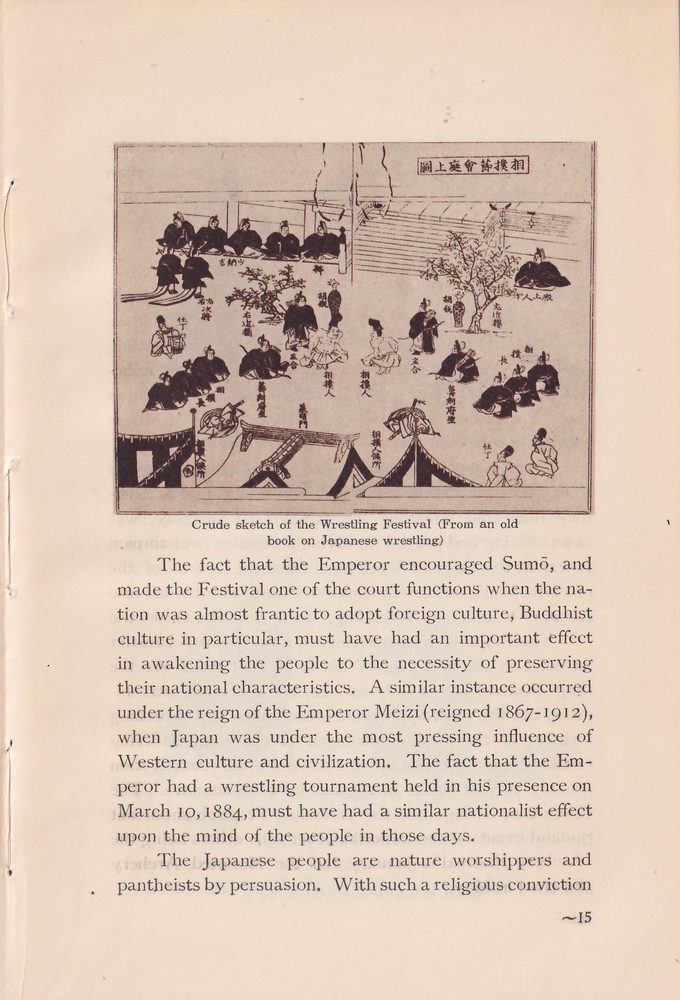
Black line drawing of an open courtyard seen from above, with a framed title in Japanese characters at the upper right and small Japanese labels written beside the figures. Rows of men in dark robes sit on the ground along the top left, at the right, and at the lower left and lower right. A flight of steps and a long veranda run across the upper right, with a bare tree in front of it and another tree at the left. At the center two men in pale garments sit on the ground near a tall vase on a stand, with kneeling men in dark robes beside them. Roofs of small gates and tents cross the bottom of the picture.
Crude sketch of the Wrestling Festival (From an old book on Japanese wrestling)

[p. 16]
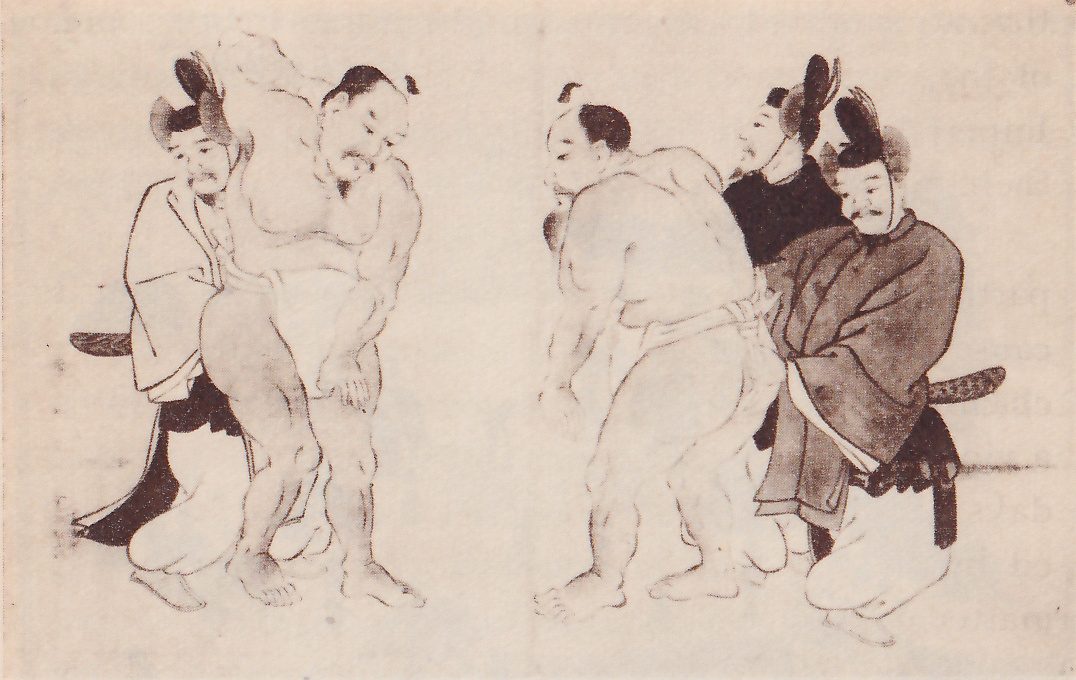
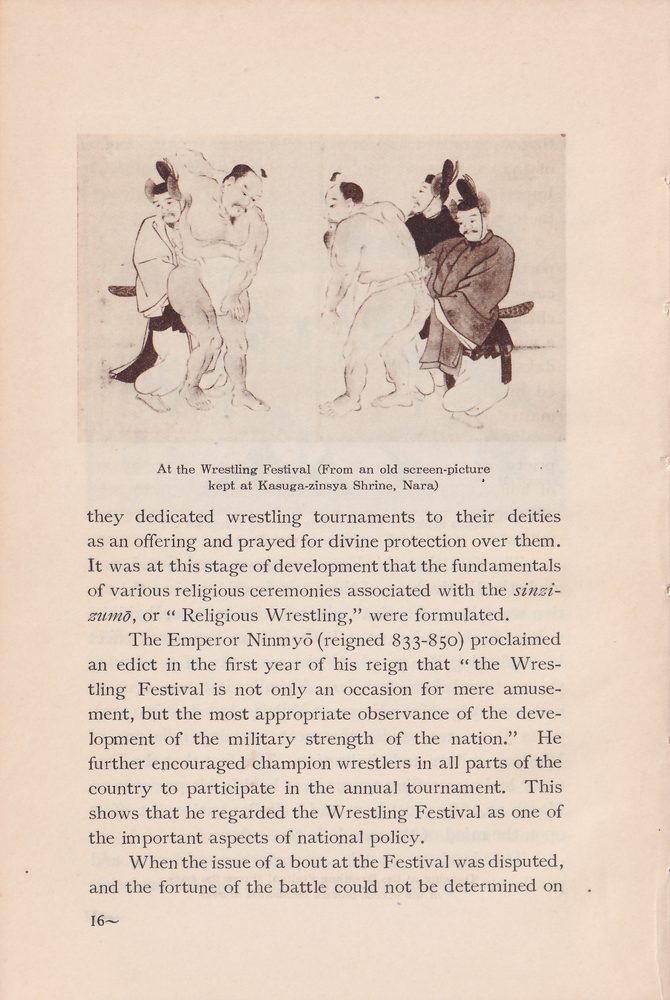
Two painted scenes side by side, in soft brown tones. At the left two large, nearly bare men are locked together, one bent forward with his head at the lower right of the pair, while a man in a pale robe and black cap kneels close beside them at the left. At the right a large bare man in a pale loincloth stands bent forward, in profile, with two men in dark robes and tall black caps kneeling behind him; a long dark object juts out behind each of the kneeling men.
At the Wrestling Festival (From an old screen-picture kept at Kasuga-zinsya Shrine, Nara)

[p. 17]
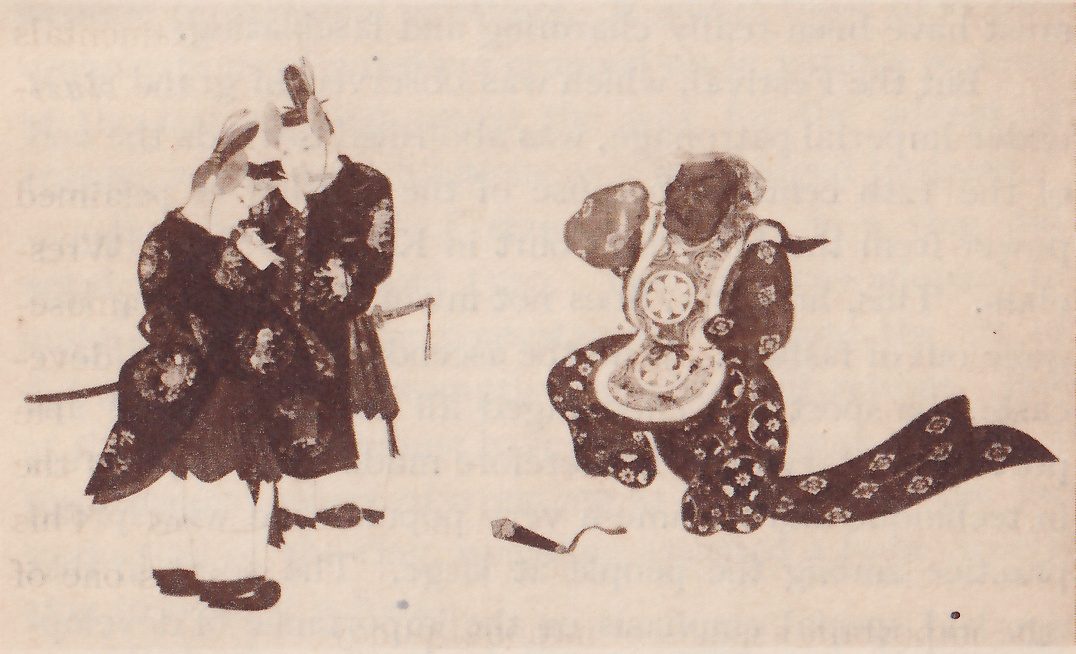
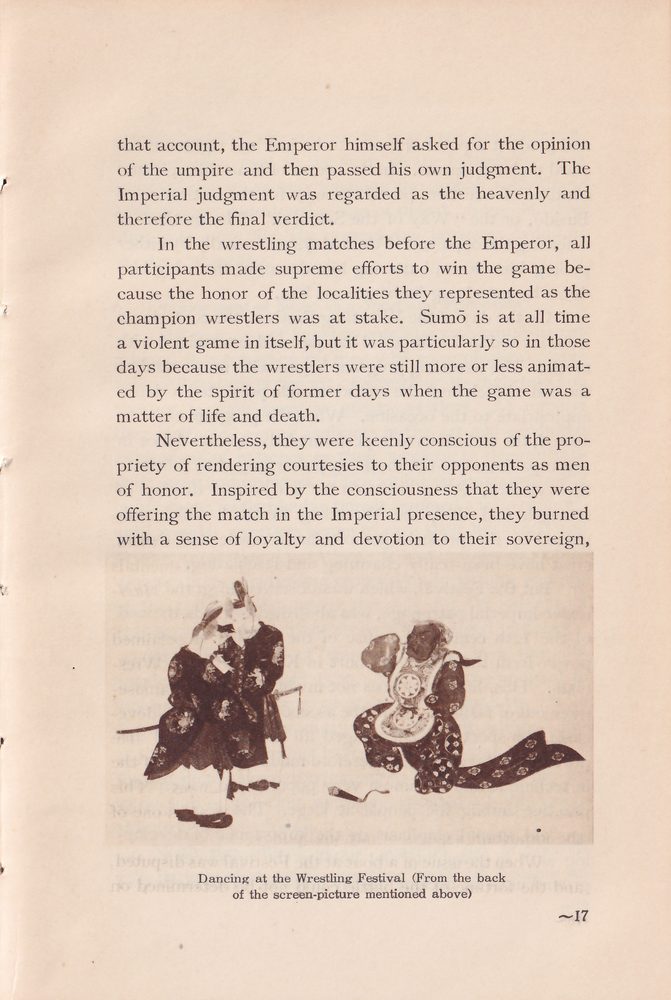
Painting of three figures in dark robes patterned with small round flower shapes. At the left two stand close together in tall black caps, one with a hand raised to his face, a sword hanging at the side of the nearer one. At the right a third figure with a dark face crouches in a stepping pose, a pale breast piece with a large round design on his chest, a hand raised at the level of his head, and a long patterned sleeve or sash trailing out to the right. A small dark object lies on the ground between them. Faint lines of printed text from the other side of the leaf show through the whole picture.
Dancing at the Wrestling Festival (From the back of the screen-picture mentioned above)

[p. 20]
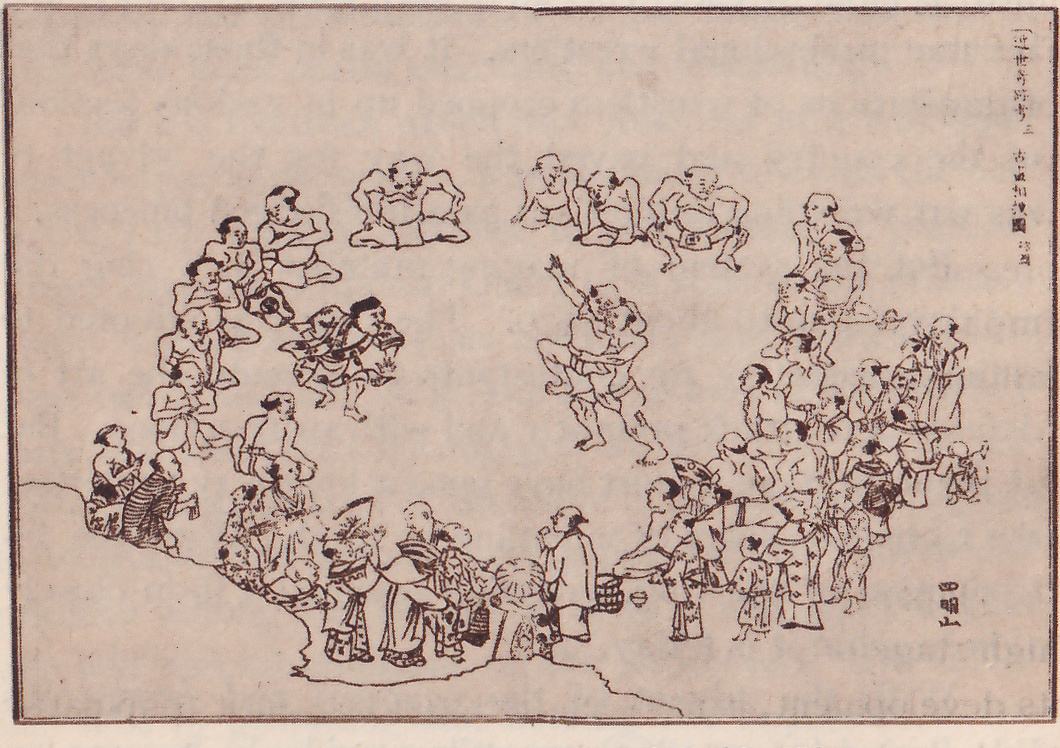
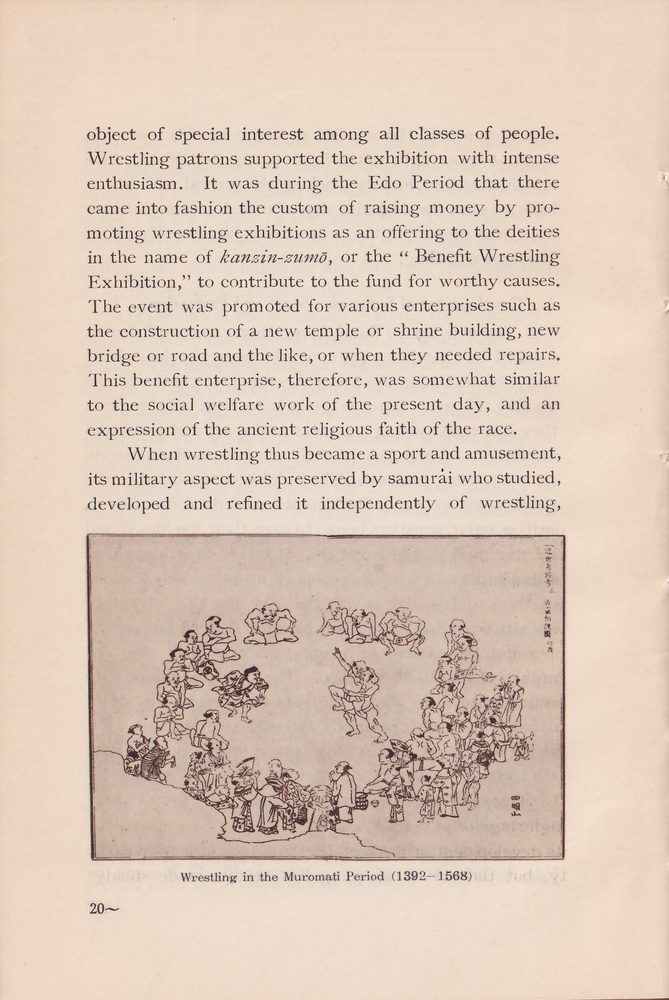
Black line drawing of a ring of people on open ground, with a title in Japanese characters in vertical lines at the upper right and a small mark at the lower right. Bare-skinned men squat or sit around an open space along the top and down the left side. In the open center two men stand locked together, one with an arm raised high. A crowd of onlookers in robes, among them children, fills the lower left and the right side. A rough line of ground runs along the lower left edge.
Wrestling in the Muromati Period (1392—1568)

[p. 21]
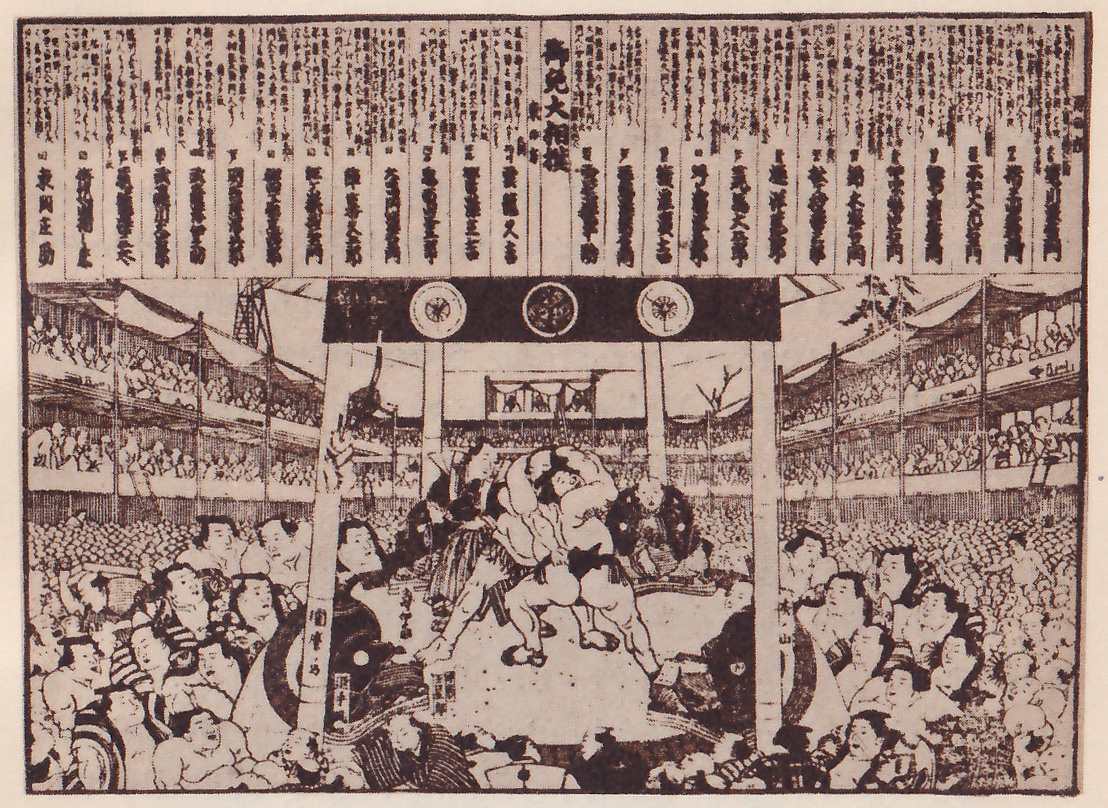
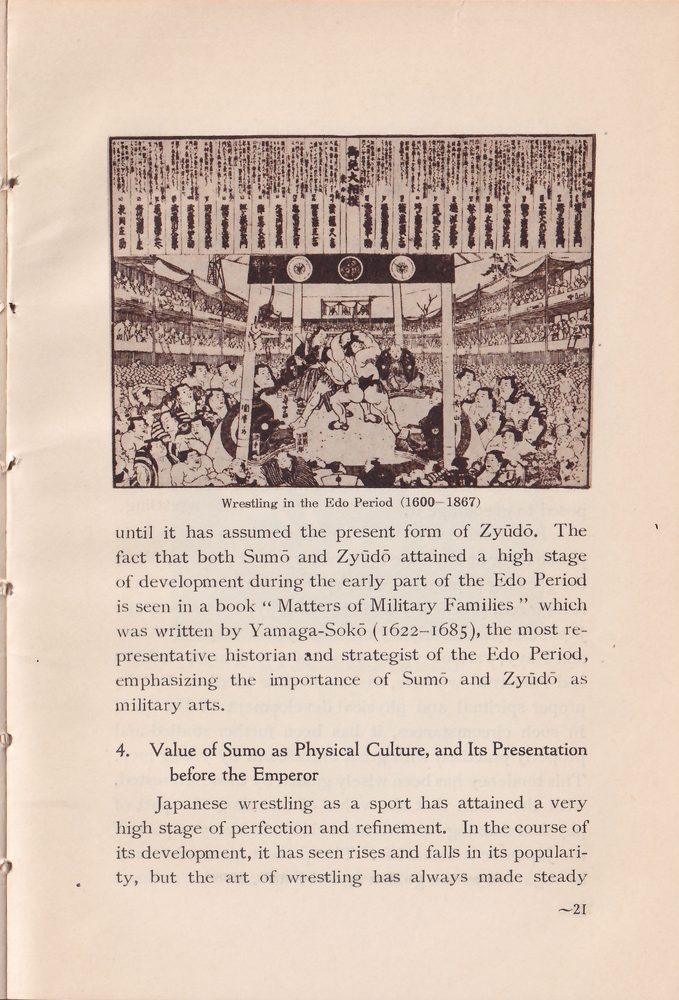
Black-and-white print of a crowded hall. A row of tall hanging strips written in vertical Japanese characters fills the top, with one wider strip at the center. Below, tiers of galleries filled with spectators run down both sides. A dark band carrying three round crests is held up by tall posts across the middle, and between the posts two men stand locked together in an open space, with another man bending beside them. Densely packed spectators fill the lower part, large in the foreground at the left and right.
Wrestling in the Edo Period (1600—1867)

[p. 23]
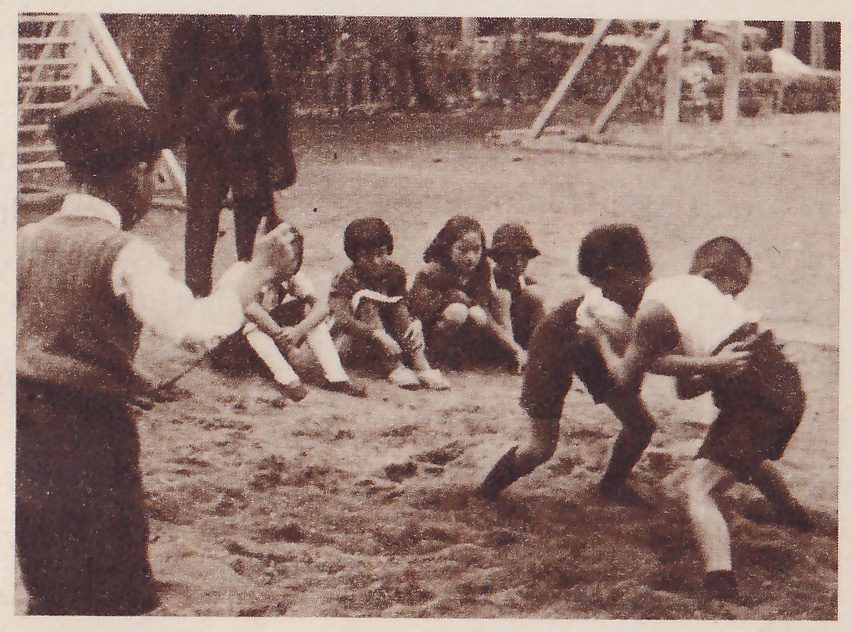
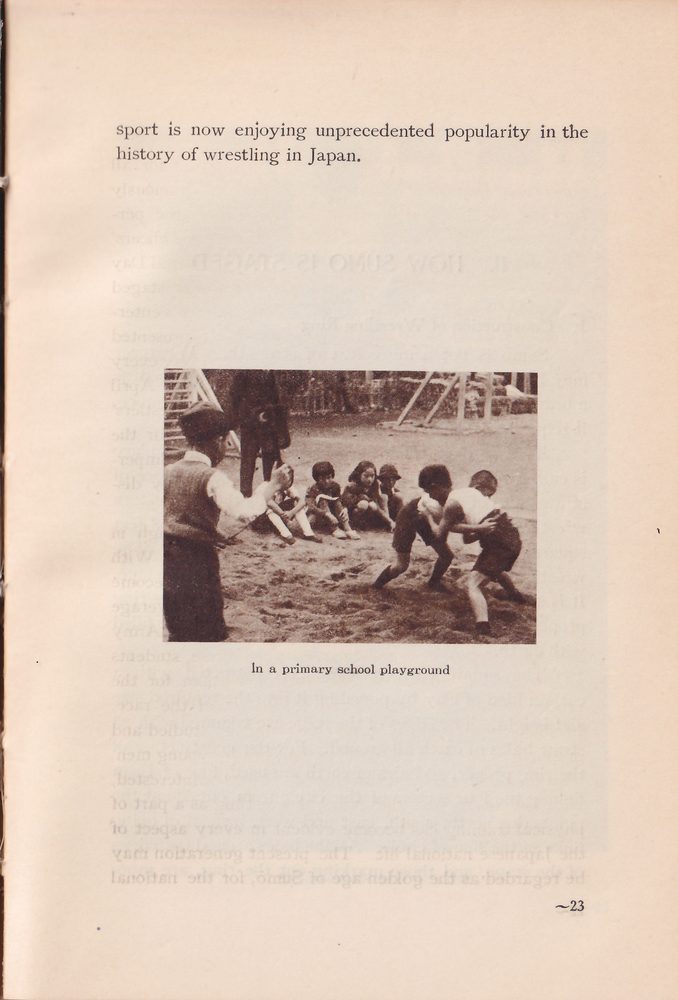
Photograph of bare ground in a playground. At the right two boys in shorts and light tops face each other, bent forward and gripping each other's arms. Four small children sit on the ground in a row in the center, one wearing a cap. At the left a man in a cap and a vest stands in the foreground with one arm raised toward them, and a dark-clothed figure stands behind. Climbing frames show at the top of the picture.
In a primary school playground