
Sumo—Japanese Wrestling
Tourist Library 34
Sumo—Japanese Wrestling
by Kōzō Hikoyama (彦山光三)
Tourist Library 34
Board of Tourist Industry, Japanese Government Railways, 1940
TOURIST LIBRARY
Volumes Already Published
1. TEA CULT OF JAPAN
By Y. Hukukita, B. A.
2. JAPANESE NOH PLAYS
By Prof. T. Nogami, D. Litt.
3. SAKURA (Japanese Cherry)
By M. Miyosi, D. Sc.
4. JAPANESE GARDENS
By Prof. M. Tatui
5. HIROSIGE AND JAPANESE LANDSCAPES
By Prof. Yone Noguti, D. Litt.
6. JAPANESE DRAMA
By B. T. I.
7. JAPANESE ARCHITECTURE
By Prof. H. Kisida, D. Sc.
8. WHAT IS SINTO?
By Prof. G. Katō, D. Litt.
9. CASTLES IN JAPAN
By Prof. S. Ōrui, D. Litt. and Prof. M. Toba
10. HOT SPRINGS IN JAPAN
By Prof. K. Huzinami, M. D.
11. FLORAL ART OF JAPAN
By Issōtei Nisikawa
12. CHILDREN’S DAYS IN JAPAN
By Z. T. Iwadō, M. A.
13. KIMONO (Japanese Dress)
By Ken-iti Kawakatu
14. JAPANESE FOOD
By Prof. Kaneko Tezuka
15. JAPANESE MUSIC
By Katumi Sunaga
16. ZYUDO (ZYUZYUTU)
By Prof. Zigorō Kanō
17. FAMILY LIFE IN JAPAN
By Syunkiti Akimoto
18. SCENERY OF JAPAN
By T. Tamura, D. Sc.
19. JAPANESE EDUCATION
By Prof. K. Yosida, D. Litt. and Prof. T. Kaigo
20. FLORAL CALENDARPrinted: CALENDER OF JAPAN
By T. Makino, D. Sc. and Genzirō Oka
21. JAPANESE BUDDHISM
By Prof. D. T. Suzuki, D. Litt.
22. ODORI (Japanese Dance)
By Kasyō Matida
23. KABUKI DRAMA
By Syūtarō Miyake
24. JAPANESE WOOD-BLOCK PRINTS
By Prof. S. Huzikake, D. Litt.
25. HISTORY OF JAPAN
By Prof. K. Nakamura, D. Litt.
26. JAPANESE FOLK-TOYS
By Tekiho Nisizawa
27. JAPANESE GAME OF “GO”
By Hukumensi Mihori
28. JAPANESE COIFFURE
By R. Saitō, D. Litt.
29. JAPANESE SCULPTURE
By Seiroku Noma
30. JAPANESE POSTAGE STAMPS
By Yokiti Yamamoto
31. JAPAN’S ANCIENT ARMOUR
By Hatirō Yamagami
32. ANGLING IN JAPAN
By Meizi Matuzaki
33. JAPANESE PROVERBS
By Otoo Huzii, D. Litt.
34. SUMO—Japanese Wrestling
By Kōzō Hikoyama
Volumes in preparation
AINU LIFE AND LEGENDS
By Kyōsuke Kindaiti, D. Litt.
JAPANESE BIRDS
By Prince Nobusuke Takatukasa
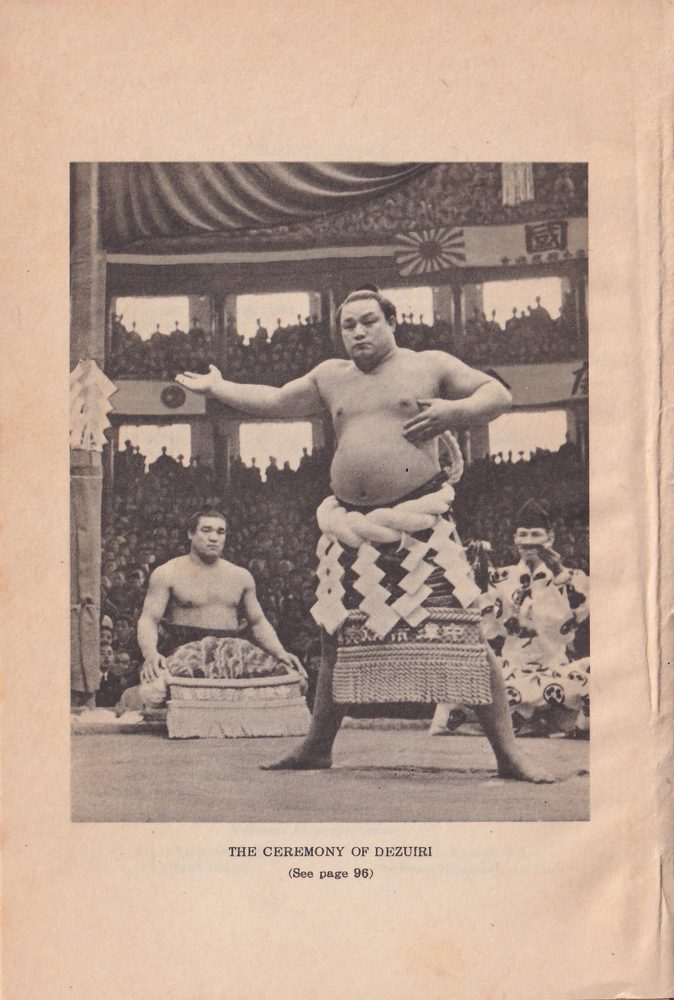
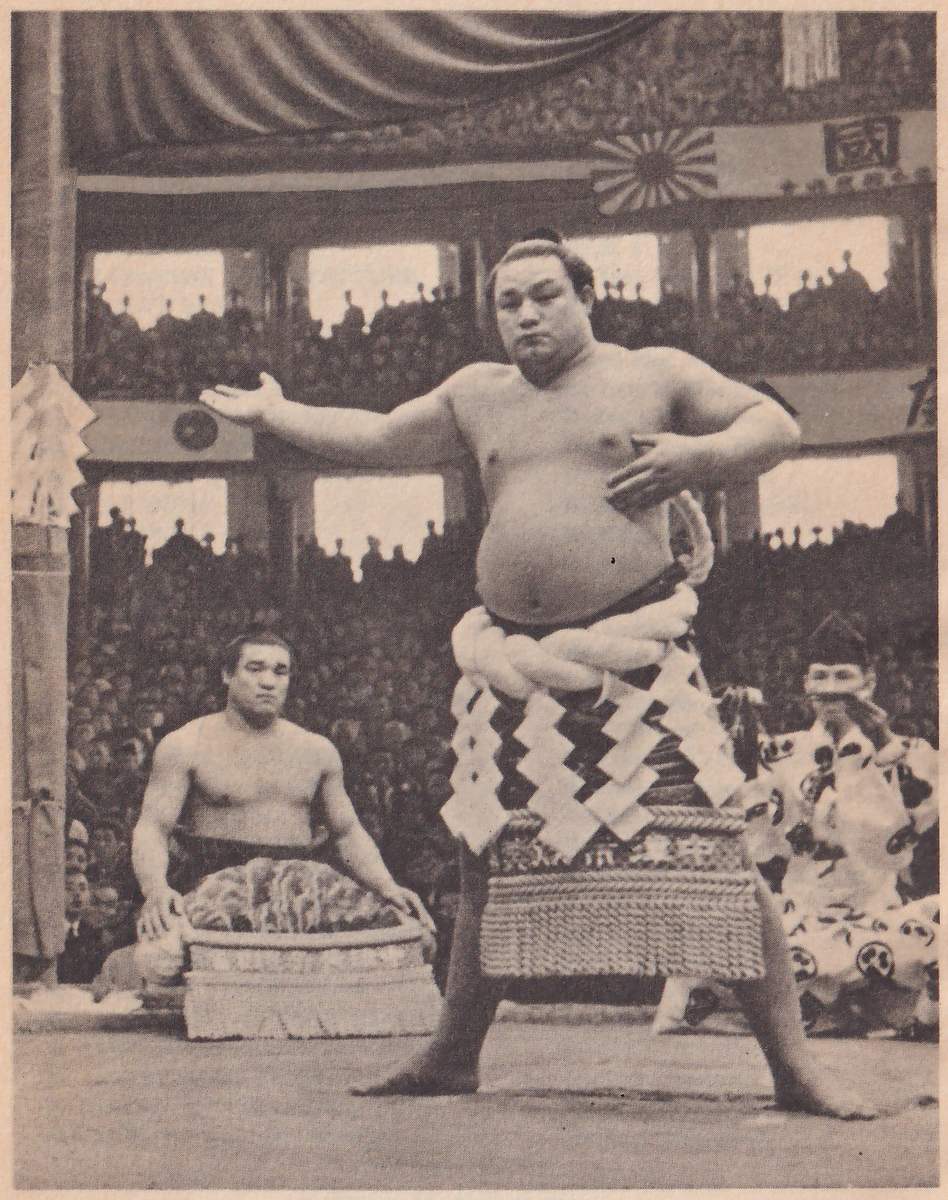
(See page 96)
SUMO
Japanese Wrestling
BY
KŌZŌ HIKOYAMA
BOARD OF TOURIST INDUSTRY
JAPANESE GOVERNMENT RAILWAYS
COPYRIGHT 1940
It is a common desire of tourists to learn something of the customs, manners, and culture of the countries they visit, but flying visits merely for sightseeing furnish neither the time nor opportunity for more than a passing acquaintance with the life of the people. The Board of Tourist Industry recognizes this difficulty and is endeavouring to meet it by publishing this series of brochures.
The present series will, when completed, consist of more than a hundred volumes, each dealing with a different subject, but all co-ordinated. By studying the entire series the foreign student of Japan will, we hope, gain a general knowledge of the country and its people.
Board of Tourist Industry,
Japanese Government Railways.
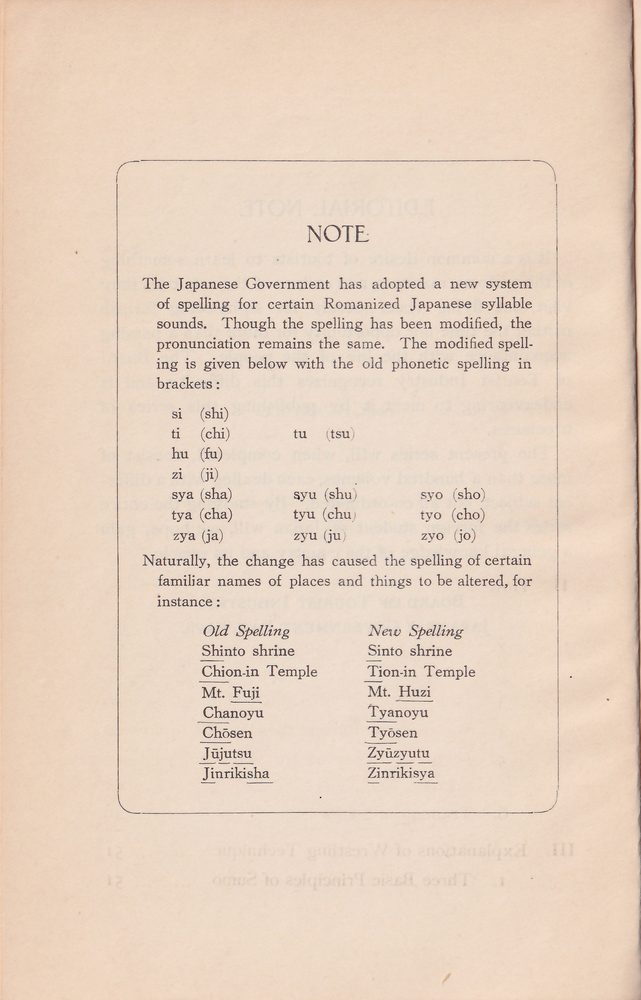
NOTE
The Japanese Government has adopted a new system of spelling for certain Romanized Japanese syllable sounds. Though the spelling has been modified, the pronunciation remains the same. The modified spelling is given below with the old phonetic spelling in brackets:
si (shi)
ti (chi) tu (tsu)
hu (fu)
zi (ji)
sya (sha) syu (shu) syo (sho)
tya (cha) tyu (chu) tyo (cho)
zya (ja) zyu (ju) zyo (jo)
Naturally, the change has caused the spelling of certain familiar names of places and things to be altered, for instance:
Old Spelling New Spelling
Shinto shrine Sinto shrine
Chion-in Temple Tion-in Temple
Mt. Fuji Mt. Huzi
Chanoyu Tyanoyu
Chōsen Tyōsen
Jūjutsu Zyūzyutu
Jinrikisha Zinrikisya
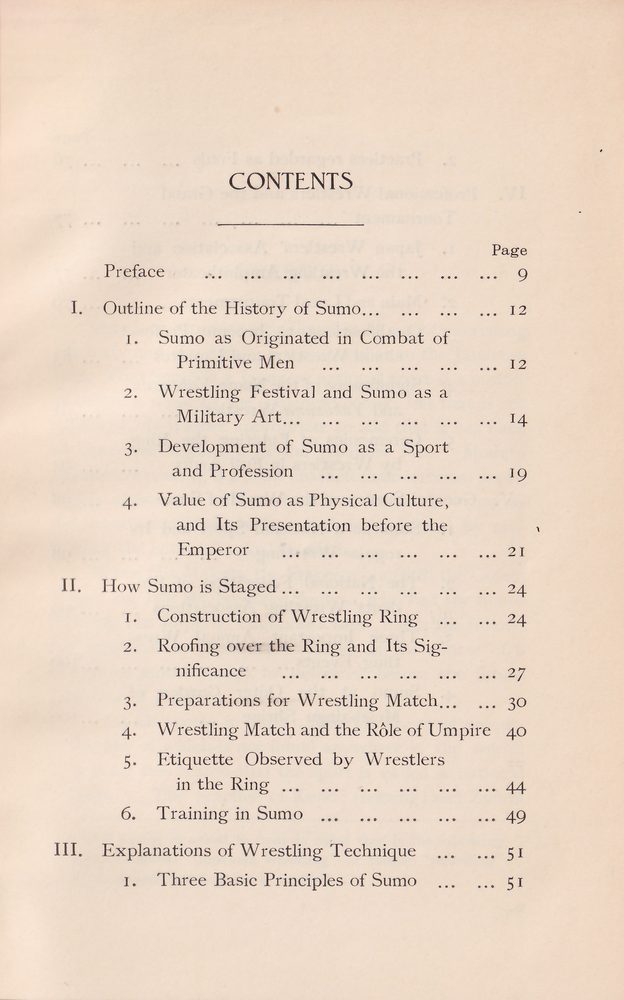
CONTENTS
Page
Preface ... ... ... ... ... ... ... ... 9
I. Outline of the History of Sumo... ... ... ... 12
1. Sumo as Originated in Combat of Primitive Men ... ... ... ... ... 12
2. Wrestling Festival and Sumo as a Military Art... ... ... ... ... ... 14
3. Development of Sumo as a Sport and Profession ... ... ... ... ... 19
4. Value of Sumo as Physical Culture, and Its Presentation before the Emperor ... ... ... ... ... ... 21
II. How Sumo is Staged ... ... ... ... ... ... 24
1. Construction of Wrestling Ring ... ... 24
2. Roofing over the Ring and Its Significance ... ... ... ... ... ... 27
3. Preparations for Wrestling Match... ... 30
4. Wrestling Match and the Rôle of Umpire 40
5. Etiquette Observed by Wrestlers in the Ring ... ... ... ... ... ... 44
6. Training in Sumo ... ... ... ... ... 49
III. Explanations of Wrestling Technique ... ... 51
1. Three Basic Principles of Sumo ... ... 51
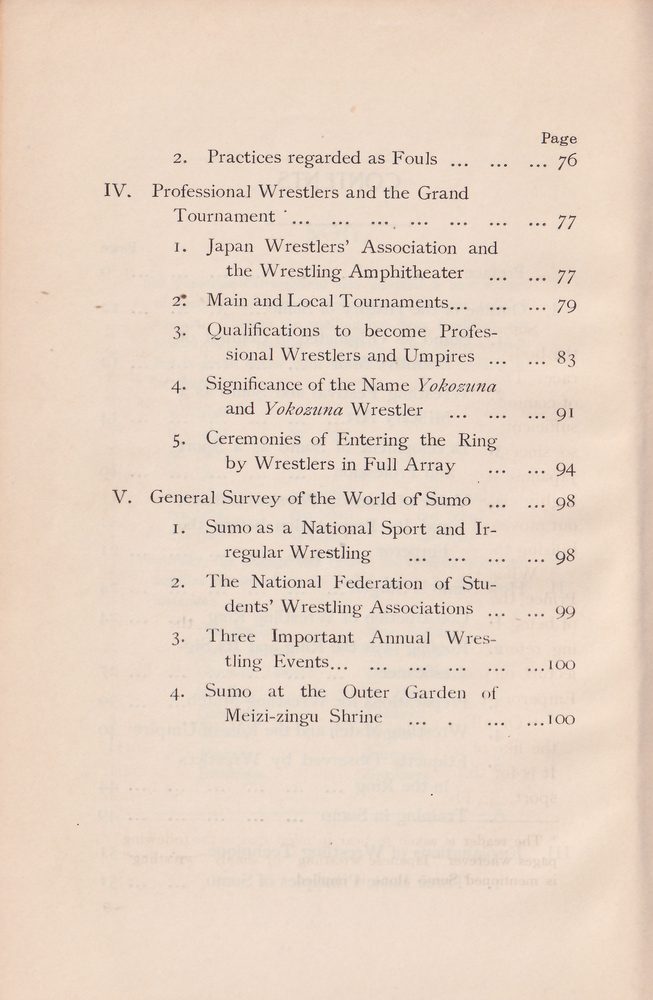
Page
2. Practices regarded as Fouls ... ... ... 76
IV. Professional Wrestlers and the Grand Tournament ... ... ... ... ... ... 77
1. Japan Wrestlers’ Association and the Wrestling Amphitheater ... ... 77
2. Main and Local Tournaments... ... ... 79
3. Qualifications to become Professional Wrestlers and Umpires ... ... 83
4. Significance of the Name Yokozuna and Yokozuna Wrestler ... ... ... 91
5. Ceremonies of Entering the Ring by Wrestlers in Full Array ... ... 94
V. General Survey of the World of Sumo ... ... 98
1. Sumo as a National Sport and Irregular Wrestling ... ... ... ... 98
2. The National Federation of Students’ Wrestling Associations ... ... 99
3. Three Important Annual Wrestling Events... ... ... ... ... ...100
4. Sumo at the Outer Garden of Meizi-zingu Shrine ... . ... ...100