
APPENDIX
A BRIEF BIOGRAPHICAL DICTIONARY OF COLOUR PRINT ARTISTS
NOTES
1. The names of the Japanese eras ending with the present era of Syōwa (1926– ) are given in their chronological order, whereas those of wood-block painters are in alphabetical arrangement.
2. The names entered as head-words are those most frequently used in referring to those artists, and we have given in brackets the Chinese characters used in representing them.
3. The term “studio name” is essentially identical with “pen-name,” but has been coined to remind the reader of the fact that pen-names ending in “sai (齋),” “ken (軒),” and “an (庵)” originally referred rather to the artist’s study or studio (or dwelling) than to the artist himself.
4. The “studio surname” is the surname (or a sort of artistic family name) adopted by or given to an artist whose master or teacher had it either as his real family name or as his “studio surname” given him by his master. In other words, it is the family name of his school.
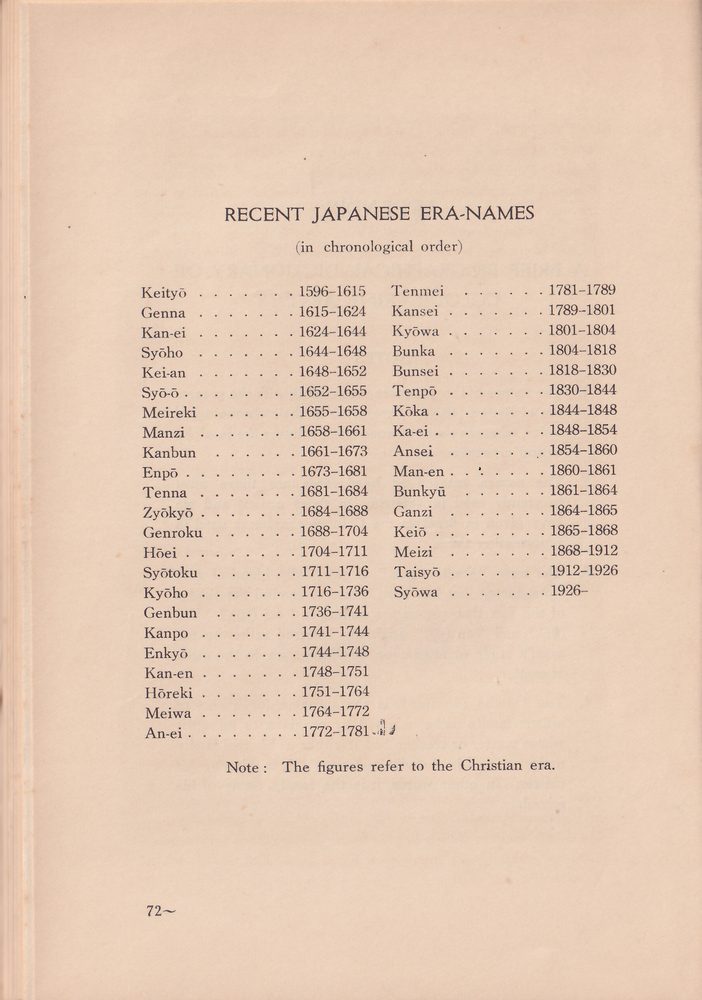
RECENT JAPANESE ERA-NAMES
(in chronological order)
| Keityō | 1596–1615 |
|---|---|
| Genna | 1615–1624 |
| Kan-ei | 1624–1644 |
| Syōho | 1644–1648 |
| Kei-an | 1648–1652 |
| Syō-ō | 1652–1655 |
| Meireki | 1655–1658 |
| Manzi | 1658–1661 |
| Kanbun | 1661–1673 |
| Enpō | 1673–1681 |
| Tenna | 1681–1684 |
| Zyōkyō | 1684–1688 |
| Genroku | 1688–1704 |
| Hōei | 1704–1711 |
| Syōtoku | 1711–1716 |
| Kyōho | 1716–1736 |
| Genbun | 1736–1741 |
| Kanpo | 1741–1744 |
| Enkyō | 1744–1748 |
| Kan-en | 1748–1751 |
| Hōreki | 1751–1764 |
| Meiwa | 1764–1772 |
| An-ei | 1772–1781 |
| Tenmei | 1781–1789 |
| Kansei | 1789–1801 |
| Kyōwa | 1801–1804 |
| Bunka | 1804–1818 |
| Bunsei | 1818–1830 |
| Tenpō | 1830–1844 |
| Kōka | 1844–1848 |
| Ka-ei | 1848–1854 |
| Ansei | 1854–1860 |
| Man-en | 1860–1861 |
| Bunkyū | 1861–1864 |
| Ganzi | 1864–1865 |
| Keiō | 1865–1868 |
| Meizi | 1868–1912 |
| Taisyō | 1912–1926 |
| Syōwa | 1926– |
Note: The figures refer to the Christian era.
BUNTYO 〔文調〕. Dates of birth and death not ascertained. Family name: Mamoru. Studio name: Ippitusai. Disciple of Isikawa-Kōgen. Period of production: Meiwa and An-ei eras. Greatly influenced by Suzuki-Harunobu, but more realistic. Skilled in portraying lovely women and actors. Extant specimens of his hand-painted pictures are rare, but a considerable number of printed picture-books and book-illustrations executed by him remain. One of the representative painters in the period of upward progress made by the art of ukiyo-e. Kisi-Bunsyō (1754–1796) was one of his leading pupils.
DENZEN 〔田善〕 (1748–1822). Family name: Nagata. Personal name: Zenkiti. Studio name: Aōdō. Went to Nagasaki to study copper-plate engraving, began reproduction of foreign copper-plate masterpieces, and himself produced many masterpieces. Some of his hand-painted pictures are also excellent. Among his disciples were Yasuda-Denki. Endō-Den-iti and Arai-Reikyō.
EISI 〔榮之〕 (1756–1829). Family name: Hosoda. Personal name: Tokitomi. Studio name: Tyōbunsai. Of aristocratic birth, but being extremely fond of painting, enrolled himself as a disciple of Kanō-Eisen-in. Afterwards became an ukiyo-e painter. Period of production: Tenmei to Bunsei. Excelled in pictures of beautiful women, and had a very refined style. Equally skilful in hand-painted and printed pictures, and also illustrated many books. One of the representative painters in the golden age of ukiyo-e. Among his disciples were Eikō, Eisui, and Eiri, all of whom painted lovely women.
EIZAN 〔英山〕 (1787–1867). Family name: Kikugawa. Personal name: Tosinobu. Studio name: Tyōkyūsai. Son of Eizi, a painter of the Kanō school. Studied the works of Suzuki-Nanrei, Katusika-Hokusai, etc. and finally developed a style of his own, thus founding the Kikugawa school of painters. He was skilled in the representation of lovely women, and produced his best from Bunka to Keiō era. In his earlier years he followed the style and manners of Kitagawa-Utamaro; but in his advanced age he lived a retired life in the country and delighted in the production of hand-painted pictures. Among his pupils were Eisen, Eiga, Eisi, Eisyū, Eisyō, Eisin, Eiryū, and Eiri.
GOYO 〔五葉〕 (1880–1921). Family name: Hasiguti. Personal name: Kiyosi. Graduate of the Tokyo Academy of Fine Arts. Painted in oils, but took a special interest in wood-block prints, and produced a number of pictures of beautifulPrinted: beaubtiful women and landscapes, which are worthy of note as modernized forms of the traditional patterns of ukiyo-e prints.
HARITU 〔破笠〕 (1663–1747). Family name: Ogawa. Personal name: Kan. Common name: Kin-ya or Heisuke. Pen-names and studio names: Rituō, Sisen, Hōkansi, and Mutyū-an. Called himself also Hanabusa-Issen, because he was a disciple of Hanabusa-Ittyō. Skilled in the composition of haiku. Produced excellent handpainted portraits of beautiful women, and also illustrated books. Famous as originator of a kind of lacquerware called Haritu-zaiku.
HARUNOBU 〔春信〕 (1725–1770). Family name: Suzuki. Personal name: Zihei. Studio name: Tyōei-ken. Disciple of Nisimura-Sigenaga. Period of production: Hōreki and Meiwa eras, which happened to be a period of change in the modes of ukiyo-e painting. Thanks to the efforts of Harunobu it became possible in the 2nd year of Meiwa (1765) to publish polychromatic prints called nisiki-e. By reason of his delicate lines and curves, harmonious tints, superior designs and backgrounds, and his dreamy expression, he was the best representative of the Meiwa mode of depicting women. His style influenced Buntyō, Kōryūsai, Syunsyō, and Kiyonaga. He also produced some hand-painted masterpieces. His leading disciples were Harusige (i. e. Siba-Kōkan) and Harutugu.
HIROSIGE 〔廣重〕 (1797–1858). Family name: Andō. Studio names: Itiyūsai and Itiryūsai. Superior disciple of Utagawa-Toyohiro. Began producing pictures of lovely women in the Bunka era, and in the early part of the Tenpō era established a school of his own as painter of flowers, birds, and landscapes. Published celebrated pictures of the fifty-three stages on the Tōkaidō national highway, and many other masterpieces. His manner as a painter was characterized by objective realism, and he achieved great success in giving graphic expression to Japanese climate and weather, and geographical features. Regarded as the best representative of the ukiyo-e painters towards the close of the Edo period; and formed a worthy trio with Toyokuni III. (skilled in portray-
ing actors) and Kuniyosi (who excelled in the representation of warriors in armour). Among his disciples were Hirosige II., and a few others, none of whom, however, attained high reputation. (For further information on Hirosige, vide “Hirosige and Japanese Landscapes Volume 5 of “Tourist Library.”)
HOKUSAI 〔北齋〕 (1760–1849). Surname: Nakazima; but surnamed himself Katusika. A disciple of Katukawa-Syunsyō, he at first called himself Syunrō, but later he used more than twenty pennames, such as Sōri, Hokusai, Iitu, Manzi, etc. Period of production: from An-ei to Ka-ei—a very long period. Skilful both in hand-painted and printed pictures, he devised unique methods of representing beautiful women and landscapes. The thirty-six views of Mount Huzi constitute his representative masterpiece. He also produced many picture-books and illustrated many books. Founder of the Katusika school, he was the chief representativePrinted: reprsentative of the ukiyo-e artists towards the end of the Edo period. He had a considerable number of pupils, among them being such celebrated painters as Hokkei, Hokuzyu, and Hokuba.
KAIGETUDO 〔懷月堂〕. Prominent among painters using “Kaigetudō” as their common studio name and specializing in the portrayal of beautiful women, were Ando, Dohan, Dosyū, Dosyu, Dosin, and Anti. Ando was the founderPrinted: fonuder of the school. Others belonging to this group were Matuno-Tikanobu, Baiōken-Eisyun, Baiyūken-Katunobu, Tōsendō-Rihū, Kūmeidō-Nobuyuki, and Ryūsendō-Gihū. Few specimens of wood-block prints made by these artists remain, most of their works being hand-painted. They painted life-size portraits of lovely women, either standing alone or in groups of three. Their pictures are characterized by thick lines, rich and beautiful colouring, and unified designs. Ando flourished in the Hōei and Syōtoku eras, while the others were painters of the Kyōho era.
KIYOMASU II. 〔清倍〕 (1706–1763). Disciple of Torii-Kiyonobu I. and succeeded Kiyonobu I. in the Torii line of painters. He was skilful in depicting actors. and produced excellent beni-zuri-e (crimson prints). His manner as a painter is even more delicate than his master Kiyonobu I. Period of production: from Kyōho to Hōreki.
KIYOMITU 〔清滿〕 (1735–1785). Second son of Kiyomasu II. Personal name: Kamezirō. Third generation of the house of Torii. Period of production: from the Enkyō to the Tenmei era. Produced few hand-painted pictures, but gave the public many crimson prints, nisiki-e theatrical programmes, and picture-books; and illustrated numerous blue-covered story-books or romances. Skilful in representing actors and beautiful women. As a painter he greatly modified the traditional methods of the Torii school, and developed a refined and delicate style of his own. With Suzuki-Harunobu and Isikawa-Toyonobu he devoted much of his energy to the development or improvement of nisiki-e. Among his pupils were Kiyonaga and Kiyotune (who produced pictures in the Hōreki and An-ei eras).
KIYONAGA 〔清長〕 (1752–1815). Disciple of Torii-Kiyomitu I. Family name: Sekiguti or Seki. Personal name: Sinsuke, later renaming himself Itibei. Began producing pictures from the latter part of the Meiwa era. At first acquired the Meiwa manner of representing women practised by Kiyomitu, Harunobu, and Kōryūsai; but afterwards, in the Tenmei era, established a style of his own, called the Kiyonaga manner, which was the culmination of the art of ukiyo-e. Produced a great many prints and picture-books, besides illustrating other books. Only a few hand-painted pictures bear his name, but they are of superior order. He represented the fourth generation of the Torii house. His son Kiyomasa was also adept in depicting beautiful women. As head of the Torii school Kiyonaga was succeeded by Kiyomine (1788–1868) in the fifth generation, by Kiyoyosi (1832–1892) in the sixth generation, and finally by Kiyotada, who is happily with us representing the seventh generation.
KIYONOBU 〔清信〕 (1664–1729). Family name: Torii. Personal name: Syōbei. Son of Kiyomoto. Moved to Edo from Osaka with his father, and painted bills and programmes for the three great Kabuki theatres of Edo, thus opening a school of his own. Founder of the Torii school, which (as above stated) formed special relations with the theatres. This school has continued unbroken to the present day. Kiyonobu was skilled in the representation of actors and beautiful women, and produced both hand-painted and
printed pictures of these gay people. His leading pupils were Kiyomasu I., Kiyonobu II., Kiyomasu II., Kiyotada, Kiyosige, Kiyotomo, Kiyoharu. Husanobu (Ginsetu) and Tintyō (?–1753).
KIYOTIKA 〔清親〕 (1847–1915). Family name: Kobayasi. Produced many colour prints and hand-painted pictures during the Meizi and Taisyō eras. His style may briefly be described as a compromise between Japanese and Occidental pictorial arts, or as Japanese art greatly modified by Western methods, and he endeavoured to express this compromise through the technique of wood-block printing. He thus accomplished the difficult task repeatedly attempted by ukiyo-e artists ever since ukiyo-e painting began, viz., of imparting to our art of colour prints something of the expressive power of Western artists. He was, indeed, the most representative wood-block printer of the Meizi era.
KOKAN 〔江漢〕 (1783–1818). Studio surname: Siba. Being a disciple of Suzuki-Harunobu, he called himself Harusige and painted beautiful women after the manner of his teacher. Later on he enrolled himself as a pupil of Sō-Siseki. He also acquired from Dutchmen the art of copper-plate engraving, and published the first Japanese landscapes printed from copper plates. His methods as painter were preserved to posterity by Aōdō-Denzen and others.
KORYŪSAI 〔湖龍齋〕. Dates of birth and death not certain. Family name: Isoda. Personal name: Masakatu. Common name: Syōbei. Said to have been a disciple of Nisimura-Sigenaga, but it seems more correct to regard him as a disciple of Harunobu, and indeed he called himself Koryūsai-Haruhiro. Many of his colour prints represent lovely women, and not a few of them are master-pieces. He also illustrated yellow-covered story-books, and produced excellent hand-painted pictures. In his advanced age he was given the dignified title or treatment of hokkyō, a high priestly rank corresponding to the fifth Court rank. Period of production: from the Meiwa to the Tenmei era. He exerted some influence upon Torii-Kiyonaga and others.
KUNISADA 〔國貞〕 (1786–1864). Disciple of Toyokuni I. and successor to Toyokuni III. Studio names or pen-names: Kōtyōrō, Iti-
yū-sai, and Hutyō. Most skilful in representing actors, he produced innumerable prints of these, besides painting pictures by hand. He also illustrated a large number of story-books known as kusazōsi. It must be admitted, however, that he was not equal to Toyokuni I. as an artist. He had a great many pupils.
KUNIYOSI 〔國芳〕 (1797–1861). Family name: Igusa. Personal name: Magosaburō. Studio names: Iti-yū-sai, Tyō-ō-rō, etc. Distinguished disciple of Toyokuni I. Period of production: from the Bunka to the Man-en era. Highly spoken of as painter of warriors. Produced landscape masterpieces characterized by Western modes of expression. Also skilled in representing insects and fish. Yositora, Yosimune, Yosi-iku, and Yositosi were among his pupils, and all followed the methods of their master in a worthy manner. The most distinguished of them was Yositosi.
MASANOBU 〔政信〕 (1686–1764). Family name: Okumura. Personal names: Sinmyō and Genpati. Studio and pen-names: Hōgetudō, Tantyōsai, Bunkaku, and Baiō. His genealogy as a painter is not clear. He acquired the style of Torii-Kiyonobu by his own efforts, and established a school of his own. Produced superior works both hand-painted and printed. Period of production; from the Genroku to the Hōreki era. Also published picture-books and illustrated story-books. He was the first to apply to wood-block prints the principles of linear perspective. He was a publisher as well as an artist, and did much for the development and improvement of the various modes of wood-block printing. Two of his leading pupils were Tosinobu and Masatosi. He exerted profound influence on the subsequent stages of ukiyo-e.
MASANOBU 〔政演〕 (1761–1816). Family name: Iwase. Studio surname: Kitao. Personal name: Samuru. An Edo dealer in tobacco utensils. Disciple of Kitao-Sigemasa, he was skilful in portraying lovely women. He produced masterpieces in nisiki-e and picture-books. Under the pseudonym of Santō-Kyōden he produced story-books of the descriptions known as “yellow-covered books” and “jest-books,” thus making a name for himself as a literary man as well as a graphic artist. In addition to these he wrote some books on curios and other archaeological subjects.
MASAYOSI 〔政美〕 (1764–1810). Family name: Kuwagata. Studio surname: Kitao. Personal name: Tuguzane. Pen-name: Keisai. Disciple of Kitao-Sigemasa. Period of production: from the latter part of the An-ei to the Bunsei era. In the middle of the Tenmei era he began producing nisiki-e. He painted lovely women, but was at his best in representing warriors. He also produced landscapes known as uki-e, based on the principles of linear perspective. In his later years he called himself Kuwagata-Keisai. Having acquired the methods of the Kanō and Tosa schools, he represented the manners and customs of much older periods, besides publishing picture-books designed to illustrate graphic methods. The best-known of his picture-books is entitled kaihakurai-kin-zu-i.
MATABEI 〔又兵衞〕 (1578–1651). Family name: Iwasa. Personal name: Matabei. Pen-name: Katumoti. Disciple of Tosa-Mitunori. Period of productive activity: from Genna to Keian. Moved from Kyōto to Hukui in Etizen Province, and thence summoned to Edo. Studied the styles and methods of the Tosa, Kanō, and Unkoku schools of painters, but later abandoned them all and produced pictures of old customs and manners in the classic style. He has popularly been regarded as originator of the ukiyo-e type of colour prints, but as a matter of fact he never depicted contemporary manners and fashions. Unquestionably one of the greatest painters of the early modern period. His son, Katusige who also lived at Hukui, acquired an enviable reputation as a painter
MORONOBU 〔師宣〕 (1618?–1694?). Family name: Hisikawa. Personal name: Kitibei. Pen-name: Yūtiku. During the six eras from Manzi to Genroku he lived in Edo and produced genre-pictures, which came to be popularly called ukiyo-e, or pictures of the ephemeral world. He was thus the originator of ukiyo-e. He was a prolific worker, producing both hand-painted and printed pictures, publishing picture-books and illustrating story-books. Disciples: Morohusa, Moronaga, Morosige, Moromasa, Morotane, Masataka, Harunobu, Tomonobu, and Wa-ō. Most prominent of these was Morosige, who founded a school of his own, using Huruyama as his studio surname.
SIGEMASA 〔重政〕(1739–1820). Family name: Kitabatake. Studio surname: Kitao. Eldest son of the bookseller Subaraya-Saburōbei. Had several pen-names, such as Karan and Kōsuisai. Period of production: from the Hōreki to the Bunsei era, an unusually long period of activity The An-ei, Tenmei and Kansei eras constituted his mature period, and with Katukawa-Syunsyō and others representedPrinted: reperesented the palmy days of ukiyo-e. He was indeed the founder of the Kitao school, which produced (as his disciples) such masters as Kitao-Masanobu and Kitao-Masayosi. Kitagawa-Yosimaru succeeded him as Sigemasa II.
SIGENAGA 〔重長〕(?–1756). Family name: Nisimura. studio names or pen-names: Eikadō, Senkadō, Hyakuzyu, etc. His lineage as a painter is not clear, but it is certain that he acquired the style of Torii-Kiyonobu and became prominent from about the middle of the Kyōho era as a skilful painter of women. He then came gradually under the influence of Nisikawa-Sukenobu, Okumura-Masanobu and others, and finally established a style of his own. Some of his pictures are landscapes to which he applied the principles of linear perspective. Had several disciples, the more conspicuous among them being Isikawa-Toyonobu, Suzuki-Harunobu, and Tomikawa-Husanobu.
SUKENOBU 〔祐信〕(1671–1751). Family name: Nisikawa. Personal name: Yūsuke; afterwards changed to Ukyō. Studio names: Bunkadō, Zitokusai etc. Born in Kyoto, he became a pupil first of Kanō-Einō, and then of Tosa-Mitusuke. Founder of the Nisikawa school, he was the principal representative of the art of ukiyo-e in Kyōto, Osaka, and their surrounding districts. Produced many masterpieces in hand-painted pictures of beautifulPrinted: beauteful women. Also produced a large number of picture-books and illustrations of story-books, besides a few one-piece wood-block prints. His superior and refined manner as a painter greatly influenced Harunobu and other ukiyo-e artists in Edo. Among his disciples were Suketada and Suketame.
SYARAKU 〔寫樂〕. Dates of birth and death not known. Period of production: 6th and 7th years of Kansei. Family name: Saitō. Studio name: Tōsyūsai. Neither his career nor his lineage as painter has been clearly recorded. Said to have been a Noh-play
actor at first. He displayed creative genius in portraying men and women, especially actors, whose facial expressions he depicted with a masterly hand. By combining with this skill his clever application of the technique of wood-block printing, he produced colour prints de luxe. He may indeed be said to have greatly improved upon the manners of Syunsyō’s disciples Syun-ei and Syunkō. His creations did not exceed a few hundred, and they are highly valued by collectors and students of art.
SYUNMAN 〔俊滿〕 (1757–1820). Family name: Kubota. Called himself Kubo. Disciple of Kazitori-Uohiko and Kitao-Sigemasa. Studio name: Syōsadō. Besides being a painter he wrotePrinted: worte plays comic and satirical verse, and haiku. From the beginning of the An-ei era he began painting ukiyo-e and producing prints of beautiful women. In his later years he produced many hand-painted pictures.
SYUNSYO 〔春章〕 (1726–1792). Studio surnames: Miyagawa, Katumiyagawa, and Katukawa. Personal name: Yūsuke. Pen-names: Kyokurōsei, Ririn, etc. Disciple of Miyagawa-Syunsi, he alsoPrinted: slso studied under Kōsūkoku and others. Period of production: from Meiwa to Kansei. He exerted himself for the consummation of the art of nisiki-e, and was one of the representativePrinted: repesentative painters of the golden age of ukiyo-e. He showed superior talent and skill both in hand-painted and printed pictures, and produced excellent pictures of beautifulPrinted: beauteful women and actors. In his portraits of actors he displayed great originality and set examples to the younger generation of painters, considerably influencing artists like Kiyonaga, Utamaro, Syaraku, and Toyokuni. Among his pupils were Syun-ei, Syunkō, Syuntyō, Syunzan, Syunsen, Syunzyō, Syundō, Syunrō (i. e. Hokusai), and others.
TOYOHARU 〔豊春〕 (1735–1814). Family name: Utagawa. Personal name: Masaki. Studio names: Itiryūsai, Senryūsai, Syōzirō, etc. Disciple of Toriyama-Sekien. Established a school of his own, called the Utagawa school, of which he is thus called the founder. Period of production: from the Meiwa to the Bunka era. Skilled in portraits of women, he gradually became more of a landscape painter. He applied the principles of linear perspective to his pictures of the sights of Edo and exotic scenes in foreign coun-
tries. He thus revived the art of uki-e, or embossed pictures. Among his pupils were Utagawa-Toyokuni I. and Utagawa-Toyohiro, both of whom had a great manyPrinted: greatm any under-disciples, so that he became the founder of a very wide school.
TOYOHIRO 〔豊廣〕 (1773–1828). Family name: Okazima. Studio surname: Utagawa. Personal name: Tōzirō. Studio name: Itiryūsai. He was only equalled by Toyokuni among the disciples of Utagawa-Toyoharu. His artistic activity began in the Tenmei era. His earliest works were portraits of actors, but when he found Toyokuni unrivalled in the representation of actors, he devoted his energy to pictures of beautiful women. He produced excellent hand-painted and printed portraits of women. His own son, Toyokiyo, was among his pupils, who included Toyokuma, Hironobu, Hirokane, Hiromasa (廣昌) and Hiromasa (廣政), Hirotika Hirotune, and Hirosige I. The last-named artist, Hirosige, alone developed to the full his genius as a landscape painter.
TOYOKUNI 〔豊國〕 (1769–1825). Family name: Kurahasi. Studio surname: Utagawa. Studio name: Itiyōsai. One of the best pupils, if not indeed the best pupil, of Toyoharu, he was skilful both in painting women and in portraits of actors, but especially in the painting of actors, where he established a style of his own. During the Kansei era he followed the mode peculiar to Syaraku, but later on he gradually developed a manner of his own. However, by seeking to adapt his art to popular taste, he somewhat lowered the general tone of his pictures. He had a large following, including Toyokuni II. (1802–?), Toyokuni III. (1786–1864), Toyokuni IV. (1832–1880), Kuniyasu, Kunimaru, Kuninao, Kuninobu, Kuniyosi, Kunitane, Kunikatu, Kunitake, and Kunimasa. Each of them had a considerable number of pupils of his own, so that the Utagawa painters carried all before them among the ukiyo-e artistsPrinted: artits and collectors towards the end of the Edo period. Of them all Toyokuni III. and Kuniyosi were most celebrated.
TOYONOBU 〔豊信〕 (1711–1785). Family name: Isikawa. Personal name: Magosaburō. Studio or pen-names: Meizyōdō and Syūha. First called himself Nisimura-Sigenobu, being a disciple of Nisimura-Sigenaga. Period of production: from Kyōho to Meiwa. Produced urusi-e (lacquer pictures), beni-zuri-e (crimson prints), and
nisiki-e (brocade pictures). A few specimens of picture-books and story-books illustrated by him also remain. He had a delightfully refined style as artist, and with Suzuki-Harunobu represented the best in the art of portraying lovely women in the Hōreki-Meiwa period. His was indeed a master hand.
TYOKI 〔長喜〕. Dates of birth and death not ascertained. Pen-names: Eisyōsai and Sikō. Hitherto erroneously regarded as identical with Sikō, a disciple of Toriyama-Sekien, but in reality the two artists are not to be identified with each other. His lineage as painter is not clear, but his style is closely related to that of Torii-Kiyonaga, and also shows some influence of Kitagawa-Utamaro. Yet it must be said that he formed a style of his own. He produced masterpieces in pictures of women and actors. He also illustrated many books.
TYOSYUN 〔長春〕(1683–1753). Studio surname: Miyagawa. Founder of the Miyagawa school. Personal name: Kiheizi. Period of production: Syōtoku to Kan-en. Developed a style of his own from that of Hisikawa-Moronobu, which he studied thoroughly. He produced no colour prints, but devoted himself to the practice of painting beautifulPrinted: beauteful women by his own hand. He excelled both in the manipulation of the brush and in the art of colouring, and produced not a few masterpieces. He counted Syunsui, Tyōki, Issyō and Seikō among his disciples, who all produced hand-painted pictures.
UTAMARO 〔歌麿〕(1753–1806). Family name: Kitagawa. Personal name: Nobuyosi. Pen-names: Sekiyō, Mokuen, Entaisai, Murasaki-ya, etc. Disciple of Toriyama-Sekien (1712–1788). Period of productive activity: from the middle of the An-ei era to the third year of Bunka. At first he was under the influence of painters like Syunsyō, but during the period from Tenmie to Kansie he soared above all his contemporaries and became unrivalled as an ukiyo-e painter of lovely women. Indeed, he surpassed all his predecessors and contemporaries, and has not been sur-passed by any one since. He published a large number of masterpieces. He produced only a few hand-painted pictures, but some of them are masterpieces. He showed extraordinary originality in designing his colour prints, picture-books, and illustrations of story-books,
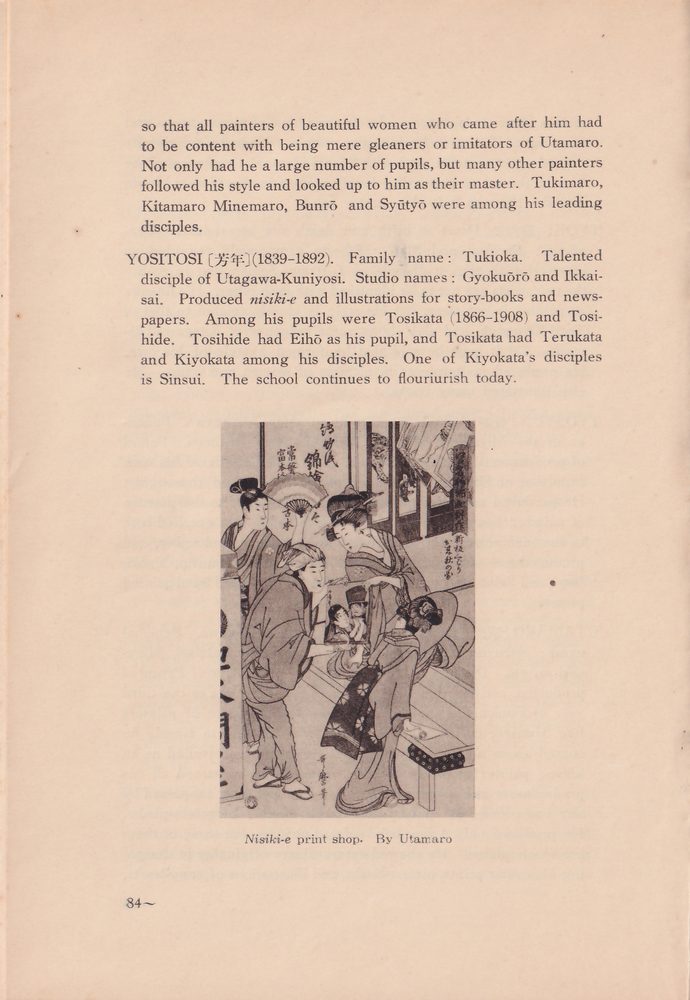
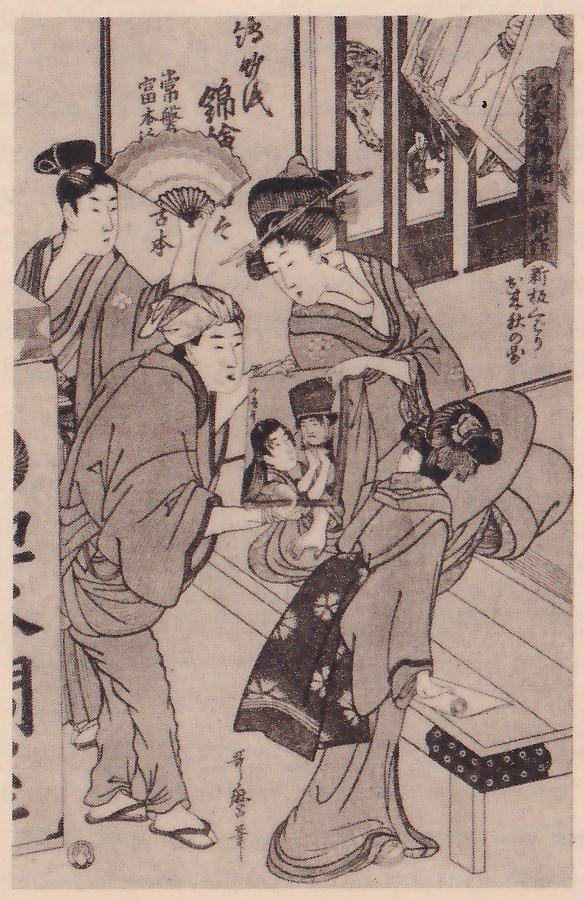
so that all painters of beautiful women who came after him had to be content with being mere gleaners or imitators of Utamaro. Not only had he a large number of pupils, but many other painters followed his style and looked up to him as their master. Tukimaro, Kitamaro Minemaro, Bunrō and Syūtyō were among his leading disciples.
YOSITOSI 〔芳年〕 (1839–1892). Family name: Tukioka. Talented disciple of Utagawa-Kuniyosi. Studio names: Gyokuōrō and Ikkaisai. Produced nisiki-e and illustrations for story-books and newspapers. Among his pupils were Tosikata (1866–1908) and Tosihide. Tosihide had Eihō as his pupil, and Tosikata had Terukata and Kiyokata among his disciples. One of Kiyokata’s disciples is Sinsui. The school continues to flourishPrinted: flouriurish today.