THE JAPANESE HOMESTEAD
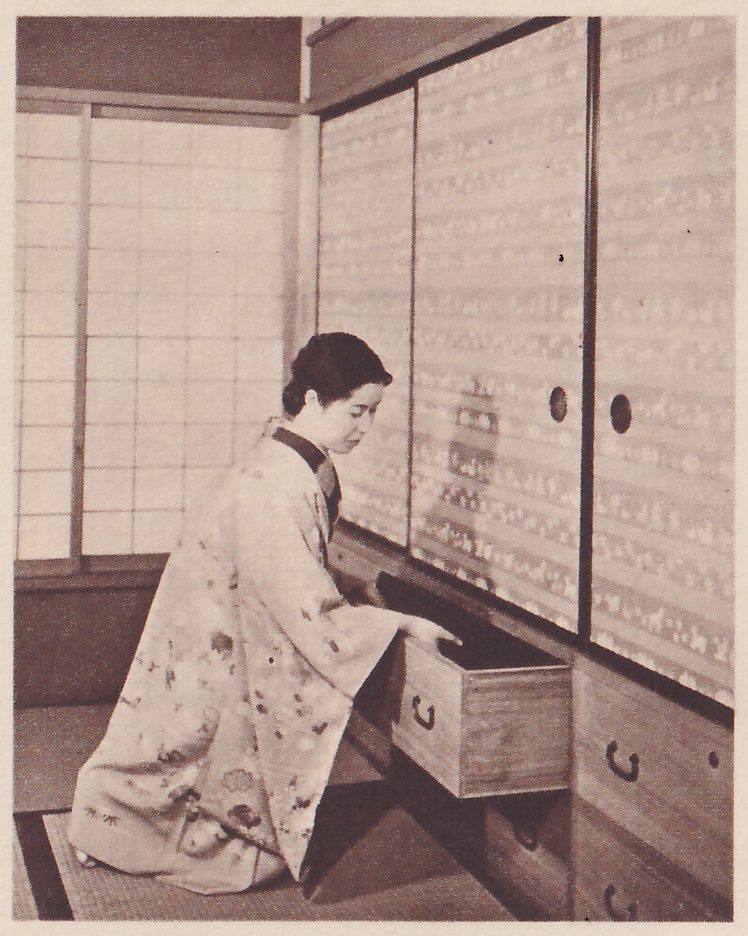
As far as outward appearances go, Japanese houses are the least pretentious part of the material life in the Empire. Except in busy modern cities they are for the most part wooden structures with tiled or thatched roofs, the floor covered with mats and the partitions generally made of “paper doors” sliding in grooves.
The comparative backwardness in modern Japanese architecture, excepting Buddhist temples and Shinto shrines, was due to the frequent outbreak of fires, earthquakes, volcanic eruptions and tidal waves which wrought havoc during the Tokugawa Period, and to the national isolation enforced during nearly 300 years which prevented the influence of Western architecture from penetrating this country. In the past half-century, however, Japan has awakened to a consciousness of this defect; and that she has been rapidly and energetically making up for the lost time is evidenced by the signs of modernization which may be seen everywhere. The most notable symbol of the remarkable progress made is the Diet building in Tokyo, completed in November, 1936, built entirely by Japanese architects and with home-produced materials. In its interior arrangement, a decorative scheme with original Japanese ideas has been embodied, and the great edifice stands a monumental demonstration of what Japan is capable of doing in modern architecture.
Falsified Prophecy
For all that, the underlying principles of the proper Japanese house are not forgotten. Time was, in early Meiji, when tidal waves of Westernism swept over the land, that the Japanese house was thought to be doomed, together with tea ceremony, flower arrangement, the Ogasawara etiquette, Kabuki drama and all other pre-Meiji arts and accomplishments. In 1885 the late Mr. J. M. Dixon, in the course of a lecture on a Japanese subject, said: “Japanese etiquette is rapidly giving way before the powerful thawing influence of Western customs. Its old bloom is gone beyond recall, for modern Japan is too busy over more important matters to busy itself with the minutiae of Cha-no-yu and other ceremonies.”
If this Japanologue came to life today he would open his eyes in sheer incredulity to see all the arts and ceremonies of old Japan he considered as doomed to disappear being revived in a more attractive form than ever dreamed of in Japan. Regarding the Japanese house, some of its principal features are now being adopted on board Japanese liners, in modern foreign-style hotels expressly built for foreigners and in the houses of Japanese residents in foreign countries.
There is an intimate link between the Japanese house and the Japanese life and character. Take the tokonoma, for instance. Without it, half the refinement of Japanese home life would be gone. It was originally said to be a sacred niche in which to deposit the image of the Buddha or a domestic shrine, but it has since become a place in which to hang scrolls and put an incense box, flower
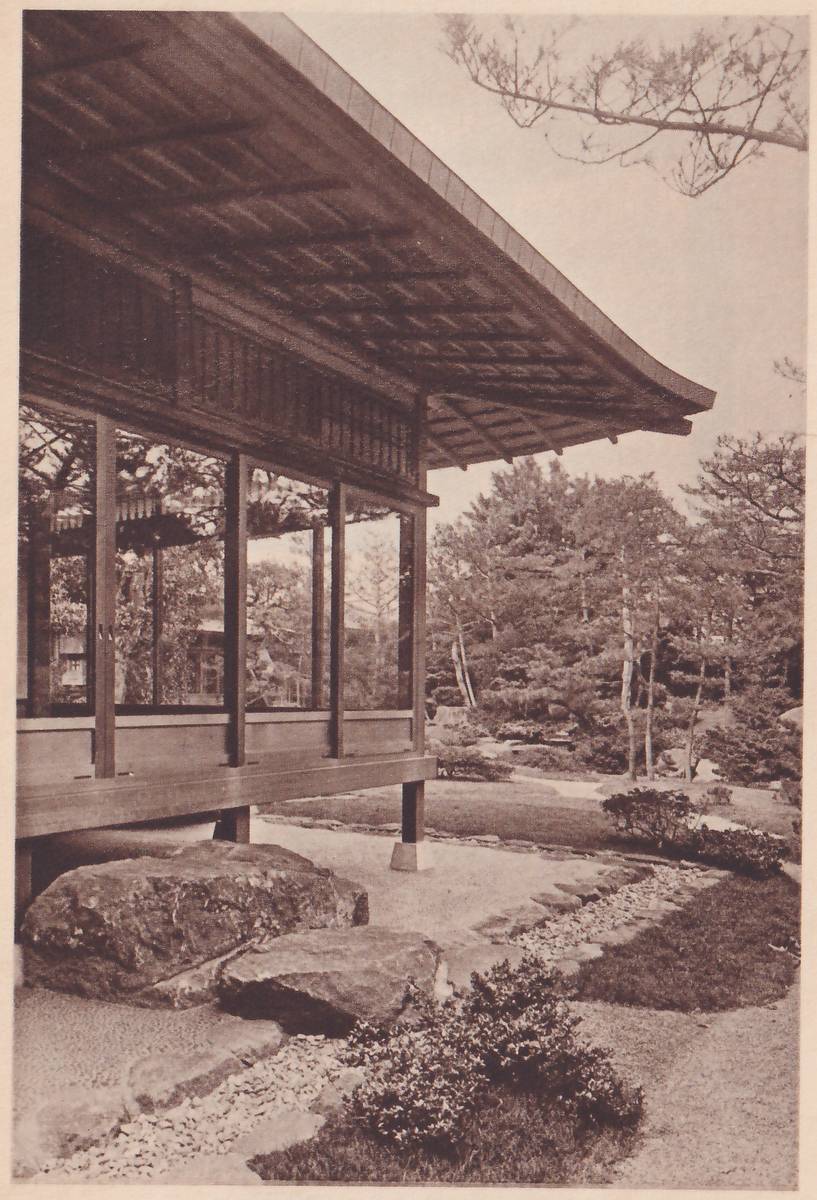
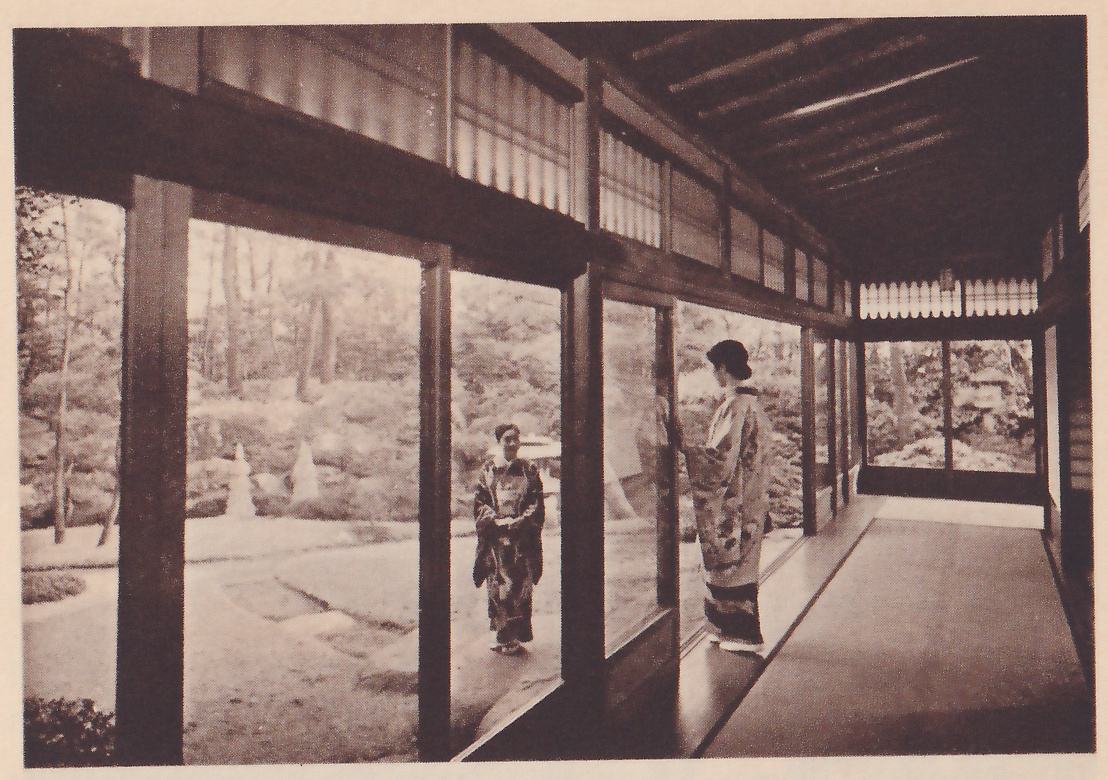
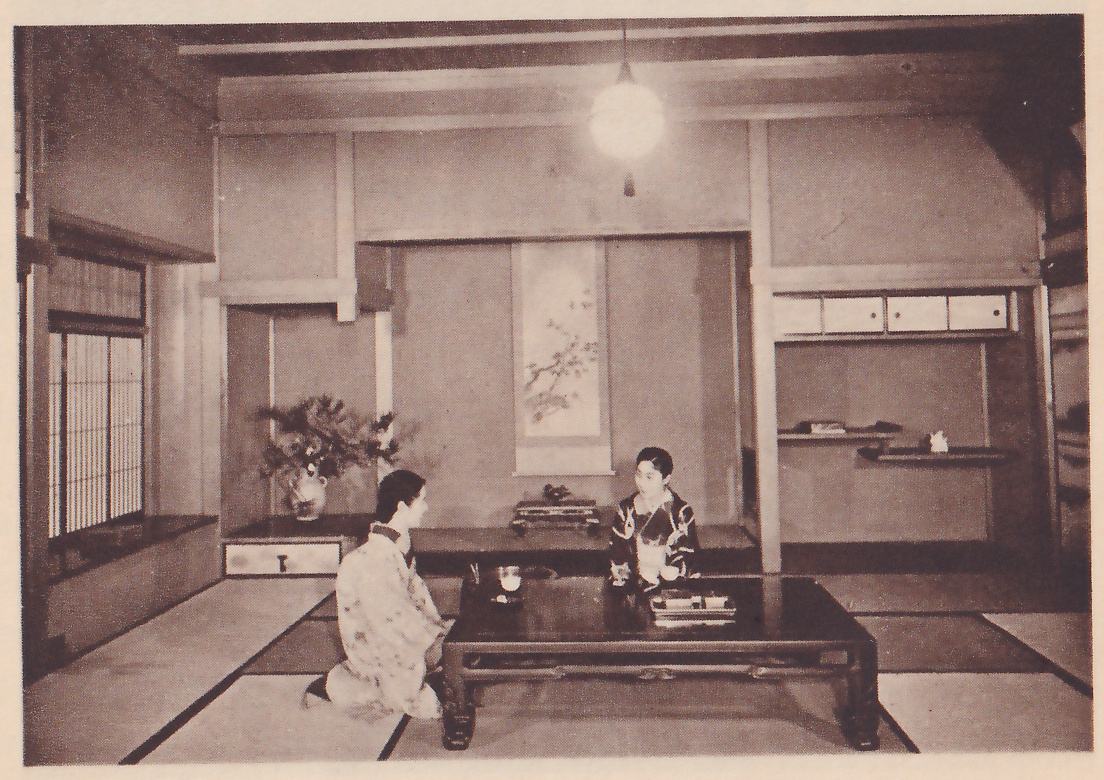
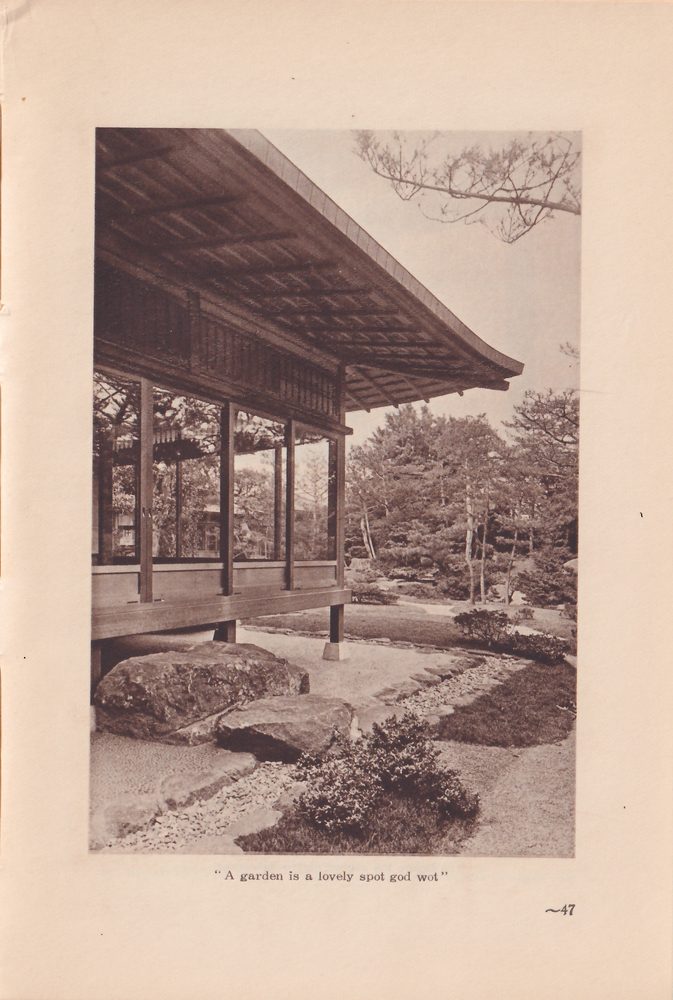
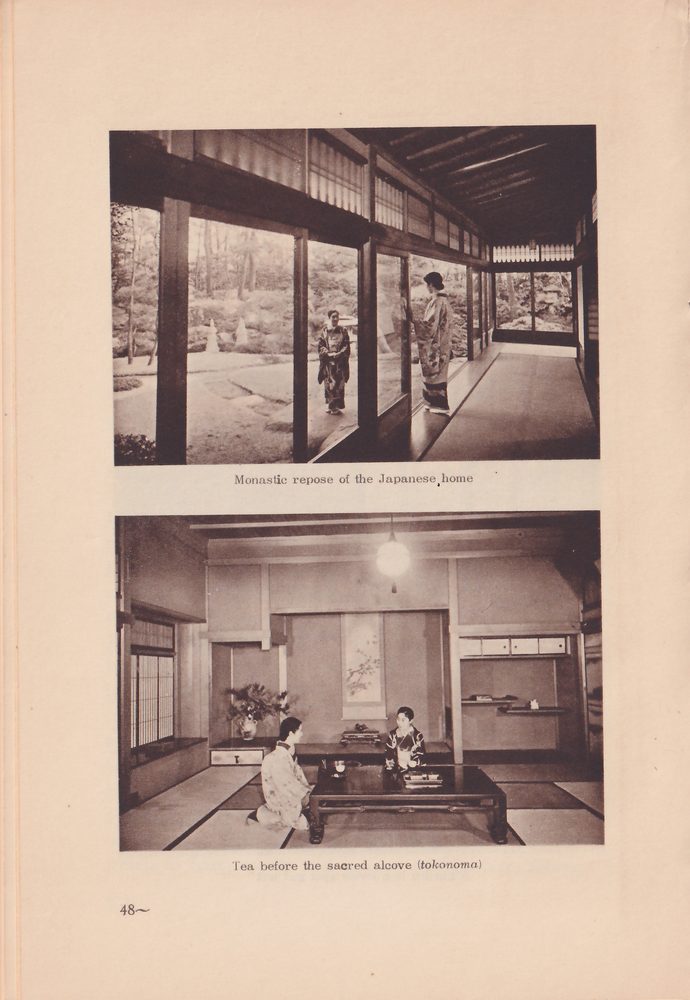
vase, etc. Where would be the tea ceremony without the tokonoma, or the tatami to sit on, and the landscape garden to look out upon?
Home, Not Castle
It has been said of the Englishman’s home that it is his castle, a bulwark of his liberty, but the Japanese house has no such bellicose associations. A European house savours strongly of a mediaeval castle with high walls around it, doors hermetically sealed and small windows like loopholes looking out into the world below. In it the chambers are partitioned from one another and are locked on the inside, like so many cells in a dungeon; in which the occupants surround themselves with trophies of battle and hunting, revelling in the sense of comfort and security in contrast to the cold and stormy weather which is raging in the world outside. Its inside arrangement reminds us of the Tower of London or the Kremlin of Moscow upon a diminutive scale—palace, museum, prison, fortress combined.
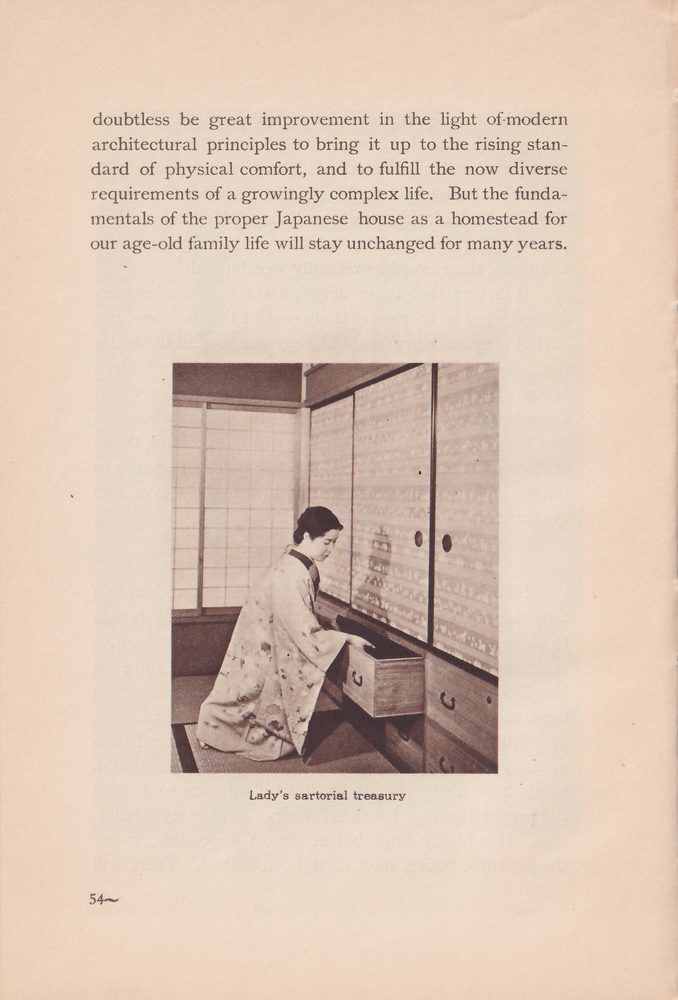
The Japanese house suggests nothing of the kind. It stands exposed to the four corners of heaven, the sun creeping into the furthest corners. If there is no privacy, strictly speaking, privacy is unnecessary in a well-regulated house, as it too often is a source of intrigue or conspiracy. Inside, it has room, rather than rooms, for the whole house is thrown into one big space the moment the paper doors are removed from their grooves. If there is no superfluous furniture, it is only invisible, being stowed away in the oshiire, or the stronghouse at the back, not necessarily an evidence of poverty. It is considered vulgar to
display unnecessary furniture, as a woman putting rings on all her fingers would be.
It has been said and with good reason that the Japanese house has probably been developed from the native bungalow in the tropical regions from which some of the Japanese ancestors may have migrated to Japan. Yes, the Japanese house has all the laughing and loud-talking qualities of the warmer south in which the inhabitants love to lounge on the wide verandah, basking in the sun, talking freely with their neighbours across a smiling garden of flowers and birds. It has had nothing to do with the ice-bound stone-house of the arctic zone in which men and women are huddled together in dark, gloomy silence. So the Japanese house is more fit to live in during summer than winter, but, as the human skin is weakening, under the softening influence of growing wealth and luxury, better means are being studied to take the sting of wintry cold from it.
Gods and Buddhas
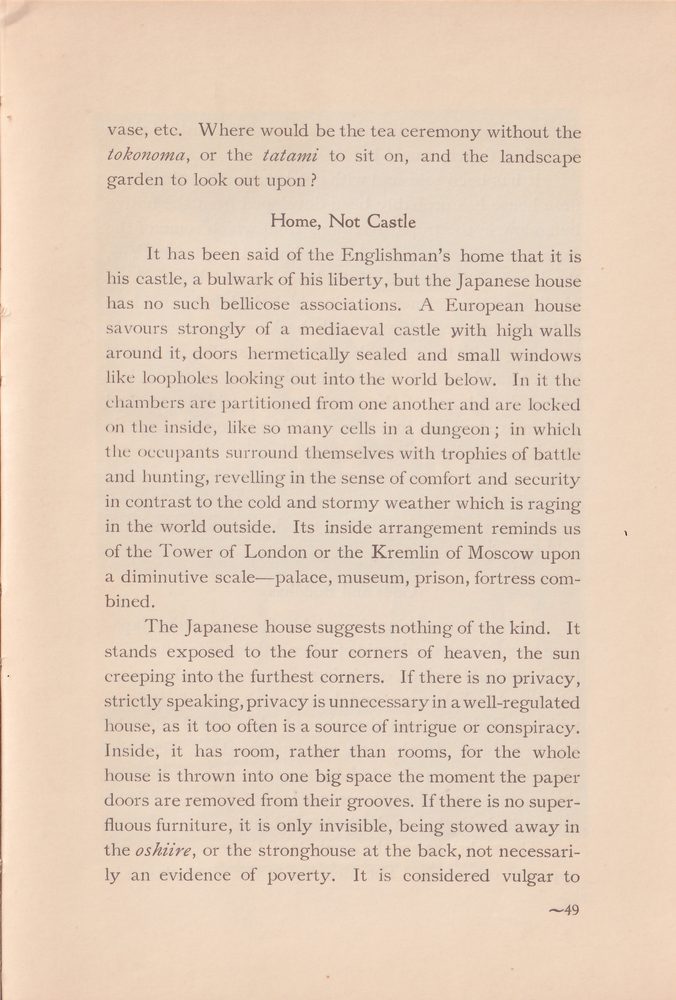
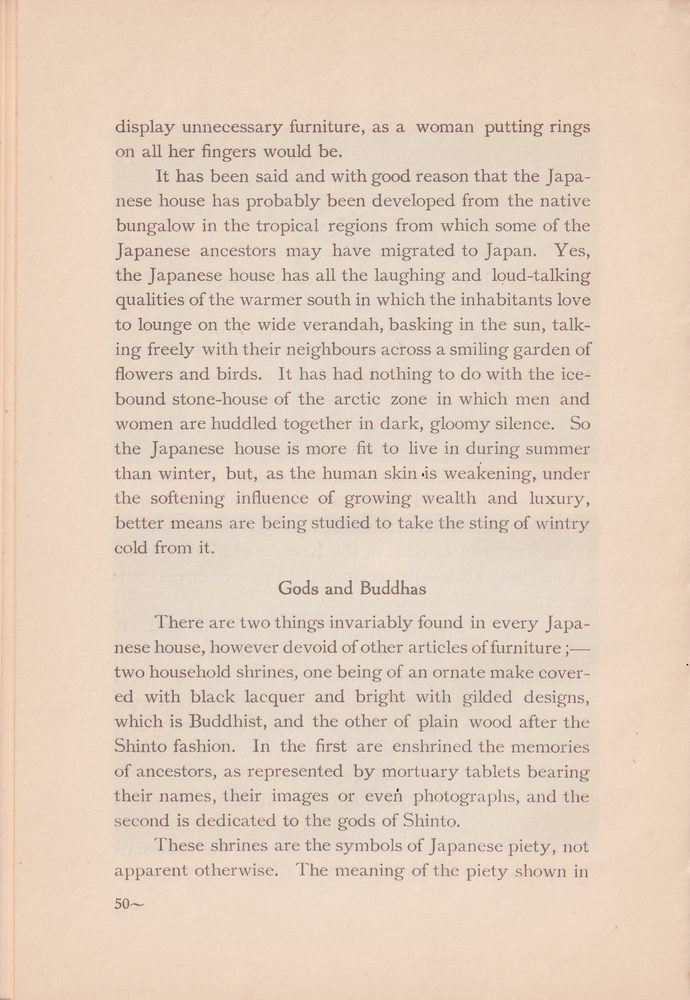
There are two things invariably found in every Japanese house, however devoid of other articles of furniture;—two household shrines, one being of an ornate make covered with black lacquer and bright with gilded designs, which is Buddhist, and the other of plain wood after the Shinto fashion. In the first are enshrined the memories of ancestors, as represented by mortuary tablets bearing their names, their images or even photographs, and the second is dedicated to the gods of Shinto.
These shrines are the symbols of Japanese piety, not apparent otherwise. The meaning of the piety shown in
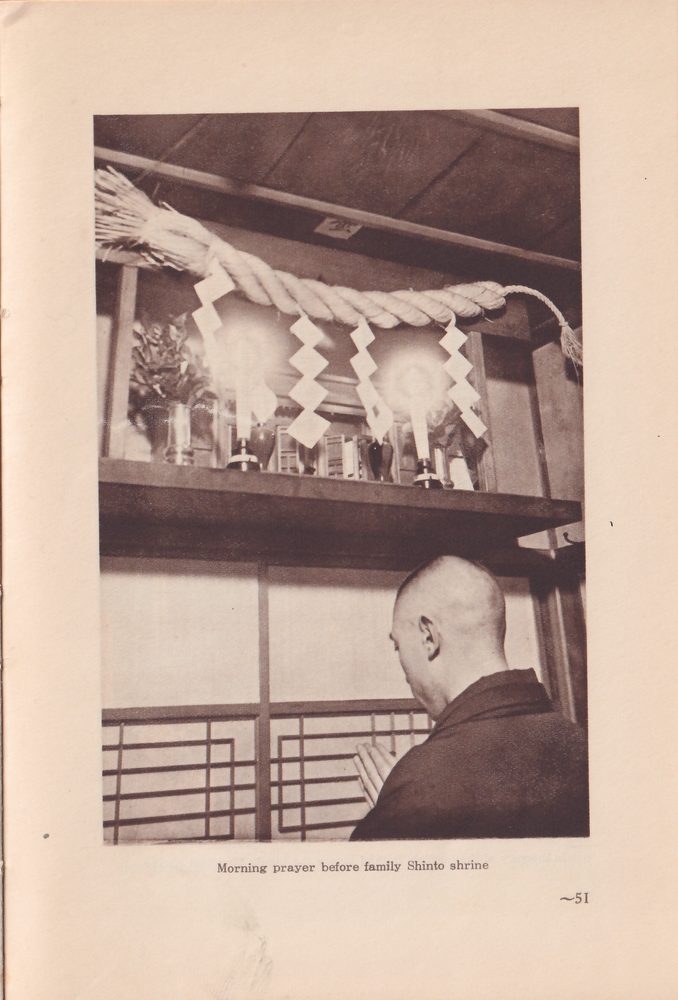
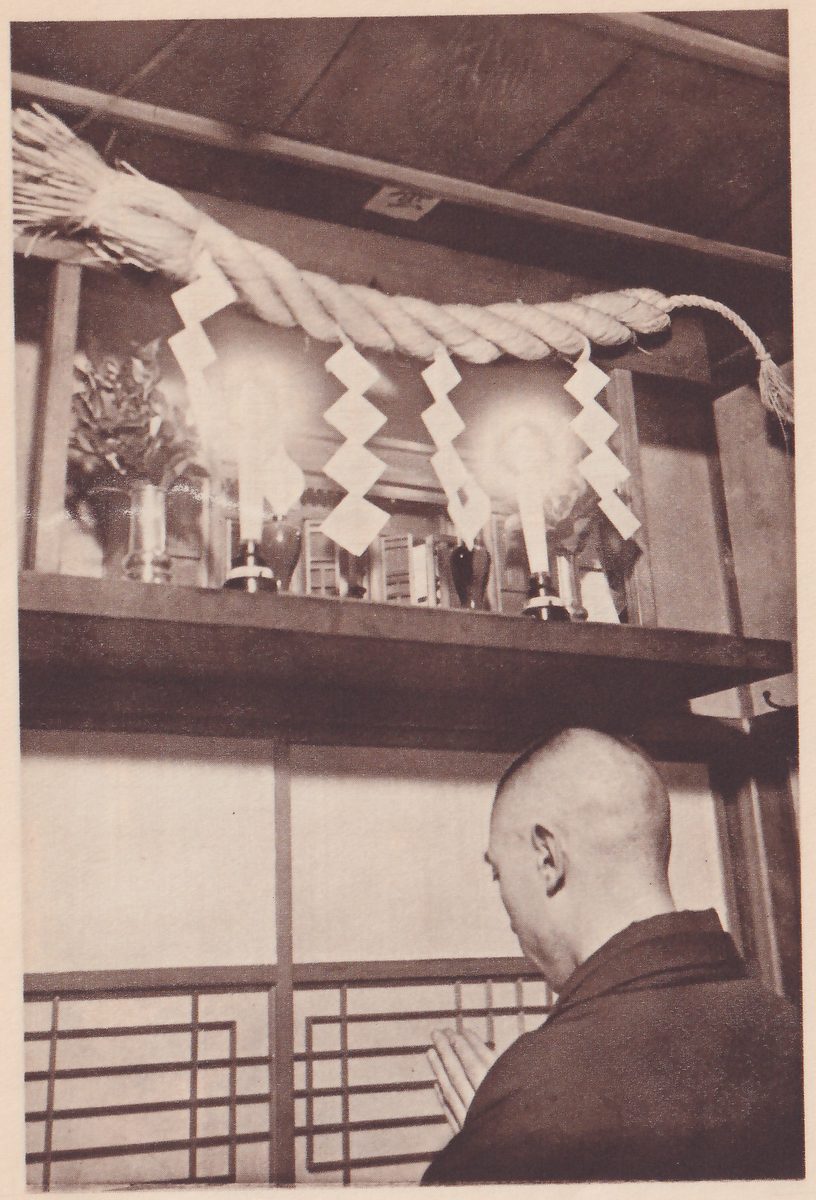
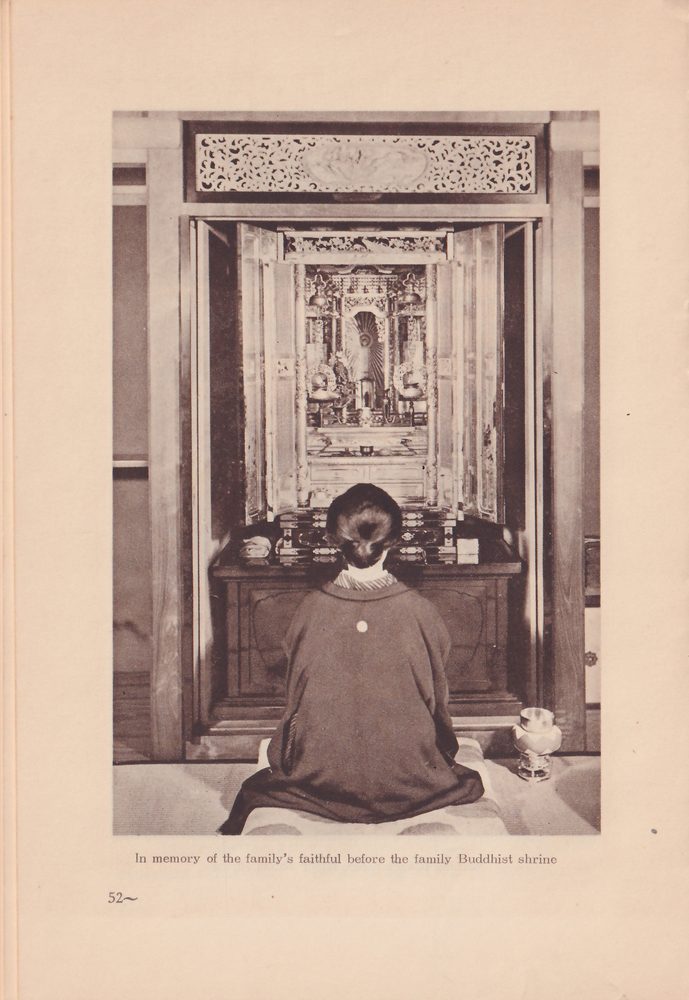
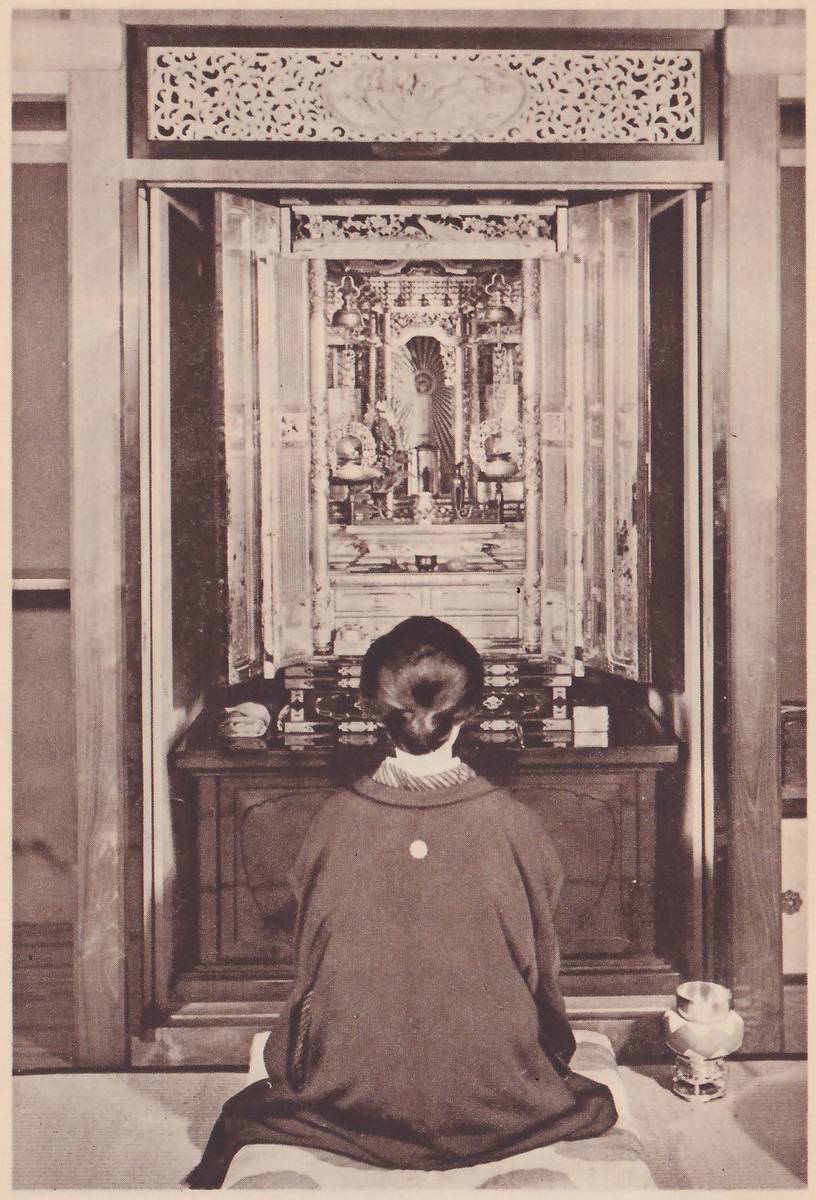
the daily worship at these altars is quite simple. Buddha belongs to a sacred region above this world to which men must go after this sublunary life is over, so his grace must be invoked both for themselves and for their dead relatives. The Shinto deities are the guardians of this land of Nippon, keeping it secure from calamity and foreign enemies, and must, therefore, be gratefully worshipped.
It is true that these devotional acts are often performed more as matters of daily routine than as conscious acts of religious devotion, but they cannot fail to shed a purifying and sanctifying light on the house. Children brought up in such an atmosphere will come to believe that there are somewhere in the house the souls of ancestors and the gods of the land watching them, protecting them, ready to punish if wrong is done but merciful enough to forgive if forgiveness is asked with penitent prayer and atonement.
Japanese Houses will Last
Since the Imperial Restoration began more than half a century ago, it has become customary for many homes to place in the tokonoma, or in the shelf adjoining it, a portrait of the Emperor or some member of the Imperial Family, in the same spirit in which our forbears observed the custom of worshipping the Shinto gods at home.
All these characteristic acts of piety and other habits of daily life, bequeathed to us from time immemorial, would have to be greatly modified if we were to discard the proper Japanese house in favour of foreign-style buildings. It is highly improbable, almost impossible, to see the Japanese house, such as it is, abolished. There will
doubtless be great improvement in the light of modern architectural principles to bring it up to the rising standard of physical comfort, and to fulfill the now diverse requirements of a growingly complex life. But the fundamentals of the proper Japanese house as a homestead for our age-old family life will stay unchanged for many years.