

III. HOW TO SEE AND STUDY JUDO
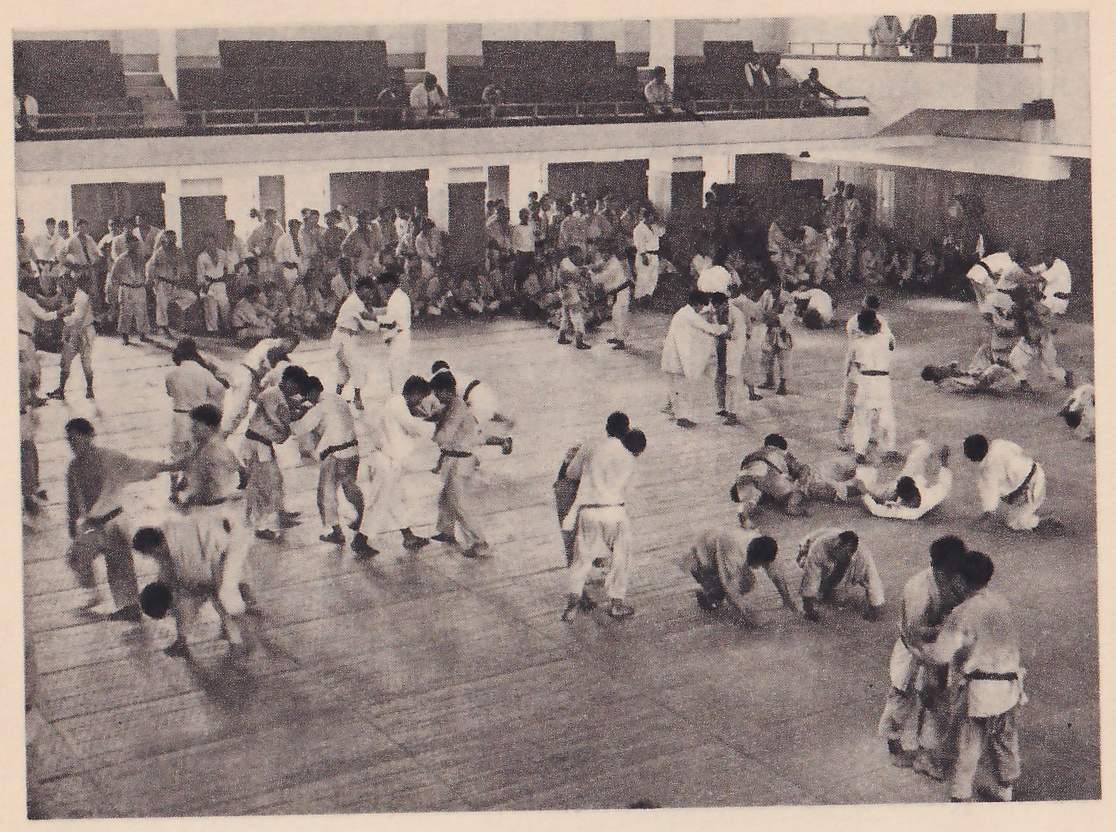
There are many things necessary for the practice of Jūdō, among which the following are noteworthy:—
1. Dojo or Exercise Hall
The Dōjō, or exercise hall for Jūdō, is used chiefly for Randori and Kata, and also for Judo matches. Sometimes it is also used for lectures, or for the exchange of questions and answers. It must be a hall having quilted mats. It must also be surrounded by panels of about the shoulder’s height, and all nails, and pillars with angles must be eliminated to prevent any danger in running against them.
If the mats are torn, or if there are openings between them, or even if they are laid unevenly, there is a risk of danger. The origin of the name “Dōjō” is found in Buddhism, and means a “Buddhist monastery.” The hall, therefore, must be as clean as possible, and within it there should always be that solemn and sacred atmosphere which ought to prevail in every place of worship or mental training.
2. Judo-gi or Costume for Judo
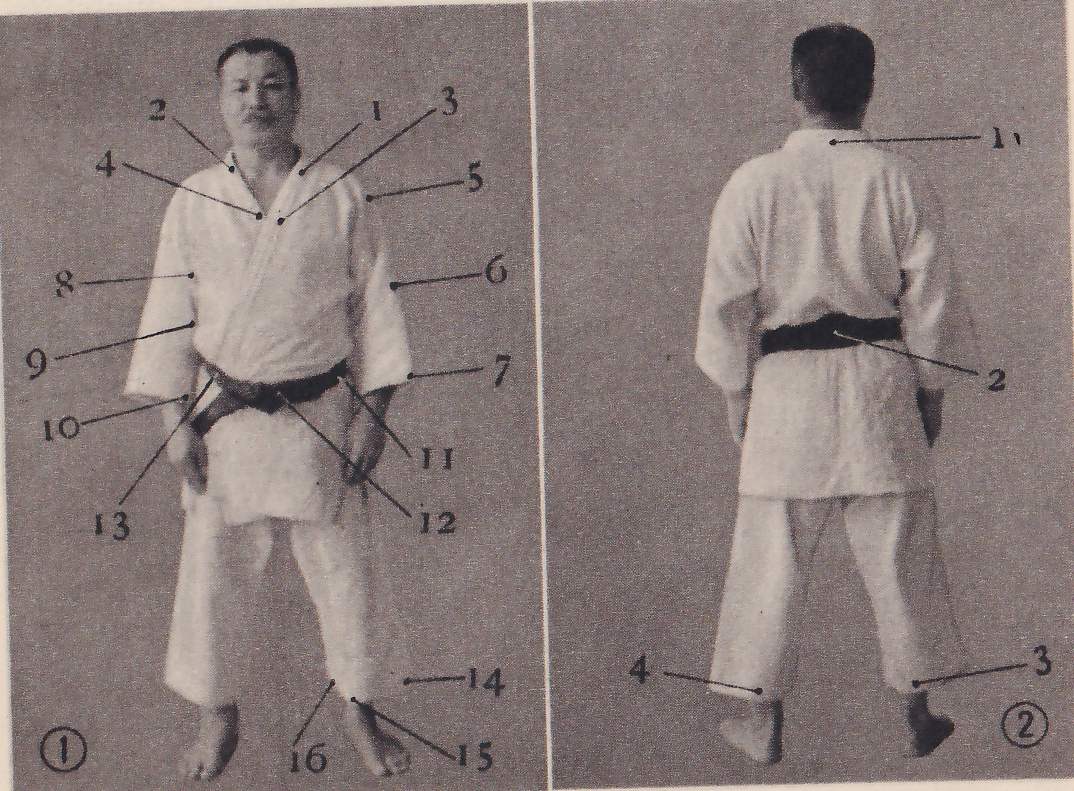
The costume to be worn while practising consists of a coat, trousers and belt. They are shown in the accompanying illustrations. The costume is white, and the belt is of a different colour according to the grade of practice. These grades are as follows:—
(a) A black belt in the first five Dan* grades of qualified students;
(b) A striped belt of red and white from the sixth through the ninth Dan grade;
(c) A red belt in the tenth and all higher Dan grades. (Those who hold sixth and all higher Dan grades may also use the black belt for their respective belts above-mentioned;)
(d) A white belt is used by all students unqualified for the Dan and Kyū grades;
(e) A brown belt is used from the third Kyū
*The course of Jūdō is divided into two grades or ranks called “Dan” and “Kyū.” In the Dan grades, the numbers increase to indicate the higher grade, but in the Kyū grades, it is different: thus the first Kyū grade follows the first Dan grade.
grade to the first Kyū grade of the senior division (adults);
(f) A violet belt is used from the third Kyū grade to the first Kyū grade of the junior division (boys).
Those who hold Dan or Kyū grades in the women’s division, which correspond to those of the men’s division mentioned above, should use respectively the red, red and white, black, brown or violet belts with white stripes around the middle.
The names of each part of the costume are as follows:—
Illustration No. 1. (Left)
1. left-side-collar 2. right-side-collar
3. left-front-collar 4. right-front-collar
5. left-outer-upper-sleeve 6. left-outer-middle-sleeve
7. left-outer-lower-sleeve 8. right-inner-upper-sleeve
9. right-inner-middle-sleeve 10. right-inner-lower-sleeve
11. left-side-belt 12. front-belt
13. right-side-belt 14. left-outer-bottom-trousers
15. left-front-bottom-trousers 16. left-inner-bottom-trousers
Illustration No. 2. (Right)
1. back-collar 2. back-belt
3. right-back-bottom-trousers 4. left-back-bottom-trousers
(14, 15 and 16 of Illustration No. 1 show the names of the left trouser; but those of the right trouser correspond respectively to the left one.)
3. Salutation and Manners in the Exercise Hall
As the salutation is an expression of respect for others, it should be made both before and after Kata and Randori, as well as before and after the match. Both Kata and Randori are by nature methods of contest and the combatants must pay respect to each other both before and after the exercise. In this way we express our state of mind, viz., that we only contend for perfection in the technique and practice of Jūdō, so that the contestants must respect each other.
There are two forms of salutation: one is made sitting and the other standing.
Sitting salutations should be made as follows: the combatants sit facing each other with a space of about 5 feet between them. (See Fig. 1.) The insteps should be close to the mat; the hips rest on the heels; the hands are on the mat with the finger-tips turned slightly inward, and when making a bow the back of the head should be as low as the shoulders. (See Fig. 2.) This is a formal sitting salutation, and must always be made before and after practising Kata. As it takes too much time to observe at
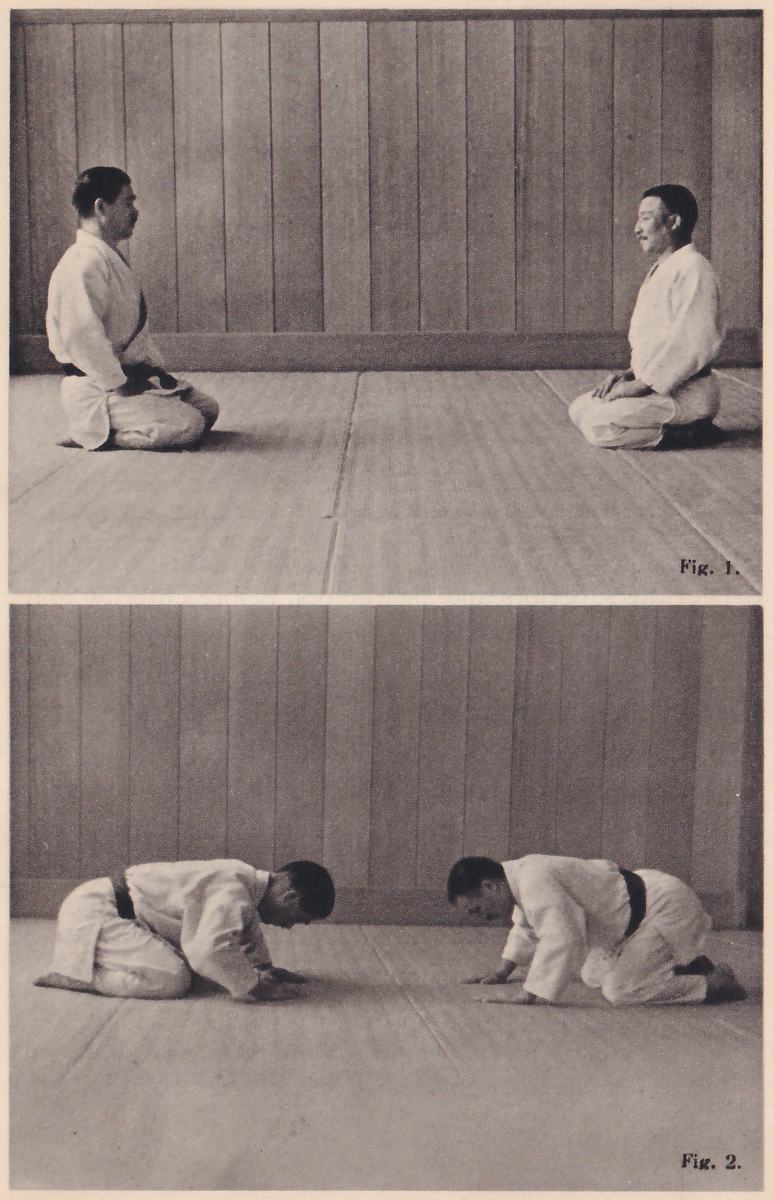
ordinary times, contestants are permitted to abbreviate it somewhat before and after the practice of Randori. In this case, it is permitted to have the toes and hips raised; however, the movements of hands and head must always be formal, as previously described.
Standing salutations should be made in the following manner: combatants should stand face to face with more room between them than when sitting, as shown in Fig. 3. Then the salutation is made as shown in Fig. 4.
According to the time and circumstance, salutations may be made from a greater distance than that mentioned above, but they should always be made sincerely.
Salutations must be made not only between the combatants as in Kata or in Randori, but also toward the dais of the superiors and instructors, before entering and leaving the hall.
There are many other things which the novice must learn in addition to the salutations. First, the Jūdō hall is a place for culture, and one must, therefore, compose oneself and behave seriously without talking idly or acting noisily. Both at the time of practice and during the match one must apply the fullest energy to every exercise. Even at the time of repose, one must maintain a good deportment and be attentive to others who are doing exercises, and by watching them learn some lessons which are helpful for improving oneself. Finally, co-operation should be the ruling spirit to keep the hall well arranged and to maintain order, since it is the common house for all who use it.
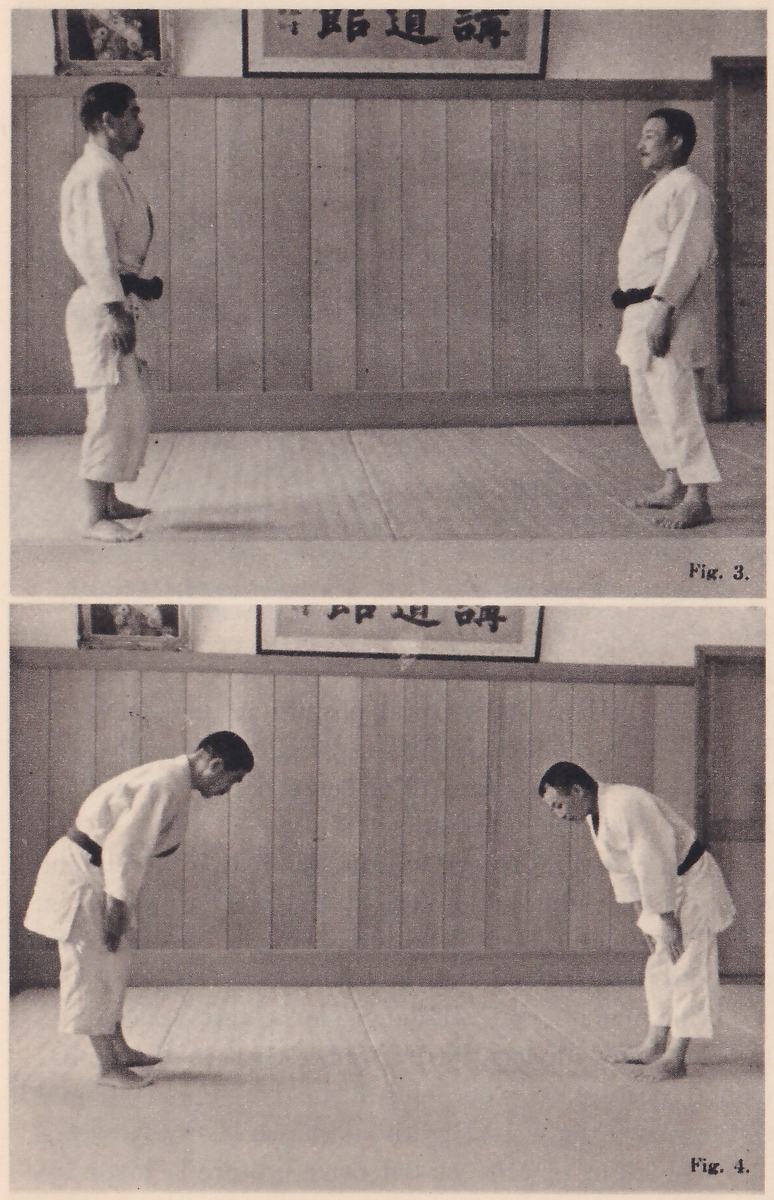
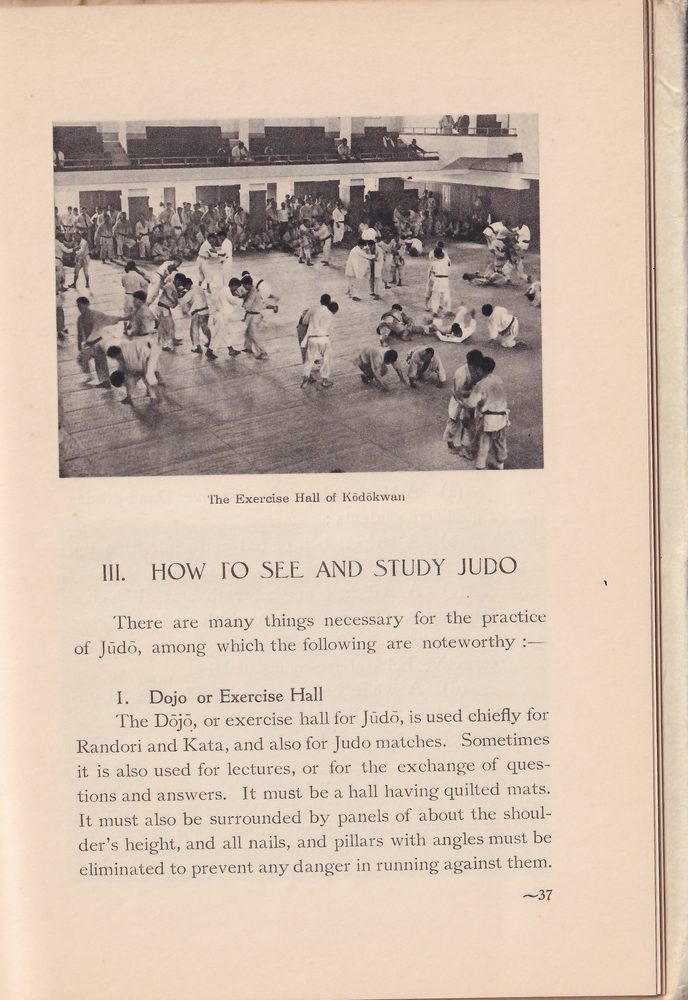
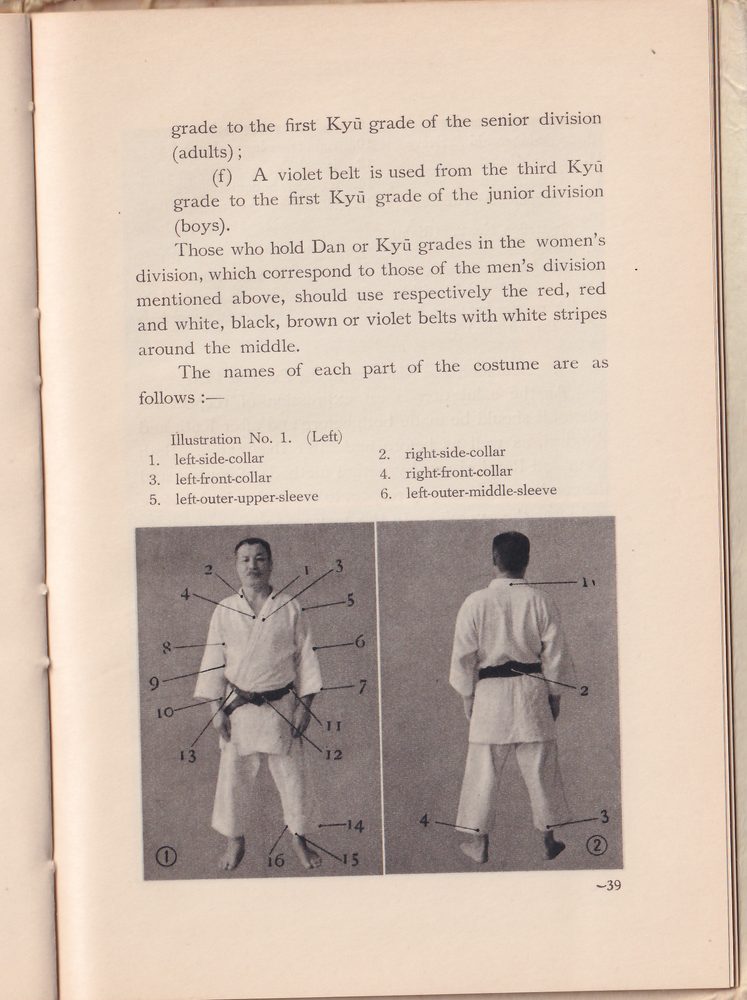
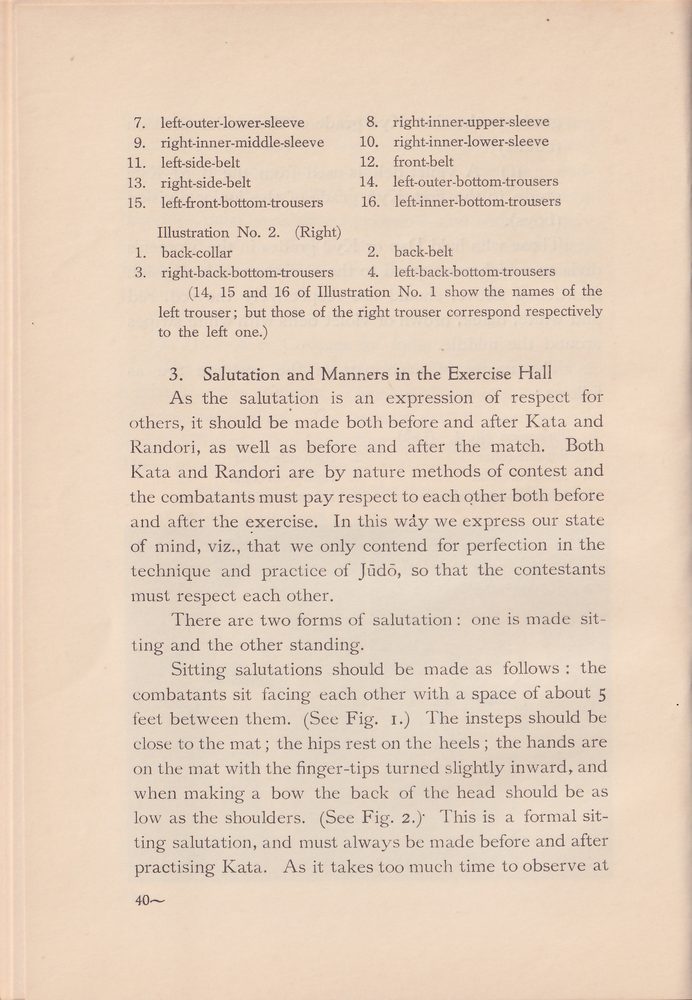
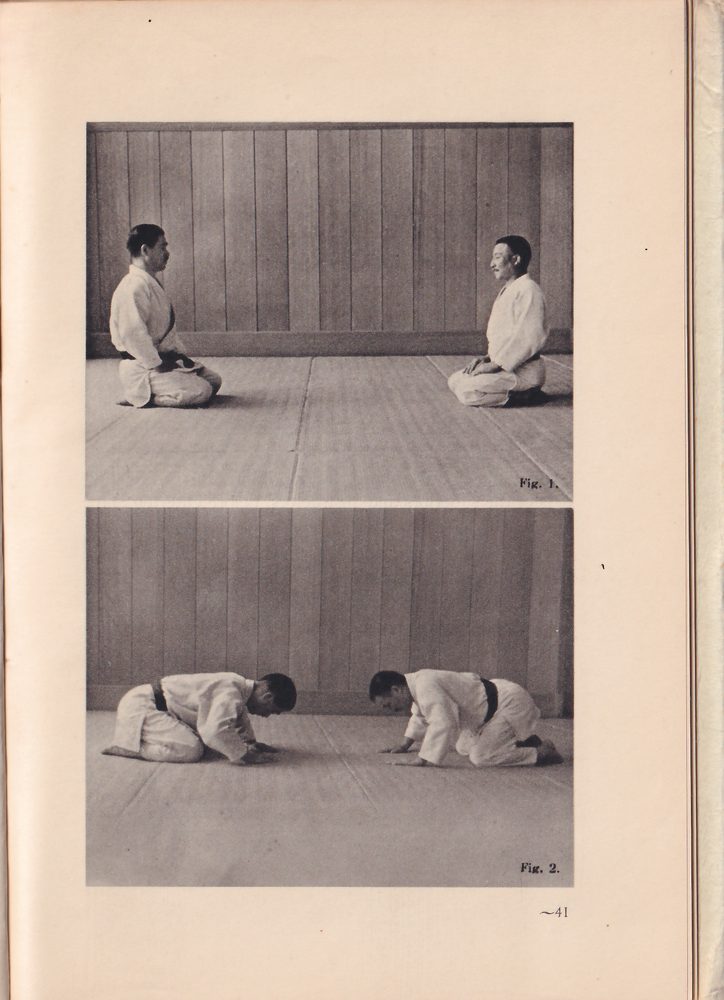
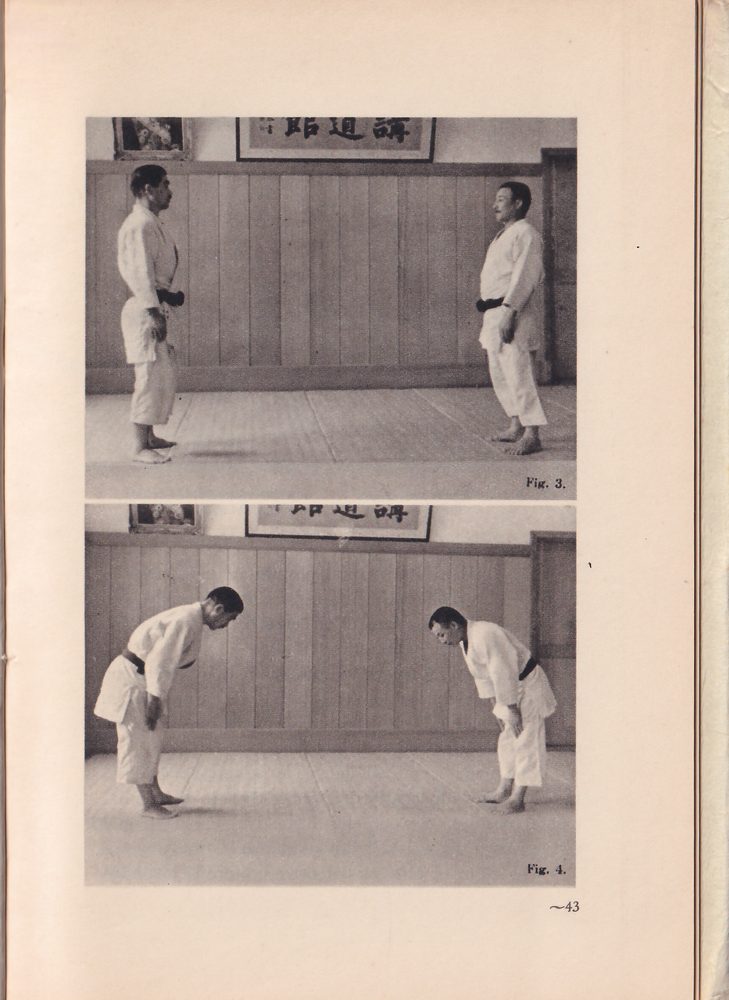
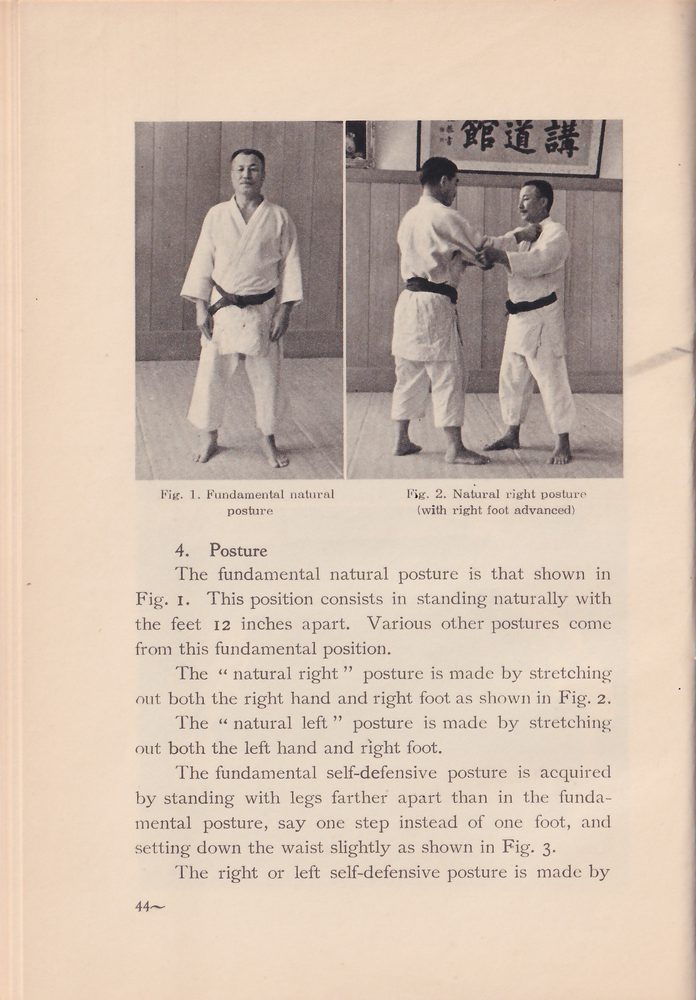
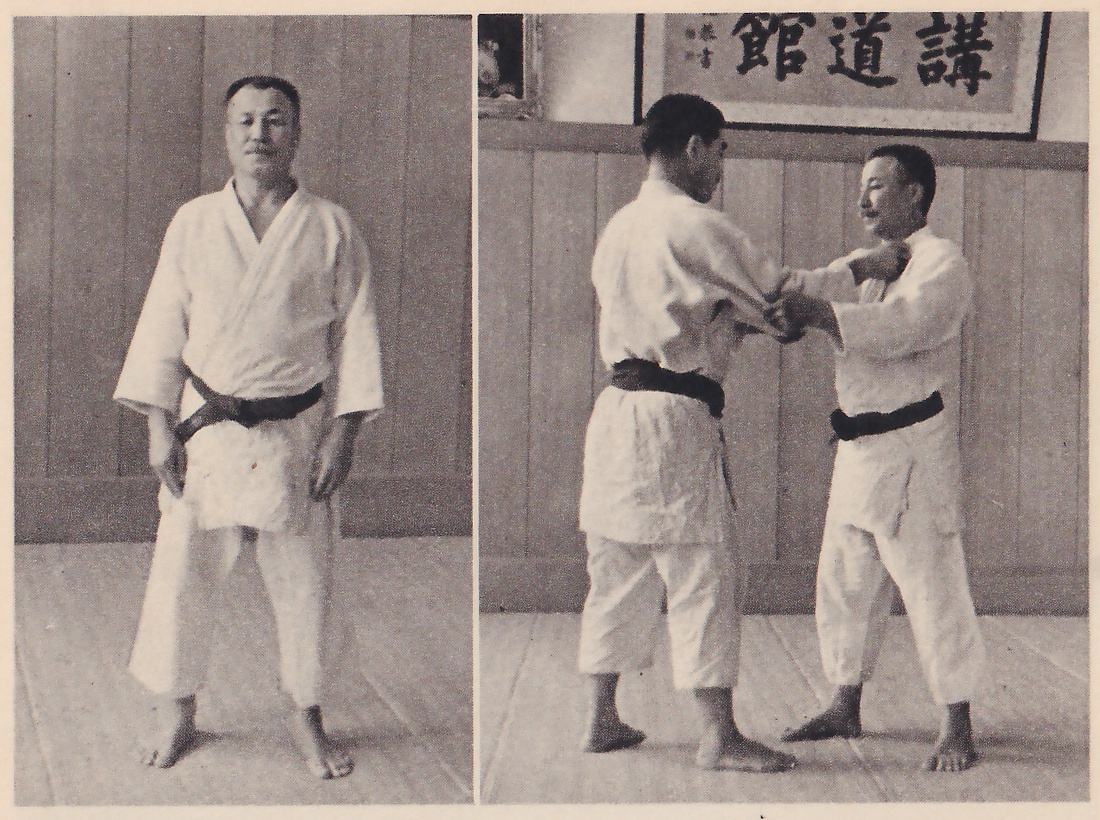
Fig. 2. Natural right posture (with right foot advanced)
4. Posture
The fundamental natural posture is that shown in Fig. 1. This position consists in standing naturally with the feet 12 inches apart. Various other postures come from this fundamental position.
The “natural right” posture is made by stretching out both the right hand and right foot as shown in Fig. 2.
The “natural left” posture is made by stretching out both the left hand and right foot.
The fundamental self-defensive posture is acquired by standing with legs farther apart than in the fundamental posture, say one step instead of one foot, and setting down the waist slightly as shown in Fig. 3.
The right or left self-defensive posture is made by
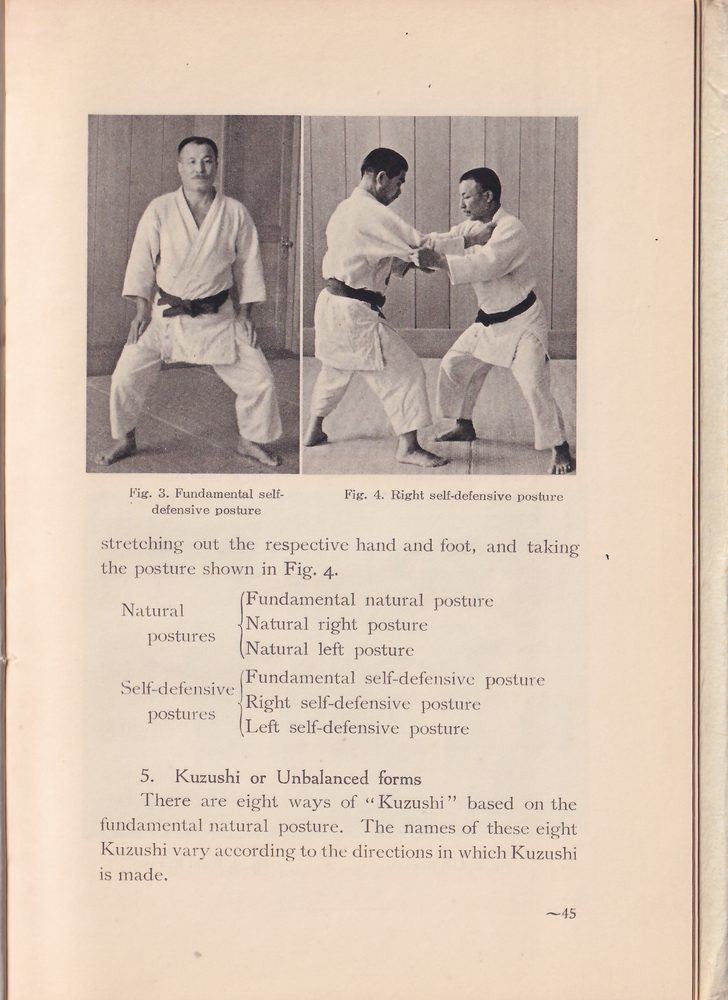
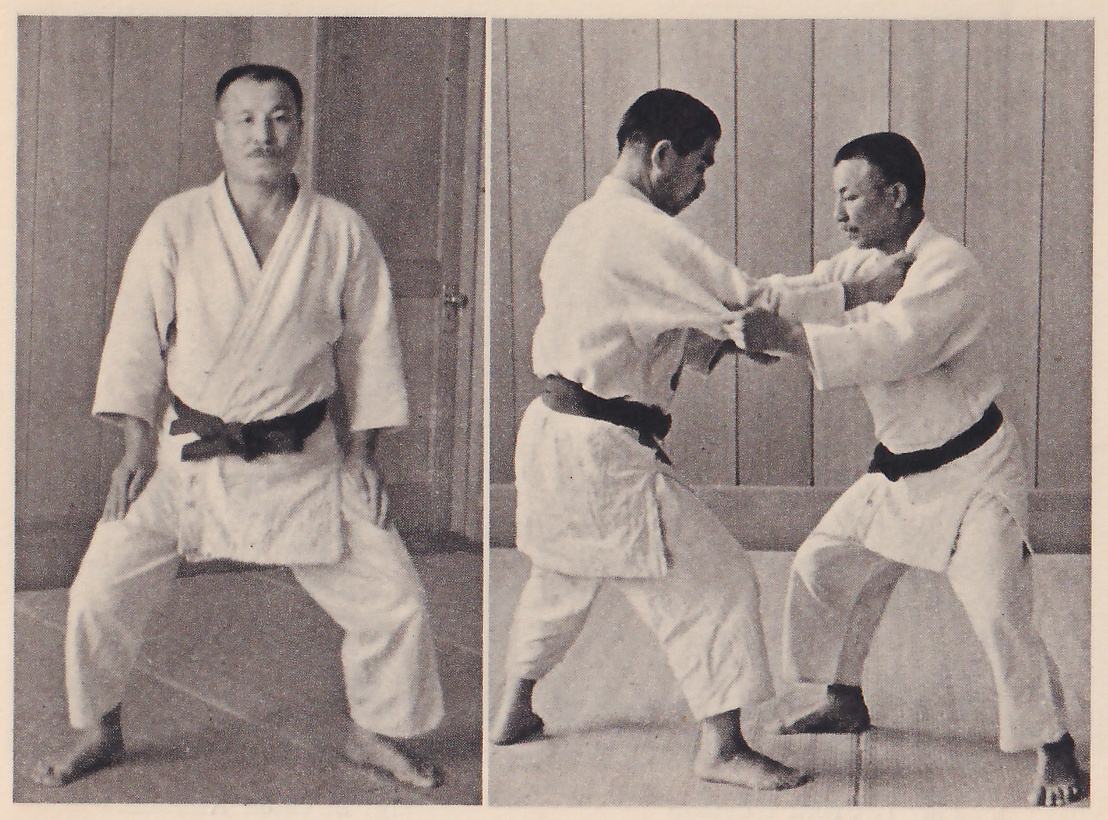
Fig. 4. Right self-defensive posture
stretching out the respective hand and foot, and taking the posture shown in Fig. 4.
| Natural postures | Fundamental natural posture Natural right posture Natural left posture |
|---|---|
| Self-defensive postures | Fundamental self-defensive posture Right self-defensive posture Left self-defensive posture |
5. Kuzushi or Unbalanced forms
There are eight ways of “Kuzushi” based on the fundamental natural posture. The names of these eight Kuzushi vary according to the directions in which Kuzushi is made.
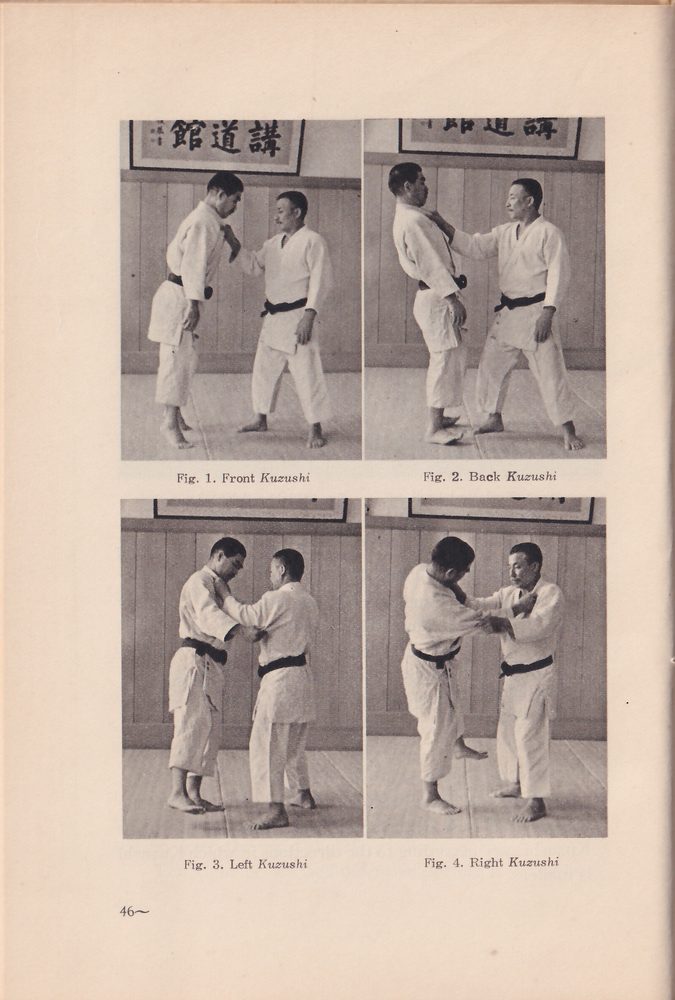
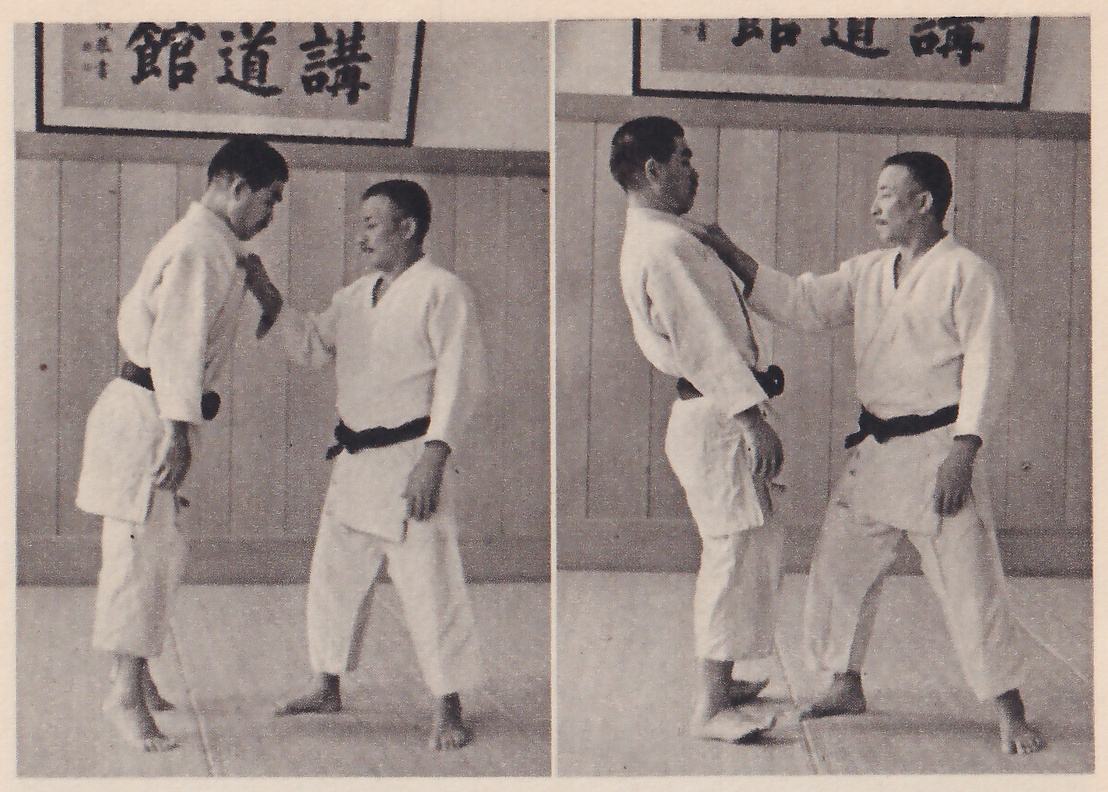
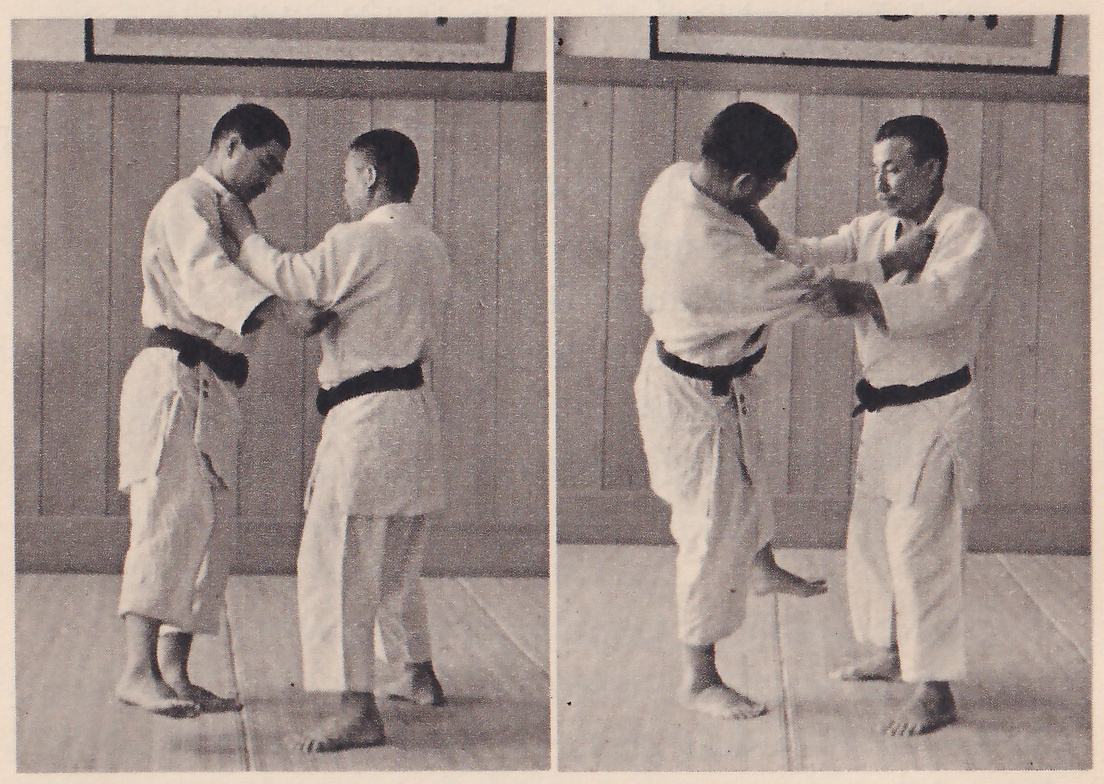
Fig. 2. Back Kuzushi
Fig. 3. Left Kuzushi
Fig. 4. Right Kuzushi
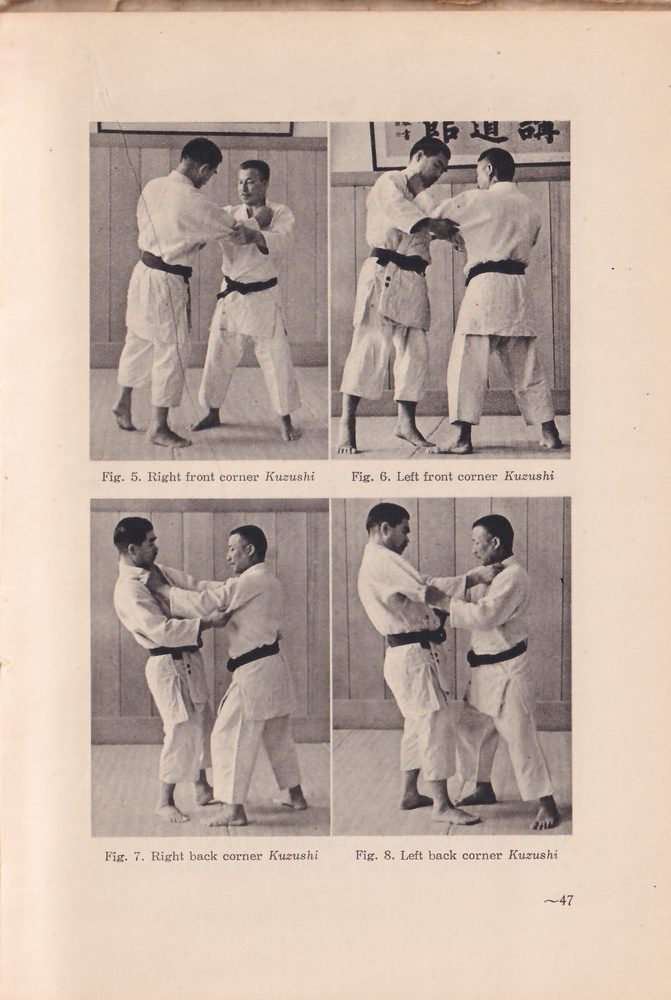
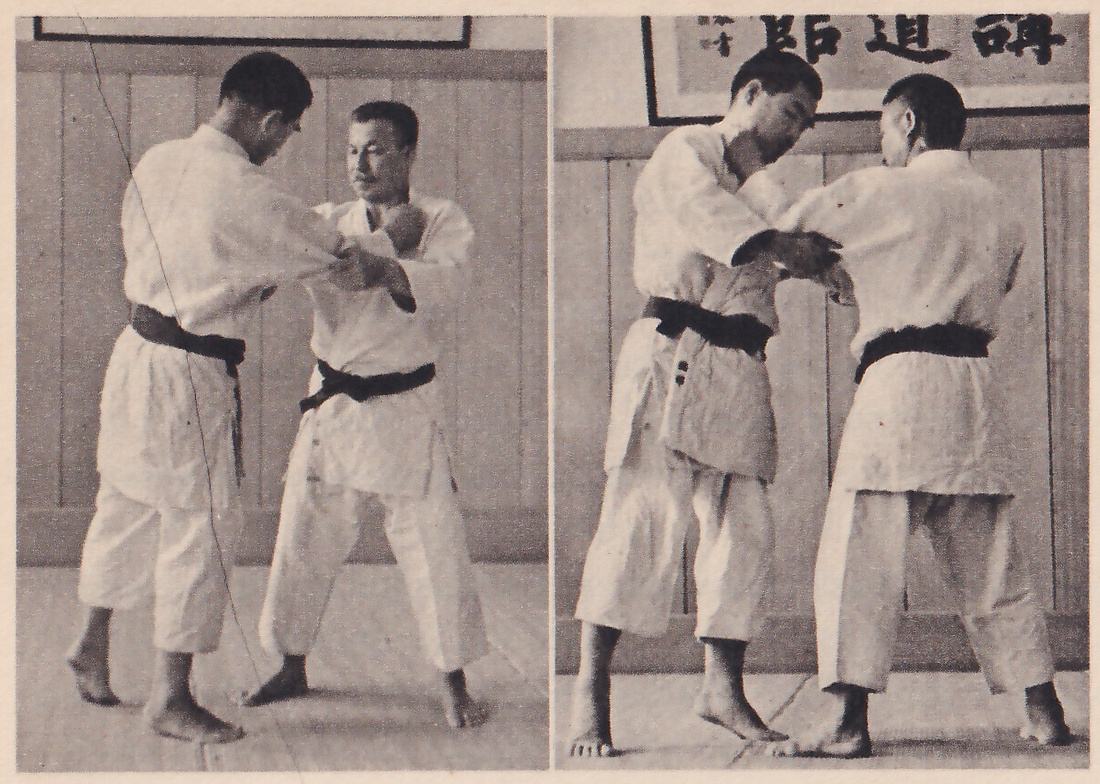
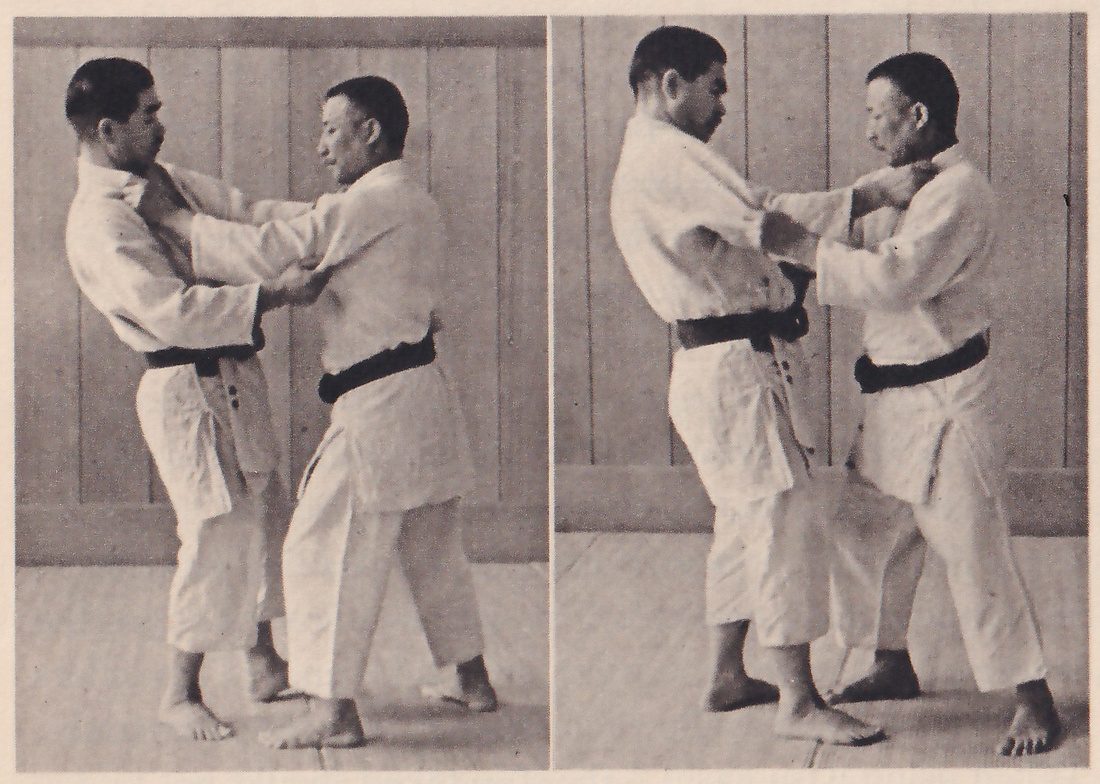
Fig. 6. Left front corner Kuzushi
Fig. 7. Right back corner Kuzushi
Fig. 8. Left back corner Kuzushi
6. Hygiene
If one wishes to secure the best results from this practice one must consistently observe moderation in eating, drinking and sleeping. One must also as a matter of course refrain from eating and drinking during the exercises, as well as immediately before and after the exercises. In order to obtain sound sleep one must finish without danger of being disturbed. Keeping one’s body clean and wearing neat clothes is necessary not only for health but also out of consideration for others. Besides, one should remember to pare one’s nails, not to neglect mending one’s clothes, and to make oneself comfortable before beginning. During the exercises one should close the mouth and breathe through the nose.
7. Movement
“Movement” means the manner of advancing or retreating—forward or backward, to the left or right, from the place which has been occupied. Each detail of this will be explained fully when Randori is given. Only its principle will be mentioned here.
Whenever one moves one’s body forward or backward, to the left or right, or turns in any direction, the weight of the body should be on the leading foot. When one gets close to the combatant, “tsugiashi” must be used. (In this one foot is used as the leading foot, while the trailing foot comes up to within a few inches of the leading foot before the next step is taken.) This differs from the ordinary walk when the feet are used alternately. When using “tsugiashi,” the step taken should not be too wide, nor should both feet be brought together.
Speaking of the movement, we must here call attention to one important point. When a contestant is pushed by an opponent in Randori practice, he should pull the opponent more than he is pushed without losing his own balance; also, when he is pulled by his opponent he should push the opponent more than he is pulled without losing his own balance. In this way he can break the opponent’s posture or balance and thus make his attack against the opponent easier.
8. Tsukuri or Fitting Action for Attack, and Kake or Attack
To break the opponent’s posture or balance so as to make one’s attack easier while holding oneself ready at the same time to attack the opponent, is called Tsukuri or “the fitting action for attack.” To attack the opponent with effective technique, while his posture has already been broken by Tsukuri, is named Kake or attack.
In practising Randori, especially in studying the technique of throwing, it is advisable to emphasize first the importance of Tsukuri and later to make an effort toward the practice of Kake. This is because when one has mastered Tsukuri the technique may be effective, though the Kake or attack is not so hard. On the contrary, if one has not yet mastered Tsukuri, the technique might not be effective against a strong opponent though Kake were done well; and if the opponent is weak, it is possible to hurt him. The technique, therefore, should be used when the opponent’s posture or balance is lost of itself, or after it has been lost by pushing, pulling, turning, luring, etc.
In addition to what has been said about throwing the opponent off his balance, it is also necessary to hold oneself ready to attack. This means to take advantage of the opponent’s loss of balance, while at the same time putting oneself in a favourable posture for making the attack. The relation between Tsukuri and Kake is not only found in the technique of throwing but in all other forms as well.
9. Ukemi or Falling-way
Before practising Randori, “Ukemi” or “falling-way” must be learned. Ukemi is the way which enables one to fall easily without hurting oneself whether one falls alone or is thrown by an opponent.
There are several kinds of Ukemi: falling forward and backward, falling to the right side and to the left, and falling by the somersault. The practice of Randori cannot be done correctly unless Ukemi has first been satisfactorily mastered. In the following, we explain the different ways of falling.
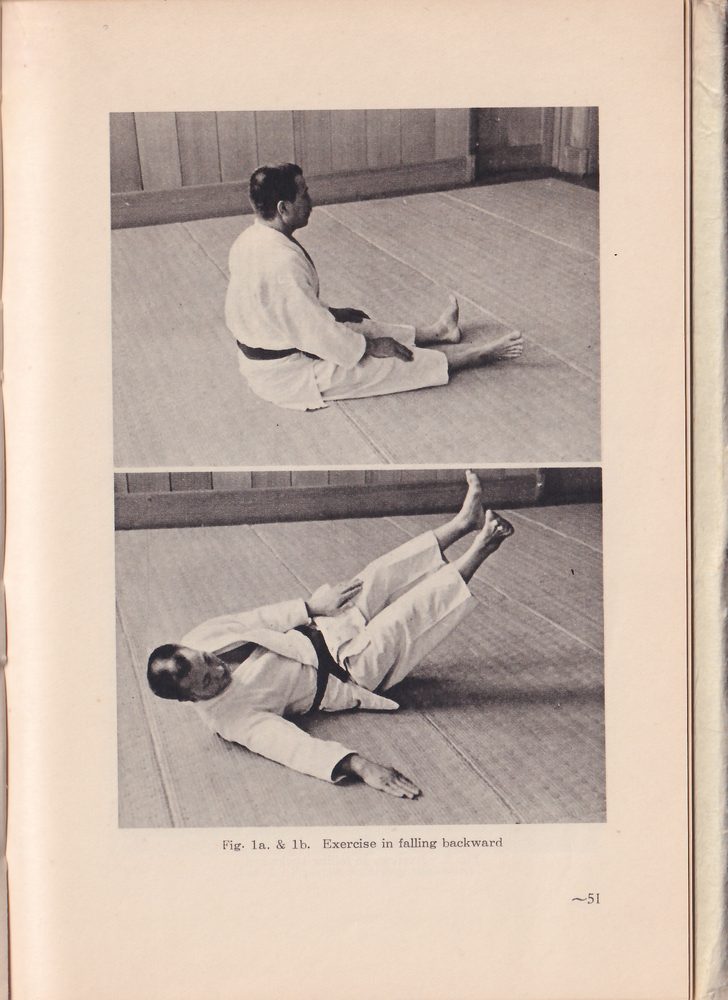
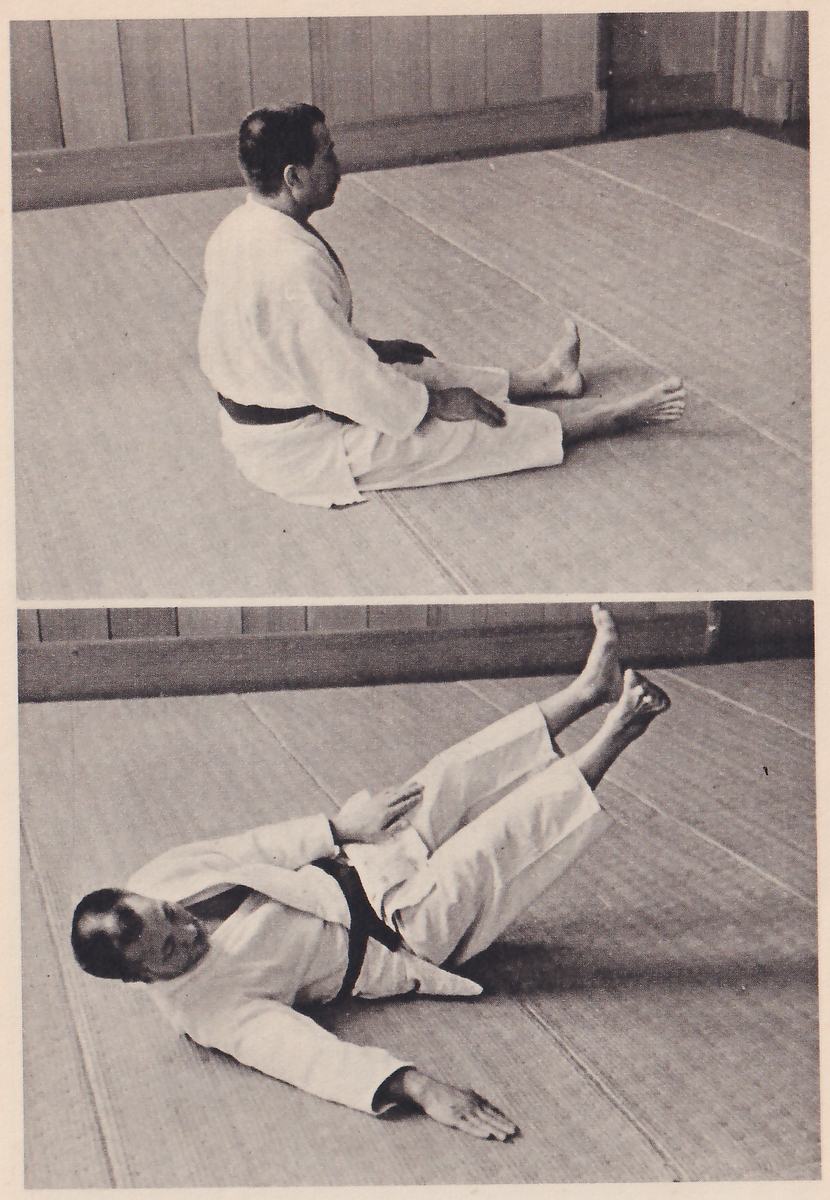
a) Falling backward. This is an exercise in falling backward. Take a posture as in Fig. 1a, with the legs thrown out, and fall backward as in Fig. 1b, hitting the mat with one hand while stretching the arm at an angle of 30 to 45 degrees with the body. When hitting the mat with the right hand, one should slightly twist the body to the right. Similarly, when hitting the mat with the left hand, one should slightly twist the body to the left.
In practising falling backward there is one thing which it is important to bear in mind. This is an exercise to prevent the head from striking the floor. For that
purpose, one should be accustomed, in falling backward, to bend the neck forward so as to fix the eyes on the knot of one’s belt.
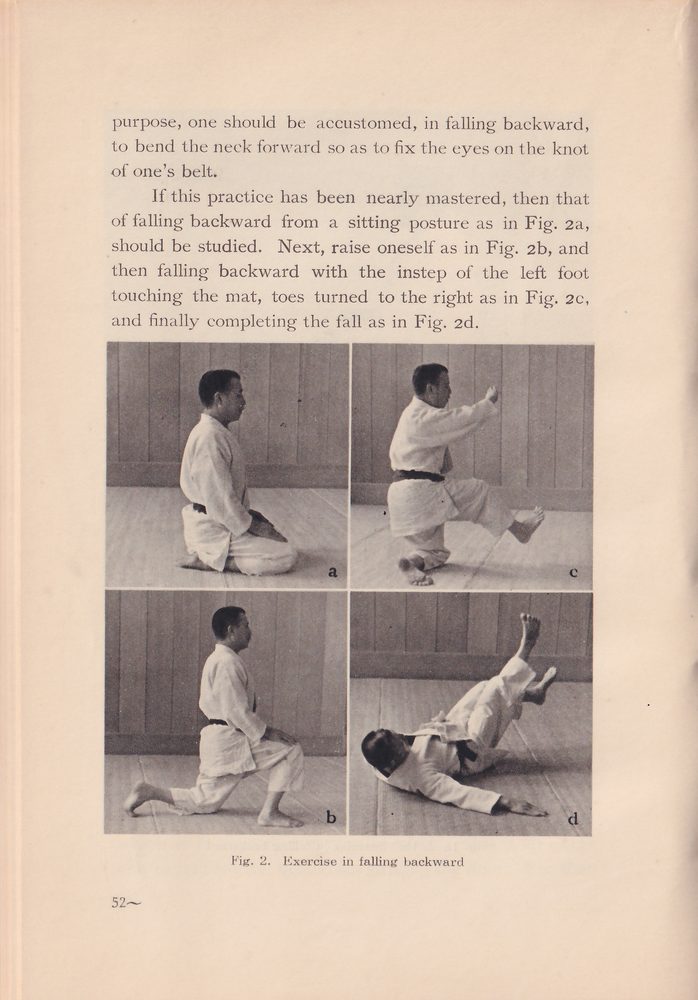
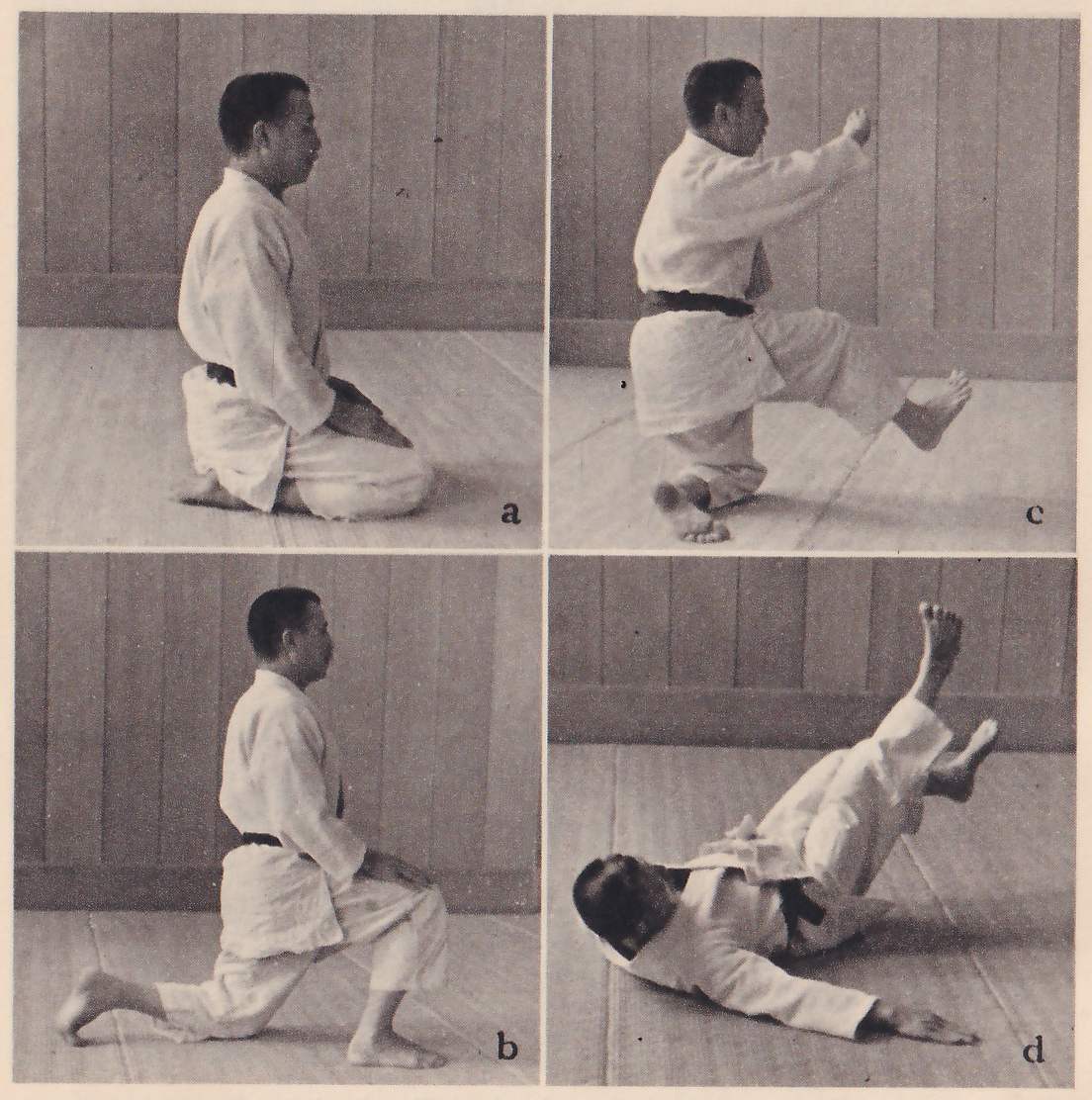
If this practice has been nearly mastered, then that of falling backward from a sitting posture as in Fig. 2a, should be studied. Next, raise oneself as in Fig. 2b, and then falling backward with the instep of the left foot touching the mat, toes turned to the right as in Fig. 2c, and finally completing the fall as in Fig. 2d.
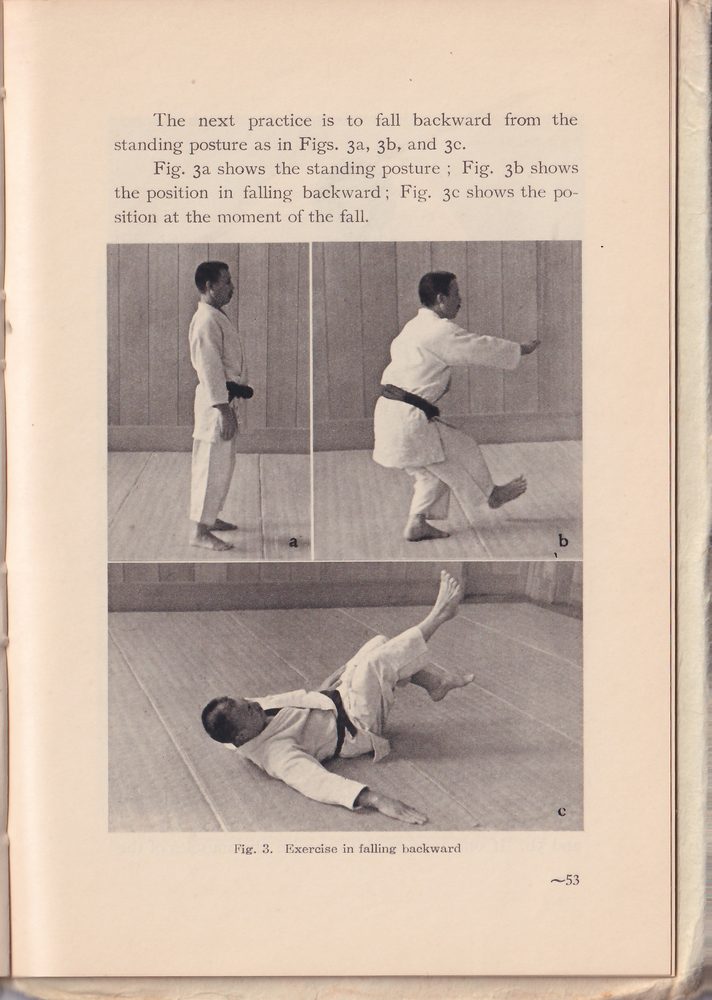
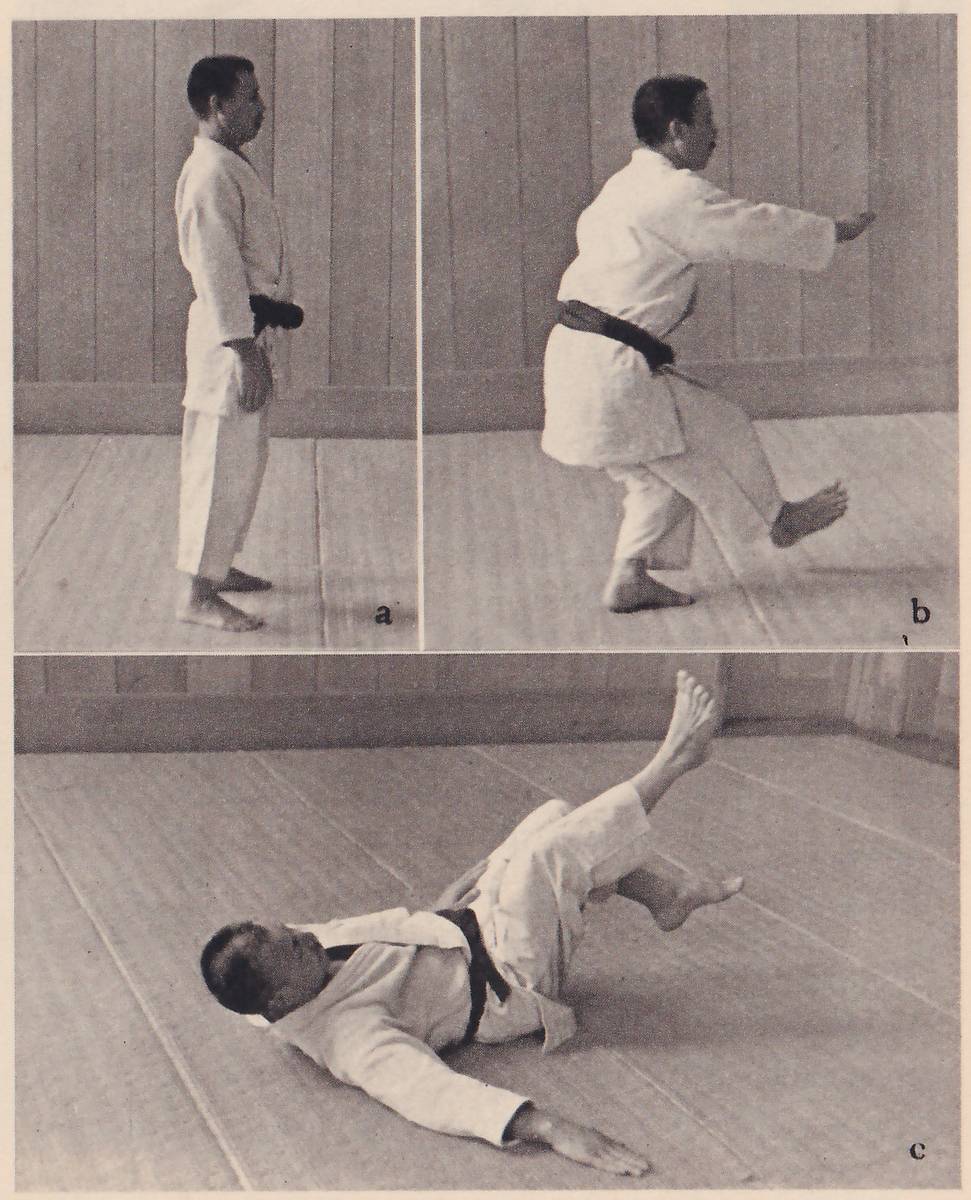
The next practice is to fall backward from the standing posture as in Figs. 3a, 3b, and 3c.
Fig. 3a shows the standing posture; Fig. 3b shows the position in falling backward; Fig. 3c shows the position at the moment of the fall.
After these exercises have been done, there comes the practice of the backward somersault. However, we will not explain it here, because it is not so necessary in Randori as in other forms.
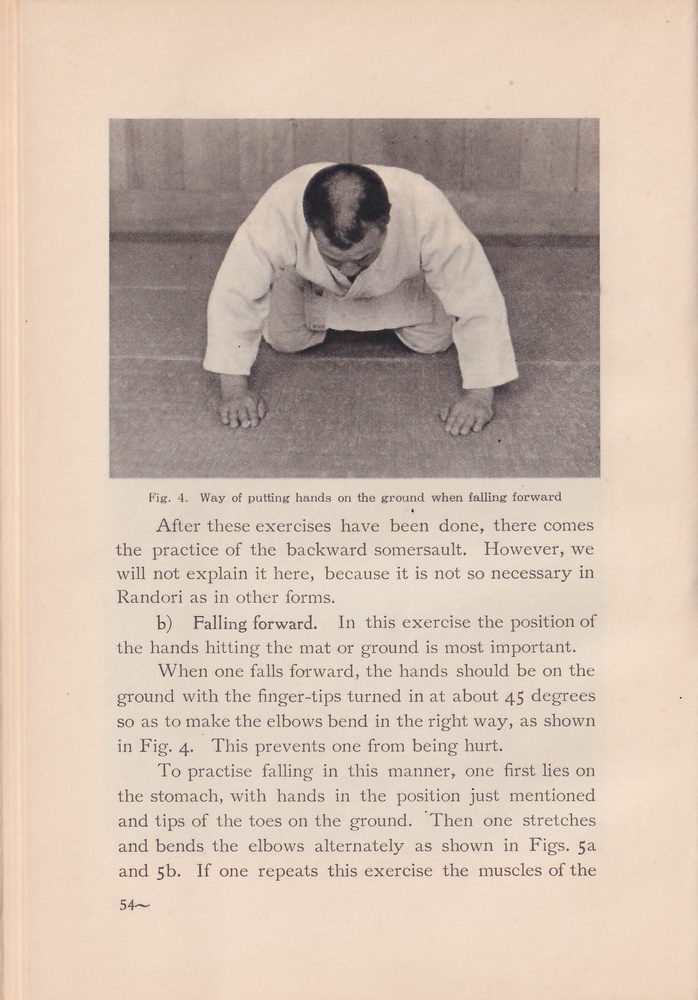
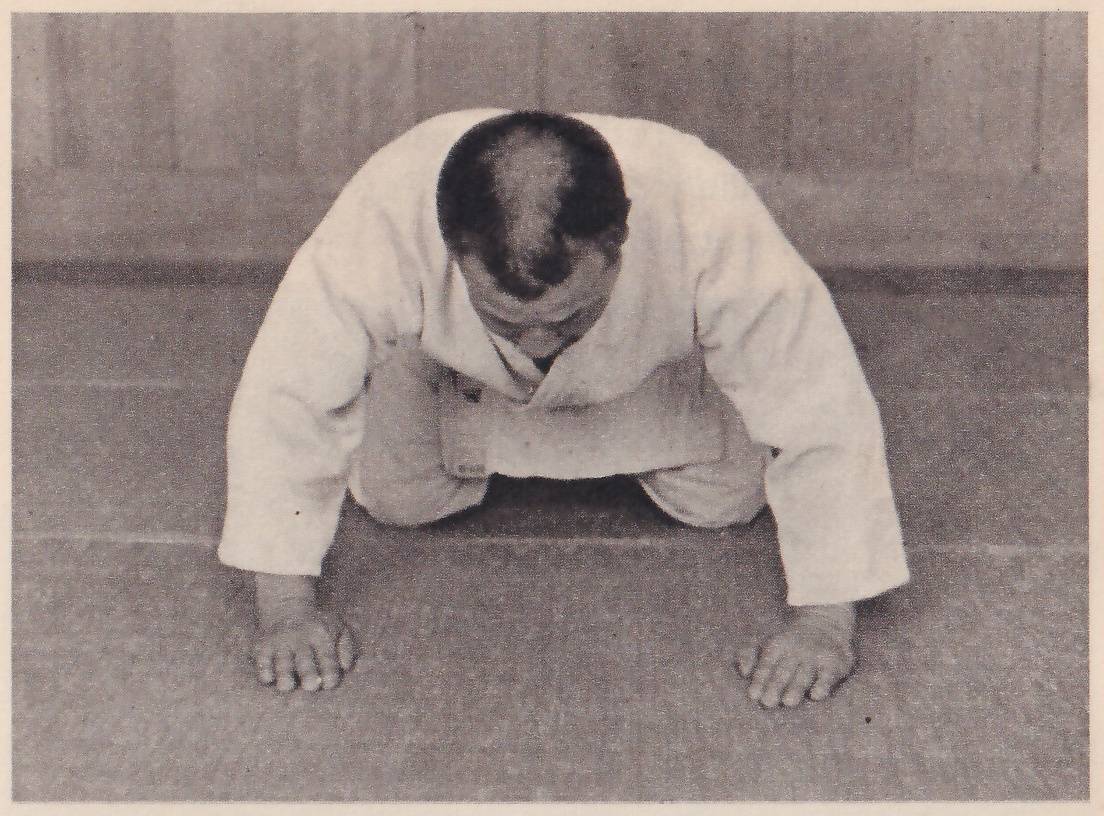
b) Falling forward. In this exercise the position of the hands hitting the mat or ground is most important.
When one falls forward, the hands should be on the ground with the finger-tips turned in at about 45 degrees so as to make the elbows bend in the right way, as shown in Fig. 4. This prevents one from being hurt.
To practise falling in this manner, one first lies on the stomach, with hands in the position just mentioned and tips of the toes on the ground. Then one stretches and bends the elbows alternately as shown in Figs. 5a and 5b. If one repeats this exercise the muscles of the
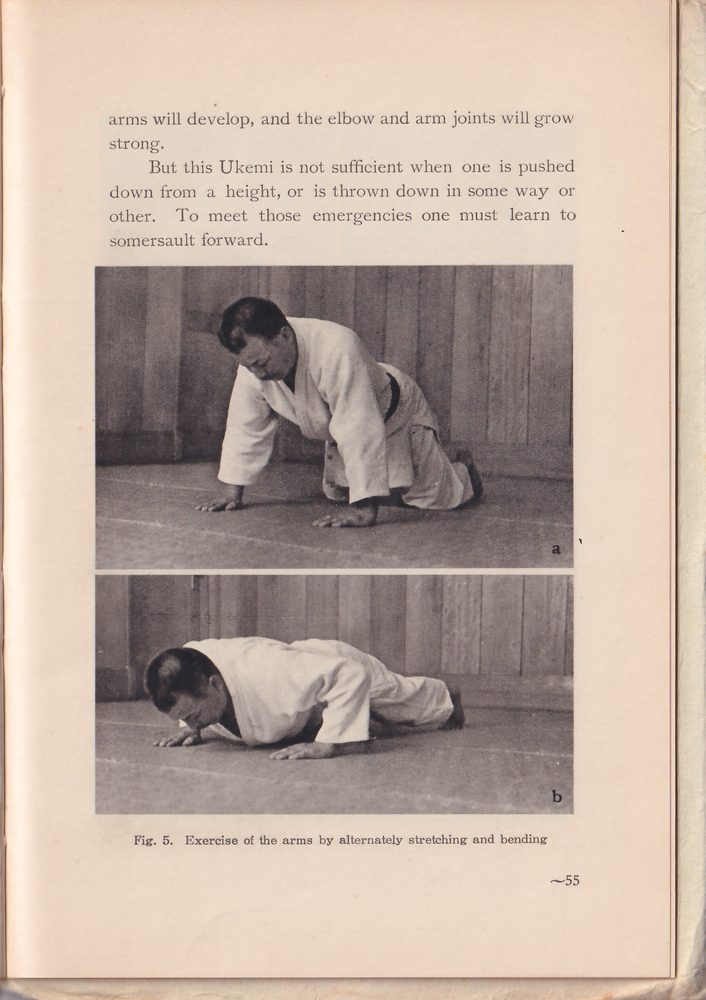
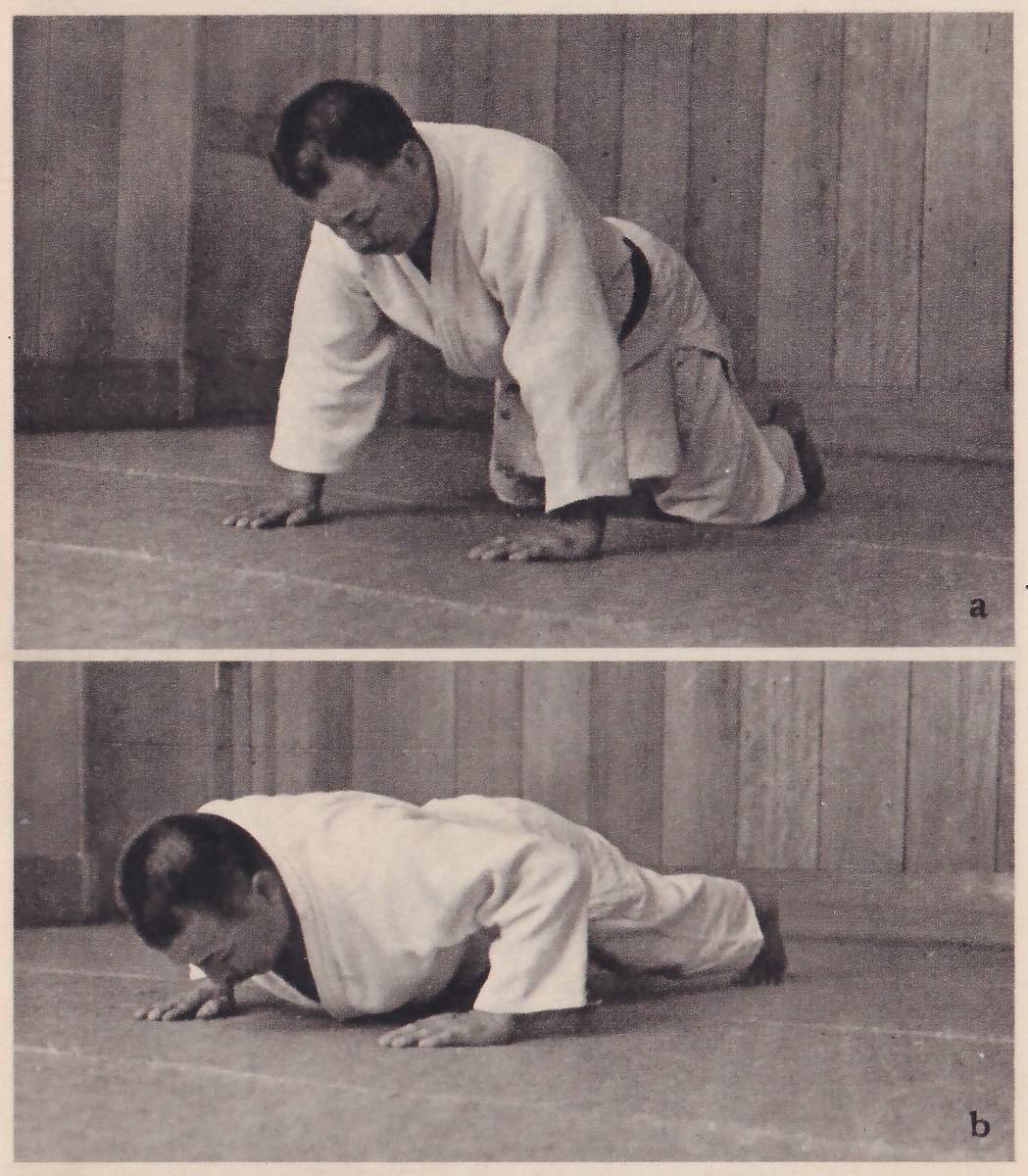
arms will develop, and the elbow and arm joints will grow strong.
But this Ukemi is not sufficient when one is pushed down from a height, or is thrown down in some way or other. To meet those emergencies one must learn to somersault forward.
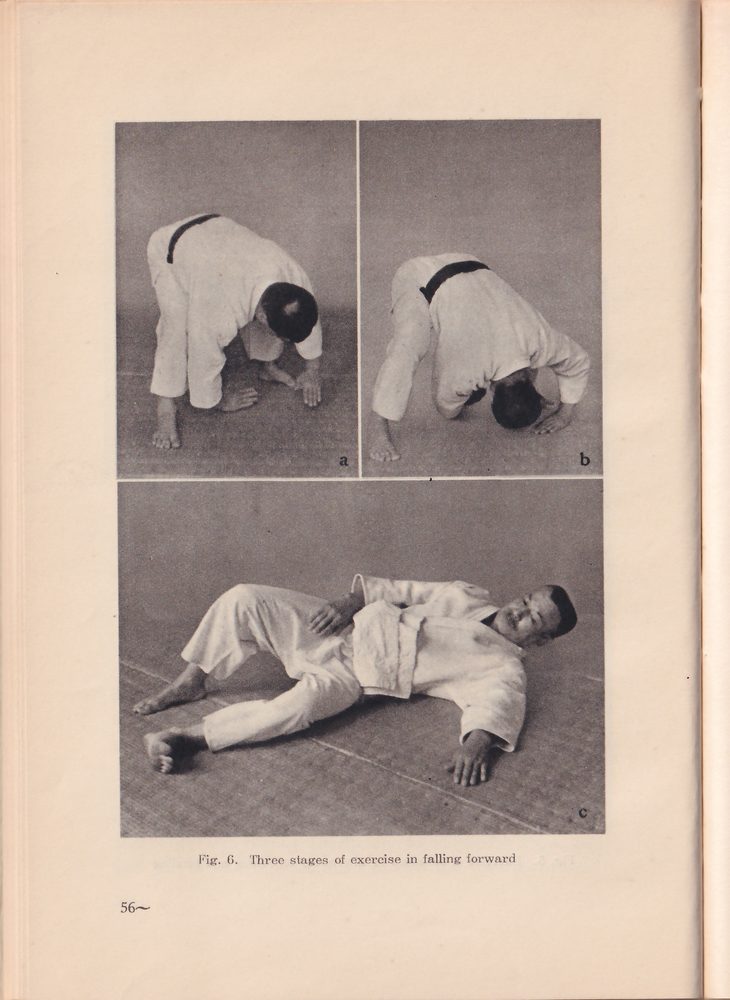
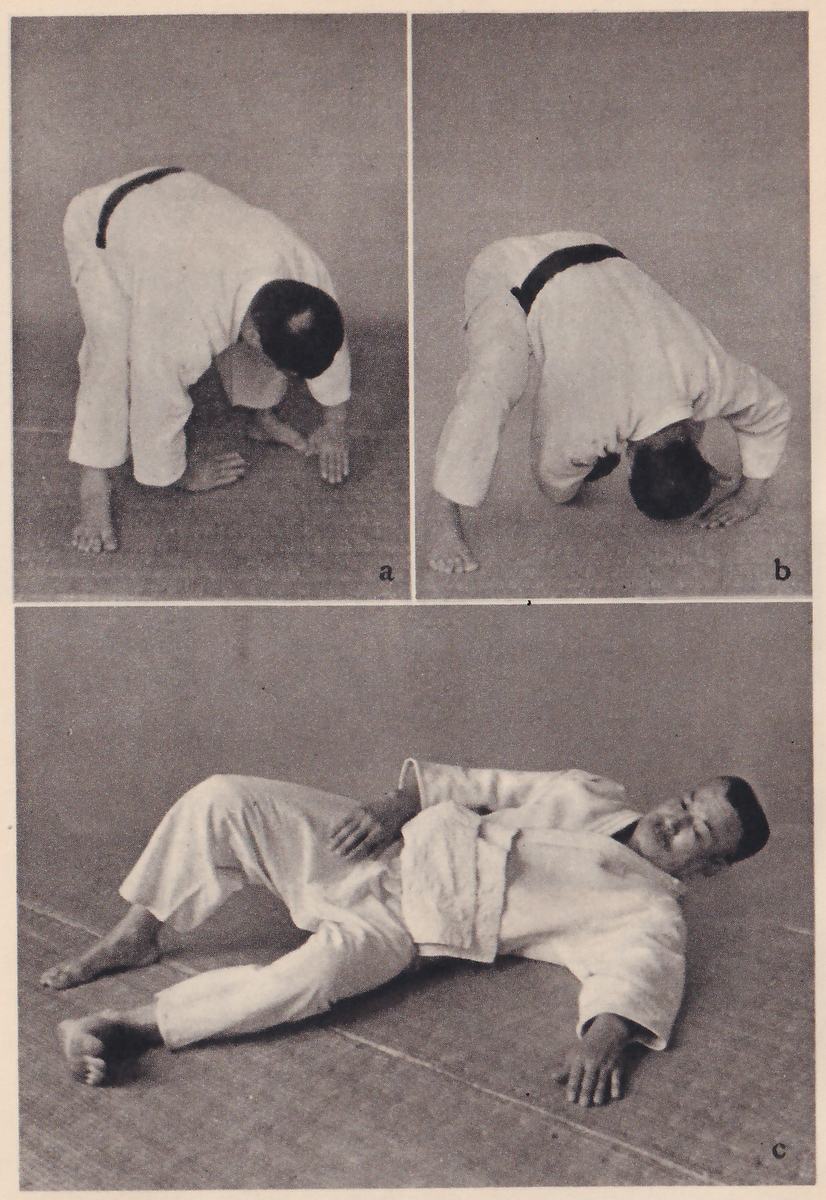
To practise this, the combatant first puts his right foot a little forward, then puts his right hand between the legs, lowering his head as shown in Fig. 6a; then he draws both hand and head in more, and finally pushes them as shown in Fig. 6b, throwing his legs and waist forward: Fig. 6c shows the posture when the somersault has been finished. By repeating it from time to time, one can eventually stand by the mere force of falling. Thus by the practice of falling forward the forward somersault may be accomplished.
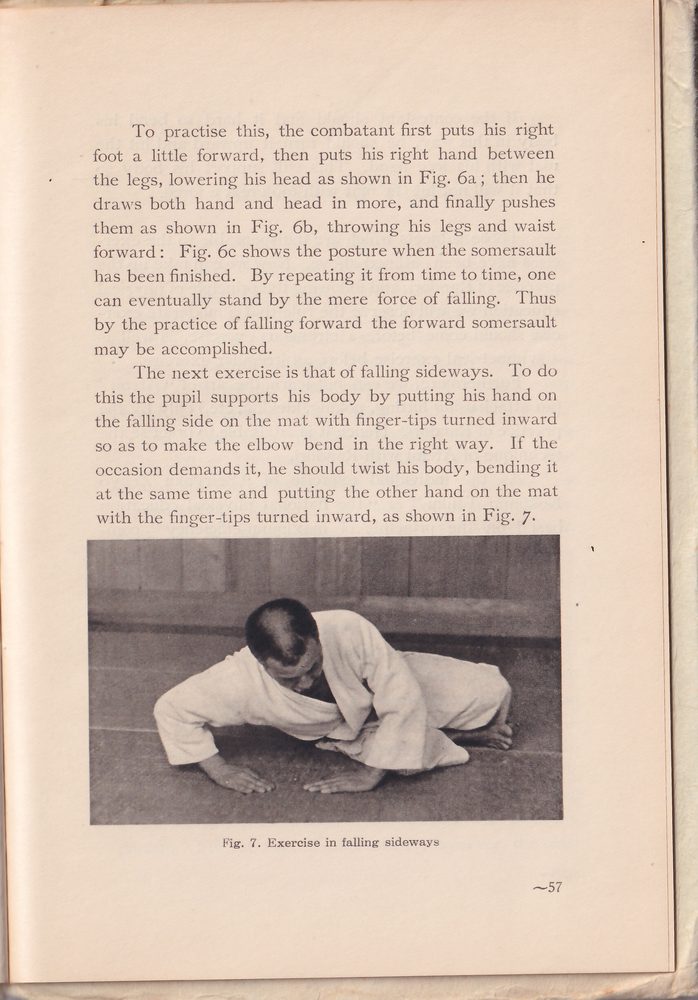
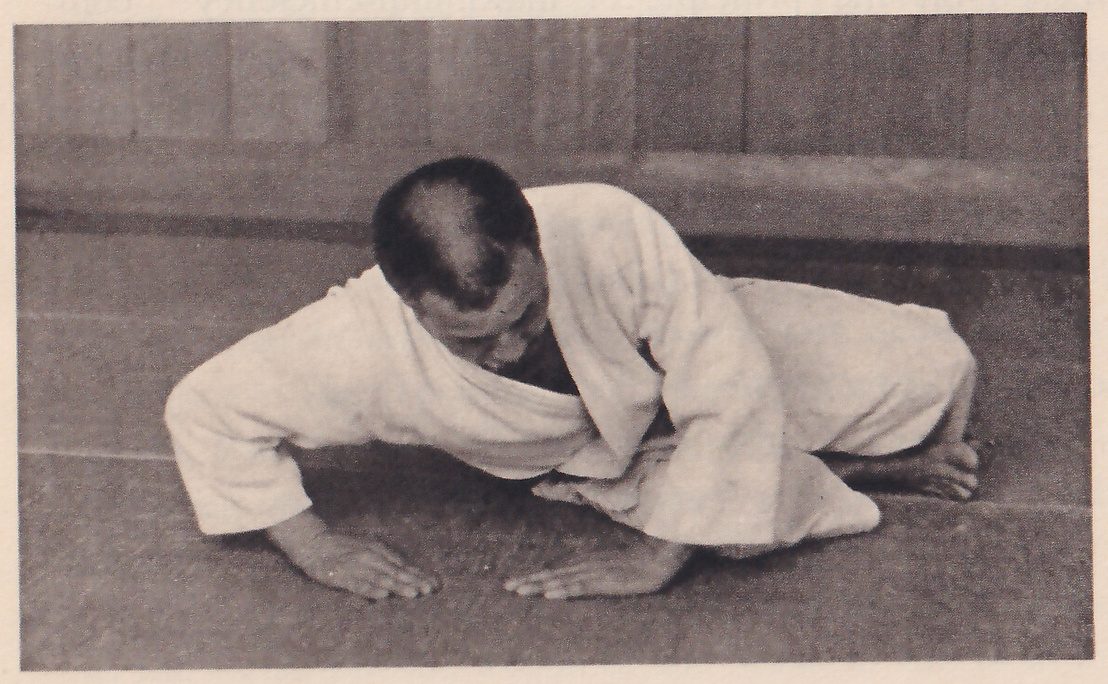
The next exercise is that of falling sideways. To do this the pupil supports his body by putting his hand on the falling side on the mat with finger-tips turned inward so as to make the elbow bend in the right way. If the occasion demands it, he should twist his body, bending it at the same time and putting the other hand on the mat with the finger-tips turned inward, as shown in Fig. 7.
If the contestant should find it hard to bend his body in this way, he should turn it upward and hit the mat with his free hand. This will support his body so that it will not hit the mat with too great a force.
Those subjects which are indispensable to the exercises have been outlined above. Now we can take up the practice of Randori, and following the principle of physical education we will observe the rule that a moderate exercise should come before a strenuous exercise, as well as a symmetrical exercise before an irregular exercise.
Furthermore, we can not learn the art of “Atemi” (an attack using hitting, poking, kicking, etc.) only by the practice of Randori. Hence it is advisable to practise the technique of Atemi with Randori.
As the individual exercise of “Seiryoku Zenyō Kokumin Taiiku” or “the national physical education based on the principle of maximum-efficiency” combines the principle of physical education with the art of Atemi, it should be practised before the study of Randori is begun.