
VII. THE TEA CEREMONY COLLATION
It was after the flowers had fallen in the season of fresh new leaves that Mr. and Mrs. H. were invited to the house of a certain rich man where there was a representative ceremonial tea room. There were five participants, Mr. and Mrs. H. as chief guests, the president of the Women’s College, the master of the house and his charming young daughter. The tea ceremony collation is composed of a few dishes skilfully made of the materials of the season, and it is attractive in its combination of bright things and simplicity. For instance, in an autumn menu, there will be some autumn fish, mackerel, served with an autumn flower, a yellow chrysanthemum, on a tinted persimmon leaf, while the guest sits gazing at the reddened maple leaves.
And since it truly displays an autumn scene with quail, mullet roe, gingko-nuts, chestnut cakes, etc., it has the flavour of food and natural scenery harmoniously combined.
It is extremely simple with the number of dishes always fixed, either one soup and two side-dishes or one soup and three side-dishes.
Well, we went to the tea ceremony wondering what foods would be chosen in the Japanese early summer celebrated in the seventeen-syllable verse,
Young leaves everywhere;
The mountain cuckoo singing;
My first bonito!
And the menu was as follows:
Menu at Tea Ceremony Collation
Mukōzuke
Bonito sliced after broiling only on the surface, horse-radish, grated radish, soy.
Shiru (soup)
Sanshū bean-paste soup (used in elegant menus), water-shield with water mustard.
Gohan (boiled rice)
Kō-no-mono (pickles)
Wanmori (bowl)
Minced shrimp, lotus root, hanayuzu or citron flower.
Hachizakana (fish dish)
Young trout broiled with salt, egg-plant cut in the shape of a bamboo tea whisk.
Suimono or Kuchiarai (soup)
Green pine-cone.
Hassun
Ear-shell steamed with salt, horse-beans.
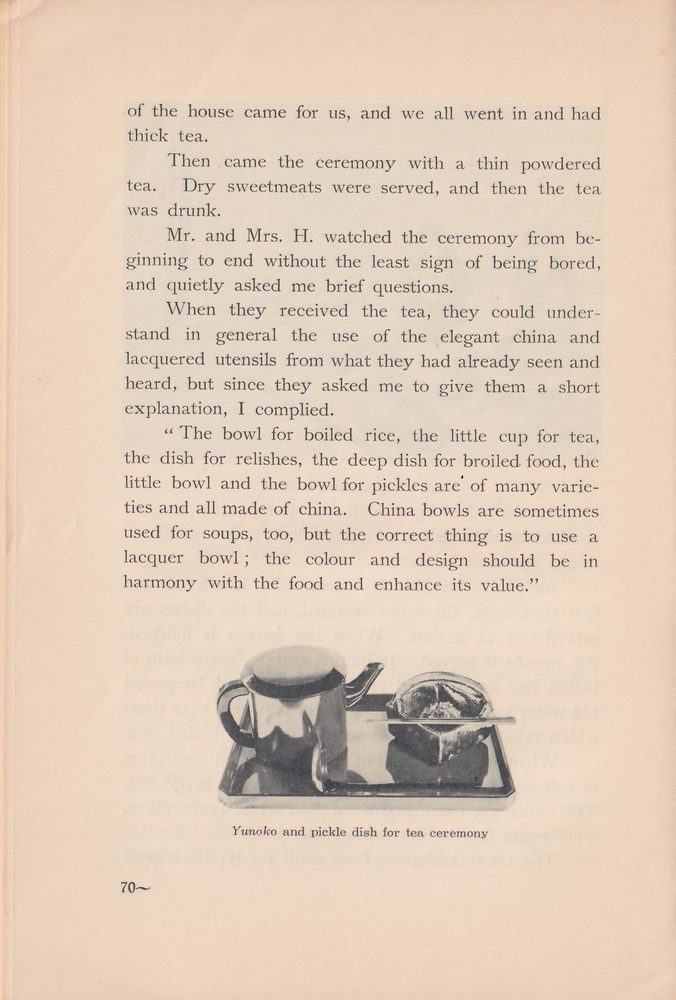
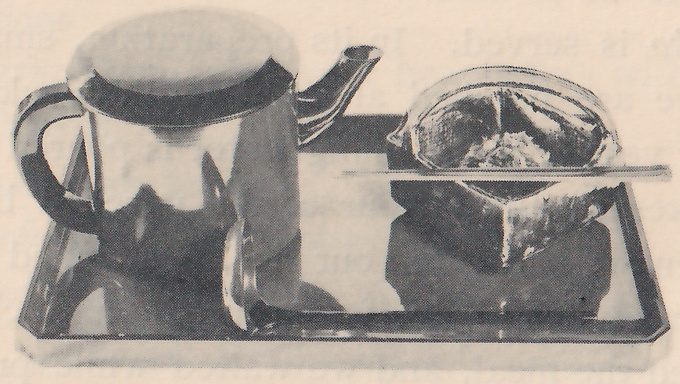
Yunoko
Confections
Mizuyōkan (soft sweet bean-jelly) with cherry leaves.
Powdered thick tea
Dry confection—hototogisu (cuckoo)
Powdered thin tea
Since the bowl is considered a side-dish, the mukōzuke, the bowl and the fish course make the three side-dishes and the bean-paste soup the one soup.
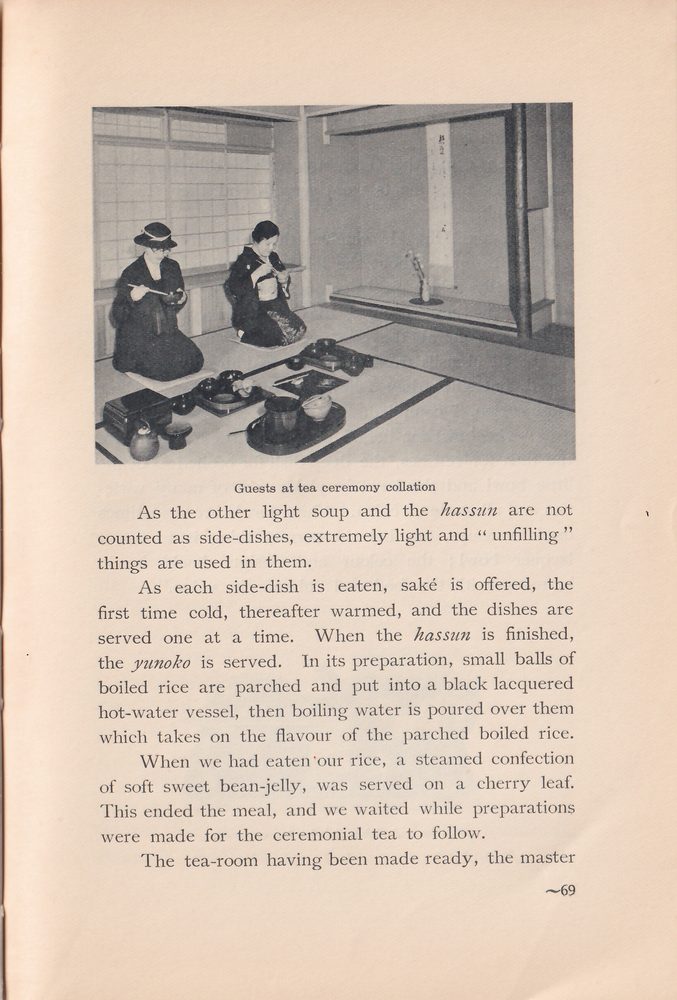
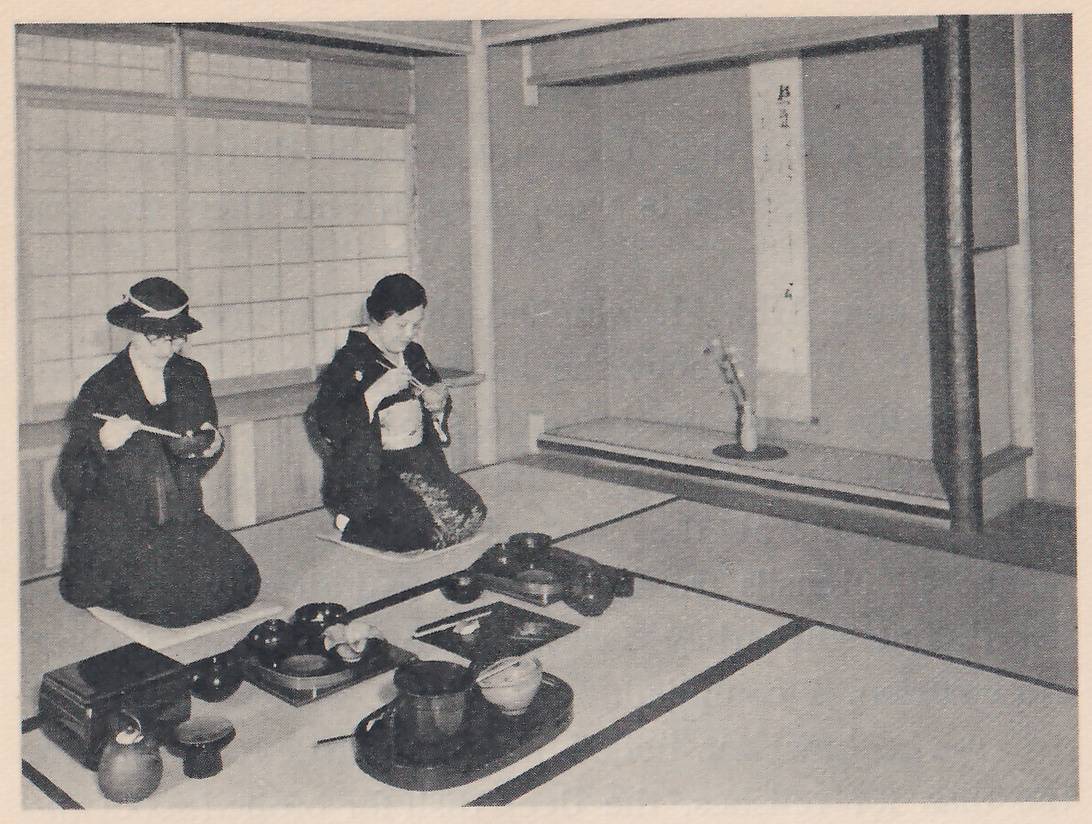
As the other light soup and the hassun are not counted as side-dishes, extremely light and “unfilling” things are used in them.
As each side-dish is eaten, saké is offered, the first time cold, thereafter warmed, and the dishes are served one at a time. When the hassun is finished, the yunoko is served. In its preparation, small balls of boiled rice are parched and put into a black lacquered hot-water vessel, then boiling water is poured over them which takes on the flavour of the parched boiled rice.
When we had eaten our rice, a steamed confection of soft sweet bean-jelly, was served on a cherry leaf. This ended the meal, and we waited while preparations were made for the ceremonial tea to follow.
The tea-room having been made ready, the master
of the house came for us, and we all went in and had thick tea.
Then came the ceremony with a thin powdered tea. Dry sweetmeats were served, and then the tea was drunk.
Mr. and Mrs. H. watched the ceremony from beginning to end without the least sign of being bored, and quietly asked me brief questions.
When they received the tea, they could understand in general the use of the elegant china and lacquered utensils from what they had already seen and heard, but since they asked me to give them a short explanation, I complied.
“The bowl for boiled rice, the little cup for tea, the dish for relishes, the deep dish for broiled food, the little bowl and the bowl for pickles are of many varieties and all made of china. China bowls are sometimes used for soups, too, but the correct thing is to use a lacquer bowl; the colour and design should be in harmony with the food and enhance its value.”