
VI. CONGRATULATORY CELEBRATIONS AND RELIGIOUS FOOD
“Though not to be compared in size and representativeness with the wedding ceremony, there are ceremonies called the shichi-go-san* (seven-five-three) and chōju (longevity) feasts to celebrate the growth and longevity of the family.
“The seven-five-three feasts are celebrations of the growth of children held for boys when they are three and five, and for girls when they are three and seven. In olden times, the celebration at the age of three for both boys and girls was a ceremony called kamioki (hair-leaving), connected with letting the hair grow long, but today it is a feast in celebration of the healthy growth of the child.
“The boy’s fifth year feast is celebrated with a ceremony in which the hakama, the man’s formal divided skirt, is worn for the first time, put on over a smart little crested kimono, with a crested coat to match.
“The girl’s seventh-year feast is a celebration at which the formal obi is bound round the kimono to take the place of the cords used up to that age.
“Both feasts are celebrated on November 15, on which day a pilgrimage is made to the shrine of the patron god of the district or of the family, and the
* Ref. Tourist Library: 12. Children’s Days in Japan.
future happiness of the child is prayed for.
“The parents invite their relatives and friends and celebrate with them the growth of the child with a feast of sekihan (red rice with red beans), soup containing red and white rice-cake, small sea-bream broiled in salt and things suitable to children.
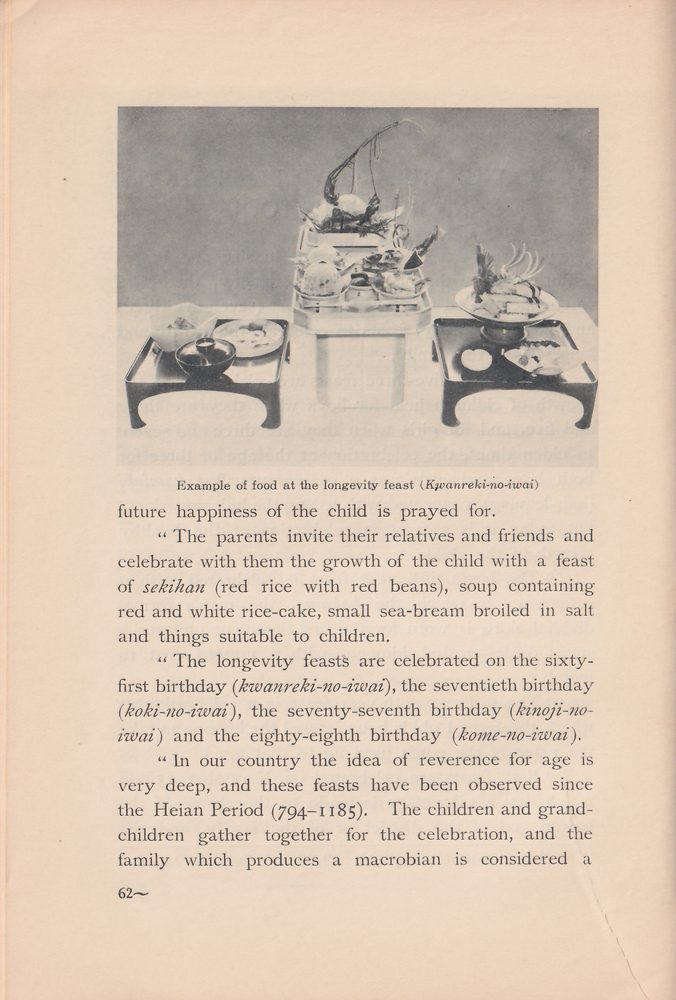
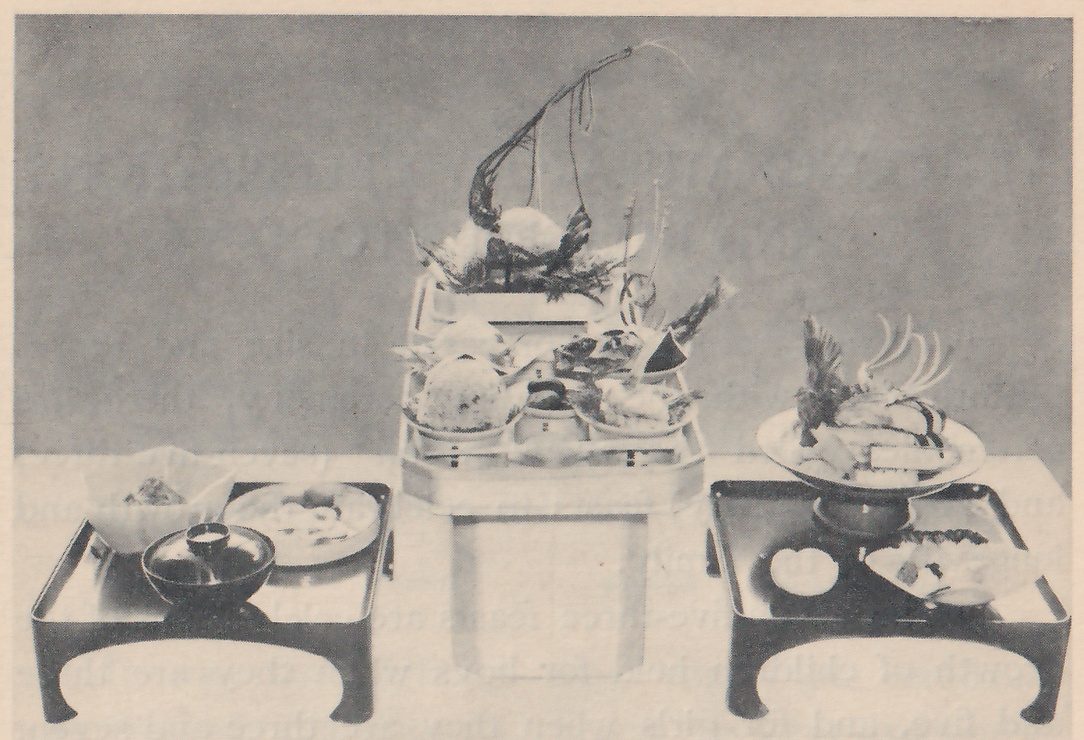
“The longevity feasts are celebrated on the sixty-first birthday (kwanreki-no-iwai), the seventieth birthday (koki-no-iwai), the seventy-seventh birthday (kinoji-no-iwai) and the eighty-eighth birthday (kome-no-iwai).
“In our country the idea of reverence for age is very deep, and these feasts have been observed since the Heian Period (794–1185). The children and grandchildren gather together for the celebration, and the family which produces a macrobian is considered a
healthy and diseaseless family and the whole house rejoices in the distinction.
“The Imperial Family usually sends a gift to the aged one at the time of such a celebration.
“The menu at the longevity feasts differs with the social class and likes of the different families, but it is always the same in making sekihan the principal dish.”
When he had heard this explanation, Mr. H. said,
“I see that Japan is a country with a remarkable family system; it’s interesting that they have such feasts for the young and aged.”
“Yes, and besides these family feasts, there are the four feasts of the Imperial Family, Genshisai (Emperor’s New Year Festival), Kigensetsu (Anniversary of the Accession of the Emperor Jinmu), Tenchō Setsu (the Emperor’s Birthday) and Meiji Setsu (Commemorative Festival for the Emperor Meiji), when the sovereign and people celebrate together and foods associated with the occasion are eaten. For example, there is a soup called hinomaru-shinjo made by mashing the white flesh of a choice fish, thinning with dried-bonito stock, putting in a flat mould, sticking into it cooked carrots like rising suns, steaming in a steaming-basket, cutting in the shape of flags with the rising sun carrot in the middle, putting into bowls, adding citron cut into the shapes of arrowheads, adding clear soup and serving.”
“It seems to be as tasty as it is symbolic. And what sort of direct connection is there between thePrinted: the the religious sentiment of the Japanese and their food? For instance what corresponds to such a holiday as Christmas in our country?”
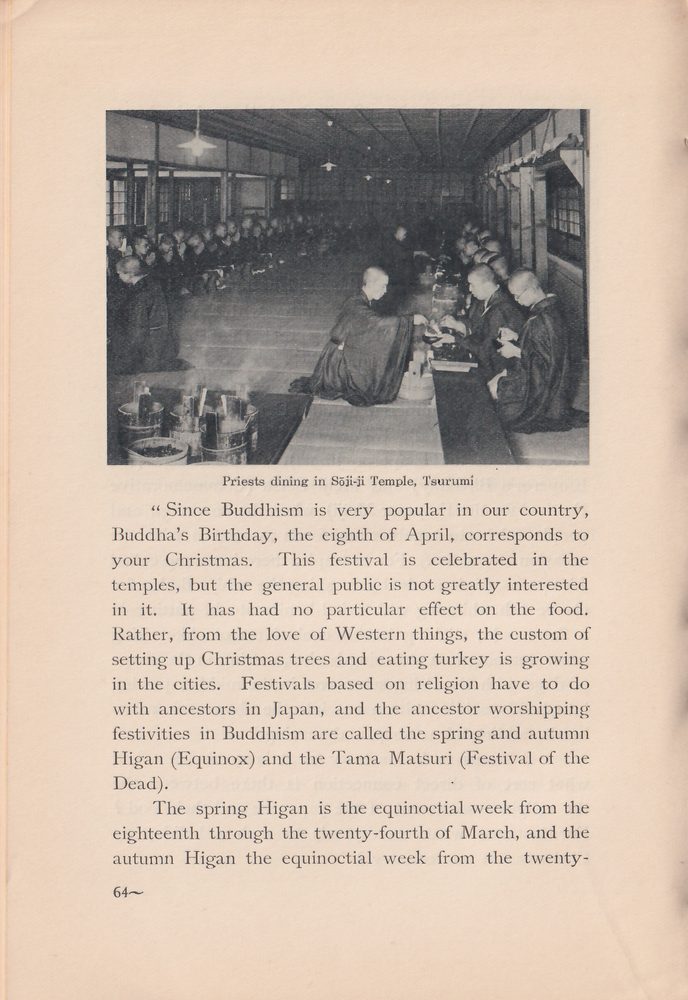
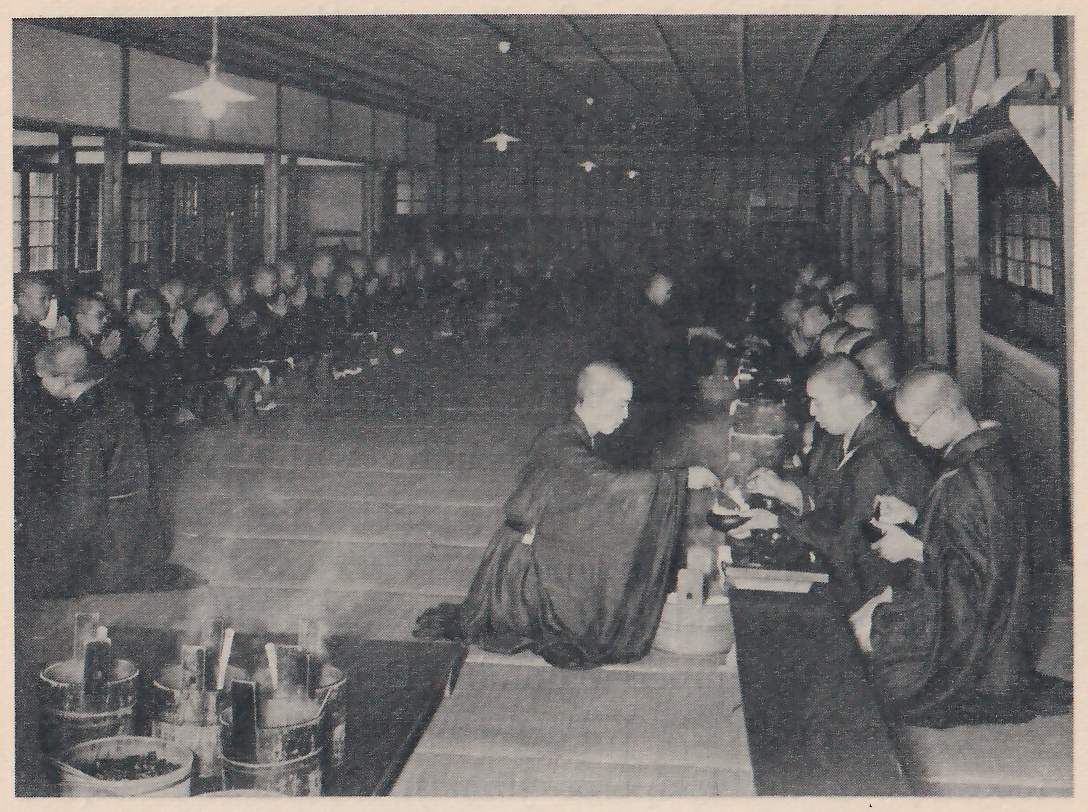
“Since Buddhism is very popular in our country, Buddha’s Birthday, the eighth of April, corresponds to your Christmas. This festival is celebrated in the temples, but the general public is not greatly interested in it. It has had no particular effect on the food. Rather, from the love of Western things, the custom of setting up Christmas trees and eating turkey is growing in the cities. Festivals based on religion have to do with ancestors in Japan, and the ancestor worshipping festivities in Buddhism are called the spring and autumn Higan (Equinox) and the Tama Matsuri (Festival of the Dead).
The spring Higan is the equinoctial week from the eighteenth through the twenty-fourth of March, and the autumn Higan the equinoctial week from the twenty-
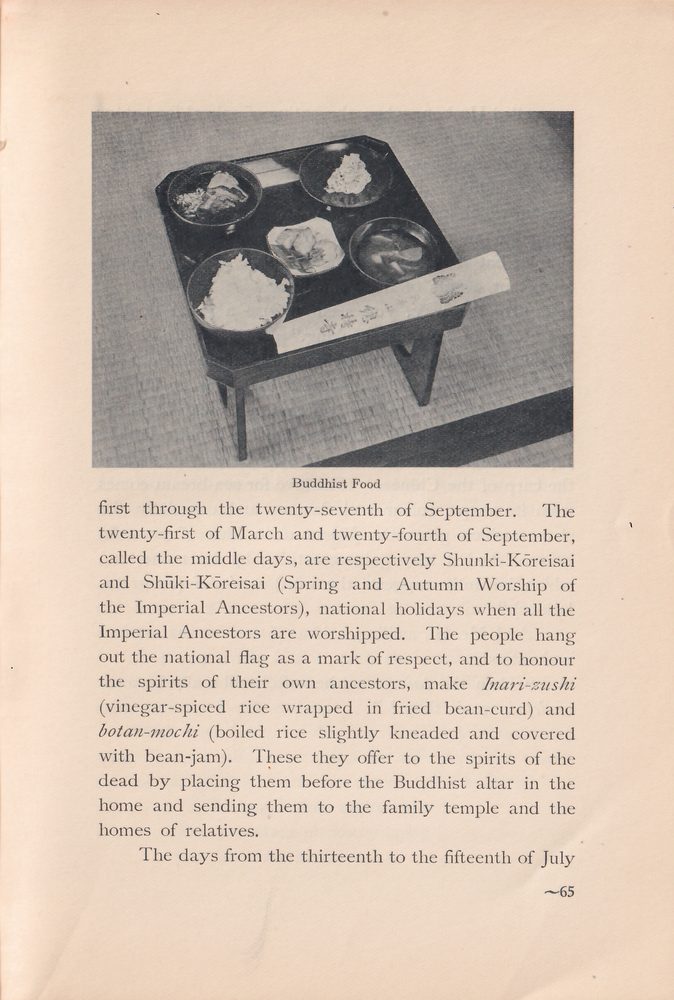
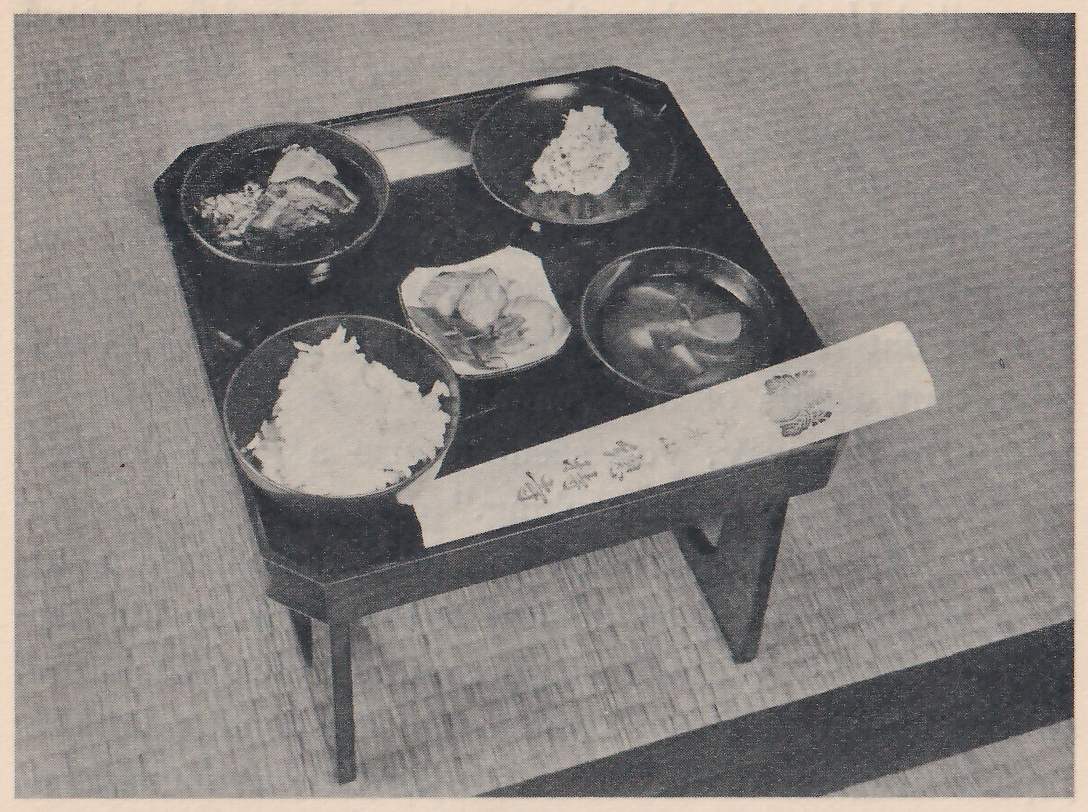
first through the twenty-seventh of September. The twenty-first of March and twenty-fourth of September, called the middle days, are respectively Shunki-Kōreisai and Shūki-Kōreisai (Spring and Autumn Worship of the Imperial Ancestors), national holidays when all the Imperial Ancestors are worshipped. The people hang out the national flag as a mark of respect, and to honour the spirits of their own ancestors, make Inari-zushi (vinegar-spiced rice wrapped in fried bean-curd) and botan-mochi (boiled rice slightly kneaded and covered with bean-jam). These they offer to the spirits of the dead by placing them before the Buddhist altar in the home and sending them to the family temple and the homes of relatives.
The days from the thirteenth to the fifteenth of July
are called Urabon, when the eating of animal food stops and vegetable foods such as rice-cake, udon, soba, bean-curd and dishes made of green vegetables are offered at the Buddhist altar and eaten by the family. This season, which marks the half year, is called Chūgen and brings to an end all half-yearly terms. The food is simple, but it is for the general public one of the most important events of the years.”
“By the way, you seem to use a great deal of sea-bream in Japanese cooking.”
“Yes, sea-bream has come to be quite essential at formal dinners, and is doubtless the king of all fish served whole. Without sea-bream, no meal could be called formal. The sea-bream corresponds on the Japanese menu to the roast of the Western menu and the carp of the Chinese. The love for sea-bream comes from its shape, colour and flavour, and especially the shape, which gives the Japanese an idea of powerful grace. And it may gain something by its name, tai, which instantly suggests the word mede-tai (congratulations).”
And Mr. H., smiling, said as if to show that he had understood,
“Then the tai we eat hereafter will really be most medetai, won’t they?”