
V. AN INVITATION TO A WEDDING CEREMONY
At about the time the cherries bloom, in the ideal season of which the proverb says, “An hour of a spring evening is worth a thousand pieces of gold,” there are many weddings.
Wedding ceremonies are celebrated according to Shinto, Buddhist, Christian and other rites, in keeping with the faith of the individuals, but the pure Japanese wedding is the home wedding.
The home wedding has existed since olden times, and since the significance of the ceremony is that either the bride or the groom is leaving one family and entering another, the home wedding is the regular form.
Through my introduction, Mr. and Mrs. H. were able to attend and witness a Japanese home wedding.
In the ornamental alcove, hung three scrolls with paintings of pine, bamboo and plum on them. Long strips of congratulatory dried sea-ear were set out on sanbō or an offering-stand, sacred wine in bottles stood at the two sides, as congratulatory dainties such as laminaria, dried pounded chestnuts and dried cuttlefish, shaved and rolled, were set out on an offering-stand covered with thick soft white paper, and a pair of saké pots called kannabe were set out in front of the alcove.
The bride and groom sat facing each other in front of the two sides of the alcove, and the go-between and
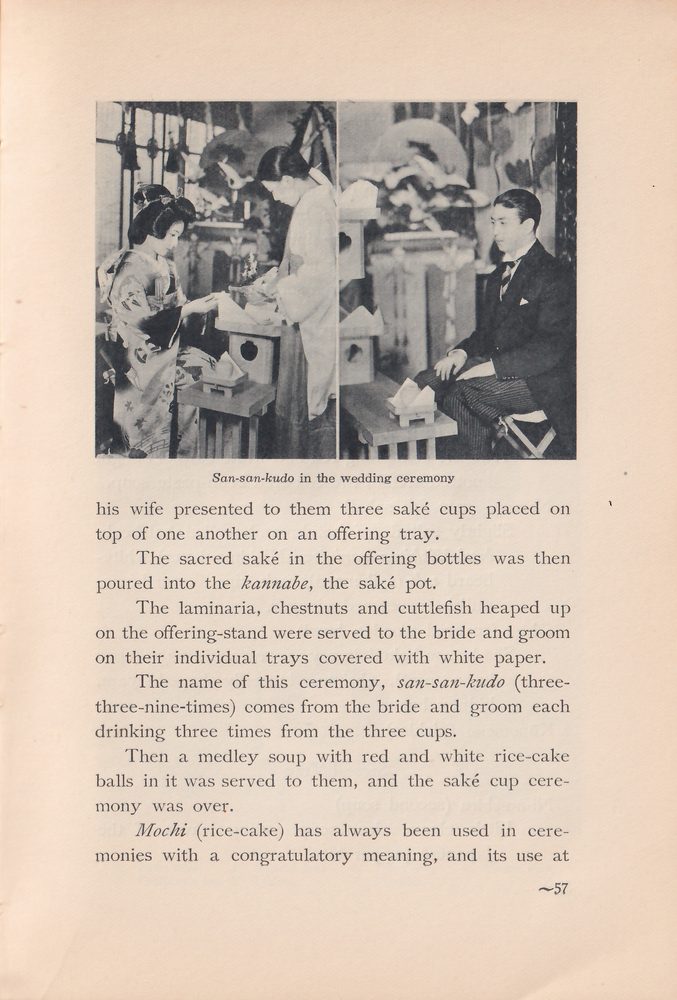
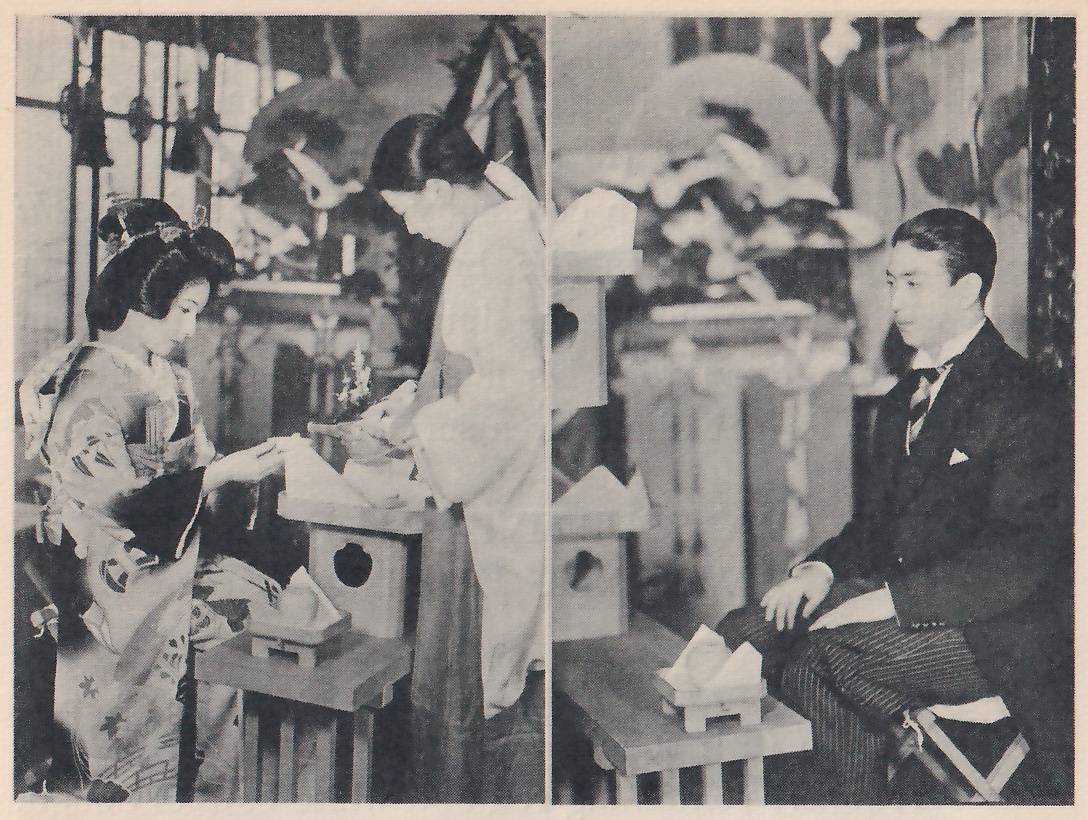
his wife presented to them three saké cups placed on top of one another on an offering tray.
The sacred saké in the offering bottles was then poured into the kannabe, the saké pot.
The laminaria, chestnuts and cuttlefish heaped up on the offering-stand were served to the bride and groom on their individual trays covered with white paper.
The name of this ceremony, san-san-kudo (three-three-nine-times) comes from the bride and groom each drinking three times from the three cups.
Then a medley soup with red and white rice-cake balls in it was served to them, and the saké cup ceremony was over.
Mochi (rice-cake) has always been used in ceremonies with a congratulatory meaning, and its use at
the New Year has already been explained, but in the wedding ceremony, it has the further punning significance of ochitsuku (to settle down).
After the saké cup ceremony, came the ironaoshi (colour changing) when the bride changed from her pure white ceremonial robe into a beautiful garment sent by the groom with his family crest dyed into it, and then a formal dinner was served in another room.
THE TWO-SOUP-FIVE-DISH FORMAL WEDDING DINNER
Main Tray
Ichi-no-shiru (fish soup)
Tsumiire containing red and white balls of dough, knotted trefoil, two-coloured bean-paste soup.
Namasu (raw fish salad)
Slightly salted tai (sea-bream), rolled halfbeak, beni-Mishima nori (red-Mishima laver) white-beard udo (spikenard), rock-tripe, flower horse-radish, sweetened vinegar.
Ohira (covered wooden bowl)
Sea-bream baked in soy, sugomori-tamago (eggs in a nest), shrimp, butterfly-shaped yam, kidney beans.
Kōnomono (pickles)
Second Tray
Ni-no-shiru (second soup)
Little clams, clear soup, young leaves of the Japanese pepper tree.
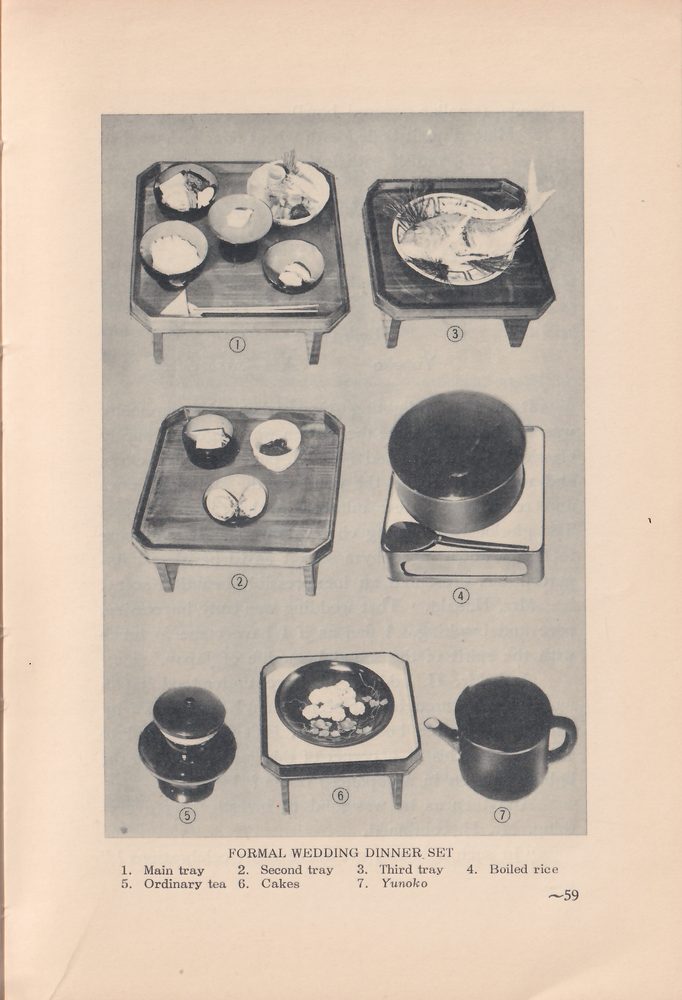
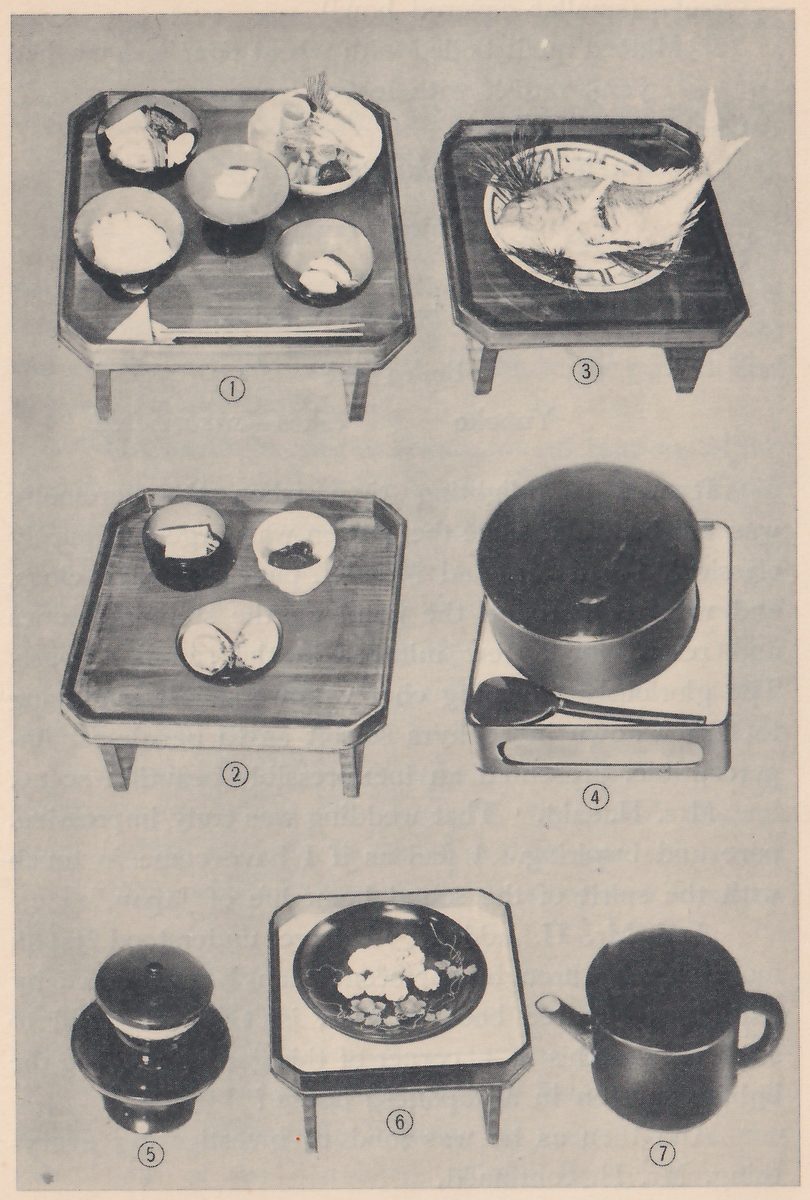
1. Main tray 2. Second tray 3. Third tray 4. Boiled rice
5. Ordinary tea 6. Cakes 7. Yunoko
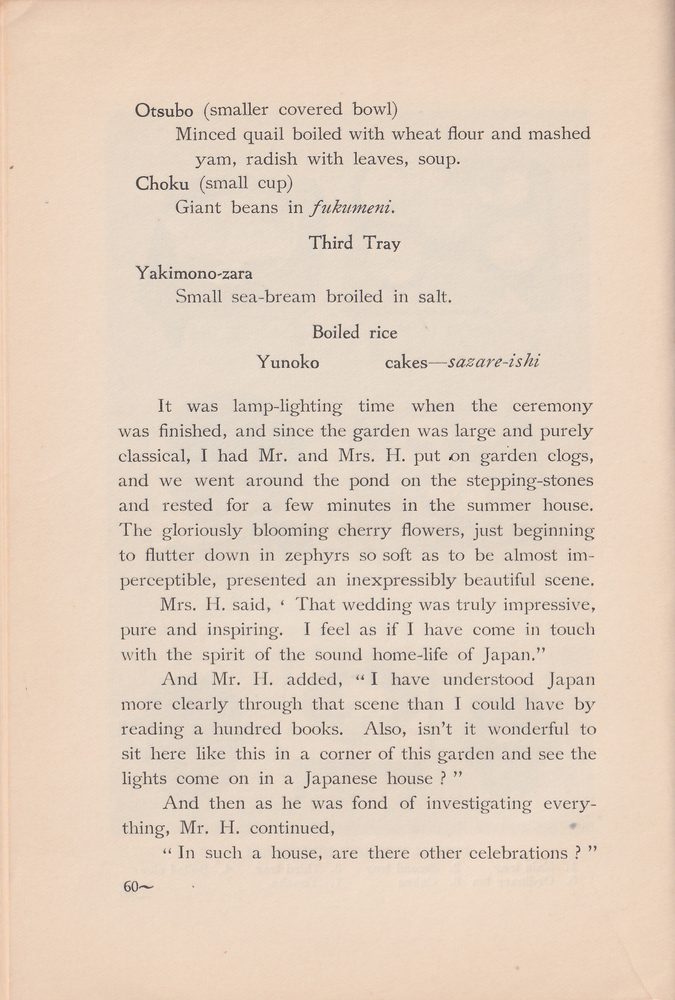
Otsubo (smaller covered bowl)
Minced quail boiled with wheat flour and mashed yam, radish with leaves, soup.
Choku (small cup)
Giant beans in fukumeni.
Third Tray
Yakimono-zara
Small sea-bream broiled in salt.
Boiled rice
Yunoko cakes—sazare-ishi
It was lamp-lighting time when the ceremony was finished, and since the garden was large and purely classical, I had Mr. and Mrs. H. put on garden clogs, and we went around the pond on the stepping-stones and rested for a few minutes in the summer house. The gloriously blooming cherry flowers, just beginning to flutter down in zephyrs so soft as to be almost imperceptible, presented an inexpressibly beautiful scene.
Mrs. H. said, ‘That wedding was truly impressive, pure and inspiring. I feel as if I have come in touch with the spirit of the sound home-life of Japan.”
And Mr. H. added, “I have understood Japan more clearly through that scene than I could have by reading a hundred books. Also, isn’t it wonderful to sit here like this in a corner of this garden and see the lights come on in a Japanese house?”
And then as he was fond of investigating everything, Mr. H. continued,
“In such a house, are there other celebrations?”