
VIII. THOUGHTS ON THE ARTISTRY OF LINE
Concerning the Beauty of Noh and Kabuki Costumes
Recently, Monsieur B has been all wrapped up in Noh and Kabuki. He is so enthusiastic that when it is impossible for me to go along, he asks about the plots, and protesting that it is all too difficult to understand, hurries cheerfully off alone. It even made me wonder when he had thrown away his previous enthusiasm for kimono, but one night he said, “Won’t you just look over this for me? I’m going to send it to one of the home magazines,” and handed me an essay entitled, “Thoughts on the Artistry of Line.” Here follows a short passage from that essay:
“It may be said that it was the kimono as usual which first attracted my interest to the Noh and Kabuki, which are difficult for me to understand.
“I know that Noh, after Greek drama had disappeared with all but the words, was the oldest synthetic art left alive in the world. And according to report it was far and away more abstract than the Greek drama, and for us, brought up in an entirely different cultural atmosphere, an ivory tower that it seemed could never be scaled, however we might strive. But for the guidance of my kind friend K, it would doubtless have remained for me forever ‘pearls before swine,’ or to put
it in the Japanese way, ‘gold coins to a cat.’
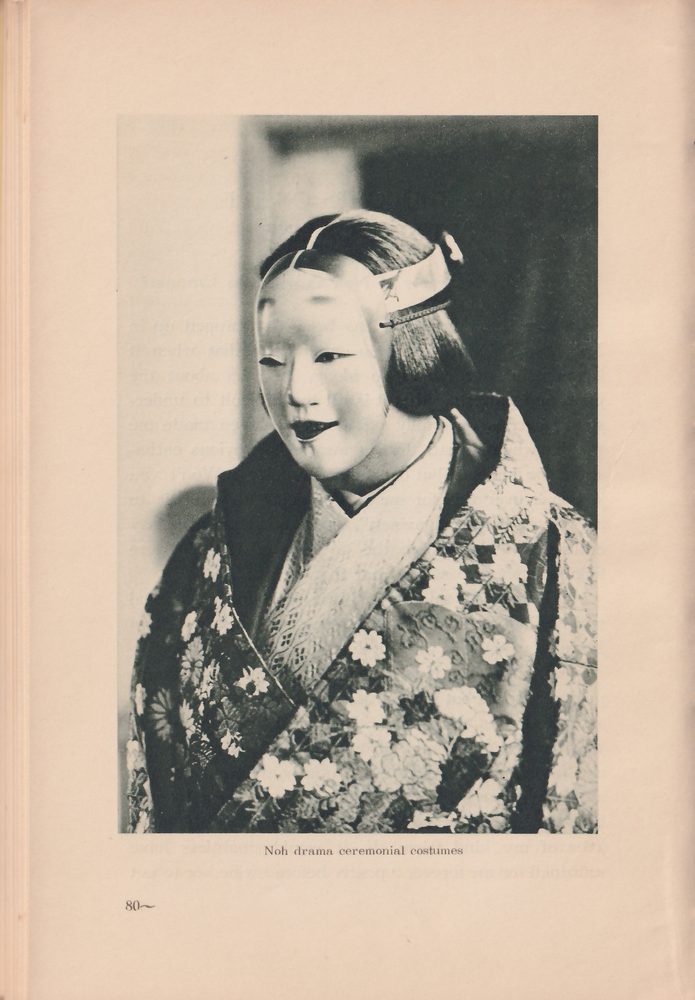
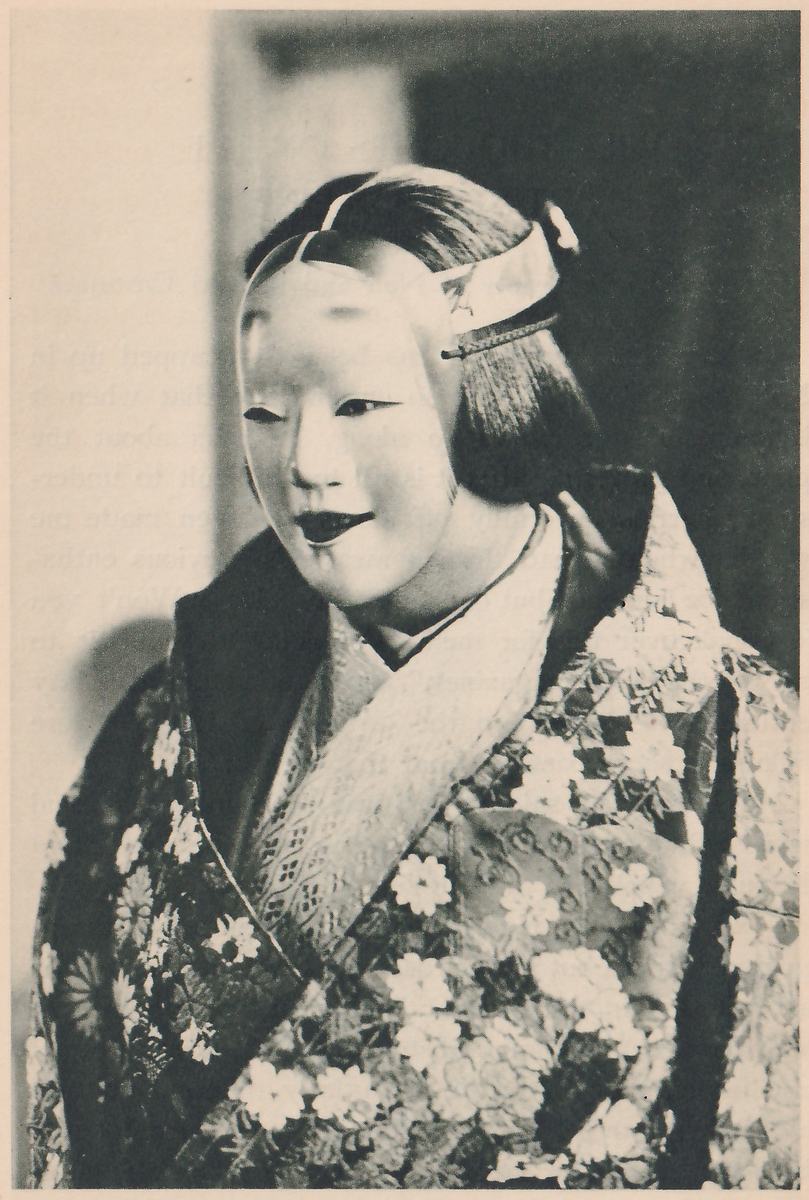
“In Noh, the background is always the same, a board wall with a pine tree painted on it, which symbolizes heaven, earth and all nature, or the universe. (Ref. Tourist Library: 2. Japanese Noh Plays.) And the costumes are in keeping with the stage and extremely abstract.
“In the ancient Greek drama, when it was desired to represent a bird, a bearded old man’s mask was worn over the face, tights showing distinctly the human lower limbs were drawn over the legs, the arms were covered with wing-like sleeves, and two birds’ legs were carried dangling from the waist. Today that seems fairly primitive, but the Noh is still more abstract and, even when they want to represent a heron, no costume characteristic of the heron is worn. The actor wears a white robe of Chinese brocade, a pair of baggy trousers and a mask, and simply carries on his head a little mark shaped like a heron with outstretched wings.
“Not only herons, but gods, beggars, evil spirits, savage beasts and robbers are alike dressed in costumes of dazzling Chinese brocade or embroidery.
“As I sat wide-eyed with amazement at these inconsistencies, suddenly a new world of beauty opened up in my heart. What splendid objects of the dyeing and weaving arts all of these costumes were!
“There are Chinese brocades designed in the richest colours in free and generous composition and embroidered costumes, and there are seductively glowing robes embroidered with gold and silver thread. Besides, there
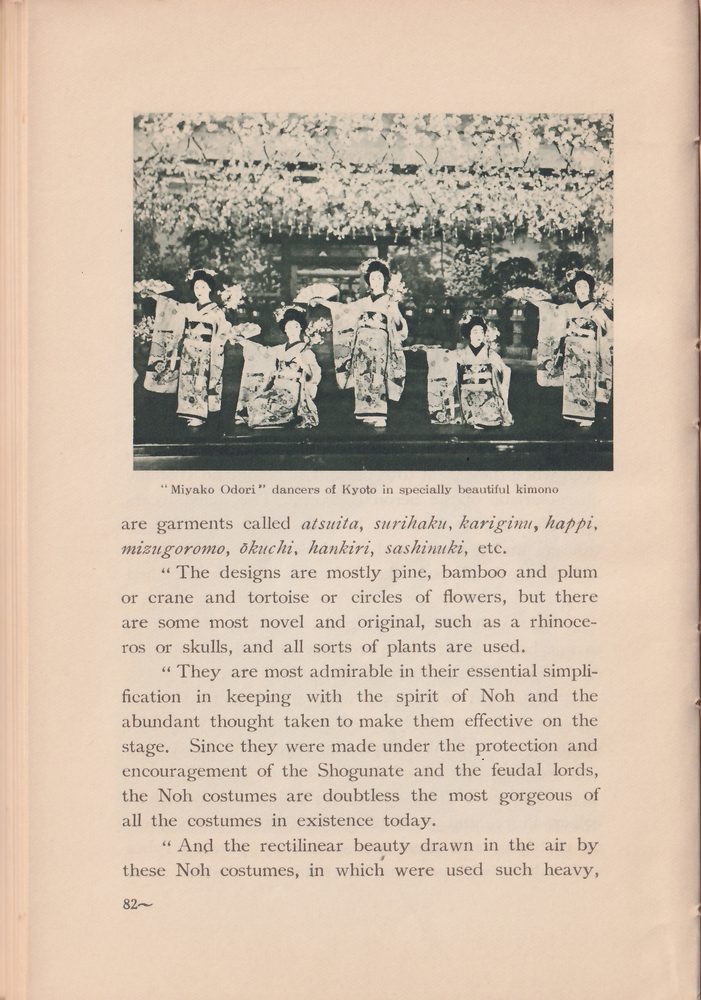
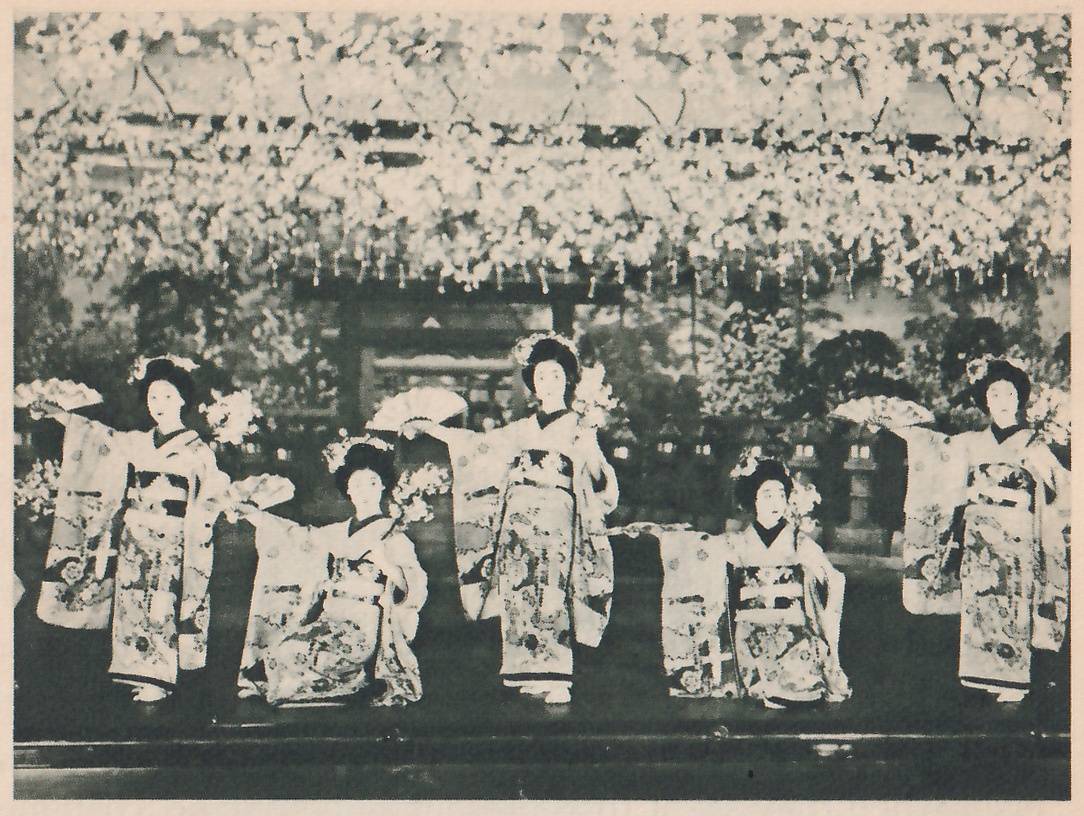
are garments called atsuita, surihaku, kariginu, happi, mizugoromo, ōkuchi, hankiri, sashinuki, etc.
“The designs are mostly pine, bamboo and plum or crane and tortoise or circles of flowers, but there are some most novel and original, such as a rhinoceros or skulls, and all sorts of plants are used.
“They are most admirable in their essential simplification in keeping with the spirit of Noh and the abundant thought taken to make them effective on the stage. Since they were made under the protection and encouragement of the Shogunate and the feudal lords, the Noh costumes are doubtless the most gorgeous of all the costumes in existence today.
“And the rectilinear beauty drawn in the air by these Noh costumes, in which were used such heavy,
thick and stiff materials, moved by action involving the deep speculations of the Orient, corresponds to the beauty arising from the fusion of the feelings of the substantially composed magnificence, grandeur, generousness and freshness revealed only in surpassingly fine examples of modern architecture dominating the azure sky. If the expression may be permitted, Noh costumes should be praised as the very ‘pinnacle of architectural beauty’ in the world of dress and ornament.
“Kabuki costumes are even worse than Noh costumes in neglecting historic accuracy and social reality. In a story of the Nara Period (646–794) anachronistic court ladies will appear in the short wadded coats and divided skirts of the Fujiwara Period (897–1185), or the leading lady will come out in the coquettish dress of a townsgirl of the Tokugawa Period (1615–1867).
“After all, these inconsistencies come from the difficulty of not being able to present on the stage the aspects of the Tokugawa Period as they actually were, but in all probability, nobody, with the stage before him, notices them. Or rather, the charm of Kabuki may be said to come of the increased complexity and exquisiteness arising from this inconsistency.
“In other words, through the surprisingly bold and free use of the costumes of the various periods, (1) all sorts of different personalities and changes of emotion are revealed, (2) these objects are promoted by the extreme use and emphasis of the expression existent in colour itself, and (3) the beauty of line of pliable garments in the soft suppleness displayed by movement naturally makes of this the special preserve of the kimono.
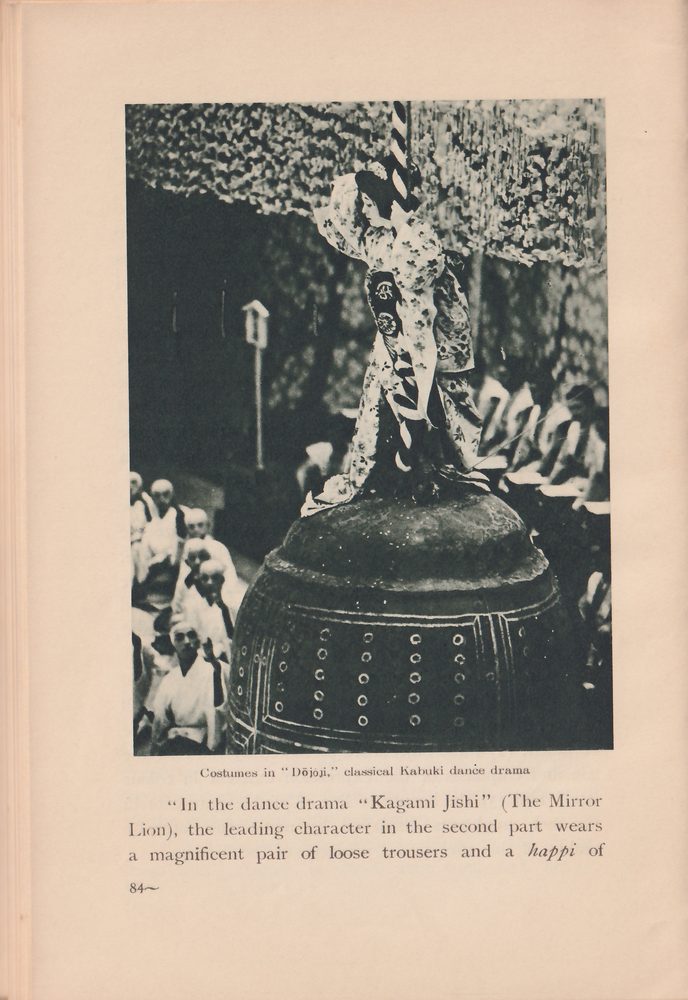
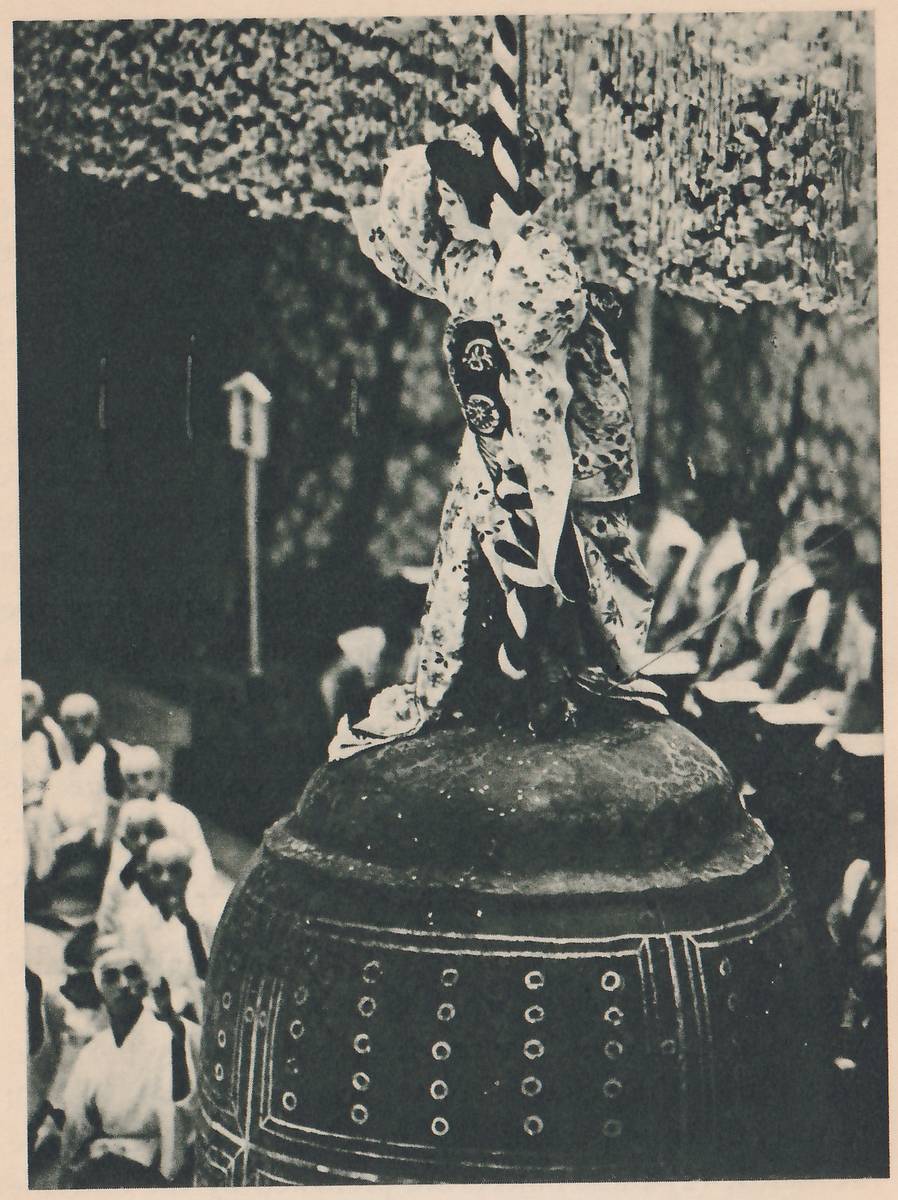
“In the dance drama “Kagami Jishi” (The Mirror Lion), the leading character in the second part wears a magnificent pair of loose trousers and a happi of
brilliant gold and reveals the dignity of the king of beasts, but the leading character in the first part appears as a lady in waiting at the palace in a long-sleeved, long-skirted garment bound in an obi with the knot tied diagonally.
“In “Dōjōji” you will find the same thing. The leading character in the second part, by wearing a white uchiginu and long red divided skirts, symbolizes the evil spirit of a woman burning with jealousy. Her movements are rectilineal and abstract, but the leading character in the first part appears as a townsgirl pure and simple in a beautiful long-sleeved dress of the Tokugawa Period (1615–1867) and dances with a towel and a hat adorned with flowers.
“As her movements slacken and accelerate, the beauty of the pliable lines drawn with animation by her freely flowing sleeves and skirts, just like the many coloured surface of a lake gleaming in the sunlight, probably far surpasses the beauty of the Greek dress that is spoken of as the veritable art of folds. The beauty of Kabuki costumes—no, one of the beauties of all Japanese kimono, may be said to be the beauty of graceful lines revealed by movement. Of course the beauty of design and colour is an important element, too.
“That which appeals to us in genre paintings, too, is, besides the special customs, the long slender lines limned by camel-hair brushes and throbbing with life.
“If the beauty of Noh costumes is architectural, this should surely be called the culmination of pictorial beauty.”