
VII. SKETCH MADE ON A CERTAIN DAY
The sky of early summer, still holding a touch of softness, shone like a canopy of thin lustrous indigo silk. The top of a hill buried deep in young leaves raised its jasper-like form distinctly against this silken sky. Fragrant was the wind that had ducked under and brushed through the profusion of young buds and leaves. It was one morning in May when you felt the purity of the enclosed waters spurting and flowing abundantly in colours, lights, forms, sounds and everything.
I was walking in silence with my friend K along a mountain road by a stream, filling my lungs with the breath of fresh nature. We were both thrilled with perfect happiness, and suddenly I thought to myself,
“Beautiful girls, weren’t they?”
And I saw in memory two girls who had quietly passed before us a little while before as we rested in the shade of a pasania spreading wide its strong arms and throwing a deep shade over the river. In their everyday clothes to save themselves trouble, they had none of the appearance of being dressed up to visit places, but they somehow left behind them such an unforgettable fragrance as does a perfume.
“I say, didn’t you think those girls were beautiful a minute ago?”
“Beautiful? Yes, they were beautiful all right, but I thought what they had was good taste rather than beauty. Shut your eyes and think of them for a minute. The matching of their kimono with their obi and the colour of the ornamental collars just showing at their necks, the narrow bands around their obi, and the cords of their wooden clogs crossing their white tabi,—not one of these things could have been advantageously changed for any other, could it? That good taste, the opulence of their hearts, doubled the beauty of their appearance. They are typical of refined Japanese taste.”
K, who is familiar with woven and dyed fabrics, said that one of them wore a lined garment of Yūki tsumugi (pongee) of spotted pattern tied at the waist with an obi of Ryūkyū yūzen and the other an Ōshima pongee (according to K, a very exquisite material). They were tied in an obi of various famous materials sewn together, and he added explanations of all these things.
“Such materials as Yūki pongee and Ōshima pongee are certainly not beautiful at a glance. But if you take them in your hand, the more you examine them—no, if you put them on, the longer you wear them—the keener the flavour you find in them, and you can never forget it. When I run across such a taste in dress, I feel as if I have come to the long-deserted old home of my soul. After all, this is probably because it is not the pretence of a moment, but something natural fostered by the good conventions of hundreds and thousands of years, something generic.
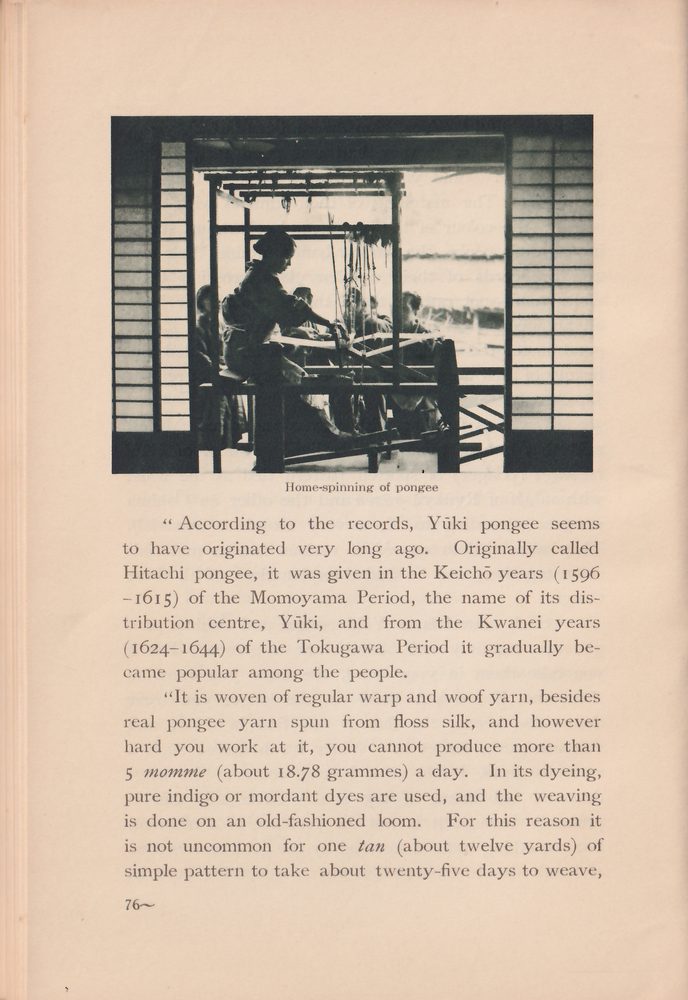
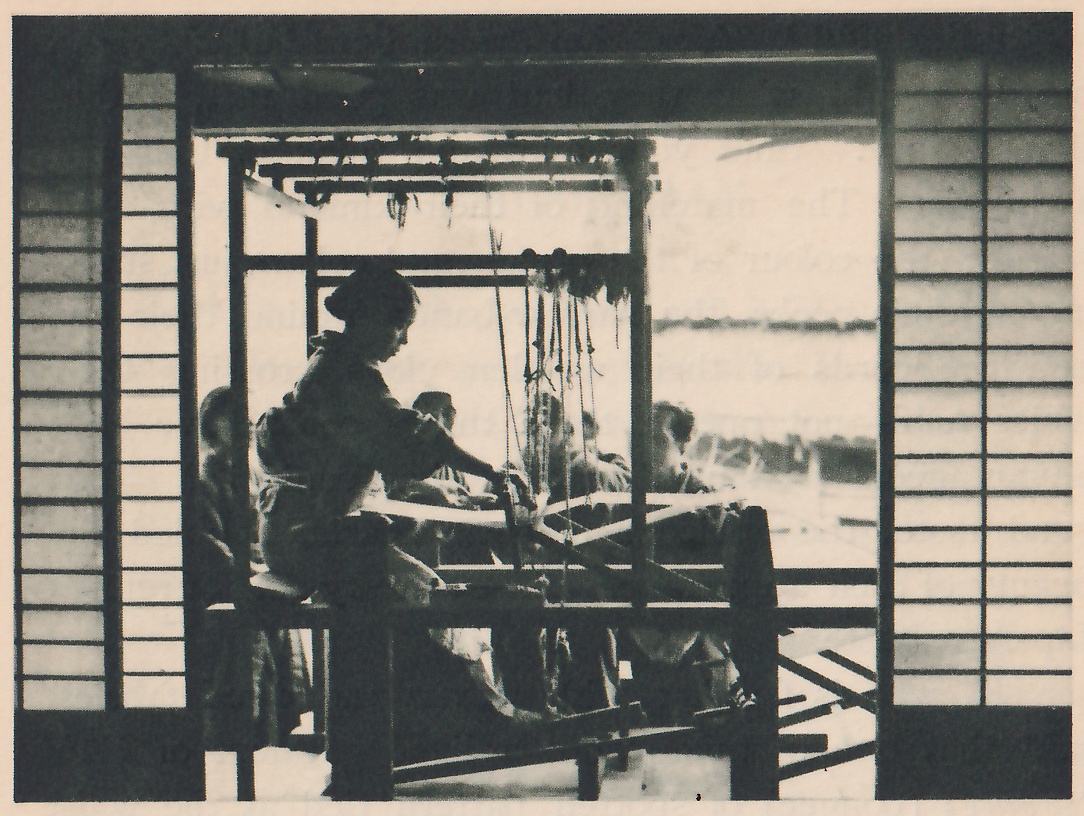
“According to the records, Yūki pongee seems to have originated very long ago. Originally called Hitachi pongee, it was given in the Keichō years (1596–1615) of the Momoyama Period, the name of its distribution centre, Yūki, and from the Kwanei years (1624–1644) of the Tokugawa Period it gradually became popular among the people.
“It is woven of regular warp and woof yarn, besides real pongee yarn spun from floss silk, and however hard you work at it, you cannot produce more than 5 momme (about 18.78 grammes) a day. In its dyeing, pure indigo or mordant dyes are used, and the weaving is done on an old-fashioned loom. For this reason it is not uncommon for one tan (about twelve yards) of simple pattern to take about twenty-five days to weave,
and there is not a very large production.
“But in the finished product there is an inexpressible sort of devotional feeling, a sort of warmth, as if the soul had been pounded in with every thread of it, and it has a characteristic appearance absolutely beyond other fabrics.
“Looked at from the point of view of utility, being hand-woven, the beating in of the woof is extremely hard, so that the fabric is very closely woven and endurable. Though the rayon goods that have recently begun to be so popular are said to be extraordinarily tough against wear, when compared with Yūki pongee, they show a considerable inferiority.
“Ōshima pongee is woven in the homes of the weavers out of yarn spun from locally produced silk floss. The dye-stuffs used are muddy indigo, pine cones and tēchiki (a plant peculiar to Ōshima, Tanegashima, Yakushima, Okinawa and Taiwan), and the yarn is dyed a dark brown and woven on high looms.
“Originally made in striped patterns for home use, in the Kyōho years (1716–1736) of the Tokugawa Period, simple spotted patterns were turned out with success, and as a result of diligent study ever since, the finished spotted pattern fabric of today has been perfected. One roll (about 24 yds.) takes several months to weave, and the fabric is a high class material hard to obtain.
“In both of these fabrics, the dye-stuffs used are special materials, and since they are hand-woven, and expensive, in this respect, they are not well suited for use by the general public. But they are refined in
colouring and have that devotional feeling, while it is said that they have the special virtue not to crease with wearing, so that many people of fashion and upper-class people delight in using them.
“In general the use of such materials made only of real silk may be thought extremely luxurious and extravagant, but when considered from the point of view of warmth and durability and, what is an important function of clothing, ornament, they must be found superior to rayon. From the practical point of view, therefore, even if they are a little more expensive, fabrics made of pure silk may be far more economical.
“But nevertheless, in the ordinary home such pure silks cannot be worn for everyday clothes, and common silk stuff and muslin, and for the majority, cotton fabrics are used. They wear well and are attractive because of their cheapness. And among these cotton fabrics themselves, there are many like Kurume spotted goods, Arimatsu dappled goods, and Tanba cloth that abundantly preserve the virtues and flavour of the places where they have been made since ancient times and have a reminiscent interest.
“I shouldn’t wonder if those girls we just saw, when they get home, will put on house kimono of Kurume spotted goods which smell strongly of the dark blue dye used, and then to sit on floor cushions made of Tanba cloth.”
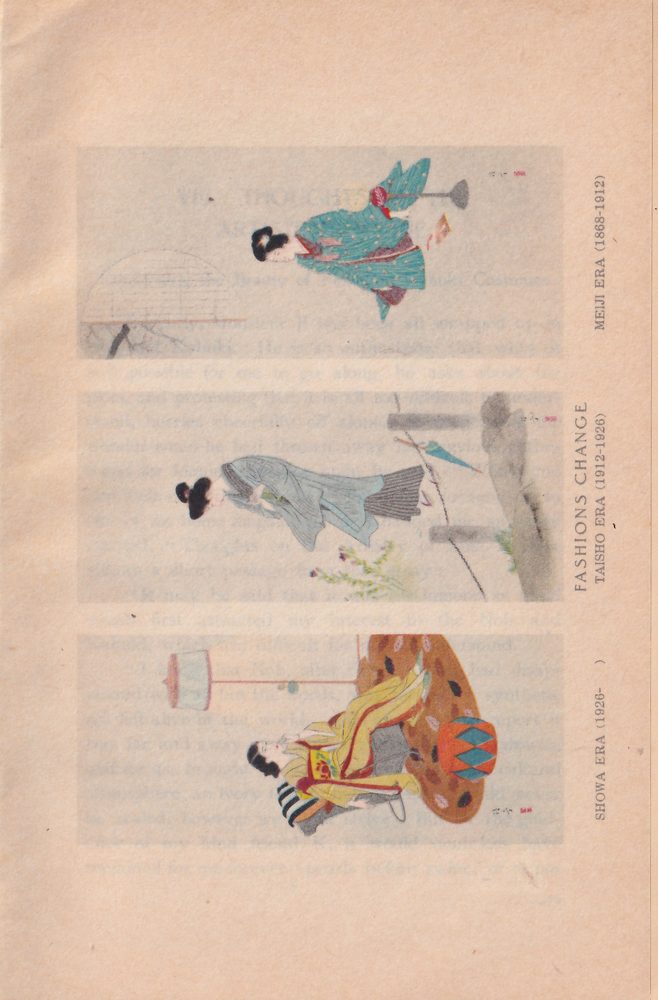
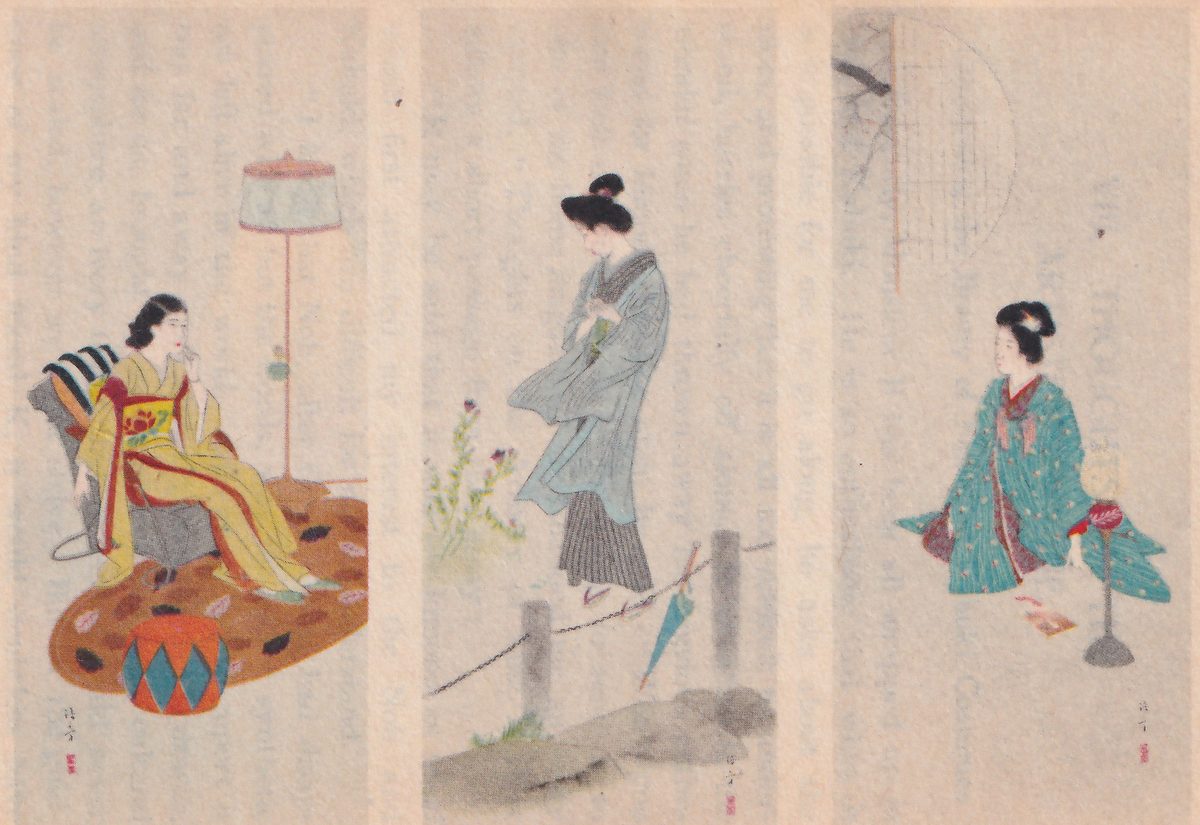
SHOWA ERA (1926- ) TAISHO ERA (1912-1926) MEIJI ERA (1868-1912)